


TL;DR
We run an AI visibility audit as two linked tests: technical accessibility and observed answer visibility. This guide shows marketing, growth, SEO, and content leaders how we scope prompts, check crawlers and indexability, analyze citations and answer accuracy, build a severity-based backlog, and retest every fix.
How to Run an AI Visibility Audit
AI answers can cite a page that a conventional rank tracker never surfaces. Even a sitemap has a hard limit of 50,000 URLs, so the job is to identify which pages and prompts deserve focused evidence, not to scan everything equally.
An AI visibility audit measures two separate outcomes: whether relevant search and AI systems can reach and interpret your pages, and whether your brand appears accurately in buyer answers. We audit crawler access, indexability, entities, answer passages, mentions, citations, sentiment, and peer share, then convert evidence into owned fixes and retest dates.
This workflow shows how to produce a defensible baseline, distinguish technical eligibility from actual visibility, and turn findings into a backlog your team can execute.
How Do You Scope an AI Visibility Audit?
We start by defining where visibility matters before collecting a single answer. An audit without a fixed engine, market, language, buyer stage, prompt set, and peer set produces anecdotal results that are impossible to compare later.
Use prompts that reflect real evaluation moments, including category discovery, problem diagnosis, comparison, implementation, and shortlist decisions. Our buyer-prompt research helps teams move from vague topic ideas to questions that reflect buyer intent.
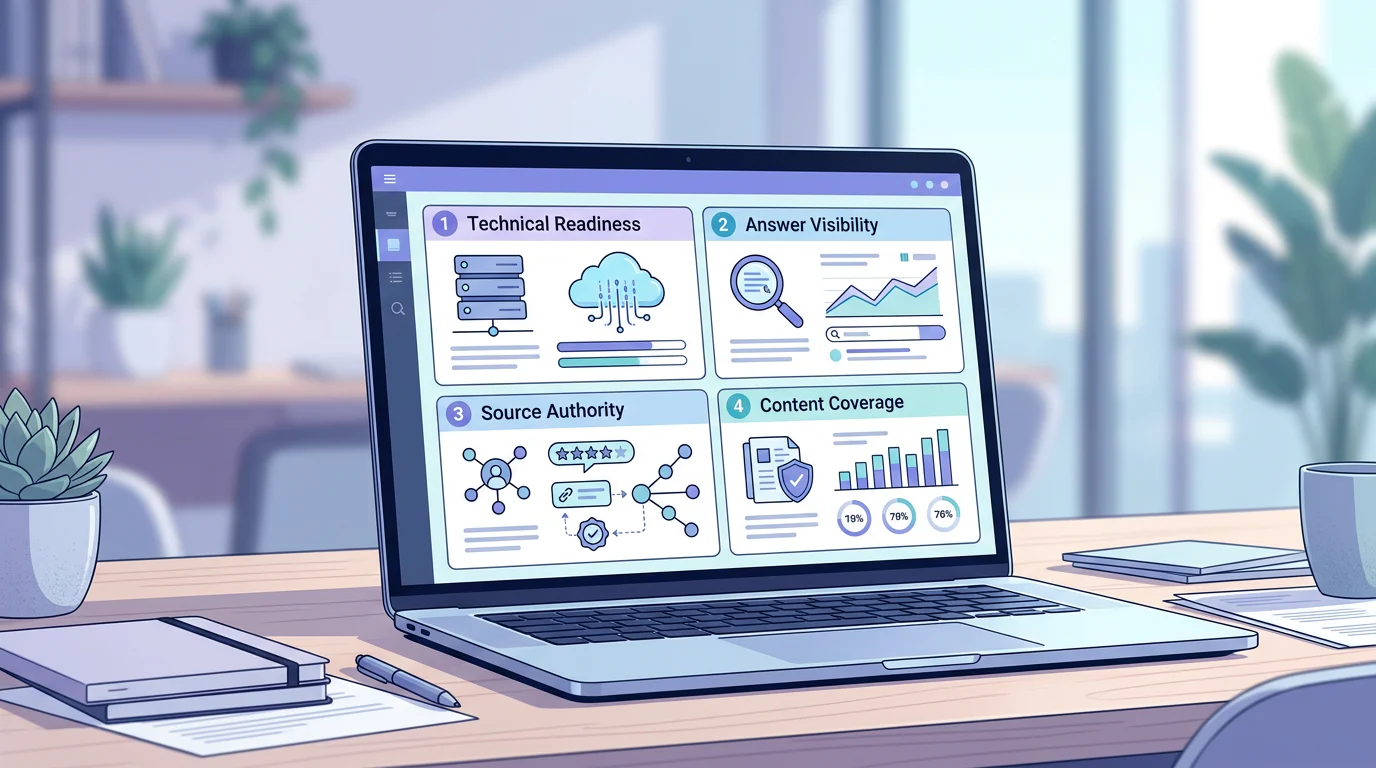
Score the audit in four separate layers rather than hiding every signal inside one number:
- Technical Readiness: Can relevant systems crawl, render, index, and understand priority pages?
- Answer Visibility: Does the brand appear in answers for the prompts that matter?
- Source Authority: Are owned pages and authoritative third-party sources represented when answers cite evidence?
- Content Coverage: Do priority pages answer the buyer question directly, accurately, and with enough proof?
Keep the component scores even if you publish a 100-point total. A site can be technically accessible but absent from answers, or visible in answers while a fragile technical issue threatens future performance.
How Do You Build a Repeatable Answer Visibility Baseline?
A baseline records what buyers actually receive, not what we assume an engine knows. We run the same prompts in the same market and language, preserve the response, and tag each result before making changes.
Google notes that AI experiences can use different systems and a query fan-out approach, which is why we treat each engine and prompt as a separate observation rather than assuming one result represents every answer environment. Google guidance
Build a 30-Prompt Sample
A practical starting point is 30 prompts: three buyer stages, two intent types, and five prompts in each combination. Include general discovery prompts alongside specific evaluation prompts, because a brand can perform well in one and disappear in the other.
For every prompt, record the engine or mode, market, language, run date, response text, cited sources, brands named, and any inaccurate claims. Use multi-engine tracking to keep engine differences visible instead of averaging them away.
Score What the Answer Says
Track mention rate, citation rate, sentiment, answer accuracy, and peer share separately. A favorable mention without a citation may still build awareness. A citation with an outdated description may create a more urgent problem than an omission.
| Metric | Definition | Why It Matters |
|---|---|---|
| Mention Rate | Answers naming the brand divided by all tested answers | Shows whether the brand enters the conversation |
| Citation Rate | Citation-bearing answers that link to an owned domain or page | Shows whether owned content earns visible evidence |
| Sentiment | Favorable, neutral, unfavorable, or mixed explicit language | Reveals how the brand is framed |
| Answer Accuracy | Correct, mixed, or incorrect against approved facts | Identifies reputational and conversion risk |
| Peer Share | Brand mentions divided by all tracked peer mentions | Shows relative presence within the same answer set |
Preserve Verbatim Evidence
Save the full answer, not only a score. The exact language tells us whether the gap is absence, inaccurate positioning, weak differentiation, missing proof, or an external source that has become the preferred reference.
How Do You Audit Technical Accessibility for AI Visibility?
Technical checks establish whether a page is eligible to be retrieved. They do not establish that a page will be cited, recommended, or even shown, so we keep this layer separate from observed answer visibility.
OpenAI says public content can be discovered and cited in ChatGPT search when OAI-SearchBot is not blocked, while Google requires pages to be indexed and eligible to show a snippet for its AI search features. OpenAI guidance
Check the Relevant Crawler Controls
The crawler-access matrix below makes each test explicit. We verify robots.txt, live HTTP responses, page-level directives, and any CDN or firewall behavior affecting priority URLs.
| User Agent | Audit Check | What A Passing Check Establishes | What It Does Not Establish |
|---|---|---|---|
| Googlebot | robots.txt, rendered content, snippet controls | Search crawling eligibility, including Google AI features | Appearance as a supporting link |
| OAI-SearchBot | robots.txt, public response, blocked resources | Content can be crawled for ChatGPT search | A citation or recommendation |
| PerplexityBot | robots.txt, crawler verification, public response | Content can be indexed for search use | Inclusion in a specific answer |
| GPTBot Or Google-Extended | Training-policy review | Training-use preference is configured | Search visibility or answer presence |
Google explains that Google-Extended controls certain training and grounding choices, but does not affect Google Search inclusion or rankings. Crawler controls
Validate Indexability and Delivery
Check status codes, redirect chains, declared and selected canonicals, HTTPS consistency, sitemap inclusion, rendering, and internal links. A priority page should return a successful response, present its primary content in rendered HTML, link to its canonical version, and receive at least one crawlable internal link.
Google identifies redirects and canonical tags as strong canonicalization signals, while sitemap inclusion is weaker. Canonical guidance
Inspect Meta Directives and Machine Signals
Review noindex, nosnippet, max-snippet, data-nosnippet, and X-Robots-Tag directives, including PDFs and other non-HTML files. Remember that a crawler blocked from a page cannot read its meta directives.
Then inspect Organization, Article, author, profile, product, and service markup against visible page content. We use an AI visibility checker to organize those checks, but the underlying rule remains simple: machine-readable claims must match the page a reader sees.
Treat Llms.txt as Optional, Not Proof
Check whether /llms.txt returns successfully, is current, and links to canonical public resources. It can be a useful curated guide for compatible tools, but it is not evidence of citation readiness.
Google says special AI text files and markup are not required for its generative search features, and the llms.txt proposal remains a proposal rather than a universal visibility standard.
How Do You Diagnose Citation and Content Gaps?
Once technical readiness is clear, we compare what answers cite with what our site offers. This is where an audit becomes useful to content, SEO, and growth leaders, because it reveals whether the real constraint is retrieval, evidence, positioning, or page coverage.
Group cited sources by domain, page type, topic, freshness, evidence type, and buyer-stage fit. Our citation source tracking workflow keeps source selection visible at the page level, rather than reducing it to a generic share-of-voice score.
For each priority prompt, compare the best owned page against the source selected instead. Look for a direct answer near the top, clear definitions, dated facts, firsthand expertise, named authors, consistent entity details, and proof that matches the buyer question. A page does not need to imitate another source. It needs to provide a more useful, verifiable answer to the same decision.
Separate authority gaps from coverage gaps before assigning work. If a strong owned page already answers the question but is not selected, investigate support from independent sources, entity consistency, and the answer environment. If the page is selected but quoted inaccurately, correct the underlying claim, clarify the passage, and document the approved wording.

How Do You Prioritize Fixes and Retest Results?
An audit becomes operational when every finding has an owner, a verification method, and a retest date. We rank fixes by severity, buyer importance, and strength of evidence, not by how easy they are to check off.
When an answer set changes, a citation loss diagnosis helps us determine whether the prompt, answer composition, source set, or site itself changed before we decide to rewrite a page.
- Critical: A high-value page is blocked, non-indexable, or producing materially harmful misinformation.
- High: Important prompts repeatedly omit the brand, cite an inferior source, or describe the brand inaccurately.
- Medium: A meaningful gap affects a limited market, prompt cluster, or content area with a credible fix.
- Low: A hygiene or experimental improvement has no observed answer impact yet.
| Finding | Audit Layer | Severity | Owner | Fix | Verification Method | Retest Timing |
|---|---|---|---|---|---|---|
| Priority page blocked for a relevant crawler | Technical Readiness | Critical | Web Engineering | Correct the directive or access rule | Live fetch and crawler check | After deployment |
| Brand absent on high-value prompts | Answer Visibility | High | Content And SEO | Upgrade or create the needed evidence-led page | Rerun the exact prompt set | Defined observation window |
| Incorrect product or company claim | Answer Accuracy | High | Product Marketing | Correct owned facts and supporting references | Verbatim answer review | Defined observation window |
| Stale optional AI resource file | Content Coverage | Low | Content Operations | Update the file if useful and maintainable | Successful response and link review | Next audit cycle |
Retest the same prompt, engine or mode, market, and language. Compare results by prompt ID, not by a new set of questions. Use AI visibility monitoring to preserve the baseline, document no-change outcomes, and distinguish a real improvement from normal answer variation.
Why Use PageLens.ai for an AI Visibility Audit?
At PageLens.ai, we help marketing, growth, SEO, and content leaders turn scattered answer checks into a governed improvement loop. Our approach keeps the two audit layers separate: first, we determine whether important pages are accessible and understandable, then we measure what buyers actually see across the prompts, markets, and engines that matter. That distinction helps teams avoid treating a crawler permission as a visibility result. We organize the evidence into owned issues, clarify what needs a technical change versus a content or authority response, and preserve the before and after answers required to judge progress. If your team needs a practical way to connect monitoring, diagnosis, and accountable follow-through, we can help establish the workflow and keep it repeatable. Start with our methodology. For the next audit cycle and beyond, with a clear owner for every material finding, Book a demo.
FAQs on AI Visibility Audit
These questions address the practical distinctions that matter most when teams begin measuring AI answer visibility.
What Is an AI Visibility Audit?
An AI visibility audit tests whether important pages can be accessed and understood, then measures whether buyer answers accurately mention, cite, and describe your brand.
What Is the Difference Between Crawler Access and Visibility?
Crawler access means an AI-related system can request and read a page. Visibility means the brand or page appears in relevant buyer answers with accurate context.
How Often Should We Retest?
Retest serious technical blockers after verifying the deployment. Then rerun the same high-value prompt set after an observation window, and repeat the full baseline quarterly.
Does Llms.txt Improve Citations?
No proven engine-wide citation benefit exists. Treat llms.txt as an optional resource guide, confirm it remains current and accessible, and never replace indexability or strong evidence.