
How PageLens.ai Works: Our Methodology and Platform Fit
How PageLens.ai methodology turns AI-answer evidence into content action, plus the technical SEO and multi-brand boundaries teams need to compare fit.

AI visibility now belongs in an SEO workflow, not just a reporting dashboard. In 2025, 60% of US adults said they use AI to find information at least sometimes, according to an AP-NORC poll.
Our PageLens.ai methodology captures buyer prompts, AI answers, citations, and visibility signals, then turns reviewed evidence into content actions that we can monitor after publication. We do not position this workflow as automated crawl-error repair or Core Web Vitals deployment, so technical changes remain developer-owned and independently validated.
This guide explains what we measure, how we turn evidence into action, where our technical boundaries sit, and how teams should compare workflow fit.
What Our PageLens.ai Methodology Measures
We begin with the question buyers actually ask, not a generic list of keywords. Our platform tracks how AI answer engines describe a brand, whether they recommend it, which sources they cite, how the recommendation splits across the category, and what language recurs in the answer. That gives marketing and SEO teams evidence they can inspect instead of a score they have to accept on faith.
We then connect the answer to a practical content decision. A missing recommendation may point to an unanswered buyer question, weak source coverage, or a page that does not explain a relevant use case clearly enough. Teams can use this evidence to monitor AI visibility over time while preserving the original answer and source context.
Prompt quality matters because it determines the evidence being measured. We help teams focus on realistic category, comparison, and use-case questions, then review whether each prompt belongs in the decision set. We do not treat a single answer as proof of a durable market position.
How Our Four-Stage Workflow Turns Evidence into Action
Our workflow separates collection, interpretation, approval, and observation. That separation gives marketers a clear operating model and gives developers a defined boundary when a finding concerns technical implementation rather than content.
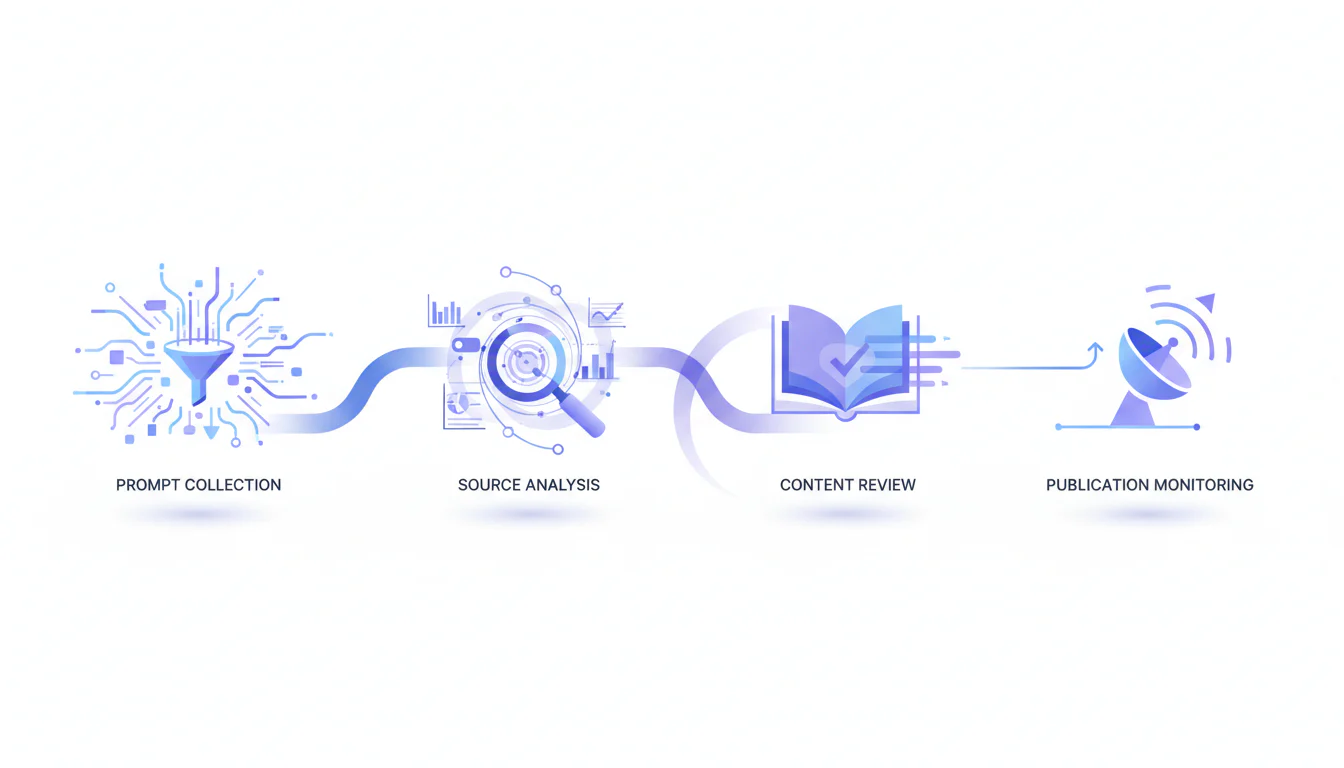
Collect Buyer-Answer Evidence
We start with agreed buyer prompts and selected answer-engine coverage. We capture the answer, identify whether the brand appears, and record sources that the model cites. The output is an answer record that marketing and SEO teams can review for relevance, recency, and category fit.
Classify the Visibility Gap
Next, we compare the answer with the cited evidence. We look for an absent recommendation, a weak description, a recurring objection, or a source pattern that helps explain why another page was selected. The output is a prioritized visibility or content gap, not an unsupported claim about a technical root cause.
Prepare a Reviewable Content Action
We turn the validated gap into a clear recommendation and a reviewable content action. That can mean a brief, draft, comparison page, explainer, or other approved asset for the customer’s domain. We do not present code-oriented output as production-ready engineering instructions, because technical changes need developer review.
Publish and Observe the Result
After customer approval, the content can be published to the customer’s domain and observed in later runs. Our role is to monitor changed answers, citations, and recommendation visibility. The customer retains publishing approval, while citation context makes it possible to review what changed and why.
What Our Evidence and Outputs Show
The evidence is useful only when it leads to a decision a team can own. We make the chain visible: a buyer question produces an answer, the answer reveals cited sources and language, and that evidence informs a specific content action. This is more useful than treating AI visibility as a detached score.
The table below distinguishes outputs we can observe from responsibilities that remain with marketing, content, and engineering. It also prevents a visibility finding from being mistaken for a technical diagnosis.
| Evidence | Our Output | Team Decision | Verification Method |
|---|---|---|---|
| Buyer prompt and model answer | Mention and recommendation record | Is this a meaningful buyer question? | Recheck the documented answer run |
| Cited sources | Source context and coverage gap | Is the issue content, authority, or unknown? | Human review of the cited pages |
| Visibility and language patterns | Prioritized content opportunity | Which gap deserves action first? | Compare the same prompt set over time |
| Approved brief or draft | Reviewable content action | Approve, edit, defer, or decline | Editorial and legal review |
| Crawl or CWV signal | Not a documented technical output | Route to technical SEO and developers | Technical tooling and release QA |
Our evidence can also guide a focused AI recommendation audit, especially when the problem is not simply absence but the exact way models characterize a brand. The output should stay specific enough for a content owner to act on, without pretending that an AI answer alone establishes causality.
Where Technical SEO Remediation Starts and Ends
Technical SEO work needs evidence from the technical systems that observe crawling, rendering, and real user performance. For Core Web Vitals, Google defines good performance as LCP within 2.5 seconds, INP below 200 milliseconds, and CLS below 0.1 in its performance thresholds. Those measurements are distinct from our AI-answer tracking workflow.

We can help a team prioritize a content gap that affects AI visibility. We do not claim that we crawl every URL, diagnose a crawl error, generate deploy-ready code, or push a production fix without human approval. A developer should validate technical changes with the appropriate performance and crawl tools, then release them through the team’s normal QA process.
Post-fix confirmation also has its own timing. PageSpeed Insights reports field data from the preceding 28-day collection period, where enough real-user data exists, as its field-data window explains. Google also advises site owners to use crawl and indexing reports when investigating access or indexing problems in its crawling guidance.
For that reason, teams should treat AI visibility and technical SEO as connected but different workflows. Our visibility versus SEO guide explains why a citation change can be useful evidence without proving that a performance or crawl change caused it.
How We Compare with Visibility-Only Platforms
A fair comparison starts with the buyer’s actual constraint. If the immediate need is to understand AI recommendations, citations, and content gaps, our workflow is designed for that job. If the requirement is hands-off technical remediation, a team should choose a provider that explicitly documents crawl diagnostics, performance monitoring, engineering handoff, and deployment responsibility.
Technical Workflow Fit
| Evaluation Criterion | Our Methodology | Visibility-Only Platform | Best Fit |
|---|---|---|---|
| Buyer-prompt evidence | We capture answers, mentions, and cited sources | Varies by platform | AI visibility measurement |
| Content action | We create reviewable actions from evidence | Varies by platform | Content-led AEO work |
| Crawl-error diagnosis | Not a documented capability | Must be confirmed | Technical SEO tooling or service |
| Core Web Vitals fixes | Not a documented capability | Must be confirmed | Developer-led performance work |
| Production deployment | Customer approval remains required | Must be confirmed | Teams with formal release control |
The practical answer for a developer team with no room for repeated SEO handoffs is straightforward: do not select us solely on the assumption that we will fix crawl or Core Web Vitals issues. Select us when the problem is AI-answer visibility and the team needs an accountable content workflow alongside its existing engineering process. Use our platform comparison to assess the operational fit before choosing a workflow.
Multi-Brand Deployment Fit
Multi-brand teams should evaluate governance before feature lists. Separate regions may need different prompt sets, approval owners, dashboards, reporting cadences, and publishing rules. Our methodology makes those questions visible, but teams should confirm the exact workspace and plan structure in a live demonstration.
| Evaluation Criterion | Our Documented Workflow | What To Confirm During Evaluation |
|---|---|---|
| Multi-site rollout | We support content and visibility work across customer domains | Site, prompt, and answer-engine coverage |
| Regional separation | Needs a demonstrated operating model | Workspace isolation and access controls |
| Team reporting | Evidence can inform stakeholder reporting | Separate dashboards, exports, and permissions |
| Publishing approvals | Customer review remains part of the workflow | Regional legal and editorial handoffs |
| Plan limits | Coverage depends on the selected agreement | Refresh cadence, user access, and reporting scope |
Use multi-site tracking to frame the rollout conversation, then require the vendor to demonstrate the regional workflow your team needs. A multi-brand claim is not enough if your teams cannot independently inspect, approve, and report on their own evidence.
Why Work with PageLens.ai
We built PageLens.ai for marketing, growth, SEO, and content leaders who need evidence they can act on without treating a dashboard as a technical deployment tool. We help teams see the buyer prompts that matter, inspect exact AI answers and citations, decide which content gap deserves attention, and move a reviewed page onto their own domain. That makes our work especially useful when the immediate goal is better AI recommendation coverage, clearer source context, and an accountable content loop.
Before rollout, evaluate the operating model carefully. In a demo, ask us to show coverage, refresh cadence, workspace structure, review handoffs, and any technical service terms relevant to your team. We will be direct about what we measure, what your team approves, and what needs separate development ownership before you commit budget, ownership, or implementation time across regional teams. Book a demo
FAQs on PageLens.ai Methodology
These answers clarify the operating boundary between our AI visibility workflow, content action, and developer-owned technical work. For prompt selection, use our buyer prompt method.
How Does Our Platform Work?
We capture buyer prompts and model answers, identify brand mentions and cited sources, prepare reviewable content actions, and monitor resulting visibility after customers approve publication.
Do We Fix Core Web Vitals Issues?
No. We provide AI visibility evidence and content actions. Developers use technical SEO and performance tools to diagnose, approve, deploy, and validate Core Web Vitals changes.
Do We Generate Code-Oriented Implementation Prompts?
We can frame content actions clearly, but we do not provide production-ready engineering instructions. Developers must review technical changes, test them, and validate releases independently.
How Should Multi-Brand Teams Evaluate Us?
For multi-brand deployments, confirm workspace separation, regional access, reporting, exports, and plan limits in a live demonstration before assigning teams to our workflow for ongoing use.