Profound Alternatives with Content Optimization: Which AEO Tools Give Prescriptive Fixes
Compare Profound alternatives with content optimization by recommendation depth, choosing tools that offer prescriptive fixes over simple gap metrics.
Profound Alternatives with Content Optimization: Which AEO Tools Give Prescriptive Fixes
AEO tooling has multiplied fast, and reviewers now split platforms less by whether they track citations and more by whether they offer profound alternatives with content optimization after a gap shows up on the dashboard. A widely cited Scrunch comparison of seven major AEO/GEO platforms found that only two meet the full set of criteria spanning monitoring, auditing, optimization, and AI content delivery, meaning most tools still stop at telling you something is wrong rather than what to write instead.
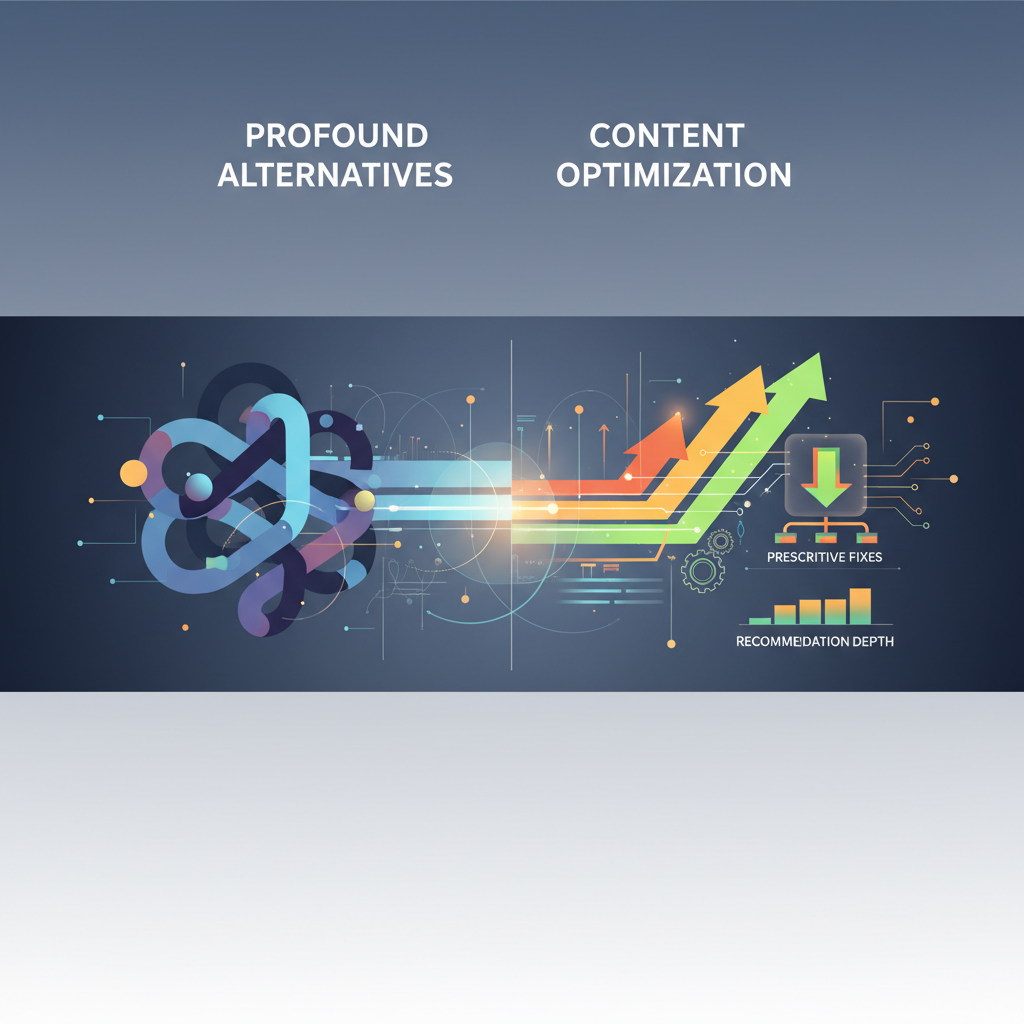
The honest answer: most Profound alternatives stop at naming a gap, not fixing it. Only a handful, including Scrunch and Adobe LLM Optimizer, push into prescriptive, near copy-ready guidance. To help you know exactly what you're buying, this piece grades each platform on a three-level recommendation depth scale: metric, gap, and prescriptive.
Below, we define the three levels and audit what each major AEO platform actually outputs when it flags a citation gap. We score them on a five-point actionability scale. Finally, we walk through a repeatable process to turn any recommendation, prescriptive or not, into a shipped content edit.
The Three Levels of AEO Recommendation Depth
Most "Profound alternative" roundups list tools side by side. They never open the product to see how a recommendation actually looks on screen. That matters more than logos and pricing tiers. Here is the framework we used to grade every platform below.

Recommendations from AEO tools generally fall into one of three buckets, and the gap between them is bigger than most comparison pages admit:
- Level 1: Metric-only. The tool tells you a number: "prompts about X cite you 12% of the time." It gives no context on why. It offers no direction on what to change.
- Level 2: Gap identification. The tool names the specific miss: "you're absent from responses to 'best CRM for early-stage startups'." Instead, responses cite Competitor A and Competitor B. This is useful, but it is still a diagnosis, not a treatment plan.
- Level 3: Prescriptive fix. The tool specifies the edit. Add a 120-word direct-answer paragraph before your comparison table. Structure it with columns X, Y, and Z. Finally, target this exact phrasing.
The jump from Level 2 to Level 3 is the one most vendors quietly skip. A content gap breakdown from Prompt Insider makes the same point about AEO gap analysis in general. An SEO gap analysis tells you which keyword a competitor ranks for. In contrast, an AEO gap tells you which question an AI engine answers with a competitor's brand instead of yours. Naming that gap is Level 2 work. Telling you the paragraph, table, or FAQ entry that closes it is Level 3, and it's a different, harder deliverable.
Profound Alternatives with Content Optimization Recommendations: The Comparison Table
We score each platform below on where its output actually lands. We use public feature documentation and independent comparisons rather than vendor marketing copy. "Actionability" reflects how close the output gets to something a writer could paste into a CMS without further interpretation. We built the PageLens platform specifically to close the gap Profound leaves open in this area.
A quick note before the table: "optimization" as a checkbox on a feature grid doesn't always mean prescriptive guidance for humans. Some platforms use it to describe formatting content for AI crawlers to fetch. This is a different job than telling a content team what to write.
| Tool | Recommendation Depth | Example Output | Actionability Score (1-5) | Best For |
|---|---|---|---|---|
| Profound | Gap identification | "Absent from X% of tracked prompts on [topic]; Competitors A and B cited instead" | 3 | Teams that want broad multi-LLM visibility monitoring and will handle the rewrite themselves |
| Scrunch | Prescriptive | Structural directive: add a defined-answer paragraph plus a comparison table with named columns | 4 | Enterprises wanting monitoring, auditing, and content guidance in one platform |
| Adobe LLM Optimizer | Prescriptive | Structural directive tied to existing content stack workflows | 4 | Enterprises already standardized on Adobe's content tooling |
| Peec AI | Metric-only | "Visibility score down 8 points this week across tracked prompts" | 2 | Agencies running lightweight multi-client dashboards without editorial work |
| AthenaHQ | Gap identification | "Missing citation in Perplexity for [query cluster]" | 3 | Mid-market teams tracking specific competitor displacement |
| Semrush AI Visibility Toolkit | Gap identification | Low AI visibility score flagged against a keyword cluster, no structural module | 2 | Teams already inside Semrush wanting a bolt-on AI visibility view |
| Bluefish | Gap identification | Cross-LLM monitoring with flagged gaps, no content delivery layer | 3 | Enterprise teams needing broad LLM coverage tracking |
| PageLens | Prescriptive | Specific H2 to add, table structure to use, and a target answer paragraph tied to the page | 5 | Content teams wanting copy-ready fixes mapped to individual pages, not just dashboards |
Per that same Scrunch comparison, Peec AI doesn't offer auditing or optimization at all. Semrush's toolkit doesn't offer optimization either. For these reasons, both tools land at the metric-to-gap end of the table above rather than the prescriptive end.
Platform by Platform: What the Recommendations Actually Say
Scores in a table only mean so much until you see the actual language a tool produces. This section walks through each tier's output in practice. It also explains why cheaper doesn't automatically mean shallower, or deeper.

Profound and the gap-identification middle tier. Profound's audits genuinely help you see where and how often you miss out on AI answers. Its reporting also spans multiple engines. Where users hit a wall is the next step. The dashboard names the miss but stops short of specifying the fix. This surface-level feeling sends people looking for alternatives in the first place. AthenaHQ and Bluefish follow a similar pattern: strong monitoring, named gaps, no drafted solution.
Scrunch and Adobe LLM Optimizer at the prescriptive end. Most public comparisons place these two platforms at the top of the "optimization" checklist. This is because their output includes structural guidance, not just a flagged miss. That deliverable is meaningfully different. However, you should check what "content delivery" means in their marketing. It could mean a draft for your writers or a formatted feed for crawlers. Those solve different problems.
Peec AI and Semrush at the metric end. Both excel at tracking visibility across engines at scale. However, neither platform offers a full optimization module. Treat their output as an early-warning system rather than a to-do list.
Cheaper clones replicate dashboards, not depth. A Reddit thread on Profound alternatives describes a lower-cost tool as offering "the same functionalities" as Profound at a lower price. That's a fair description of monitoring parity, but nothing in that thread claims parity on recommendation depth. Cost and depth are separate variables, and a budget Profound alternative can absolutely replicate the dashboards while still stopping at Level 2.
How to Turn AEO Recommendations Into Content Edits
Even a Level 3 tool won't ship the edit for you, and a Level 1 or Level 2 tool leaves more of the work on your plate. Either way, the process of going from a flagged gap to a published fix is the same five steps, whether the recommendation came from Profound, a spreadsheet, or a full audit.

- Classify the recommendation's level first. Is it a raw metric, a named gap, or an actual structural suggestion? This determines how much translation work you need to do.
- If it's metric-only, run it through a gap diagnosis. Cross-reference the underperforming topic against specific prompts and competitor citations rather than guessing, the same logic behind SERP-vs-AI gap mapping, which sorts keywords into quadrants like "strong on Google, weak in AI" to prioritize where the fix will matter most.
- Translate the gap into a concrete structural change. Draft the missing FAQ entry, standalone answer paragraph, or comparison table, don't just add more words to the existing page.
- Format for extraction. AI engines favor self-contained paragraphs, defined terms, and tables over long unstructured prose, so the fix should be pasteable as-is into a citation-worthy snippet.
- Ship it and re-check citation rates in two to four weeks. Recommendation depth only matters if the loop closes; track whether the specific prompt you targeted starts surfacing your brand.
Crack Prescriptive Content Optimization with PageLens.ai
If your current AEO tool tells you what's wrong but never what to write, that's the gap this whole piece has been describing. PageLens.ai is built to close it by pairing citation monitoring with specific, page-level edits, the section to add, the table structure to use, the exact answer paragraph to target, rather than another dashboard full of gaps you still have to translate yourself. If you advise clients on AEO strategy, our affiliate program is also worth a look for adding prescriptive optimization to your service without building it in-house.
FAQs on Profound alternatives with content optimization
What are the best Profound alternatives that give content optimization recommendations, not just monitoring? Scrunch and Adobe LLM Optimizer are the two platforms most public comparisons place in the prescriptive tier, meaning their output includes structural guidance rather than just a citation percentage. Profound, AthenaHQ, and Bluefish sit in the gap-identification tier: they name the specific miss but leave the rewrite to your team.
What's the difference between AEO monitoring and AEO content optimization? Monitoring tells you how often and where your brand is cited across engines like ChatGPT and Perplexity. Content optimization goes further by identifying why a citation is missing and specifying the exact edit, such as adding a comparison table or a direct-answer paragraph, needed to close it.
How do I know if an AEO tool's recommendations are actually actionable? Check whether the output names a section to add, a structure to use, or sample phrasing, versus just a flagged topic or a declining score. If you could hand the recommendation directly to a writer without further research, it's prescriptive. If a human still has to figure out what to write, it's stuck at the gap-identification level.
Do cheaper Profound alternatives sacrifice recommendation depth? Not necessarily, and not automatically. Price and recommendation depth are separate variables: a lower-cost tool can replicate Profound's monitoring dashboards closely while still stopping at the same gap-identification level, or falling short of it. Evaluate the actual output screen, not the price tag, before assuming either direction.
Can I combine a monitoring-focused tool like Profound with a prescriptive optimization layer? Yes, and many teams do exactly this rather than switching platforms outright. Keep Profound (or a similar tool) for broad multi-LLM citation tracking, and route flagged gaps into a tool built for prescriptive fixes, such as PageLens, to translate each miss into a specific content edit before it goes back to your writers.