

TL;DR
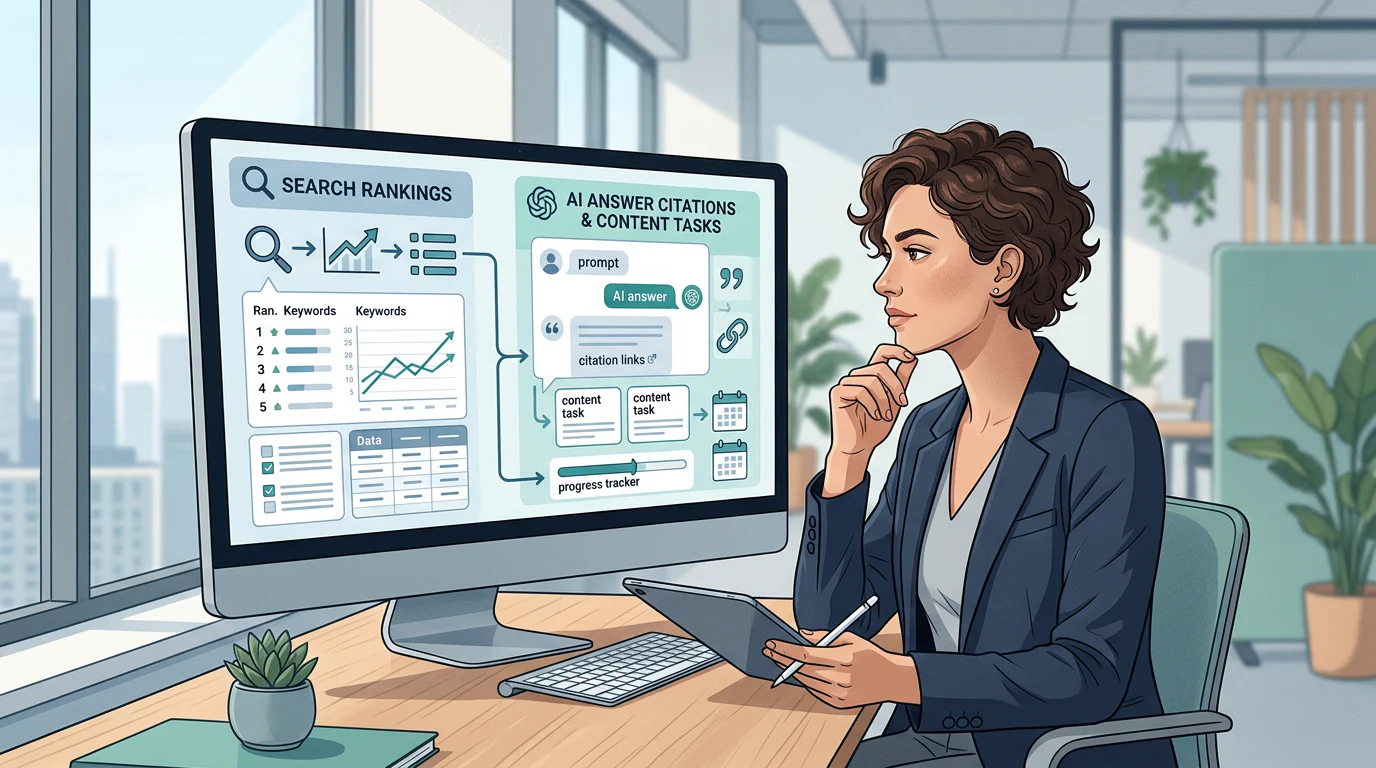
To track ChatGPT category recommendations, build a small library of unbranded buyer prompts, run each repeatedly in controlled sessions, and log whether your SaaS appears, where, the language around it, and the visible sources. Compare the same answers against competitors and trend weekly, because one manual response is a single observation. We show what to test, which metrics matter, and how to act on missed recommendations.
Prompt wording and buyer context can change what an AI recommends. A 450-experiment study across 90 prompts and five real-world datasets found no single prompt type consistently performed best, which makes a single brand check a weak visibility signal.
To track ChatGPT category recommendations, build a small library of unbranded buyer prompts, run each repeatedly in controlled sessions, and log whether your SaaS appears, where it appears, the language around it, and the visible sources. Compare the same answers with competing products and trend the results weekly, because one manual response is only one observation.
The workflow below explains what to test, how to collect responses consistently, which metrics matter, and how to turn missed recommendations into practical content and distribution work. We focus on category demand, where buyers are still assembling a shortlist.
Which ChatGPT Recommendations Matter to Your Startup?
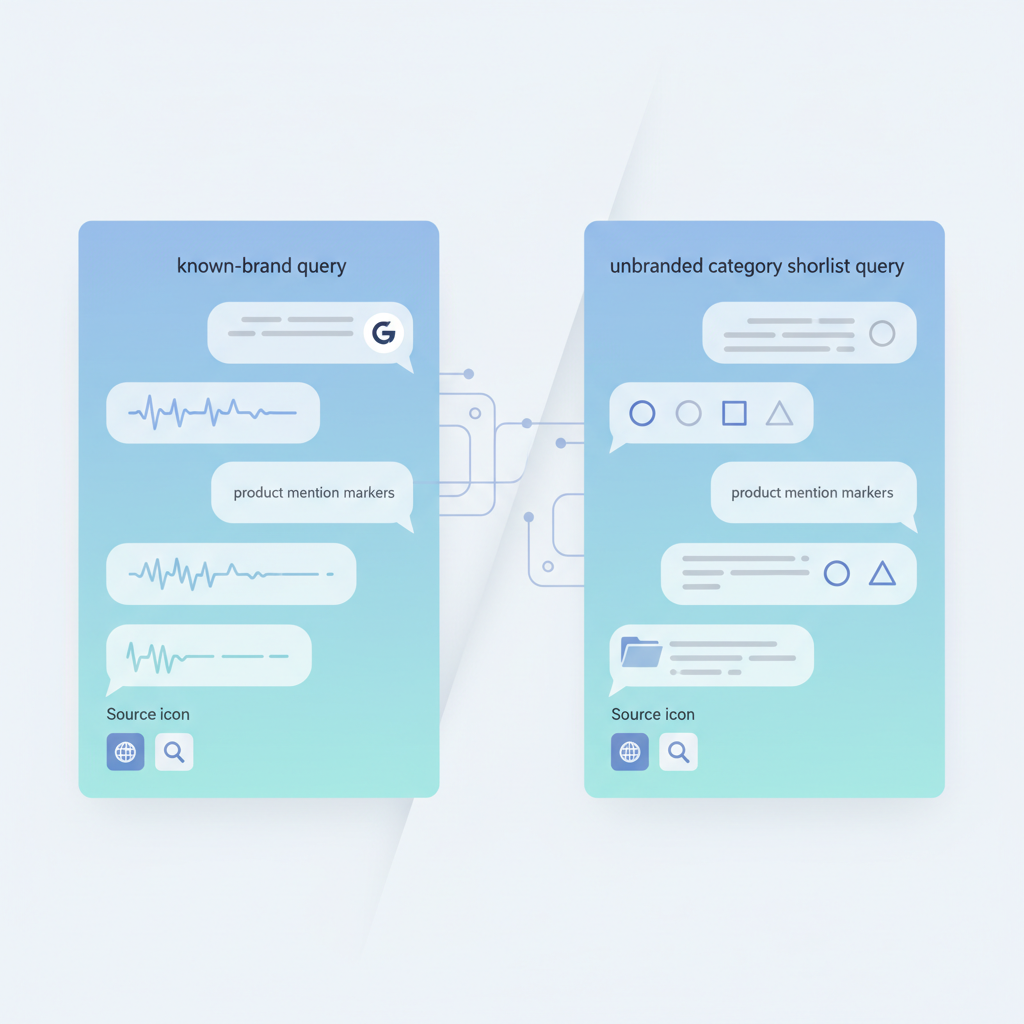
A branded prompt such as “What does our company do?” tells you whether ChatGPT recognizes your name. That matters for accuracy, but it does not answer the more valuable category question: whether a buyer who has never heard of you will see your product when asking for help.
ChatGPT category recommendation tracking starts with unbranded prompts. Ask what a prospect would ask before choosing a vendor: the best tools for a job, alternatives to an incumbent approach, options for a budget, or software suited to a particular team size. A product that appears in these answers has entered the buyer’s consideration set. A product cited as a source has earned a different kind of visibility. Track both, but do not treat them as interchangeable.
We recommend anchoring prompt selection in real buyer language, not a brainstorm of generic keywords. Our guide to buyer prompt research shows how to collect the questions that reveal comparison, evaluation, and solution-seeking intent.
Which Prompts and Settings Should You Monitor?
A useful library is representative, not exhaustive. Start with the buyer situations that change the answer, then make only meaningful variations in role, company size, budget, use case, integration needs, or region. Changing word order repeatedly adds noise without adding another decision context.
For an initial baseline, use seven prompt patterns across two buyer contexts and repeat each prompt three times. That creates 42 observations per collection cycle, enough to reveal obvious gaps while keeping the review manageable. Expand only when a pattern exposes a real audience, use-case, or positioning difference. Our explanation of prompt research helps teams separate buyer questions from conventional keyword lists.
Which Buyer Prompt Patterns Should You Include?
Use prompt patterns that ask for recommendations rather than merely describing the category.
| Pattern | Copyable Prompt Shape | What To Record |
|---|---|---|
| Best Tool | “What are the best tools for [job] at a [company type]?” | Presence, position, rationale |
| Alternative | “What are alternatives to [approach] for [job]?” | Shortlist inclusion |
| Comparison | “Compare leading [category] tools for [criterion].” | Inclusion and comparative language |
| Use Case | “What tools help a [role] [complete job]?” | Fit for the workflow |
| Problem | “How can a [company type] solve [pain]?” | Whether the product is proposed |
| Budget | “What are good [category] options under [budget]?” | Value and pricing language |
| Company Size | “What suits a [team size] company?” | Segment fit and qualification |
How Should You Control Collection Conditions?
Keep the prompt, model, date, market, language, session state, and browsing mode in every record. Use a fresh conversation for every run, document whether you are signed in, and avoid unrecorded personal context such as Memory or custom instructions.
This matters because ChatGPT Search can use general location, optional device location, and relevant memories when handling a query. OpenAI’s search guidance also explains that Search may activate automatically, so record whether you explicitly selected it or allowed automatic behavior.
Use this five-step collection routine:
- Set the target market, language, model, and browsing mode.
- Start a documented clean session.
- Submit one buyer prompt in one new conversation.
- Repeat the same prompt three times under the same conditions.
- Save the complete response, visible sources, position, and wording.
What Should Your Prompt Template Say?
You are helping a [role] at a [company-size] company choose a [category] tool. They need to [job to be done], have [constraint], and care most about [decision criterion]. What are the best options? Give a shortlist, explain who each option fits, and cite current sources where applicable.
What Belongs in a Response Ledger?
A ledger prevents “I think we showed up” reporting. Preserve the exact response so that product presence, positioning, sentiment, and citations can be checked later.
| Date | Prompt ID | Run | Model and Search Mode | Product Named | Position | Exact Wording | Visible Sources | Other Products | Sentiment |
|---|---|---|---|---|---|---|---|---|---|
| 2026-08-07 | PM-07 | 1 | Recorded at collection | Yes | 3 | Saved verbatim | Saved | Saved | Favorable |
| 2026-08-07 | PM-07 | 2 | Recorded at collection | No | Not Named | Not Applicable | Saved | Saved | Not Applicable |

Which Metrics and Tracking Methods Show Visibility?
Do not report one blended “AI visibility score” without its ingredients. A marketing leader needs to know whether the product was absent, present but buried, described inaccurately, or cited without being recommended.
Use operational definitions that your team can reproduce. These metrics describe the sample you collected, not a hidden ranking system inside any AI model. For a broader measurement framework, see our guide to AI visibility metrics.
Which Recommendation Metrics Should You Calculate?
| Metric | Verified Definition | What It Reveals |
|---|---|---|
| Recommendation Rate | Responses naming the product as an option divided by total responses, multiplied by 100 | How often the product enters shortlists |
| Response Position | First ordinal placement in a list, reported only when named | How prominently the product appears |
| Citation Rate | Responses visibly citing the company domain divided by sourced responses, multiplied by 100 | Whether the company site appears as visible evidence |
| Competitor Overlap | Responses naming both the product and a tracked competitor divided by responses naming the product, multiplied by 100 | Which shortlists the product joins |
| Net Sentiment | Favorable mentions minus unfavorable mentions, divided by coded mentions, multiplied by 100 | Whether the wording helps or harms perception |
| Consistency | Most common mention outcome across repeated runs divided by total runs | Whether one result reflects a stable pattern |
Position and wording deserve more attention than a simple mention count. Being named fourth with hesitant language is not the same as being named first with a clear use-case match. When your team codes sentiment, preserve the exact model language rather than assigning a positive label from instinct. Our citation tracking guide explains how to make visible-source evidence part of the same report.
Which Tracking Method Fits Your Team?
Manual collection is best for a small baseline because people can inspect every sentence. Scripted collection improves repeatability, but it should be presented as a controlled API setup rather than assumed to match every consumer ChatGPT experience. A monitoring platform reduces recurring effort, provided its prompt coverage, collection settings, and exports are clear.
| Method | Accuracy Strength | Maintenance | Reporting Trade-Off | Best Fit |
|---|---|---|---|---|
| Manual Collection | High transcript fidelity | High | Small sample size | Baselines and spot checks |
| Scripted Collection | Consistent settings and exports | Medium | Measures a defined technical setup | Teams with engineering support |
| Monitoring Platform | Broad recurring coverage | Lower operational effort | Audit the methodology before relying on trends | Ongoing category monitoring |
NIST’s evaluation guidance emphasizes reproducible reporting and valid interpretation. In practice, that means keeping the raw responses, documenting the conditions, and resisting conclusions that a handful of answers cannot support.
How Do You Inspect Sources and Act on Missed Recommendations?
Inspect what a reader can actually see. In ChatGPT, that means inline citations and the Sources panel when they appear. Record the URL, domain, page type, claim supported, and whether the source describes your product accurately. Do not claim access to every internal retrieval signal or assume that every uncited sentence came from a visible page.
For API-based tests, source annotations can provide a more structured record of cited URLs and retrieved sources. OpenAI’s source documentation distinguishes citations from a complete source list for supported web-search outputs, which is useful for auditability but still does not reveal a consumer chat’s hidden reasoning.
For a consistent way to review the wording that surrounds each mention, use our sentiment analysis guide. It helps keep language coding tied to what the model actually said rather than a reviewer’s impression.
How Do You Run a Weekly Review?
- Collect the fixed prompt library and append every response to the ledger.
- Refresh recommendation rate, position, citation rate, competitor overlap, sentiment, and consistency.
- Diagnose whether the issue is absence, poor placement, inaccurate wording, or missing visible sources.
- Assign one content or distribution action to each material gap.
- Re-test with the original prompt and controlled settings, then compare the new sample with the prior one.
The most effective action is specific. If your product is absent from budget prompts, improve the pages and third-party evidence that explain value for that buyer. If it is named but described incorrectly, correct the factual source material that a prospect could verify. If it appears only for branded queries, build content around the buyer job that is missing from category answers. Our framework for content optimization helps turn those findings into work that content, SEO, and growth teams can own.
Keep public product pages crawlable and clear, but avoid promising that crawlability guarantees inclusion. Publisher guidance says public sites can appear in ChatGPT Search and that allowing OAI-SearchBot can support inclusion in summaries and snippets. It also notes that referral URLs can carry utm_source=chatgpt.com, which helps separate referral measurement from recommendation visibility.

How PageLens.ai Helps Teams Monitor Category Recommendations
At PageLens.ai, we help marketing, growth, SEO, and content teams replace isolated ChatGPT checks with a monitoring routine they can defend in a planning meeting. We start with the buyer questions that shape category shortlists, then make the response record useful: recommendation presence, position, exact language, competing products, and visible sources. Our role is not to promise that a model will recommend anyone. It is to give your team a clearer evidence trail, a repeatable review rhythm, and a practical route from a missed prompt to a content or distribution action. If you are beginning with a smaller program, our single-site monitoring workflow explains the operating model. We also help align reporting with the owners who can make changes, so findings do not sit in a dashboard. If you need help shaping a durable monitoring program around your market and buyer prompts, Book a demo.
FAQs on ChatGPT Category Recommendation Tracking
Does ChatGPT Recommend My SaaS?
Yes. Test unbranded buyer questions, repeat them in clean sessions, then record whether your product is recommended, where it appears, and what claims accompany it.
How Many ChatGPT Prompts Should I Track?
Start with seven prompt patterns across two meaningful buyer contexts, then repeat each prompt three times. Expand only when results reveal a real segment, use-case, or wording gap.
Can I See Every Source ChatGPT Used?
No. You can inspect visible inline citations and Sources panels, but those are reader-facing evidence, not a complete record of every internal retrieval or model influence.
Is a Citation the Same as a Recommendation?
No. A citation shows a visible source supports part of an answer. A recommendation means your product is actually named as a viable option for that buyer.