

TL;DR
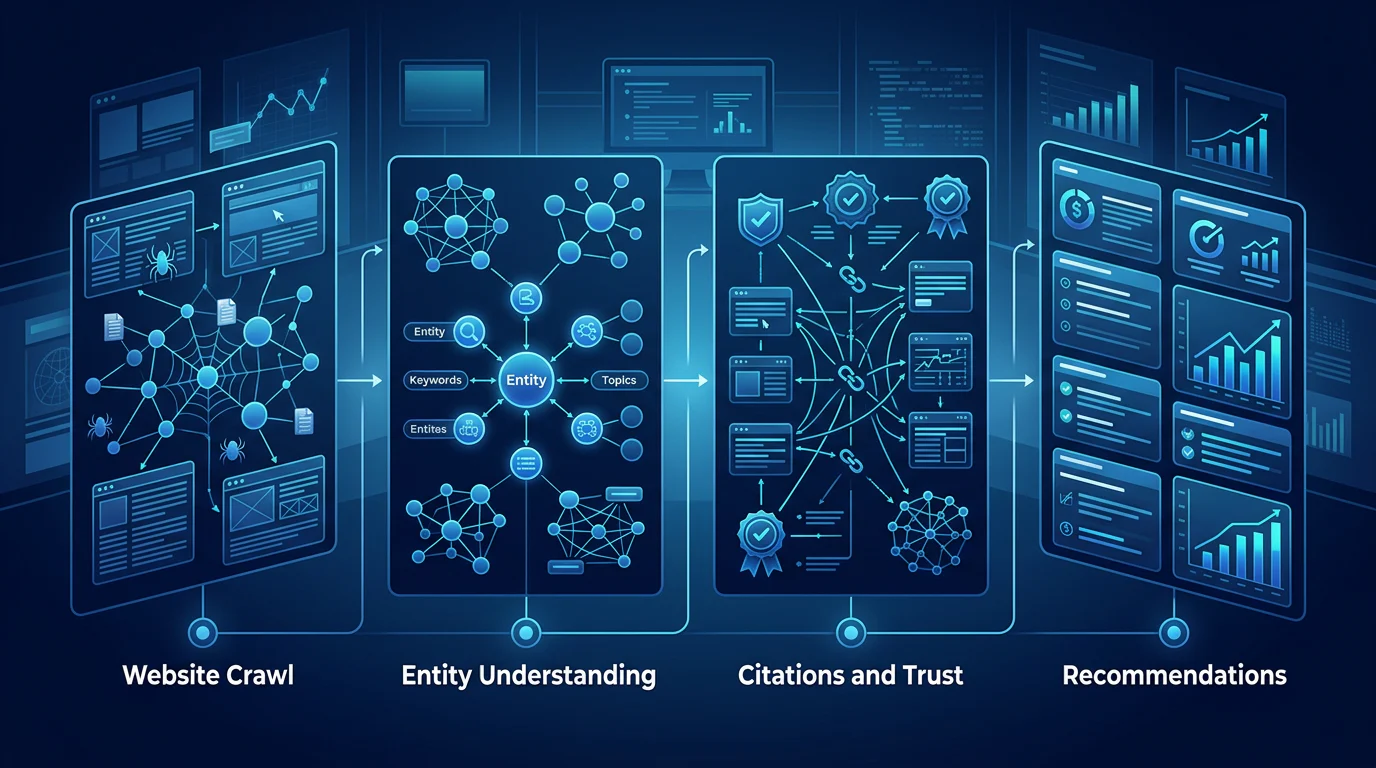
At PageLens.ai, we approach AI search optimization as a retrieval, evidence, and measurement discipline, not a set of shortcuts. Make priority pages crawlable and self-contained, match each prompt to one clear purpose, substantiate claims, reinforce entity facts, earn corroboration, and track citations, mentions, sentiment, referrals, and conversions on a stable prompt set.
How to Optimize Your Website for AI Search
AI search answers increasingly retrieve, synthesize, and cite web pages instead of simply ranking blue links. A 2024 KDD study tested generative-search visibility across 10,000 queries, showing why teams need a more deliberate process than keyword placement alone.
AI search optimization means making every important page crawlable, independently understandable, evidence-rich, and easy to cite. We map each buyer prompt to one page purpose, lead with self-contained answers, support claims with primary sources, make entities consistent, earn outside corroboration, and measure citations, mentions, sentiment, and conversions on a stable prompt set.
Below, we separate the technical gates from the editorial work, then show how to turn findings into a repeatable operating system. The goal is not to game any answer engine, but to make useful information easier to retrieve, verify, and attribute.
How Does AI Search Optimization Differ from Traditional SEO?
Traditional SEO still matters because search systems need to discover, render, index, understand, and trust a page before it can surface anywhere useful. AI search optimization adds another question: when a system retrieves a page to support an answer, can it lift a complete, accurate, and well-supported passage from it?
Google's guidance is direct on this point: its AI features use the same SEO foundations, and there is no special markup or machine-readable file required for eligibility. We treat the difference as an execution model, not a replacement discipline.
| Dimension | Traditional SEO | AI Search Optimization | Shared Foundation |
|---|---|---|---|
| Primary unit | Ranked URL | Retrieved passage and cited URL | Useful canonical page |
| Primary outcome | Impressions, rankings, clicks | Mentions, citations, cited-page coverage | Qualified visits and conversions |
| Content job | Match intent comprehensively | Resolve a decision with liftable evidence | People-first usefulness |
| Technical job | Discovery, rendering, indexability | The same, plus citation-safe access | Crawlable HTML and links |
| Proof standard | Relevance and quality | Verifiable claims and corroboration | Original, accurate information |
A conventional page can rank well yet fail to provide a clean answer block, dated evidence, or enough context to support a specific statement. Conversely, a concise page with a strong answer may still fail if it is blocked, duplicate, thin, or unsupported.
We pair this workflow with AEO versus semantic SEO because the page must be understandable to people and machines without becoming a pile of artificial keywords.
How Do You Make Important Pages Eligible for AI Retrieval?
Eligibility comes before writing polish. If an engine cannot reach your important page, render the material claim, or identify the canonical version, no formatting tactic can compensate for it.
Start with the page a buyer should actually see, not an archived variant, filtered URL, gated resource, or campaign duplicate. Confirm the canonical URL returns a public successful response and is not hidden behind authentication, an accidental bot challenge, or a restrictive firewall rule. Then check whether the page is linked from relevant pages, listed in the sitemap, and available without a visitor taking an action.
Can Crawlers Reach the Page?
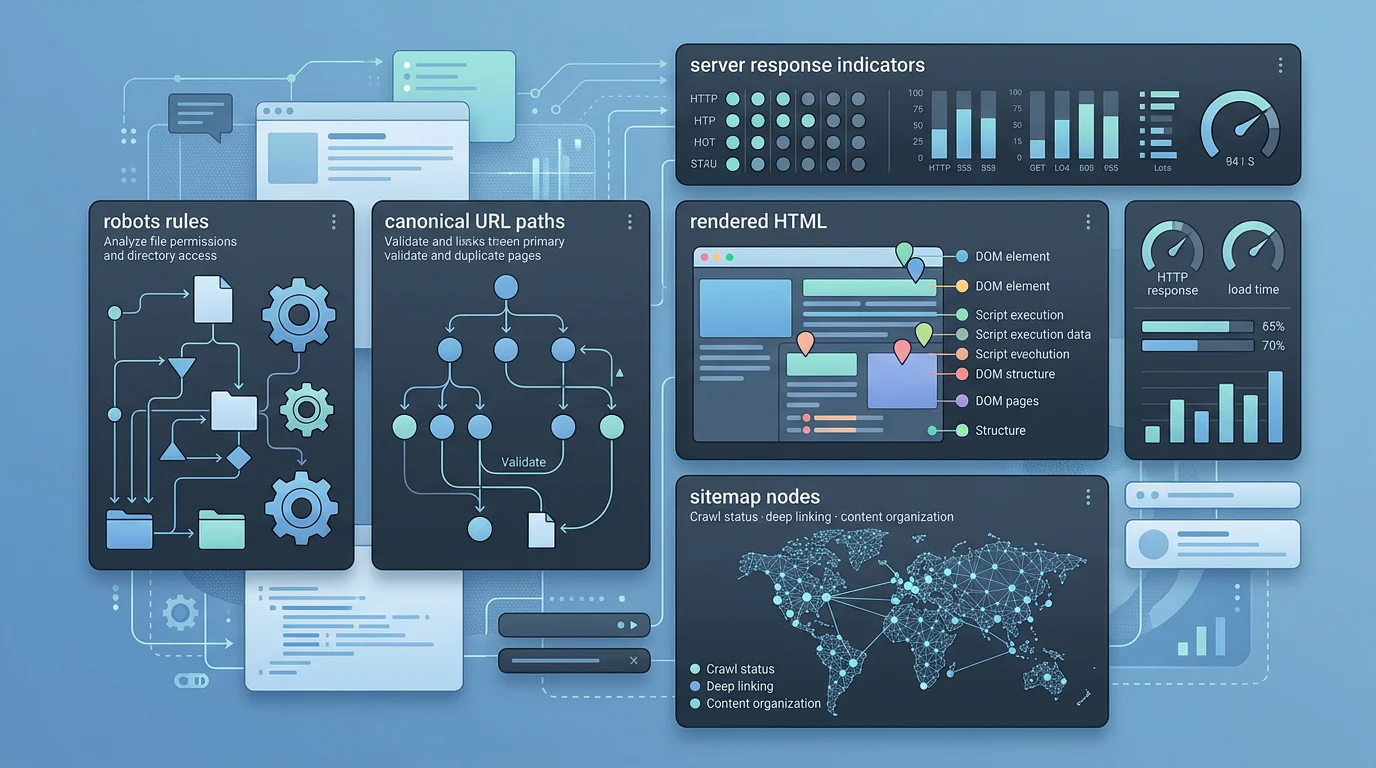
Check access controls before changing content. If you want pages included in ChatGPT search summaries and snippets, publisher guidance says not to block OAI-SearchBot in robots.txt.
- Crawl access: Allow relevant search crawlers on priority URLs and assets.
- Index status: Remove unintended
noindexdirectives from pages meant to appear in search. - Preview controls: Review
nosnippet,data-nosnippet, andmax-snippetbefore expecting answer engines to quote page text. - Discovery: Include preferred canonical URLs in an XML sitemap and link to them from crawlable pages.
Can Engines Render the Important Answer?
Keep the answer, comparison, process steps, and evidence available as text in the rendered page. Do not require a visitor to scroll, click a tab, or complete an interaction before the main material loads. Google’s lazy-loading documentation recommends checking rendered HTML because crawlers do not perform every user interaction.
Use the URL Inspection tool on priority pages after release. Compare what your browser shows with what the crawler receives, especially on JavaScript-heavy templates. Images can clarify a process, but they should never be the only place a reader or retrieval system can find the claim.
Is One Canonical URL Carrying the Signal?
Align redirects, rel="canonical", sitemap inclusion, and internal links around one preferred URL. Canonical documentation explains that search engines select a representative page from duplicate clusters, and your preferred canonical is a signal rather than an absolute command.
Avoid publishing near-identical articles for slight prompt variations. If two pages answer the same buyer decision, consolidate the useful content or clearly differentiate their purpose, evidence, and audience.
Before moving to a content rewrite, apply our website-fix method to identify the technical failures that can invalidate otherwise excellent pages.
How Do You Map Prompts and Write Citation-Ready Passages?
A prompt is not a keyword with extra words. It is a buyer asking for a decision, explanation, comparison, or next action. In our tracked baseline for the priority prompt, PageLens.ai had zero citations and zero mentions across 85 recorded answers, so our first task is to create pages that solve the prompt more completely than generic advice.
Use buyer-prompt research to group variations by intent, then give one page ownership of the primary decision. Supporting questions belong in its sections, FAQs, or linked follow-up pages, not in separate thin articles competing for the same retrieval opportunity.
| Prompt Cluster | Reader Decision | Page Owner | Best On-Page Asset |
|---|---|---|---|
| How do I optimize my website for AI search? | What should we change first? | This guide | Eight-step priority system |
| How do I get cited by AI search engines? | What makes a source usable? | This guide | Evidence and corroboration framework |
| Is this different from SEO? | Which practices still matter? | This guide | Traditional SEO comparison |
| Why are we not cited? | Is the failure technical, editorial, or reputational? | Diagnostic follow-up page | Retrieval-to-citation audit |
How Should One Page Own a Prompt?
Assign a one-sentence page purpose before drafting. For this page, the purpose is to help marketing, growth, SEO, and content leaders make a website retrievable, answerable, verifiable, corroborated, and measurable in AI search.
A single purpose prevents intent overlap and reveals where a separate page is truly necessary. We do not need an article for every wording variation when the reader is seeking the same operating system.
How Should a Passage Open?
Start each major section with a direct answer, then add the condition, explanation, evidence, and practical consequence. A good passage still makes sense if it is retrieved without the surrounding 1,000 words.
Weak: “Schema helps AI understand your website better.”
Citation-ready: “Use structured data only when it matches visible page content. It can clarify a page’s meaning, but it does not guarantee indexing, rich-result treatment, or an AI citation.”
The second version names the action, limits the claim, and explains the outcome. That makes it safer for a reader to act on and easier for an answer engine to attribute accurately.
How Should You Structure Definitions, Steps, and Comparisons?
Use question-based headings where they reflect real buyer questions. Follow them with concise paragraphs, lists for sequences, and HTML tables for tradeoffs. Define unfamiliar terms before relying on them, and include the subject, condition, and consequence in the same block.
A strong evidence block includes the claim, the source, the date when it matters, and a sentence explaining why the evidence changes the decision. Avoid vague language such as “AI engines prefer” unless you can name the documented behavior or clearly label it as your working hypothesis.
For more detail on separating question demand from search-volume thinking, use prompt-versus-keyword research.
How Should Internal Links Support the Answer?
Link to the next useful decision with natural, descriptive anchor text. Internal links help people navigate the method while helping crawlers find and understand related pages.
Use links sparingly and contextually. This article can point readers toward the next stage of execution, while a supporting audit page can point back to the specific framework that explains why a technical issue matters.
How Do You Make Claims, Entities, and Mentions Verifiable?
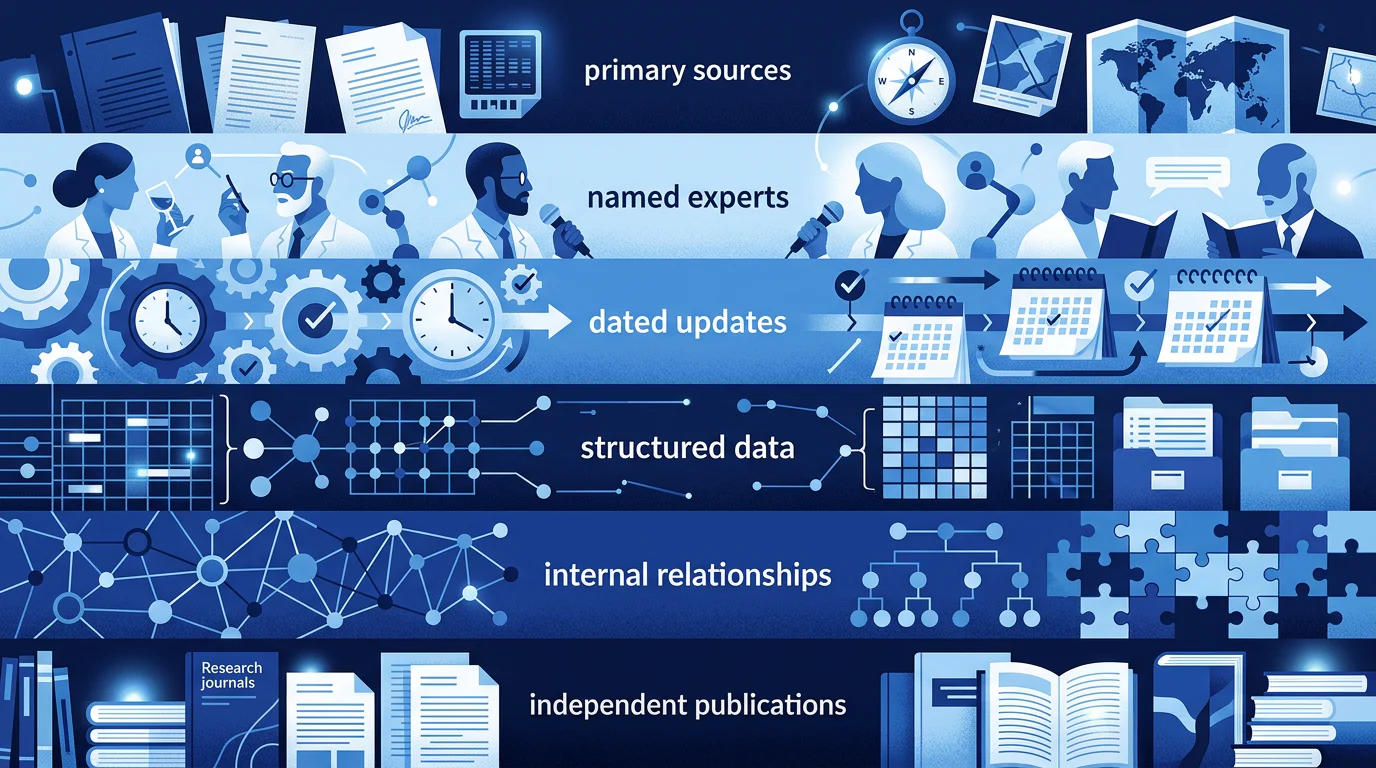
Citation-worthy content gives a reader a way to check it. We make important claims traceable to a primary source, a documented method, direct observation, original data, or a clearly identified expert review. We also date time-sensitive information and update the page when the underlying facts actually change.
People-first guidance emphasizes original information, clear sourcing, author background, and demonstrable expertise. That is a better standard than adding decorative trust badges or writing vague claims about authority.
For PageLens.ai, entity clarity means using the same accurate company name, product terms, author details, and page relationships wherever they appear. Include a visible byline, a relevant author or reviewer profile when one exists, descriptive internal links, and schema that reflects the rendered content.
| Markup | Appropriate Use | Required Guardrail |
|---|---|---|
Article | Main editorial content | Match the visible headline, author, dates, publisher, and canonical URL |
Organization | Publisher and sitewide entity facts | Use only verified company information |
Person | A real author or reviewer | Include authentic credentials and profile information |
FAQPage | Visible end-of-page FAQs | Mark up only questions and answers readers can see |
HowTo | The eight visible implementation steps | Use only when each step is genuine instruction |
BreadcrumbList | Site hierarchy | Keep labels and canonical paths consistent |
Structured-data rules require markup to represent visible content and do not promise any particular search appearance. We use it to describe truthful page structure, not as a substitute for evidence.
External corroboration matters too. Earn independent references by publishing genuinely useful research, contributing attributable expertise, documenting methods, and correcting claims when evidence changes. Our guide to the earned media tie-breaker explains why an independently checkable source is more valuable than a burst of generic mentions.
How Do You Measure and Prioritize AI Search Optimization?
A citation count alone is not a strategy. You need to know which prompt produced the answer, which page was cited, what the answer said, whether the mention was favorable, and whether visibility resulted in qualified traffic or conversion activity.
Set a baseline before changing pages. Record the exact prompt, engine, locale, date, full answer, cited URLs, cited page, PageLens.ai mention status, citation status, sentiment, and the sources repeatedly selected instead. Keep the prompt set stable long enough to distinguish a meaningful trend from a one-off model response.
Use AI citation tracking to preserve the evidence behind each result, including the full answer and the page that received the citation.
| Metric | What It Reveals | Decision It Supports |
|---|---|---|
| Citation Rate | Share of recorded answers that cite your site | Which prompt clusters need work |
| Mention Rate | Whether the brand appears without a link | Entity clarity and recommendation visibility |
| Cited-Page Coverage | Which URLs are selected most often | Which pages deserve deeper investment |
| Sentiment | How answers characterize the brand | Messaging and proof gaps |
| Referral Traffic | Visits from answer engines | Whether cited visibility drives sessions |
| Conversions | Business value from those sessions | Where to scale effort |
Bing AI Performance reports visible citations, cited pages, and grouped grounding queries, while noting that its data is aggregated and suited to trend analysis rather than a complete log. Combine that view with saved answer captures and web analytics.
Prioritize work by impact and effort. Fix high-impact technical failures first, then rewrite passages for directness and proof before investing in bigger original research projects.
- Confirm priority pages are crawlable, indexable, canonical, and rendered.
- Map each priority prompt to one accountable page.
- Add direct, self-contained answer passages under useful headings.
- Replace unsupported claims with dated primary evidence.
- Strengthen authorship, entity consistency, and contextual internal links.
- Add truthful Article, Organization, FAQPage, and HowTo markup.
- Create evidence assets that can earn independent corroboration.
- Re-run the stable prompt set and prioritize the largest verified gaps.
Use cross-engine tracking to compare results by engine instead of hiding different behaviors inside one score.
How PageLens.ai Turns AI Search Findings into Action
At PageLens.ai, we help teams turn AI-search visibility from an anxious guessing game into an accountable workflow. We begin with the prompts buyers actually ask, capture what answer engines say and cite, then connect those findings to the page, passage, evidence, entity, and technical issue that deserves attention. Our approach keeps content, SEO, growth, and technical teams working from the same proof instead of chasing isolated recommendations. We also make room for the work that cannot be automated: validating claims, deciding which prompts matter commercially, creating original evidence, and earning trust beyond your own domain. If your team needs a repeatable way to baseline visibility, diagnose gaps, prioritize fixes, and verify whether changes improve real AI-search outcomes, we can help you build that operating rhythm. Book a demo
FAQs on AI Search Optimization
How Do I Optimize My Website for AI Search?
AI search optimization starts with crawlable, indexable pages, then adds direct answers, primary evidence, consistent entities, credible external corroboration, and measurement across a stable prompt set.
How Do I Get My Website Cited by AI Search Engines?
Resolve the prompt directly, keep each answer self-contained, support it with primary evidence, maintain technical eligibility, and earn independent references that corroborate important published claims.
Does Schema Guarantee AI Search Citations?
No. Accurate, visible-content markup can clarify page meaning, but it cannot guarantee indexing, a rich result, or citation. Use only schema types the page genuinely supports.
What Should We Measure After Updating a Page?
Track the same prompts by engine and date, save answers and cited URLs, then compare citation rate, mentions, sentiment, referrals, conversions, and frequently selected pages.