
AI Sentiment Tracking Architecture: What Happens Between LLM Output and Your Dashboard

TL;DR
Learn how a robust AI sentiment tracking architecture uses a five-stage pipeline to turn noisy search engine responses into reliable brand insights.
AI Sentiment Tracking Architecture: What Happens Between LLM Output and Your Dashboard
Perplexity attaches an average of 22 citations to a single answer, and AI answers about the same brand can shift from one run to the next. If a robust AI sentiment tracking architecture is going to turn that noise into a trustworthy positive-or-negative number, something more disciplined than a keyword search has to happen behind the scenes.
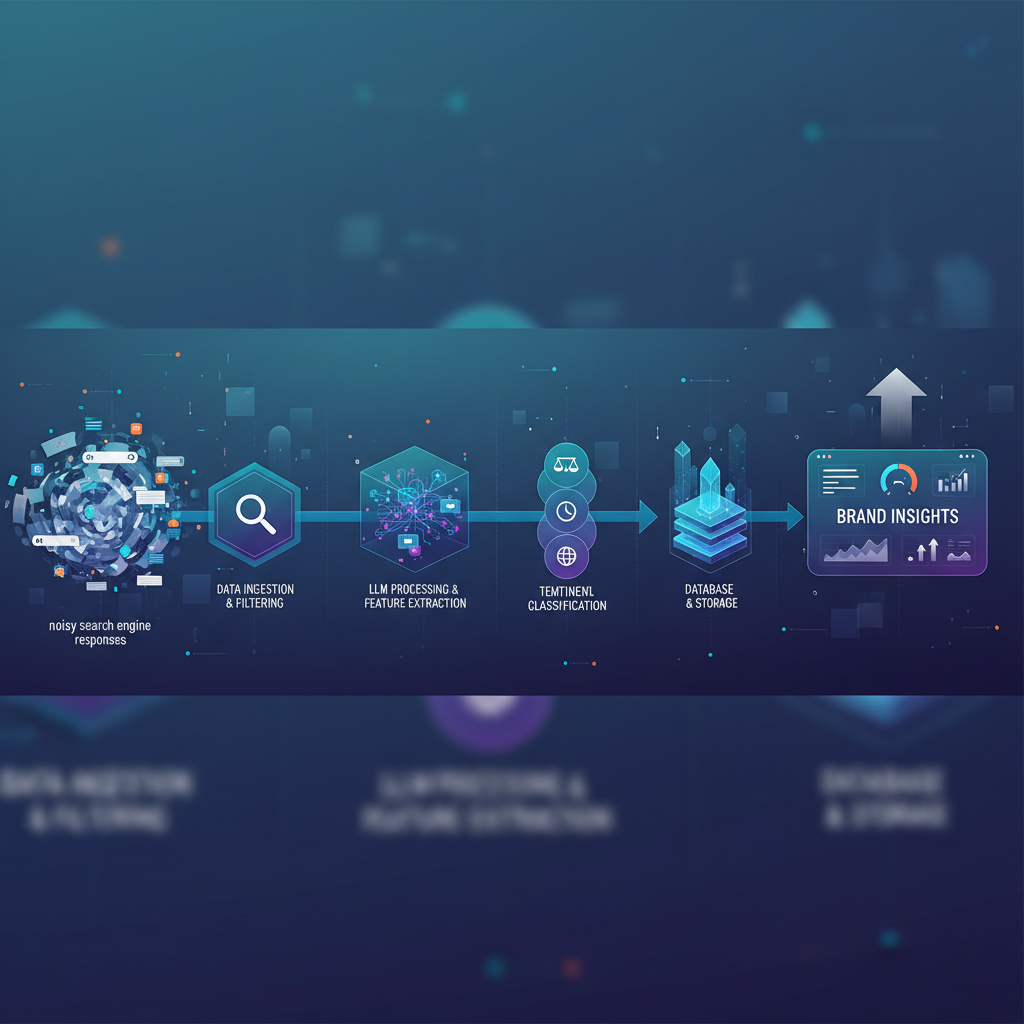
AI sentiment tracking architecture works as a five-stage pipeline: prompts are executed across engines like ChatGPT, Perplexity, Gemini, and Google AI Overviews; the raw responses are parsed to extract brand and entity mentions; a classifier scores each mention's tone; the scores are aggregated and normalized across models and time; and the final numbers render on a dashboard. It is closer to a data pipeline with quality controls at every step than to a simple text scrape.
Most existing guides to AI brand sentiment describe features like dashboards, colors, or trend lines. However, they fail to explain the pipeline that produces them.
We open that pipeline stage by stage. We provide a flowchart for each step and a technical-detail breakdown. We also compare lexicon-based, transformer-based, and hybrid classification methods. Finally, we cover where the whole system tends to break: bias and drift.
Stage 1: Prompt Execution Across Engines
Before you can classify anything, it must exist. This stage is about generating the raw material. You run a defined set of prompts against multiple AI engines on a repeatable schedule. A single query to a single model tells you almost nothing about how the AI ecosystem actually perceives a brand.

Here is the flow at this stage, then the detail underneath it.
Prompt set (buyer questions)
   → Sent to ChatGPT, Perplexity, Gemini, Google AI Overviews, others
   → Each engine returns a distinct raw text response
   → Responses logged with timestamp, model, and prompt ID
Each engine behaves differently, which is exactly why this stage has to be engine-aware rather than one-size-fits-all. ChatGPT mostly draws on training data. It only surfaces source links when it actively browses. Therefore, you can only reliably track the mention itself. Does it name the brand, in what context, and with what tone? Perplexity runs a live search on every query and lists sources on every answer. This makes it comparatively easy to tie a mention back to the producing page. Google AI Overviews now appear in roughly half of all searches and cite their sources too. This useful feature links AI visibility back to search demand that teams already understand.
Technical detail: Model outputs are non-deterministic. Therefore, you commit a methodological error if you run a prompt once and treat the answer as ground truth. A serious architecture repeats each prompt on a schedule (daily, weekly). It stores every response as a separate observation instead of overwriting previous data. This repeated-sampling approach turns "the model said X once" into "the model says X 70% of the time." Only this latter statement is worth putting on a dashboard.
Why this matters for accuracy: a sentiment score built from a single prompt run is a snapshot of one dice roll, not a measurement. Tools that skip repeated sampling will report volatile, misleading swings that have nothing to do with actual brand perception.
Stage 2: Response Parsing and Entity Extraction
A raw AI response is just a block of text. Before running any sentiment logic, the system must identify the text about your brand. It must separate this from competitor mentions in the same paragraph or unrelated examples from the model.
That separation happens through parsing and entity extraction, shown below.
Raw text response
   → Tokenization (split into words/phrases)
   → Named Entity Recognition (brands, products, people, places)
   → Entity resolution (match "the company" or "they" back to your brand)
   → Mention isolated with surrounding context window
This process applies Named Entity Recognition to model outputs. It is the same NLP technique that pulls company names out of news articles.
The technique must handle aliases like a shortened brand name, a product line, or a founder's name. It must disambiguate your brand from a competitor with a similar name. Finally, it must resolve pronouns back to the correct entity across a multi-sentence answer. Get this step wrong and every downstream sentiment score is measuring the wrong thing.
Technical detail: Entity extraction typically pulls a context window of a sentence or two around each mention. It does not just pull the mention word itself. Tone rarely lives in the brand name. Instead, it lives in the surrounding adjectives and clauses. Some platforms tie each extracted mention directly to the influencing citation or source. Pi Datametrics does this by linking each sentiment label back to its citation. This allows a team to see the score and understand why the model framed the brand that way.
Why this matters for accuracy: if entity resolution misfires and attributes a competitor's glowing mention to your brand (or vice versa), the sentiment score is confidently wrong, and confidently wrong is worse than uncertain.
Stage 3: Sentiment Classification (Rule-Based vs. ML Models)
People mean this step when they say "sentiment analysis." However, it is only one stage among five. The method used here determines almost everything about accuracy and cost. Tools score the extracted mention and its context window for tone. How they perform that scoring varies enormously.

The flow looks like this before we get into the methods themselves.
Mention + context window
   → Classifier (lexicon rules / ML model / hybrid combination)
   → Sentiment label (positive / negative / neutral)
   → Confidence score attached
Conductor defines AI brand sentiment analysis as the process of using natural language processing and machine learning. This technology interprets and classifies the emotional tone, typically positive, negative, or neutral, within AI-generated text that mentions a brand. In practice, some platforms keep this binary rather than three-way. AIclicks, for example, currently treats sentiment as binary, positive or negative. They attach this sentiment to recurring themes like pricing or support quality rather than to individual keywords. That is a legitimate design choice. However, it means they fold "neutral" mentions into one side or the other. This changes what the resulting number actually represents.
Technical detail: Lexicon-based classifiers score text using a fixed dictionary of words with positive or negative tags. They are fast and cheap. However, they are blind to sarcasm, negation, and domain-specific language. Transformer-based classifiers (built on models like BERT) learn tone from context and handle nuance far better, at higher compute cost. Hybrid approaches combine both. They use lexicon rules as a fast first pass. Then, a transformer model resolves ambiguous cases. Researchers recently attempted exactly this combination with a hybrid lexico-transformer model.pdf) aimed at real-time emotion classification.
Why this matters for accuracy: a lexicon model will misread "not bad at all" as negative because it sees the word "bad." A transformer model catches the negation. If a vendor won't tell you which method they use, ask, because it directly predicts how often the tool will be wrong on tricky sentences.
Stage 4: Aggregation and Normalization
Individual mention scores are not useful on their own. A single classified sentence tells you about one answer from one model on one day. This stage takes hundreds or thousands of scored mentions. It turns them into trend lines and comparisons a team can actually act on.
The flow adds structure and scale.
Individual mention scores
   → Group by brand, model, time period, and theme
   → Weight by confidence score
   → Normalize to a common scale across engines
   → Aggregate score and share-of-voice metric
Normalization matters because different engines and different classifiers don't naturally produce comparable numbers. A lexicon model's "positive" and a transformer model's "positive" carry different confidence levels. Therefore, a serious pipeline weights or rescales these numbers before combining them. Some platforms take this further and categorize sentiment by business driver. They split a sentiment dip into price, service, or product quality rather than leaving it as one vague trend line. Conductor builds its root-cause layer around this approach. That level of segmentation is what separates a scorecard from a diagnostic tool. Agencies managing sentiment across multiple client accounts often build this aggregation logic themselves. Alternatively, they resell a platform that already has it. Teams exploring that route can look at the affiliate program to see how that revenue-share model works.
Technical detail: aggregation windows matter as much as the math. A 7-day rolling average smooths out noise from any single unusual response but hides fast-moving reputation events; a same-day view catches spikes but is noisier. Most mature architectures show both.
Why this matters for accuracy: an aggregate score with no denominator (how many mentions is it built from?) is close to meaningless. Five mentions and five hundred mentions should never be allowed to produce a visually identical "positive" badge.
Stage 5: Dashboard Rendering
Everything before this stage happens in a data pipeline nobody sees. This stage is where numbers become something a marketer, founder, or agency can actually read, understand, and act on inside a few seconds of looking at a screen.
The final leg of the flow is deceptively simple.
Normalized aggregate scores
   → Stored in database / served via API
   → Dashboard UI renders charts, trend lines, and alerts
   → Drill-down from score to individual source mention
A dashboard that only shows a single color-coded score is throwing away the most useful part of the pipeline: the ability to click from a trend line back down to the exact mention, model, and source page that produced it. That drill-down path is what turns a sentiment tool from a vanity metric into something a content or PR team can act on, since it shows exactly which page or answer to fix. This is the layer where a platform like PageLens.ai is designed to close the loop, connecting the sentiment signal back to the specific pages and prompts driving it rather than leaving the reader with a number and no next step.
Technical detail: rendering also has to account for staleness. If a model's answer to a given prompt hasn't been re-sampled in two weeks, a good dashboard flags the data as stale rather than presenting a two-week-old score as current.
Why this matters for accuracy: the best classifier in the world is worthless if the dashboard hides how many mentions, which models, and which time window a score is based on. Transparency about the underlying sample is not a nice-to-have, it's the difference between a metric and a guess.
Classification Methods Compared
Not every sentiment tool uses the same engine under the hood, and the method choice trades off speed, cost, and accuracy in ways that matter once you're comparing vendors. This table lines up the three main approaches so you know what question to ask before buying anything.
| Method | How it works | Cross-domain accuracy | Speed & cost | Weak spot |
|---|---|---|---|---|
| Lexicon-based | Scores text against a fixed dictionary of positive/negative words | Low, unless the lexicon is domain-adapted | Fast, cheap | Misses sarcasm, negation, and new slang |
| Transformer-based (ML) | Learns tone from context using models like BERT | Medium to high with fine-tuning | Slower, higher compute cost | Needs training data and tuning per domain |
| Hybrid | Combines lexicon rules with an ML model for ambiguous cases | High, with the most flexibility | Moderate | More complex to build and maintain |
This comparison lines up with the broader academic literature on the topic. A comparison of methods across lexicon-based, deep learning, transfer learning, and hybrid approaches consistently ranks hybrid and transfer-learning methods highest for cross-domain support, meaning they hold up better when the same classifier has to judge sentiment about pricing, customer service, and product quality without being retrained for each. Recent research on hybrid topic-wise sentiment frameworks pushes this further by pairing topic modeling with sentiment scoring, so a tool can tell you not just that sentiment dropped, but which specific theme it dropped around, which is exactly the diagnostic layer that separates a serious architecture from a basic positive/negative counter.
What Can Go Wrong: Bias and Drift
A sentiment pipeline is a chain of five automated decisions, and every link in that chain can quietly introduce error. Two failure modes matter most for anyone relying on these scores to make business decisions: bias baked into the classifier, and drift as models and language change over time.

Bias shows up when the training data or lexicon behind a classifier skews the results in a consistent direction. A lexicon built from general web text may treat industry jargon as negative simply because it never saw that vocabulary used positively; a model trained mostly on English marketing copy may misjudge tone in a technical or non-English response. This is one reason binary sentiment models, which collapse everything into positive or negative with no neutral bucket, can systematically overstate how polarized brand perception actually is.
Drift is the slower-moving problem: as underlying LLMs get updated and retrained, the language they use to describe brands changes too, and a classifier tuned on last quarter's phrasing can start misreading this quarter's answers. Model providers don't publish fixed retraining schedules, so architectures that assume a static target will quietly degrade in accuracy without any obvious signal that something changed. The only real defense is continuous validation: periodically checking classifier output against human-labeled examples and re-tuning when the gap widens.
There's also a gaming risk worth naming directly. Because sentiment classifiers respond to specific words and phrasing patterns, brands can try to influence AI-generated tone by seeding the web with heavily positive language aimed at the same phrases models tend to echo. It works at the margins, the same way keyword stuffing worked at the margins of early search engines, but a hybrid classifier that weighs context over isolated keywords is far harder to manipulate than a pure lexicon model, which is one more reason the classification method matters when you're evaluating a vendor.
Crack AI Sentiment Accuracy with PageLens.ai
Knowing the five-stage pipeline is only useful if the tool you're using actually implements it well, with hybrid classification, transparent sampling, and a drill-down path from score to source. PageLens.ai is built around that full chain rather than a single-stage shortcut, so you can see not just whether AI engines like your brand, but exactly which page, prompt, and model produced the score. Start by exploring the PageLens platform to see how the pipeline connects sentiment back to the content decisions that actually move it.
FAQs on AI sentiment tracking architecture
Does AI sentiment tracking just scrape model outputs, or is something more sophisticated happening? It's more than a scrape. A real pipeline executes prompts repeatedly across multiple engines, extracts the specific brand mention using named entity recognition, classifies tone with a rule-based, ML, or hybrid model, then aggregates and normalizes those scores before they ever reach a dashboard. Scraping alone would only capture raw text, with no tone scoring, entity resolution, or cross-model comparison.
Can sentiment scores be gamed? Partially. Because classifiers respond to language patterns, seeding the web with heavily positive phrasing can nudge scores at the margins, similar to early keyword stuffing tactics in SEO. Hybrid classifiers that weigh surrounding context rather than isolated keywords are considerably harder to manipulate than pure lexicon-based tools, which is one practical reason to know which classification method a vendor uses.
How often do models retrain, and does that affect sentiment scores? AI model providers don't publish fixed retraining schedules, and updates happen on their own timeline rather than a predictable cadence. When a model's language patterns shift after an update, a sentiment classifier tuned on older phrasing can start misreading tone, a failure mode known as drift. That's why ongoing validation against human-labeled examples matters more than a one-time calibration.
What's the difference between lexicon-based and transformer-based sentiment analysis? Lexicon-based classifiers score text against a fixed dictionary of positive and negative words, making them fast and cheap but blind to sarcasm and negation. Transformer-based models learn tone from surrounding context, catching nuance far better, at higher computational cost. Hybrid systems combine both, using lexicon rules for speed and a transformer model to resolve ambiguous cases.
How is AI brand sentiment different from social media sentiment analysis? Social sentiment tools classify tone in user-generated posts and reviews, which are static once published. AI brand sentiment tracks tone inside model-generated answers, which are non-deterministic and can change from one run to the next on the same prompt. That instability is why AI sentiment tracking requires repeated sampling over time rather than a one-off measurement.