
Which Fast-Start AI Citation-Tracking Alternatives Launch Fastest?
Compare fast-start AI citation-tracking alternatives by evidence, setup friction, contracts, and report readiness before your team commits.

Which Fast-Start AI Citation-Tracking Alternatives Launch Fastest?
Google reports that AI Mode has surpassed 1 billion users globally. For marketing, growth, SEO, and content leaders, that makes reliable answer evidence more valuable than another unexplained visibility score.
The fastest fast-start AI citation-tracking alternatives are not the ones with the shortest signup form. They are the options that complete the same prompt set, return visible mentions and source URLs, show competitor context and verbatim answers, and allow an export without a sales call, developer work, or an incomplete dashboard.
This guide defines a fair launch test, explains the commercial checks that change deployment speed, and shows what a decision-ready first report must contain.
How Do Fast-Start AI Citation-Tracking Alternatives Earn a Speed Claim?
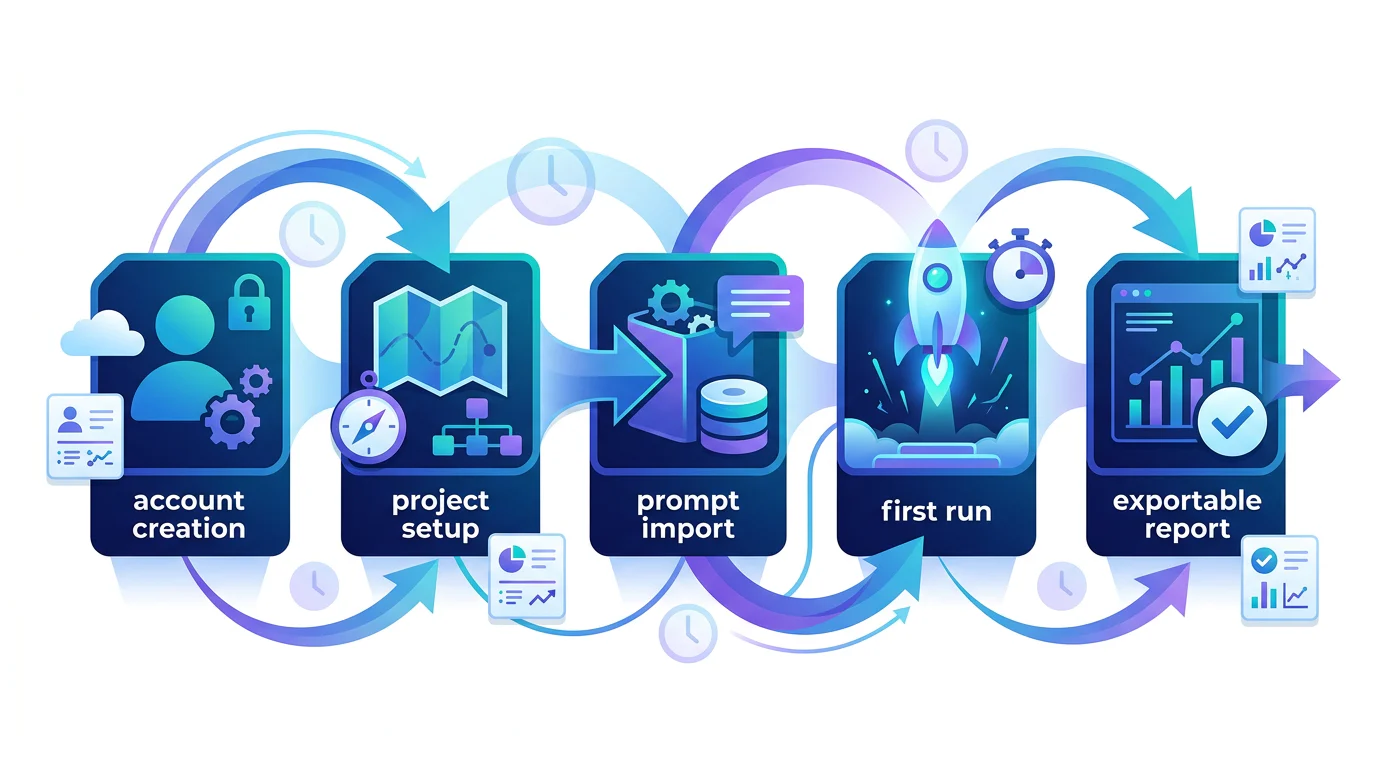
Speed means time from account creation to first usable data. It does not mean the time to see a welcome screen, create a project shell, or view a sample dashboard.
A completed run needs inspectable evidence because AI citations can be incomplete or outdated, as OpenAI guidance explains. Teams should retain the answer, source URLs, prompt, engine, timestamp, and export behind every number they share internally.
| Test Event | Fast Pass | Not Decision Ready | Evidence To Save |
|---|---|---|---|
| Signup | Account and workspace available | Demo request or inaccessible workspace | UTC timestamp and gate screenshot |
| Project setup | Domain, market, engines, and competitors saved | Required developer work or unresolved validation | Configuration log |
| Prompt import | Same CSV imports without rework | Prompts manually rebuilt or silently dropped | Original CSV and import result |
| First run | Selected prompts complete | Scan remains queued or partially empty | Run start and completion timestamps |
| First report | Mentions, citations, competitors, full answers, and export available | Score-only dashboard or non-exportable result | Export file and answer evidence |
A mention is not a citation, and a citation is not automatically a recommendation. Our citation evidence guide helps teams separate those signals before they rank platforms or brief content work.
How Should Teams Run a Fair First-Report Test?
A controlled test prevents a polished demo from becoming an unearned speed claim. Use one non-branded enterprise B2B SaaS domain, the same fresh business account type, US-English settings, and one locked prompt file for every product.
Freeze the Inputs
Use 30 prompts, split across category, comparison, and high-intent buyer questions. Keep the domain, competitors, locale, and selected engines constant, then record unsupported engines as a coverage limitation rather than a speed advantage.
A prompt set should reflect real buying language, not only familiar keywords. Start with a documented buyer prompt dataset so every candidate receives the same workload.
Measure the Full Clock
Set T0 when the account-creation form is submitted. Capture signup completion, email verification, project creation, prompt import, first-run click, run completion, dashboard population, and first export in UTC.
Do not substitute browser load time for report readiness. The relevant question is whether a stakeholder can inspect and export evidence, then use it to make a content, PR, or competitive decision.
Apply One Pass Rule
A candidate passes only when every selected prompt has completed or has a documented exception, and the report shows visible mentions, source URLs, competitor context, full responses, and exportable results.
The same setup should span more than one answer engine where coverage allows. This matters because a single-engine result can conceal a material coverage gap.
Which Launch Route Fits Your Deployment Window?
Same-day deployment is possible only when access, configuration, the first run, and evidence export all occur without a human gate. Same-week deployment can still be useful, but it should be described accurately when security review, procurement, or support creates delay.
Google notes that AI Mode uses query fan-out across multiple sources and can miss context, so a completed first report is a baseline, not a permanent truth. That is why teams need a documented refresh and review process after launch.
| Deployment Route | Practical Conditions | Appropriate Use |
|---|---|---|
| Same Day | No mandatory sales call, no developer task, successful prompt import, supported engines, and exportable evidence | Fast pilot for one owned site |
| Same Week | Access is self-serve, but verification, support, approvals, or a longer first run adds time | Structured evaluation with stakeholder review |
| Assisted Deployment | SSO, security review, custom contract, implementation service, or regional configuration is required | Governed enterprise rollout |
Procurement belongs in the launch clock, not in a footnote. Our AI visibility governance guide outlines the owners, approvals, and evidence controls that turn a pilot into an operating program.
What Makes a Citation Report Decision-Ready?
A useful report lets a leader move from “we appeared” to “this page, phrase, and source explain why.” That requires answer-level evidence and a visible denominator for every category comparison.
Can Teams Inspect Source and Page Evidence?
Require the source URL, cited page, full answer, prompt, engine, market, timestamp, and history for each reported citation. A dashboard that aggregates these records is useful, but it should never replace them.
Use a source-tracking method to confirm whether a cited page belongs to your brand, a competitor, a publisher, or an unrelated source.
Does Category Comparison Show Its Denominator?
A category average needs the included prompts, brands, engines, locations, dates, exclusions, and calculation method. Without those inputs, a percentage can rise simply because the comparison set changed.
Teams comparing raw mention counts should also inspect normalized share of voice. The calculation should remain available to reviewers, so they can tell whether a movement reflects performance or a changed comparison set. Publish the prompt membership and exclusions with every result so finance and leadership teams can evaluate whether the average supports the decision.
Can Sentiment Be Traced to Exact Language?
Aggregate sentiment can be useful for scanning, but it is not enough for an executive decision. The report should preserve the exact phrase, associated prompt, answer context, date, and label that produced the sentiment finding.
That evidence makes it possible to distinguish an inaccurate description from a genuine product objection. Use verbatim answer evidence before changing messaging or publishing a response page.
How Do Price, Contracts, and Operations Change the Choice?
A public monthly price is a starting point, not proof of a low-commitment deployment. Teams should confirm renewal language, cancellation timing, export rights, retention, support, implementation costs, and any usage limits before calling a platform easy to launch.
Our current public PageLens.ai plans list monthly billing, guided onboarding, unlimited users, and the following monitoring scope. Enterprise teams should still confirm the written commercial terms that apply to their specific rollout.
| PageLens.ai Plan | Listed Monthly Price | Prompt Cadence | Listed Answer Volume | Listed Engine Coverage |
|---|---|---|---|---|
| Launch | $299 | 100 prompts weekly | 300 answers weekly | ChatGPT, Google AI Mode, Perplexity |
| Growth | $699 | 100 prompts daily | 500 answers daily | ChatGPT, Google AI Mode, Perplexity, Gemini, Grok |
| Enterprise | $1,499 | 200 prompts daily | 1,400 answers daily | ChatGPT, Claude, Gemini, Perplexity, Grok, Copilot, Google AI Mode |
After the first report, compare refresh frequency, alerts, CSV or API access, stakeholder reporting, history, and data return at exit. Our enterprise tracking guide covers the operational questions that determine whether fast setup becomes useful monitoring.
How PageLens.ai Supports a Fast Pilot
When an enterprise team needs a defensible AI visibility pilot, we start with evidence reviewed after launch, not a headline score. PageLens.ai tracks prompts across engines, preserves verbatim answer evidence, surfaces citation and competitor context, and keeps monitoring connected to the work of improving pages. Our plans show monthly billing for Launch, Growth, and Enterprise, with guided onboarding and unlimited users listed on the pricing page. We use the same discipline in discovery: agree the prompt set, markets, owners, reporting audience, approval path, and the definition of a usable first report before work begins. That gives marketing, SEO, and leadership teams a shared standard for speed, evidence depth, and operating fit. If your team needs a governed rollout rather than another opaque dashboard, our measurement methodology keeps evaluation visible and consistent, built around auditable results and clear accountability. Book a demo
FAQs on Fast-start AI Citation-tracking Alternatives
What Counts as First Usable Data?
First usable data is a completed run that displays the prompt, full answer, brand mention, cited source URL, competitor context, timestamp, and an exportable result.
Can a Tool Show a Decision-Ready Report Within a Week?
First reports can qualify within seven calendar days when access, configuration, prompt import, engine selection, run completion, evidence review, and export finish. A score alone does not qualify.
Does Monthly Billing Mean There Is No Contract Commitment?
Monthly billing can include renewal notices, usage minimums, implementation fees, restricted exports, or separate services. Request written cancellation, data-return, and order-form terms before purchase carefully.
Why Does Verbatim Answer Evidence Matter?
Verbatim answer evidence lets teams validate whether a label reflects the model's actual language, identify the source context, and defend a recommendation before changing content or spending budget.