


TL;DR
An AI buyer prompt dataset combines permissioned, observed customer language with clearly labeled estimates and generated hypotheses. Capture exact wording and provenance, normalize related questions, validate demand through customer and search signals, test priority prompts across engines, then score clusters by relevance, recurrence, answerability, visibility opportunity, and conversion proximity. We show how to build it without mistaking a generated prompt idea for something a buyer actually said.
A research study found that practical guidance, seeking information, and writing accounted for nearly 80% of sampled consumer ChatGPT conversations. That makes conversational research important, but it does not make every plausible prompt real buyer evidence.
An AI buyer prompt dataset combines permissioned, observed customer language with clearly labeled estimates and generated hypotheses. Capture exact wording and provenance, normalize related questions, validate demand through customer and search signals, test priority prompts across engines, then score clusters by relevance, recurrence, answerability, visibility opportunity, and conversion proximity.
We will show how to build that system without confusing a generated prompt idea with something a buyer actually said.
What Is an AI Buyer Prompt Dataset?
An AI buyer prompt dataset is a structured record of the questions, objections, comparisons, and constraints that people use while researching a product category. It is not a keyword list with longer phrases pasted into a spreadsheet. The useful unit is a question plus its evidence: where it came from, who it represents, when it was captured, and how confidently we can use it.
This distinction matters because prompt research changes the question from “Which terms should we target?” to “Which buyer problems can we substantiate, answer clearly, and test?” Our guide to what prompt research changes explains why conversational context, modifiers, and decision criteria deserve their own fields.
| Provenance Class | What It Means | Can We Call It Observed Buyer Language? | Required Label |
|---|---|---|---|
| Observed buyer question | Verbatim language from a permissioned first-party source or attributable public discussion | Yes, when source context is retained | Observed |
| Modeled prompt estimate | An aggregate, proxy, or estimate supplied without inspectable raw wording | No | Modeled estimate |
| Suggested prompt | A research or search interface suggests a related question | No | Suggested |
| Synthetic expansion | An AI system or analyst generates a variant from a seed question | No | Synthetic |
Use question openers such as “How do I,” “What happens if,” and “Is this better than” as classification clues, not proof of funnel stage. A comparison can be early research, late evaluation, or a support concern. Preserve the original wording first, then assign stage after reviewing context, constraints, and purchase signals.
Which Sources Produce Usable Buyer-Question Evidence?
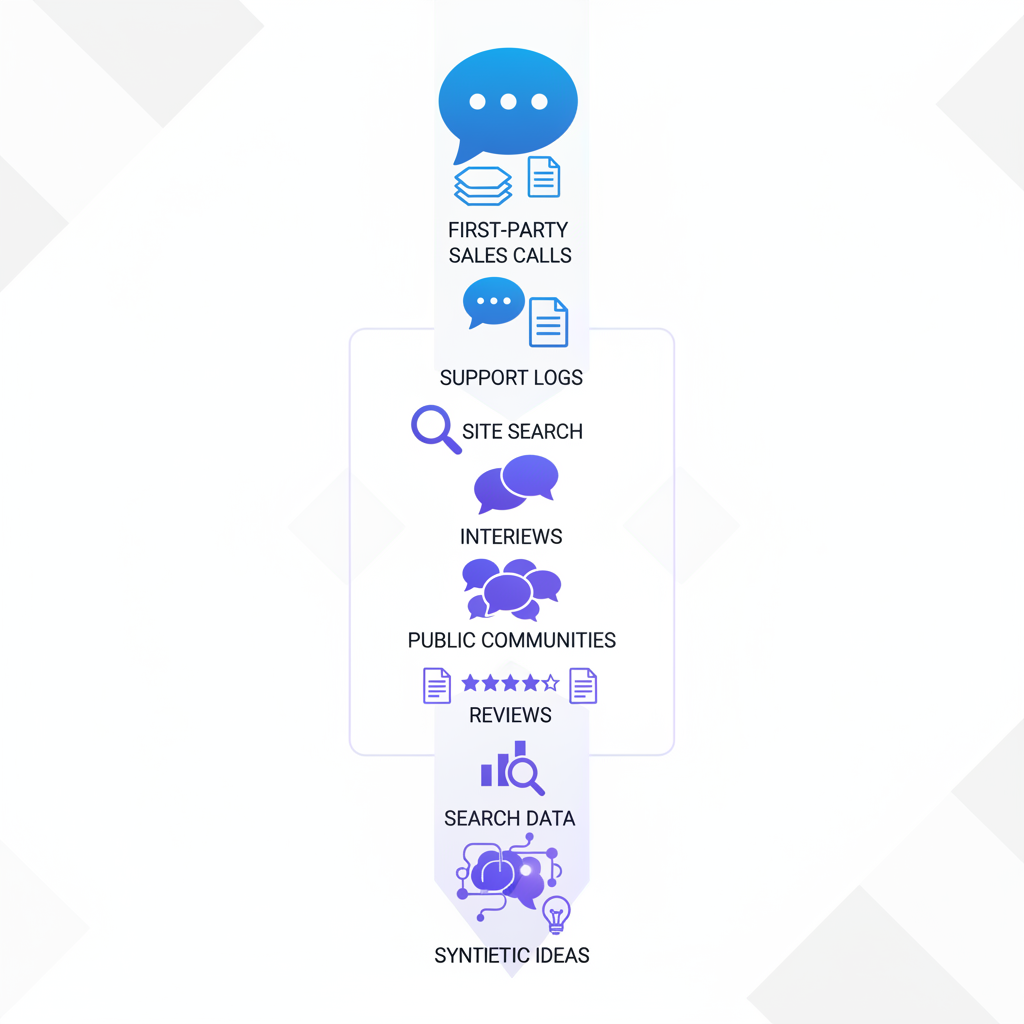
The strongest dataset starts with places where buyers describe their own problem. Sales calls, support tickets, chat transcripts, site search, interviews, communities, public reviews, and search data each add a different kind of signal. We use a source hierarchy so a vivid but unverified suggestion never outweighs repeated, permissioned customer language.
First-party sources deserve priority because they capture the category language your actual market uses. Public communities and reviews can expose objections buyers may not say directly to a vendor, but they still represent public discussion, not proof of a private AI prompt. Our inventory of buyer-prompt data sources helps teams document that distinction before collection begins.
| Source | Best Use | Evidence Strength | Important Limitation |
|---|---|---|---|
| Sales calls and discovery notes | Buying criteria, objections, comparisons | High | Requires permission and redaction |
| Support and chat logs | Setup friction, missing expectations, retention risks | High | Represents customers, not always prospects |
| Site search | Language used on your own property | High | Usually incomplete and volume-limited |
| Interviews | Clarifies intent and context | High | Small samples are not frequency data |
| Communities and reviews | Unfiltered phrasing and objections | Medium | Public language is not AI-chat evidence |
| Search Console and keyword tools | Adjacent demand and query patterns | Medium | Measures search behavior, not AI chat behavior |
| Generated variants | Coverage ideas and test cases | Low until validated | Never proof of observed demand |
Google Search Console can report queries, clicks, impressions, CTR, and position, but its reports also omit some anonymized queries to protect privacy. Treat that Google documentation as validation for Google demand, not as a window into private conversations with AI tools.
How Do You Collect and Normalize an AI Buyer Prompt Dataset?
Collection should preserve meaning before it pursues scale. If a rep rewrites a prospect’s question, or an analyst removes the condition that made it valuable, the record becomes less useful for both content and AI-answer testing. We start with a narrow category, defined audience, and explicit permission rules, then expand only after the evidence is usable.
Follow the Eight-Step Workflow
- Define the product category, audience, market, and research question.
- Approve source access, retention, consent, and redaction rules.
- Export source material without paraphrasing buyer language.
- Create one record for each question, objection, comparison, or decision constraint.
- Capture verbatim wording, provenance, date, category, and audience.
- Remove personal data and record consent and redaction status.
- Normalize duplicates, entities, modifiers, jobs, objections, and comparison intent.
- Expand, validate, prioritize, activate, and refresh approved clusters.
This creates an audit trail from raw language to published content. Teams launching a category can adapt our research workflow rather than beginning with a blank prompt list.
Use a Downloadable Field Schema
Build the downloadable CSV or spreadsheet with one record per source question. Keep the raw wording even when a canonical version groups it with close duplicates.
| Field Group | Fields | Why It Matters |
|---|---|---|
| Identity | Prompt ID, verbatim text, canonical prompt | Keeps source language connected to the normalized cluster |
| Provenance | Provenance class, source type, source reference, capture date | Shows what the record can honestly claim |
| Market Context | Category, audience, role, market, product maturity | Prevents irrelevant clustering |
| Intent | Funnel stage, job to be done, objection, comparison intent | Connects questions to an answer format |
| Modifiers | Entities, team size, budget, geography, stack, compliance need | Preserves the conditions that change an answer |
| Governance | Consent status, redaction status, owner, last reviewed | Makes the dataset usable and accountable |
| Decisioning | Recurrence, external demand signal, validation status, priority score | Separates evidence from opportunity |
Normalize Without Erasing Evidence
Merge true duplicates at the canonical-prompt level, but retain every raw source record beneath the cluster. Standardize product entities and comparison formats, then separate modifiers such as role, team size, integration, budget, geography, urgency, and compliance. This makes a cluster useful without pretending that five reworded records are one identical buyer question.
Privacy review is part of collection, not an optional cleanup task. Pseudonymised material can still be personal data, and the ICO guidance is clear that a person who holds additional identifying information may still be processing personal data.
How Do You Expand and Validate Prompt Hypotheses?
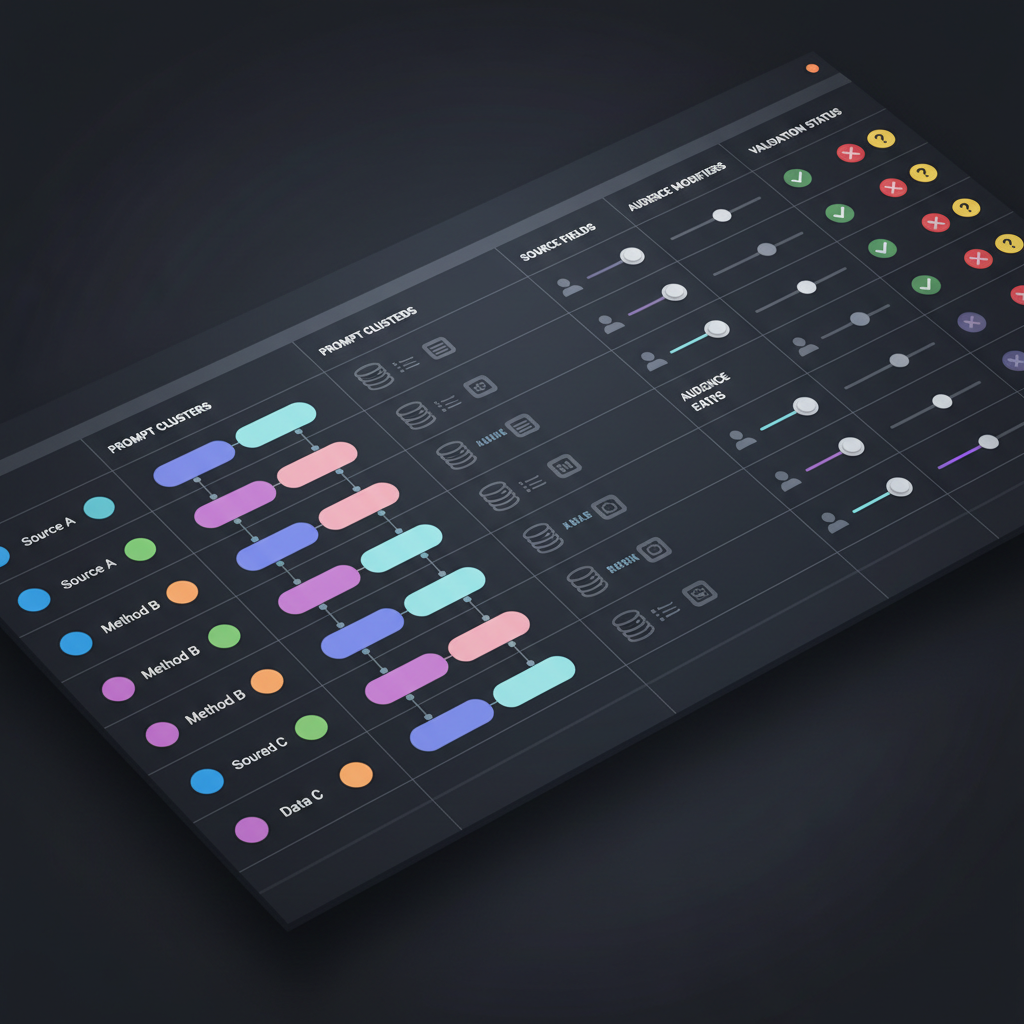
Expansion makes the dataset more complete, but it must remain visibly separate from observed demand. We use generated variants to test whether a category answer covers realistic constraints, not to claim that a customer typed every resulting sentence into an AI interface.
Expand from High-Quality Seeds
Start with an observed question or a validated search signal. Vary one condition at a time: audience, role, outcome, budget, urgency, integration, implementation concern, comparison criterion, or risk. This produces testable variants while keeping the connection to the original evidence clear.
A useful expansion can reveal a missing decision criterion. It cannot establish recurrence. Our keyword research comparison explains why search volume, AI-generated phrasing, and buyer language should remain separate inputs.
Apply Four Validation Gates
- Customer validation: Ask interview participants whether the phrasing, problem, and decision context match how they research.
- Internal review: Have sales, support, product marketing, and product teams challenge the interpretation.
- External-demand validation: Check related Search Console queries and Keyword Planner data as Google-demand signals, not AI-chat counts.
- Engine testing: Run prioritized prompts repeatedly, recording date, locale, account state, answer content, cited sources, and visibility result.
Test Engines, Not Assumptions
An engine test tells us what that interface returned under recorded conditions. It does not reveal the frequency of a buyer’s private prompt. This limit is especially important for business usage, where data controls state that inputs and outputs are not used for training by default.
Here is a fictitious record format, included to show labeling rather than report customer data:
[Source Type: Sales Call] Can our RevOps team keep its CRM while adding forecasting?
[Canonical Prompt] Forecasting software that works with an existing CRM
[Provenance: Synthetic] Do we need to replace our CRM to improve forecast accuracy?
[Validation Status] Awaiting customer interview and engine test
The synthetic variant may be useful for a test queue, but it should never inherit the observed record’s recurrence or certainty. Teams can use multi-engine signals to decide which results deserve continued review.
How Do You Activate and Refresh the Dataset?
Activation turns a validated cluster into a decision about content, documentation, product messaging, or measurement. We score opportunity and evidence separately. A rare observed question may still deserve a precise answer, while a high-priority synthetic hypothesis still needs a validation path.
| Buyer Stage | Intent Signal | Prompt Shape | Best Response Format |
|---|---|---|---|
| Problem Discovery | Pain, symptom, desired outcome | How do we solve this? | Definition, framework, checklist |
| Solution Exploration | Category, workflow, requirements | What should we look for? | Guide, requirements page, explainer |
| Evaluation | Constraints, integrations, comparisons | Which option works with our situation? | Comparison table, implementation guide |
| Selection | Risk, rollout, proof, procurement | Can we deploy this safely? | Security page, migration guide, FAQ |
Use a transparent weighted rubric: business relevance, recurrence, answerability, competitive visibility opportunity, and conversion proximity. We recommend setting weights with the commercial team, documenting the scale, and retaining a separate confidence field so a high-priority hypothesis never masquerades as observed behavior.
For each approved cluster, assign an owner, answer format, source evidence, test prompt, and refresh date. We then connect the work to citation tracking, because a strong answer still needs monitoring after publication.
Use HowTo markup for the visible eight-step process and Dataset markup for the field schema when the schema is published as structured information. Do not expect special search treatment from the first format, because Google's update ended HowTo rich results.

Build with PageLens.ai
At PageLens.ai, we use this workflow to keep prompt research tied to evidence instead of a growing spreadsheet of attractive guesses. Our platform lets teams run repeatable checks across relevant AI interfaces and review visibility findings beside source pages that need attention. That gives marketing, growth, and content leaders a practical operating rhythm: preserve buyer language, identify content gaps, test the questions that matter, and return to the dataset when a category or product changes.
We recommend beginning with a narrow category and a handful of high-fit questions. From there, we can help build a tracking cadence with clear ownership and recurring review that distinguishes observed questions from hypotheses and shows where a clear, well-supported answer may improve visibility. If you need a defensible system rather than another prompt list, use our cross-engine workflow, talk with our team, and Book a demo.
FAQs on AI Buyer Prompt Dataset
How Do You Find What Buyers Ask AI Tools?
Start with permissioned sales, support, interviews, site search, communities, and reviews. Label each record, then validate prompt hypotheses using customer feedback, demand signals, and repeatable engine tests.
How Do You Build a Buyer Prompt Dataset for B2B SaaS?
Define the category and audience, capture verbatim wording and source metadata, redact personal data, normalize related records, validate expanded hypotheses, then prioritize clusters using relevance, recurrence, and evidence.
What Tools Reveal Conversational Buyer Questions by Category?
Tools can organize permissioned material, suggest variants, cluster themes, and rerun engine tests. They cannot verify every private conversation, so every output needs clear provenance and validation.