


TL;DR
Cross-engine AI visibility tracking runs a controlled prompt set on each engine, stores full responses, and compares brand mentions, citations, recommendations, sentiment, and competitor context over time. We keep results segmented by engine because retrieval, source access, and answer behavior differ, and any combined score must disclose weights, prompt mix, dates, and missing data. This guide maps the full pipeline from prompt design to client reporting.
Cross-engine visibility is a data-collection problem before it is a dashboard problem. At scale, even the collection environment has constraints, including a documented 50 requests-per-second limit for one search API.
Cross-engine AI visibility tracking runs a controlled prompt set on each selected engine, stores full responses, and compares brand mentions, citations, recommendations, sentiment, and competitor context over time. We keep results segmented by engine because retrieval, source access, and answer behavior differ. Any combined score must disclose weights, prompt mix, dates, and missing data.
In this guide, we map the full measurement pipeline, from prompt design to client reporting. We also show how to investigate conflicting results without pretending one engine is the ground truth.
Why Does Cross-Engine AI Visibility Tracking Require Separate Answer Environments?
A prompt is not a universal test input once it reaches an AI answer engine. The final answer can reflect model behavior, search availability, generated retrieval queries, sources, account conditions, locale, and citation treatment. If those conditions differ, a blended score can hide the most important finding: where a brand is visible, absent, cited, or recommended.
We treat every engine as a separate answer environment first, then compare results only after preserving the conditions that produced them. That approach makes visibility tracking more useful than a generic ranking because it turns “our brand disappeared” into an auditable question.
Google’s Gemini grounding can generate one or more Google Search queries and return answer annotations with search steps. ChatGPT, Claude, and Perplexity also expose different search and citation behaviors, which is why a monitoring program should store the response environment instead of treating all outputs as interchangeable.
| Engine | Retrieval And Citation Behavior | Evidence To Store | Measurement Implication |
|---|---|---|---|
| ChatGPT | Search can be optional, with structured search calls and URL citations | Model, search setting, sources, citations | A searched answer and an unsourced answer are different observations |
| Claude | Search can occur multiple times during one request | Model, tool version, search count, citations | Retrieval depth can affect both answer language and source selection |
| Gemini | Grounding can create Google Search queries and annotations | Model, grounding setting, generated queries, annotations | Google-grounded results need their own baseline |
| Perplexity | Web-grounded answers and raw search results are separate surfaces | Model or preset, response mode, citations, results | Search-result rank is not the same as answer inclusion |
That separation is also necessary before applying phrase-level analysis to a brand mention. A sentiment label is only useful when its source answer, engine, and surrounding language remain visible.
How Do You Build a Shared Prompt Set?
We start with a shared core prompt library because the client’s category, buyer language, and decision moments should remain comparable across engines. That core should cover category discovery, problem-aware research, use-case fit, comparison, and decision-stage prompts.
The best prompt libraries begin with real buyer language, not a recycled keyword list. Our buyer prompt research workflow helps teams distinguish a category question from a branded comparison or a purchasing question before they start measuring results.
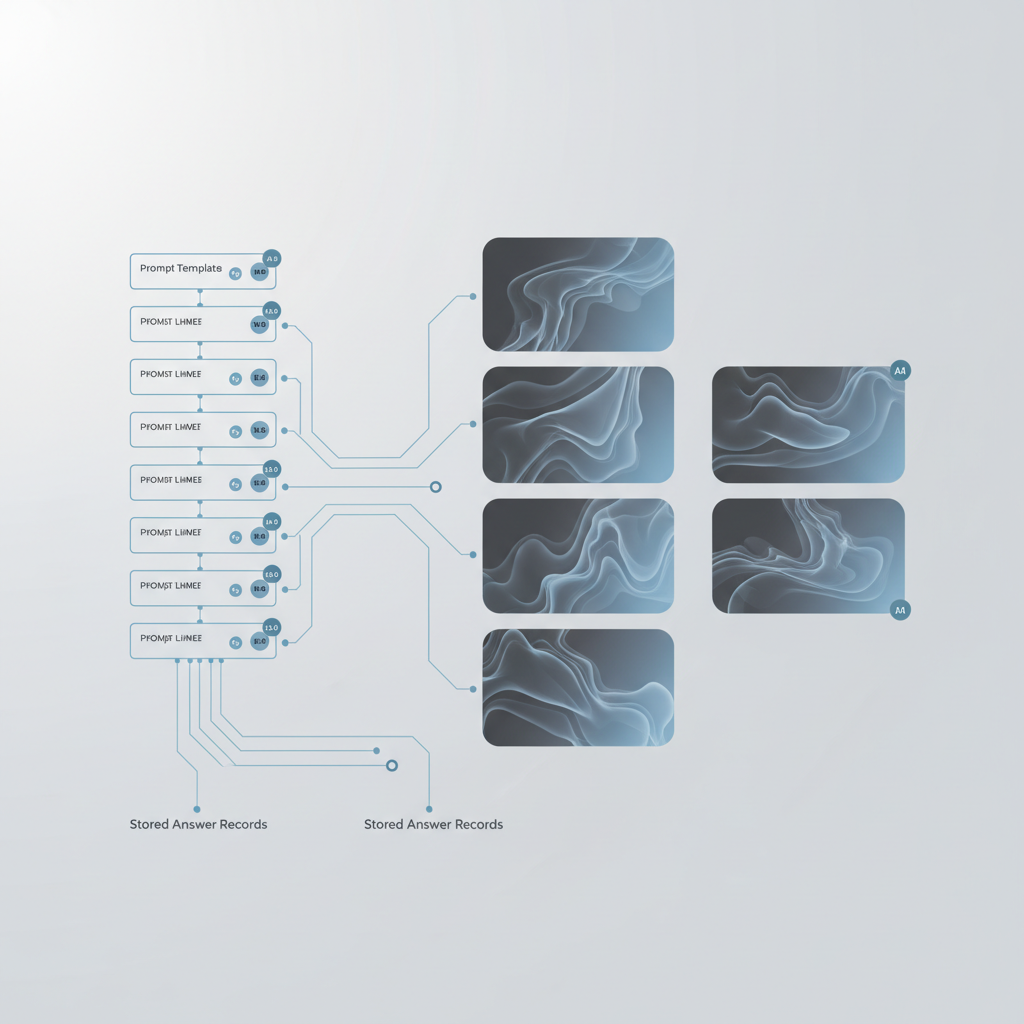
Use three prompt layers:
-
Shared core prompts: Run the same wording across every selected engine to establish comparable category coverage.
-
Engine-specific test cases: Add a separately labelled test when a surface exposes a meaningful setting, such as explicitly enabling web search.
-
Control fields: Freeze prompt revision, language, market, locale, account condition, and tracked entity list for each measurement period.
The distinction matters because an engine-specific test can be valuable without belonging in the cross-engine baseline. We report it as a separate segment, not as a silent change to the denominator.
How Do You Capture and Normalize Every Answer?
A credible program stores evidence before it calculates a score. We keep the original answer distinct from derived labels so a client can inspect what the engine actually said, what our parser extracted, and which rule produced the metric.
That audit trail follows testing guidance from NIST: document the test set, metrics, tools, and measurement process so results can be repeated and assessed as conditions change.

What Must Each Run Record?
Every response record needs a prompt ID and revision, engine, surface, model identifier, retrieval configuration, locale, timestamps, latency, status, raw answer text, raw citations, source metadata, parser version, and response hash. We also record blocked, partial, timed-out, and parse-failed runs, because missing data is not a zero.
run_id, prompt_id, prompt_revision, engine, surface, model_id,
tool_config, locale, submitted_at, completed_at, latency_ms,
run_status, response_text_raw, response_hash, citations_raw,
sources_raw, parser_version, entity_annotations
This model makes AI answer tracking reproducible. It also gives analysts enough context to explain why two answers that look similar in a dashboard may have come from materially different run conditions.
How Should We Synchronize and Rerun?
Run engines in a defined collection window, then store the window start and end rather than claiming every answer was observed at the same moment. Report successful-run rate, median latency, high-percentile latency, and missing-response count per engine.
For material changes, we recommend a controlled confirmation policy before alerting a client. Rerun the same prompt, with the same declared conditions, and retain every outcome so an apparent change can be separated from temporary availability, throttling, or an inconsistent response.
How Do We Normalize the Evidence?
Normalization starts with an approved entity dictionary: brand names, product names, domains, abbreviations, and known false positives. Each extracted mention should retain the matched text span, normalized entity ID, confidence, and the rule version that classified it.
We keep citations separate from mentions because a plain-text reference, an owned-domain citation, and a third-party citation about a brand answer different questions. ChatGPT’s search output can include both searchable action records and citation annotations, which reinforces the need to preserve source-level evidence rather than infer it later. A multi-engine tracking method turns that record into a repeatable operating system rather than a one-time audit.
Which Metrics and Investigation Steps Make Results Defensible?
The most defensible metrics are simple enough to audit from raw answers. We calculate them per engine and per prompt group before we calculate any total, because a clean numerator and denominator matter more than a polished index.
| Metric | Formula | What It Shows |
|---|---|---|
| Mention Inclusion Rate | Brand-mentioned successful answers divided by successful answers | Whether the brand appears at all |
| Owned-Domain Citation Rate | Answers citing an owned domain divided by successful answers | Whether owned content is used as a source |
| Recommendation Rate | Answers explicitly recommending the brand divided by successful answers | Whether the brand is offered as an option |
| Mention Share Of Voice | Brand mention events divided by tracked-entity mention events | Relative category presence |
| Successful-Run Rate | Successful runs divided by attempted runs | Whether the data set is complete enough to interpret |
How Is Combined Visibility Calculated?
A combined score can be useful for executive reporting, but only as a transparent rollup. We calculate it as the weighted average of per-engine scores, then publish the engine weights, prompt mix, collection dates, exclusions, and missing-data rate beside it.
Combined visibility = sum of engine weight multiplied by engine score
                      divided by sum of included engine weights
Weights should reflect an explicit reporting decision, not an invisible assumption. If one engine has missing runs or a changed configuration, we annotate the score rather than allowing a clean-looking average to imply certainty.
How Do We Investigate a Discrepancy?
A discrepancy is evidence to inspect, not a reason to choose a favorite engine. Our five-step process keeps the diagnosis grounded in the record:
-
Confirm Conditions: Compare prompt revision, model, surface, locale, account state, and collection window.
-
Check Collection Integrity: Review status, latency, timeouts, blocked runs, and missing citation payloads.
-
Read Raw Answers: Identify whether the difference is omission, source selection, recommendation order, sentiment, or competitor substitution.
-
Audit Normalization: Review aliases, entity rules, parser version, citation matching, and rank-assignment logic.
-
Rerun And Annotate: Apply the documented confirmation policy, preserve all outcomes, and report unresolved uncertainty.
For recommendation and citation review, use citation tracking layers rather than treating every mention as equal evidence.
What Must a Client Report Include?
A client-ready report should show the prompt inventory, per-engine metrics, raw-answer export IDs, dates, run health, source evidence, and a visible methodology note. It should also show why a movement is being reported, whether it was confirmed, and which conditions changed between periods.
Sentiment needs the same discipline. We classify the language around the brand mention, not the tone of an entire answer that may discuss several companies. That makes a phrase-level method more useful for correcting an inaccurate narrative or identifying a cautious recommendation.
How PageLens.ai Helps Agencies Prove AI Visibility Changes
At PageLens.ai, we built our workflow for teams that need evidence a client can inspect, not a generic chart that cannot be explained. We keep prompt revisions, engine settings, raw responses, citation records, entity rules, and rerun history connected so a change can be traced to its underlying evidence. That makes it easier to separate a genuine shift in inclusion from an unavailable run, a changed model setting, or an alias-parsing mistake.
Our reporting is designed for marketing, growth, SEO, and content leaders managing multiple stakeholders. It shows each engine before any combined score, exposes the denominator behind every rate, and preserves enough response context to discuss recommendations and competitor mentions without overclaiming causality. Use our platform when you want auditable monitoring, clearer client conversations, and a repeatable path from observation to action across every tracked prompt and reporting period. Book a demo.
FAQs on Cross-engine AI Visibility Tracking
These answers clarify the measurement rules that matter most in reporting. They are designed to keep engine-level evidence visible and client discussions grounded.
Why Can the Same Prompt Produce Different Brand Results?
Engines differ in retrieval settings, source indexes, model behavior, account conditions, and citation formats. Treat each result as a separate observation, then compare like-for-like conditions.
What Metrics Should We Track Across AI Engines?
Track inclusion rate, citation rate, recommendation rate, mention share, explicit recommendation position, sentiment, successful-run rate, and missing-data rate separately for every engine in each reporting period.
How Often Should B2B Brands Run AI Visibility Checks?
Set cadence by business risk and prompt priority, record every run window, and investigate material movements with controlled reruns before presenting an engine-specific change as a trend.
Can Agencies Use a Combined AI Visibility Score?
Yes, but preserve raw responses, dates, prompt versions, failure states, metrics, competitor context, and engine segmentation. Publish combined-score weights, exclusions, and missing-data treatment for every reporting period.