
How Multi-Engine AI Brand Tracking Works Across ChatGPT, Claude, Gemini, and Perplexity


TL;DR
See how multi-engine AI brand tracking records, normalizes, and reports brand visibility across leading AI answer engines.
Monitoring a B2B brand in an AI response is no longer a once-a-week manual check. A comparative Claude request can trigger 10 or more searches, which means one answer can already be a retrieval and synthesis event rather than a fixed ranking.
Multi-engine AI brand tracking runs the same controlled prompt set across ChatGPT, Claude, Gemini, Perplexity, and other selected systems, then records whether each answer mentions, recommends, cites, or mischaracterizes a brand. Because engines differ in retrieval, citation behavior, model versions, geography, and response variability, results must be normalized by prompt and engine before trends or competitor comparisons are interpreted.
This guide explains the workflow, the engine differences that affect measurement, the metrics worth reporting, and how agencies can preserve proof of change.
How Does Multi-Engine AI Brand Tracking Work from Prompt to Report?
The job is not to collect attractive screenshots. It is to create an evidence trail that lets a team answer a specific question later: what did this engine say, in what conditions, for which buyer prompt, and how did that observation change?
We treat each response as a versioned observation. That keeps a transient answer from becoming an unsupported claim about a brand’s overall AI visibility. A useful monitoring system begins with a governed prompt library and ends with a report that links every movement back to stored evidence. For a practical companion framework, see our guide to multi-engine signals.
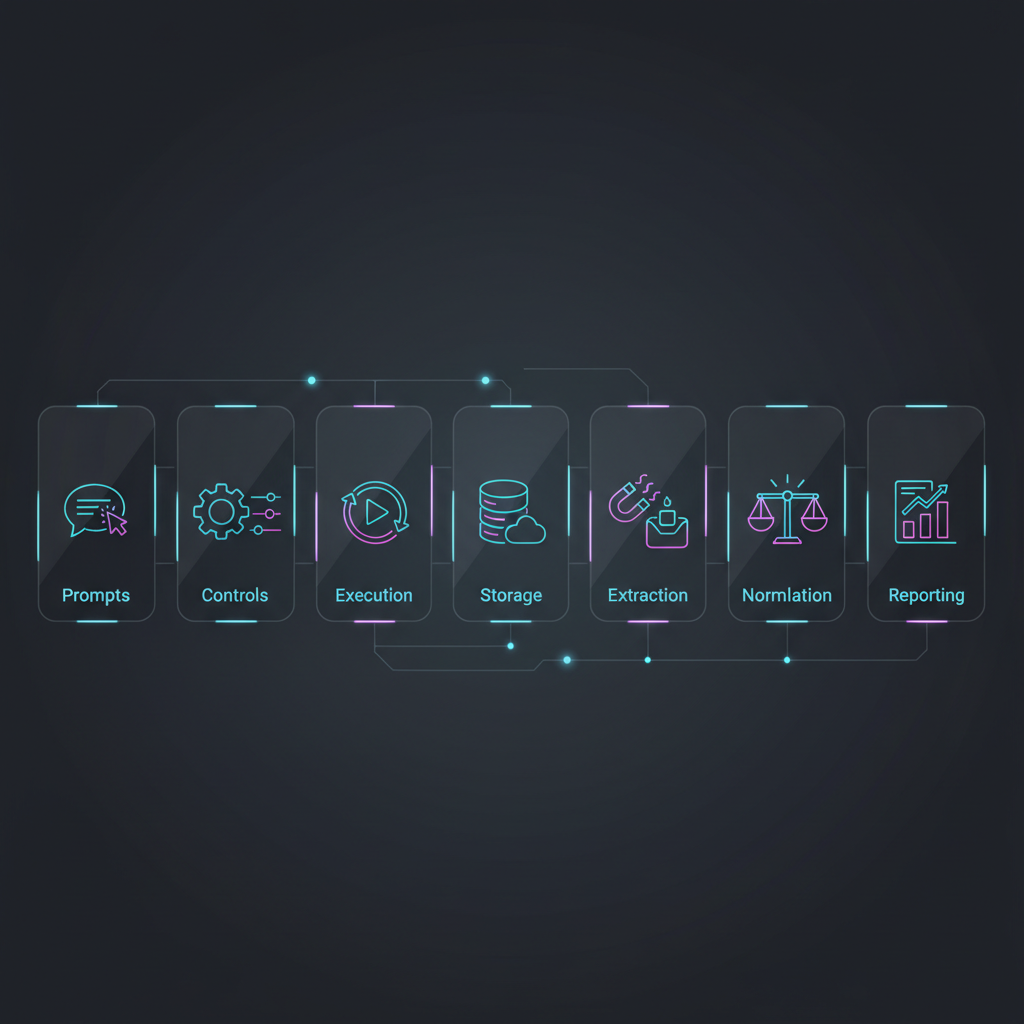
The Seven-Stage Pipeline
[1 Prompt Library] → [2 Control Snapshot] → [3 Scheduled Execution] → [4 Raw Response Storage] → [5 Entity And Citation Extraction] → [6 Normalization And Classification] → [7 Reporting And Alerts]
-
Prompt Library: Build prompts around buyer questions, category research, comparisons, and problem-aware searches. Give every prompt a stable ID, intent label, language, and version.
-
Control Snapshot: Record the engine, visible model or mode, locale, language, date, time, search setting, personalization state, and run number before evaluating the result.
-
Scheduled Execution: Run independent sessions on a repeatable schedule. Preserve failed, blocked, and incomplete attempts instead of deleting them from the denominator.
-
Raw Response Storage: Save answer text, displayed citations, source URLs, and a render or screenshot where the collection method permits it.
-
Entity And Citation Extraction: Match approved brand aliases, product names, and competitor entities. Separate a textual mention from a linked owned-domain citation.
-
Normalization And Classification: Convert raw output into consistent event fields while preserving the original answer for review.
-
Reporting And Alerts: Show trends first by engine and prompt cohort. Use an aggregate only when its rules and denominator are visible.
Gemini provides a useful example of why raw records matter. When Google Search grounding is used, its documented grounding metadata can include generated search queries, web-source chunks, and claim-to-source support. Those fields make an observation easier to audit, but they do not make it identical to a result from another engine.
| Field | Example Value | Why It Matters |
|---|---|---|
| Run ID | 2026-08-05_claude_p014_r02 | Connects the record to its exact collection event |
| Prompt ID | p014 | Preserves the buyer question and prompt version |
| Engine And Mode | Claude, recorded-if-exposed | Prevents unlabelled engine blending |
| Controls | en-US, clean session, search enabled | Shows the conditions behind the output |
| Brand Events | Mentioned, not recommended, owned domain cited | Separates visibility signals |
| Evidence | Raw answer, citation URLs, timestamp | Lets a reviewer verify the classification |
Why Can’t You Treat AI Engine Results as Interchangeable?
A brand can appear in one engine and disappear in another without either result being wrong. Each system makes different retrieval decisions, exposes different evidence, and can change what it knows or searches at different times. Conventional search and AI-answer measurement remain related but distinct, as our AI visibility guide explains.
ChatGPT Search, for example, may rewrite a question into one or more targeted searches. Its documented behavior can also use general location and relevant Memory when enabled, which is why a clean-session baseline should not be casually compared with a personalized result from another day. Review ChatGPT Search as a retrieval surface, not as a traditional static results page.
| Engine | Retrieval Behavior | Citation And Link Surface | Observable Metadata | Useful Controls | Measurement Limitation |
|---|---|---|---|---|---|
| ChatGPT | May search and rewrite prompts into targeted searches | Inline citations or a Sources panel when search is used | Search presence and visible sources vary by interface | Search state, locale, clean session, memory state | Consumer interface behavior may differ from API implementations |
| Claude | May run repeated web searches within one request | Search responses include cited sources | API can expose source URL, title, and cited text | Location, allowed domains, search limits, session state | Search use depends on prompt and mode |
| Gemini | Can generate one or multiple Google Search queries | Grounded answers can contain source-linked support | Search queries, source chunks, and grounding support metadata | Grounding state, model, language, prompt version | Metadata availability depends on mode and product surface |
| Perplexity | Searches the web in real time for answer generation | Numbered citations link to source pages | Visible citations and selected answer mode | Prompt wording, mode, language, clean session | Its product modes and selected models affect the observation |
The most important reporting rule follows from that table: do not create a universal “AI rank.” Instead, calculate engine-level visibility rates first, then combine only like-for-like samples. A combined score can be useful as a directional portfolio view, but it must never hide the engine, prompt group, period, or evidence coverage behind it.
Citation behavior is especially easy to misread. An answer might name a brand but cite a third-party source. It might link to an owned domain without explicitly recommending the brand. Or it might provide no visible citations at all. Our overview of citation layers explains why these are separate events, not interchangeable proof.
How Do You Run a Controlled Cross-Engine Test?
A controlled test does not try to force every engine into the same architecture. It controls the inputs and records the observable conditions so differences have a defensible interpretation.
Start with a canonical buyer question, then create variants only after the baseline is established. If one variant changes tone, location, and comparison set at the same time, it cannot tell you which change moved the answer. Our primer on prompt research is useful here because buyer prompts carry more context than conventional keyword lists.
Build a Prompt Library Around Real Decisions
Use prompt groups that mirror how B2B buyers investigate a category:
- Category Discovery: “What tools help teams monitor brand visibility in AI answers?”
- Problem Aware: “How can an agency prove whether a client appears in AI responses?”
- Comparison: “What should a multi-engine tracking process include?”
- Evaluation: “What evidence should an AI visibility report preserve?”
An example starter design is 12 prompts across four engines, with three independent runs per prompt. That produces 144 observations in one collection cycle. It is a practical starting structure, not a universal benchmark.
Freeze the Variables You Can Control
Record prompt wording, language, locale, collection date, device or interface, search state, model or mode when shown, session state, and run number. Use clean independent sessions for baseline observations, then run personalized or localized variants as their own cohorts.
Claude’s web-search documentation shows why location belongs in this log. Its API supports approximate location controls, and domain controls can constrain the search surface. The moment a team changes either condition, it has changed the experiment.
Repeat Runs Without Chasing the Best Answer
Repeated runs should estimate stability, not cherry-pick a favorable result. Report how many valid observations were collected, how many failed, and what share contained a mention, recommendation, citation, or misalignment.
That approach reflects repeatability research published in 2025, which explains that probabilistic language-model generation can produce different outputs even under the same input and parameters. A single answer is evidence of one event. A repeated sample is evidence of a pattern. Agencies can translate that rigor into scalable account work with agency reporting models.
What Metrics Define Brand Visibility Across AI Models?
Metrics become useful only when everyone using the report means the same thing by them. We recommend an eight-metric glossary that sits beside every dashboard, export, and client presentation.
| Metric | Definition | Calculation Or Review Rule |
|---|---|---|
| Mention | A verified brand or approved alias appears in answer text | Count once per brand per response |
| Recommendation | The answer places the brand in a suggested option set or expresses preference | Preserve the supporting excerpt |
| Citation | A displayed source link resolves to the brand’s verified domain | Keep the response URL and cited source URL |
| Visibility Rate | Eligible responses with a defined visibility event | Visibility events divided by eligible responses |
| Share Of Voice | A brand’s presence events among a fixed competitive entity set | Calculate within one engine, cohort, and period |
| Sentiment | Evaluative framing of the brand claim | Label positive, neutral, negative, mixed, or unclear |
| Factual Misalignment | A claim conflicts with approved facts or a primary source | Mark correct, uncertain, or misaligned |
| Evidence Completeness | Counted events with recoverable underlying evidence | Complete evidence records divided by counted events |
Sentiment deserves more care than a simple positive, neutral, or negative tag. “Suitable for small teams but weak for enterprise reporting” is not one sentiment event, it is two distinct claims. Keep the sentence, classify the clauses, and make the reviewer’s judgment inspectable. Our guide to sentiment analysis shows why exact model language should remain attached to the label.
Share of voice also needs a fixed competitor set and a strict counting rule. Count a brand once for presence in a response, even if its name appears repeatedly. Do not pool incompatible engine samples, and do not double-count an entity because its parent brand, product name, and abbreviation occur together.
Perplexity’s published help documentation says each answer includes numbered citations. That makes its evidence unusually visible, but citation visibility is not a reason to score it as more important than an engine with different source presentation. It is a reason to preserve an explicit evidence-completeness field.
How Should Agencies Choose Manual, Scripted, or Platform Monitoring?
The right approach depends on client count, collection frequency, technical capacity, and how much proof the agency must show when a metric changes. There is no single best method for every program.
Manual checks can be excellent for a disputed claim or a small baseline. Scripts can give a technical team more control over structured inputs and storage. A platform is often the operational choice when multiple clients need scheduled collections, permissions, alerts, and client-ready evidence.

| Approach | Best Use | Scale | Evidence Quality | Maintenance | Reporting |
|---|---|---|---|---|---|
| Manual Checks | Baselines, spot checks, disputed results | Low | High when raw answers are saved | High recurring effort | Spreadsheets and hand-built evidence packs |
| Custom Scripts | Controlled technical measurement programs | Medium to high | High when metadata and raw outputs are stored | High, especially when APIs change | Fully customizable |
| Monitoring Platforms | Scheduled multi-client coverage | High | Depends on prompt-level evidence and export quality | Lower operational burden | Workspaces, alerts, and repeatable reporting |
A fair platform review should ask whether it records prompt IDs, engine context, source evidence, failures, entity rules, access permissions, exports, and historical snapshots. If the answer is only a composite score, the agency will struggle to defend movement in a client meeting.
For teams focused on B2B account work, our B2B monitoring workflow covers the operational gap between discovering a mention and proving what changed. A team can then explain a search ranking and AI-answer presence as related but distinct channels.
How PageLens.ai Helps Agencies Report with Evidence
At PageLens.ai, we help marketing, growth, SEO, and content leaders make AI visibility reporting auditable enough to use in a client conversation. Our approach starts with the conditions that make a result meaningful: a governed prompt library, brand and competitor entities, recorded engine context, and preserved response evidence. From there, we focus reporting on changes a team can inspect, not a mysterious composite number. Agencies can organise clients into distinct workspaces, control who sees data, establish a baseline before optimization, and investigate alerts against the response. That creates a handoff between research, content, account management, and leadership. We build for that standard. If your team needs a disciplined way to monitor visibility across answer engines, compare evidence, and explain movement without overstating certainty, with an evidence trail that keeps percentage tied to eligible observations and every recommendation traceable to the answer that produced it, Book a demo.
FAQs on Multi-engine AI Brand Tracking
How Does Multi-Engine AI Brand Tracking Work?
Run the same controlled prompts in clean sessions, preserve raw answers and source sets, then calculate results separately by engine, prompt cohort, and collection period.
Can Agencies Compare Competitor Visibility Across Engines?
Yes, when they fix the competitor entity list, count each brand once per response, preserve evidence, and avoid blending incompatible engine samples into one score.
Why Should Teams Repeat the Same Prompt?
Repeated runs reveal whether a mention is stable or isolated. They also provide a denominator for reporting visibility rates, failures, and evidence completeness over time.
What Should an Agency Save with Each Response?
Save the prompt, timestamp, engine, visible mode, locale, session conditions, raw response, extracted events, cited URLs, reviewer notes, and classification for every individual tracked observation.