
AI Brand Sentiment Analysis: Audit Exact Model Language
Learn how to audit AI brand sentiment analysis with exact model phrases, prompts, engines, timestamps, cited sources, and export-ready evidence.

AI Brand Sentiment Analysis: Audit Exact Model Language
AI answers are concise, but the evidence behind a brand-sentiment claim must be reviewable. NIST’s 64-page profile identifies provenance, retention, monitoring, auditing, and assessment as relevant generative-AI governance considerations.
AI brand sentiment analysis is useful only when each score can be traced to the complete model response, the exact phrase that triggered it, the prompt, engine, date, and any cited source. That record turns a vague signal into reviewable evidence that marketing, PR, legal, and content teams can investigate, explain, and act on.
This guide explains how to build that evidence trail, evaluate platforms fairly, and report AI brand sentiment analysis without treating an aggregate score as the whole story.
Why AI Brand Sentiment Analysis Needs Evidence
AI brand sentiment analysis becomes unreliable when a dashboard collapses an answer into a color or percentage. A score may identify movement, but it cannot reveal whether the model praised onboarding, questioned price, made a neutral reference, or contradicted itself later in the response. That distinction changes the action a team should take.
Start by treating every score as an index into evidence.
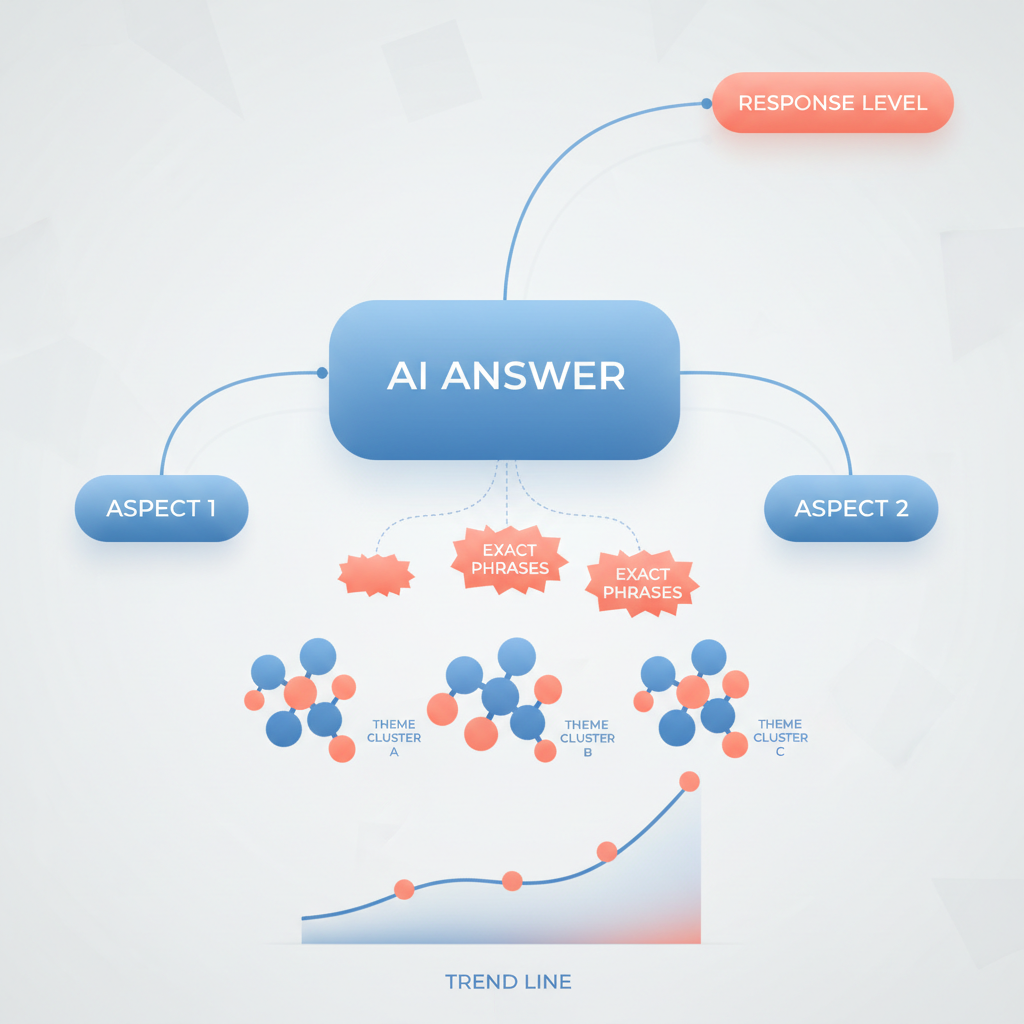
A response-level label tells you the overall framing of one answer. It is useful for monitoring, but it is not enough for a decision that needs explanation. The supporting language may be conditional, comparative, outdated, or directed at a product attribute rather than the brand as a whole. That is the central discipline of AI brand sentiment analysis.
Aspect-level sentiment adds precision. It separates opinions about topics such as implementation, pricing, support, security, or fit for a particular audience. Extracted phrases then give the reviewer the actual wording, while themes group related observations across multiple answers. An aggregate trend score is the final layer, not the original evidence.
Fine-grained analysis is grounded in 2020 ABSA research, which distinguishes aspect extraction, aspect sentiment classification, and opinion extraction. In practice, that means a negative statement about cost should not erase a positive statement about usability, and neither statement should be detached from its source response.
For the system behind the dashboard, see sentiment architecture.
What Should an Evidence Record Contain?
A defensible AI brand sentiment analysis record makes it possible to move from a reported score back to the response that produced it. The record should preserve enough context for another reviewer to understand what the model said, why it received a label, and whether its cited material supports the claim.
Use this matrix as a live evaluation checklist.
| Evidence Field | What A Buyer Should Verify | PageLens.ai Publicly States | Other Platforms |
|---|---|---|---|
| Complete response | A reviewer can open the full captured answer | Ask to see the record view | Verify in a product demo |
| Exact phrase | Highlighted wording links to the response | Exact words models use | Verify in a product demo |
| Prompt | Original prompt is visible per record | Buyer prompts are tracked daily | Verify in a product demo |
| Engine | Response identifies the answer engine | Seven major engines are listed | Verify in a product demo |
| Timestamp | Each response has a collection date and time | Ask for record-level proof | Verify in a product demo |
| Cited URL | Sources are attached to the response | Sources models pull from are tracked | Verify in a product demo |
| Sentiment dimension | Labels and definitions are explicit | Positive and negative language is described | Verify in a product demo |
| Filters | Filters preserve meaningful context | Ask for screen proof | Verify in a product demo |
| Export | Export contains the evidence fields | Ask for export proof | Verify in a product demo |
| Retention | Historical access is documented | Ask for written terms | Verify in a product demo |
| Plan availability | Feature access is stated by plan | Ask for current terms | Verify in a product demo |
A platform that tracks several engines without preserving the response is measuring coverage, not providing an audit trail. Likewise, a phrase list without the original prompt can show language but cannot establish the context that generated it. Use this matrix to determine whether AI brand sentiment analysis is genuinely reviewable.
Compare multi-engine tracking with the evidence retained for each engine.
How Do You Trace a Sentiment Label to Its Source?
The tracing workflow for AI brand sentiment analysis should be simple enough for a content manager and rigorous enough for a legal reviewer. It does not require a complex taxonomy at first. It requires consistent records, a clear review rule, and a path back to the original answer when someone questions a conclusion.
Follow the same sequence every time.
-
Select the prompt and period: Choose the monitored prompt, engine, and date range before looking at an aggregate score.
-
Apply investigation filters: Narrow the view by brand, product attribute, audience, geography, answer engine, and sentiment label.
-
Open the complete response: Read the answer around the highlighted phrase rather than judging an extracted fragment alone.
-
Confirm the evidence fields: Record the prompt, engine, timestamp, cited URLs, response-level label, aspect label, and reviewer decision.
-
Preserve the conclusion: Export or retain the record with its filters and review notes so the finding can be checked later.
A useful annotated response contains a single evidence chain: prompt, engine, date, response passage, sentiment label, cited source, and human decision. That chain turns AI brand sentiment analysis into an operational evidence process rather than a dashboard-only metric.
Generative systems may warrant additional human review, tracking, and documentation under the NIST GAI profile. Prompt selection affects the result before any model responds. Build prompt sets around buyer intent, not only familiar keywords, using prompt research.
How Should Teams Filter Exact AI Language?
Filters turn AI brand sentiment analysis from a broad monitoring activity into an investigation workflow. The right filter set lets a team isolate whether an unfavorable phrase appears only for a specific audience, in one geography, on one answer engine, or after a particular prompt framing. That context prevents overreaction to a single result.
Filter toward a question, then read the language.
Filtering keeps AI brand sentiment analysis specific enough to support a real decision.
-
Brand and competitor: Separate direct mentions from comparisons and passing references.
-
Product attribute: Group language about price, implementation, support, features, reliability, or suitability.
-
Audience: Compare statements aimed at small teams, enterprises, practitioners, executives, or a named industry.
-
Geography and language: Review regional phrasing separately, especially when product availability or terminology differs.
-
Answer engine: Keep engine attribution intact because models may frame the same brand differently.
-
Prompt group and date: Identify whether a trend follows a prompt change, a time period, or repeated observed responses.
Repeated responses should remain distinct in the raw record, even if an aggregate report deduplicates them later using a documented rule. Neutral mentions should stay in view because they clarify visibility without implying praise or criticism. Mixed responses should preserve both sides of the language rather than forcing one label.
Sarcasm, negation, and nuanced context still require human review. NIST notes persistent sentiment-analysis challenges with sarcasm, negation, mixed-language text, and context in its ARIA companion document. Connect response evidence with citation tracking when source links affect the claim.

What Should Exports and Audit Workflows Include?
An export is not audit-ready merely because it contains a sentiment score. For AI brand sentiment analysis, PR, brand, legal, and executive teams need the exact data that supports a claim, plus a clear account of how the finding was selected, classified, and retained.
Export the response context, not just the conclusion.
The same rule applies to AI brand sentiment analysis in every reporting workflow.
For PR, preserve the full response, timestamp, engine, and cited URLs so a team can assess a potential correction or escalation. For brand teams, include themes and reviewed phrases to identify recurring positioning. For legal review, retain the original prompt, raw response, collection method, filters, reviewer notes, and access history where applicable.
Executive reporting should use the aggregate score as the headline, then provide a limited set of representative reviewed passages underneath it. This makes it clear whether a change reflects a broad shift, an engine-specific issue, or a small number of repeated answers. Strong buyer prompt discovery improves the quality of the underlying evidence.
How Can Buyers Score Evidence-Ready Platforms?
A buyer rubric keeps AI brand sentiment analysis focused on verifiable workflow requirements rather than broad promises. Score only what documentation, a live interface, or a sample export proves. A missing field is not a minor inconvenience if it blocks a stakeholder from checking why a reported result exists.
Use a weighted rubric before signing a contract.
| Criterion | Weight | Full Score Requires |
|---|---|---|
| Full response retrieval | 20 | The complete captured answer opens from the metric |
| Phrase-to-response linkage | 15 | Every extracted phrase links to its source response |
| Prompt and engine attribution | 15 | Both fields exist for each response |
| Timestamp and retention | 15 | Per-record time plus written retention terms |
| Cited-URL preservation | 10 | Source URLs remain attached to the response |
| Filter granularity | 10 | Brand, attribute, audience, geography, and engine filters |
| Export readiness | 10 | Export retains all material evidence fields |
| Sentiment-method transparency | 5 | Neutral and mixed-result treatment is documented |
A weighted rubric helps teams purchase AI brand sentiment analysis on documented evidence, rather than an untested feature list. Award two points for a documented and demonstrated capability, one point for written vendor confirmation, and zero points when the feature is unavailable or unverified.
This approach is useful whether you need a broad program or single-site tracking.
Model outputs can vary when prompts, settings, or model choices change. The official output guidance recommends matching prompt text, parameters, and model choice when investigating different completions. That is why timestamps and engine attribution belong in every buyer rubric.
What Does PageLens.ai Add to the Evidence Workflow?
PageLens.ai focuses the conversation on what answer engines say about a brand, not only how often a brand appears. Its public product description states that it tracks buyer prompts daily across major engines, surfaces the exact words used to describe a brand, and identifies sources models pull from.
Use the platform as a starting point for evidence review.
For teams evaluating AI brand sentiment analysis, that focus supports a practical loop: identify the phrase, inspect the surrounding answer, understand the cited source, then decide whether the right response is content improvement, source development, clarification, or continued monitoring. It also helps prevent content work from chasing an unexplained score.
A mature workflow pairs monitoring with action. Use content beyond monitoring to turn reviewed evidence into prioritized content decisions, while preserving the original response trail for future comparison.
See Verbatim Evidence with PageLens.ai
PageLens.ai helps marketing, growth, SEO, and content leaders inspect what answer engines actually say before deciding what to publish, correct, or escalate. Its public product description emphasizes daily buyer-prompt tracking across major engines, the exact words used about a brand, and sources models draw on. That makes it useful when evidence matters more than a directional score.
Use this evidence checklist in a demo, not a feature-list conversation.
For high-stakes AI brand sentiment analysis, ask to open a single response and follow it through the original prompt, engine attribution, timestamp, phrase, cited URLs, filters, and export. Confirm how neutral and mixed results affect score calculations, whether repeated responses are retained, and whether access, exports, or history depend on a plan. The goal is a defensible route from a reported trend back to its language for teams that must substantiate a decision. Explore the PageLens Platform or Book a demo
FAQs on AI Brand Sentiment Analysis
What Is Verbatim AI Brand Sentiment Analysis?
Verbatim AI brand sentiment analysis preserves the words a model used and links them to the prompt, engine, date, cited sources, sentiment label, and review decision.
How Do I Audit the Exact Phrase Behind a Score?
Open the response record, read the full answer around highlighted wording, confirm its prompt and engine, then retain the timestamp, citations, reviewer decision, and export.
Is Response-Level Sentiment the Same as Aspect-Level Sentiment?
Response-level sentiment labels the whole answer. Aspect-level sentiment assigns polarity to a specific subject, while extracted phrases supply the evidence a reviewer can inspect.
Why Must Prompts, Engines, and Dates Be Retained?
Prompts, engines, and dates make results reproducible enough to investigate. Without them, teams cannot explain whether wording changed because of context, model behavior, time, or changed settings.
How Should Mixed or Neutral Responses Be Handled?
Keep neutral results in the denominator, preserve both sides of mixed answers, flag sarcasm and negation for review, and document how repeated responses are counted.
What Should an AI Sentiment Export Include?
A defensible export includes the full response, exact phrase, prompt, engine, timestamp, cited URLs, sentiment label, applied filters, and a record of human review where required.