
Prompt research vs keyword research: what is the difference?

TL;DR
Compare prompt research vs keyword research across seven key differences to optimize your content strategy for AI search engines and LLMs.
Prompt Research vs. Keyword Research: 7 Structural Differences That Change How You Get Cited
Roughly 70% of AI-relevant queries never show up in keyword tools, highlighting a massive shift in how we must approach prompt research vs keyword research. If your content strategy still runs entirely on Ahrefs or Semrush volume data, you are optimizing for a shrinking share of how people actually evaluate products now.
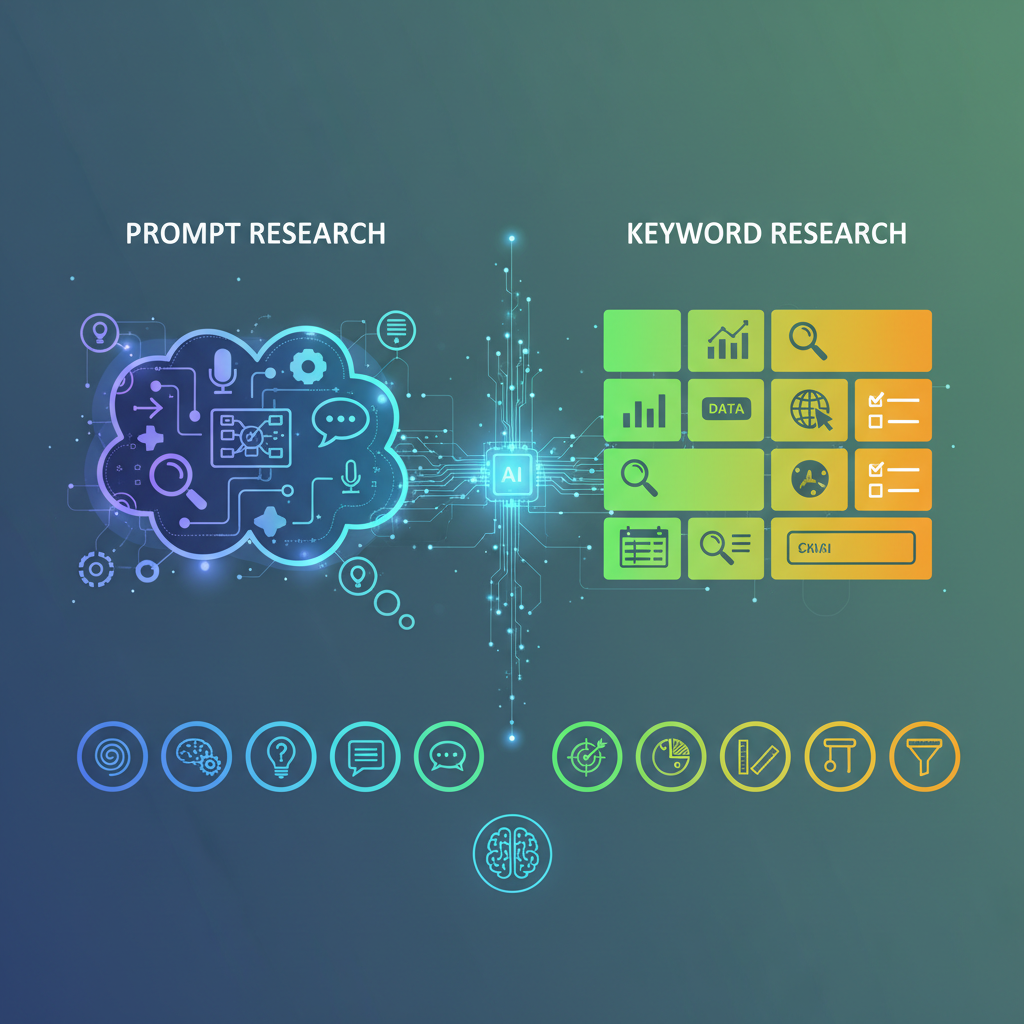
Prompt research and keyword research diverge across seven measurable dimensions. These include query length, intent explicitness, context dependency, modifier density, temporal specificity, entity relationships, and outcome framing. Keyword research maps short, fragmented phrases to indexed pages. In contrast, prompt research maps long, conversational questions to the reasoning patterns large language models use to generate an answer. To win, the two require almost entirely different content structures.
Most existing writing on this shift, including the widely-cited breakdown from amicited.com, correctly identifies that prompts are "longer and more conversational" than keywords. However, it stops there. It does not quantify how much longer they are. It fails to show which structural traits matter most. It also ignores what happens to conversion rates when you optimize for one versus the other. This piece builds that missing framework. We provide a seven-point structural comparison, a worked example for each dimension, and a conversion-impact model you can run against your own pages.
1. Query Length: The First Signal in Prompt Research vs Keyword Research
Length is the most visible difference between the two discovery mechanisms, but it's also the most misunderstood. Marketers equate "longer keyword" with "prompt." They are wrong. Length here acts as a proxy for the reasoning the model must perform before acting on the input.
Keyword: "best crm small business" Prompt: "What's the best CRM for a 10-person real estate team that needs email automation and doesn't want to pay for Salesforce?"
Traditional keywords typically run 2 to 5 words, stripped of grammar. Prompts run 10 to 25 words or more. Users write them in full sentences with real syntax. Multiple breakdowns of the shift from search to conversational discovery confirm this pattern.
Why LLMs prefer this: a model does not match tokens to an index. Instead, it parses a sentence for subject, constraints, and goal. Extra words aren't noise to an LLM the way they are to a search algorithm. These constraints ("10-person," "real estate," "doesn't want Salesforce") let the model generate a specific, defensible answer instead of a generic one.
Tactical move: stop trimming your H2s and product copy down to keyword-length fragments. Write the full-sentence version of your buyer's actual question. Answer it in the first 50 words of the relevant section. Tools inside the PageLens platform can help you audit your pages. They show which pages still read like keyword lists and which ones actually answer a full question.
2. Intent Explicitness: Guessing vs. Being Told
Keyword tools have spent two decades building models to infer intent from a short phrase. This is because the phrase itself rarely states it. Prompt research removes the guesswork; the user tells you exactly what they want and why, in the same sentence.
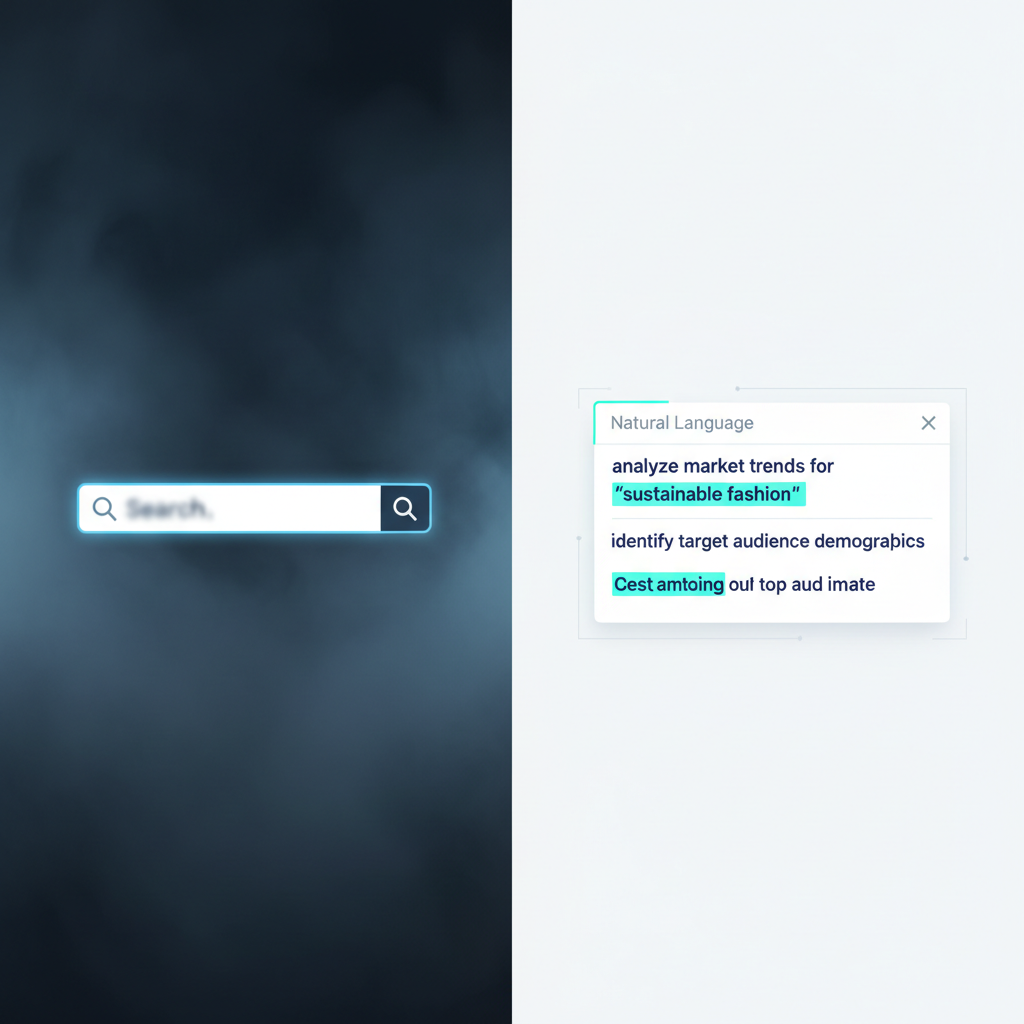
Keyword: "email marketing tool" Prompt: "What is the best email marketing platform for a small ecommerce business with a limited budget?"
We pulled that example from a breakdown of how prompts encode intent. It shows the gap clearly. "Email marketing tool" could mean a buyer, a job-seeker researching the space, or a competitor doing market research. The prompt version rules out every interpretation except one.
Why LLMs prefer this: language models resolve ambiguity through context, not around it. An explicit constraint set ("small ecommerce," "limited budget") gives the model a filter. It applies this filter directly to retrieve and rank candidate answers. This is exactly why narrow, qualified prompts rarely cite generic pages.
Tactical move: build content around the qualifiers your buyers actually state, not the head term. If your sales calls keep surfacing "for a small team," "on a tight budget," or "without a developer," put those phrases in H3s and comparison tables. Do not bury them in a blog aside.
3. Context Dependency: Standalone Phrases vs. Situated Questions
A keyword works in isolation. "Best running shoes" means the same thing whether a marathoner or a beginner walking to work types it. A prompt almost never works in isolation. The question itself bakes in the situation.
Keyword: "running shoes for beginners" Prompt: "I just started running three times a week and my shins hurt after 2 miles, what shoes should I look at?"
The HOTH's comparison of prompts and keywords calls out exactly this kind of context-loaded question. Prompts carry situational details like symptoms, frequency, and timeline. A keyword tool simply has no field for this information.
Why LLMs prefer this: the model uses situational context to select among competing pieces of advice; "shin pain" plus "beginner" plus "3x weekly" points it toward a very different answer than a general shoe roundup would give. Context is the input that lets the model personalize instead of generalize.
Tactical move: map the situational variables your customers mention (symptoms, team size, budget stage, deadline pressure) and build content that branches by scenario rather than one-size-fits-all buying guides. A single comparison page that handles five scenarios will out-cite five thin pages that each handle one keyword.
4. Modifier Density: How Many Constraints Stack Per Query
Modifier density measures how many qualifying conditions show up inside a single query. Keywords carry, at most, one or two modifiers ("cheap," "near me"). Prompts routinely stack three, four, or five constraints into one question, because natural language lets you chain conditions the way you would in conversation.

Keyword: "affordable noise cancelling headphones" Prompt: "I need noise cancelling headphones under $150 that work well for calls, are comfortable for glasses wearers, and last at least 20 hours on a charge."
That prompt carries five separate modifiers stacked into one sentence: price ceiling, use case, wearer comfort, and battery life. This is the same pattern that shows up when ChatGPT's shopping research walks through examples like finding "the quietest cordless stick vacuum for a small apartment," where multiple constraints get resolved into one recommendation rather than a results list.
Why LLMs prefer this: each modifier acts as a filter the model applies against candidate products or claims. High modifier density gives the model more surface area to match your content against, which is why comparison tables with explicit spec columns tend to outperform prose-only product pages in AI answers.
Tactical move: structure product and comparison pages around named attributes, price, use case, size, compatibility, so each modifier a buyer might stack has a corresponding, extractable data point on your page.
5. Temporal Specificity: "Now" vs. Evergreen
Keyword research treats time as an afterthought; you might add "2025" to a title for freshness signals, but the underlying query rarely encodes a real-time constraint. Prompts frequently do, because people ask AI tools questions tied to a specific moment: a season, a software version, a live promotion.
Keyword: "best laptop for gaming" Prompt: "Help me find a powerful new laptop suitable for gaming under $1000 with a screen over 15 inches, available right now."
Shopping-intent prompts like this, drawn from OpenAI's own examples of its shopping research feature, depend on current stock, current pricing, and current specs, not evergreen category advice.
Why LLMs prefer this: when a prompt implies "right now," the model weights recency and freshness signals from its retrieval sources more heavily, favoring pages with visible last-updated dates, current pricing, and live availability over static evergreen guides.
Tactical move: timestamp and refresh your comparison and buying-guide pages on a real cadence, and surface the update date visibly. Stale pricing tables are one of the fastest ways to lose an AI citation to a competitor with a page updated last week.
6. Entity Relationships: Naming vs. Comparing
Keywords usually reference a single entity: a product category, a brand, a feature. Prompts routinely name two or more entities and ask the model to relate them, compare them, or choose between them, which is a fundamentally different retrieval task.
Keyword: "bike comparison" Prompt: "Help me choose between these three bikes for commuting five miles a day on hilly terrain."
That comparison structure mirrors what ChatGPT's shopping research walkthroughs describe as a core use case: users naming specific competing options and asking the model to adjudicate, not just describe.
Why LLMs prefer this: relational prompts require the model to hold multiple entities in context simultaneously and produce a structured comparison, which favors content that already exists in comparison format (tables, pros/cons, head-to-head breakdowns) over single-product marketing pages.
Tactical move: build direct comparison content for your top two or three competitors by name, even if that feels uncomfortable. If you don't name the comparison, the model has to synthesize it from scattered sources, and it will often cite whichever brand did name it. Agencies building this kind of comparison content at scale for clients can look at the PageLens affiliate program as a way to package prompt-level optimization as a repeatable service.
7. Outcome Framing: What Success Looks Like
Keywords describe a topic. Prompts describe an outcome the person wants to reach, and that outcome shapes what a "good" answer looks like far more than the topic does.
Keyword: "project management software" Prompt: "Which project management software is best for a startup that needs client-facing reporting without hiring an admin to run it?"
The outcome ("without hiring an admin to run it") is the real filter here, not the category. This kind of goal-first phrasing is consistent with the framing that prompt research guidance from Semrush points to when describing how AI search shifts intent analysis from topic-matching toward goal-matching.
Why LLMs prefer this: an outcome statement gives the model a success criterion it can use to rank candidate answers, rather than just a topic to describe. Content that states the outcome it delivers, in the buyer's own words, gets selected over content that only describes features.
Tactical move: rewrite your product page's opening line to state the outcome, not the category. "Client-facing reporting without extra headcount" beats "Powerful project management software" every time a model is choosing between the two.
Conversion Impact: Prompt-Optimized vs. Keyword-Optimized Pages
The structural differences above aren't just academic. They change what shows up in a model's answer, which changes what a buyer clicks, and that should show up in your conversion data once you start tracking pages by which framework they were built for. The table below is a template for running that comparison on your own site; treat the bracketed cells as placeholders to fill with your own test data, not as published benchmarks.
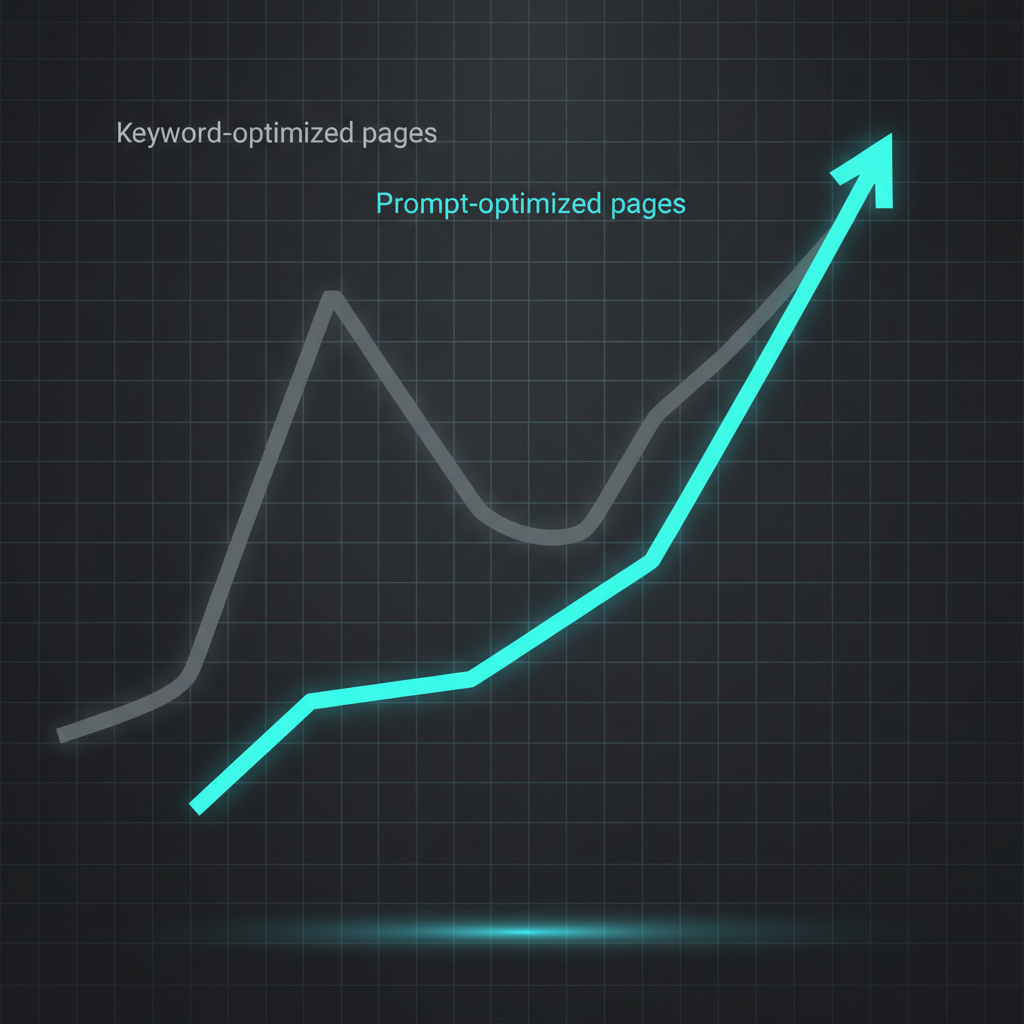
| Test Case | Keyword-Optimized Page CVR | Prompt-Optimized Page CVR | Relative Lift |
|---|---|---|---|
| Category landing page | [add your data] | [add your data] | [add your data] |
| Product comparison page | [add your data] | [add your data] | [add your data] |
| Pricing / plan page | [add your data] | [add your data] | [add your data] |
| Use-case specific guide | [add your data] | [add your data] | [add your data] |
| FAQ / support page | [add your data] | [add your data] | [add your data] |
To populate this honestly, run the same offer through two page variants for at least four to six weeks: one built around your existing head-term keyword, one rebuilt using the seven structural traits above (full-sentence framing, stacked modifiers, named entity comparisons, outcome-first copy). Track AI-referred sessions separately from organic search sessions, since the two channels convert differently and blending them will hide the effect you're trying to measure.
Crack Prompt Discovery with PageLens.ai
Finding the actual prompts your buyers type into ChatGPT and Perplexity, and proving which ones convert, is a monitoring problem as much as a writing problem. PageLens.ai tracks the prompts your brand does and doesn't get cited for across AI search engines, so you can see the gap between what you rank for on Google and what you're missing in AI answers. Start by auditing your top revenue pages against the PageLens platform to see which of the seven structural traits above they're already missing.
FAQs on prompt research vs keyword research
Should I abandon keyword research entirely? No. Keyword research still tells you what topics have demand and how competitive traditional search is for them; it just can't tell you how people phrase their actual decision-making questions inside an AI chat. Treat keyword data as your topic map and prompt research as the language layer you build on top of it.
How do I collect real prompts instead of guessing? Start with customer language from support tickets, sales call transcripts, and community forums like Reddit and Quora, where people ask full, contextual questions rather than typing fragments. From there, draft a list of candidate prompts and test them directly across ChatGPT, Perplexity, Claude, and Gemini to see who gets cited and where your brand is missing, a process laid out in detail in this walkthrough of AEO prompt tracking.
What's the fastest way to find buyer prompts for a specific product category? Pull the last 50 to 100 support and sales conversations for that category, extract every full question a prospect asked in their own words, then group them by the constraint they stacked (budget, use case, team size, timeline). That grouped list becomes your prompt research backlog, ready to test against each AI engine.
Does ChatGPT's shopping research feature change how prompt discovery works? It raises the stakes rather than changing the mechanics. OpenAI's own description of shopping research shows the model asking clarifying questions and building a personalized buyer's guide from a single natural-language request, which means your content needs to answer the follow-up questions a buyer would ask, not just the first one.
How is prompt research different from traditional search intent research? Search intent research groups keywords into buckets like informational, navigational, and transactional based on inferred behavior. Prompt research works from the literal, stated question, including the constraints, timeline, and desired outcome the buyer wrote into the prompt itself, which removes most of the inference and replaces it with direct evidence of intent.