


TL;DR
Learn how B2B teams monitor brand mentions, recommendations, and citations in Perplexity and Claude with repeatable prompt testing.
How B2B Brands Monitor Mentions in Perplexity and Claude
AI answers are not one fixed search result. Perplexity says its Deep Research mode can complete work in 2 to 4 minutes after conducting dozens of searches and reading hundreds of sources, which makes a documented testing method essential for visibility teams using Perplexity documentation.
Citation Capsule: AI answer monitoring for B2B brands works by running a versioned set of category and buyer-intent prompts in Perplexity and Claude, saving every complete response, and recording mentions, recommendations, citations, prominence, and wording. Analyze each engine separately, because source visibility and answer behavior differ; repeated runs reveal patterns, while one response is only an observation.
This guide explains the measurement unit, prompt set, repeat-run rules, entity matching, error review, and actions that make AI answer monitoring for B2B brands useful.
| Measurement Question | Perplexity | Claude |
|---|---|---|
| Web-grounded behavior | Searches the web in real time and displays numbered citations. | Web search can be enabled for current information and source-grounded answers. |
| Citation measurement | Record cited domains, source URLs, and the nearby claim. | Record citations only when visible, then classify uncited answers as source-limited. |
| Mode and model | Record the displayed mode and model when exposed. | Record the model and whether Web search was enabled. |
| Freshness rule | Treat web-search answers as time-sensitive observations. | Do not infer freshness from an answer without visible web-search evidence. |
| Comparable test design | Fresh chat, fixed settings, exact prompt, five runs. | Fresh chat, fixed settings, exact prompt, five runs. |
What Is AI Answer Monitoring for B2B Brands?
AI answer monitoring for B2B brands is a structured way to observe how AI assistants describe a company when prospective buyers ask category, use-case, comparison, and buying-criteria questions. It is not a promise of a permanent rank. It is a repeatable record of what appeared under documented conditions.
Use the same unit of measurement every time.
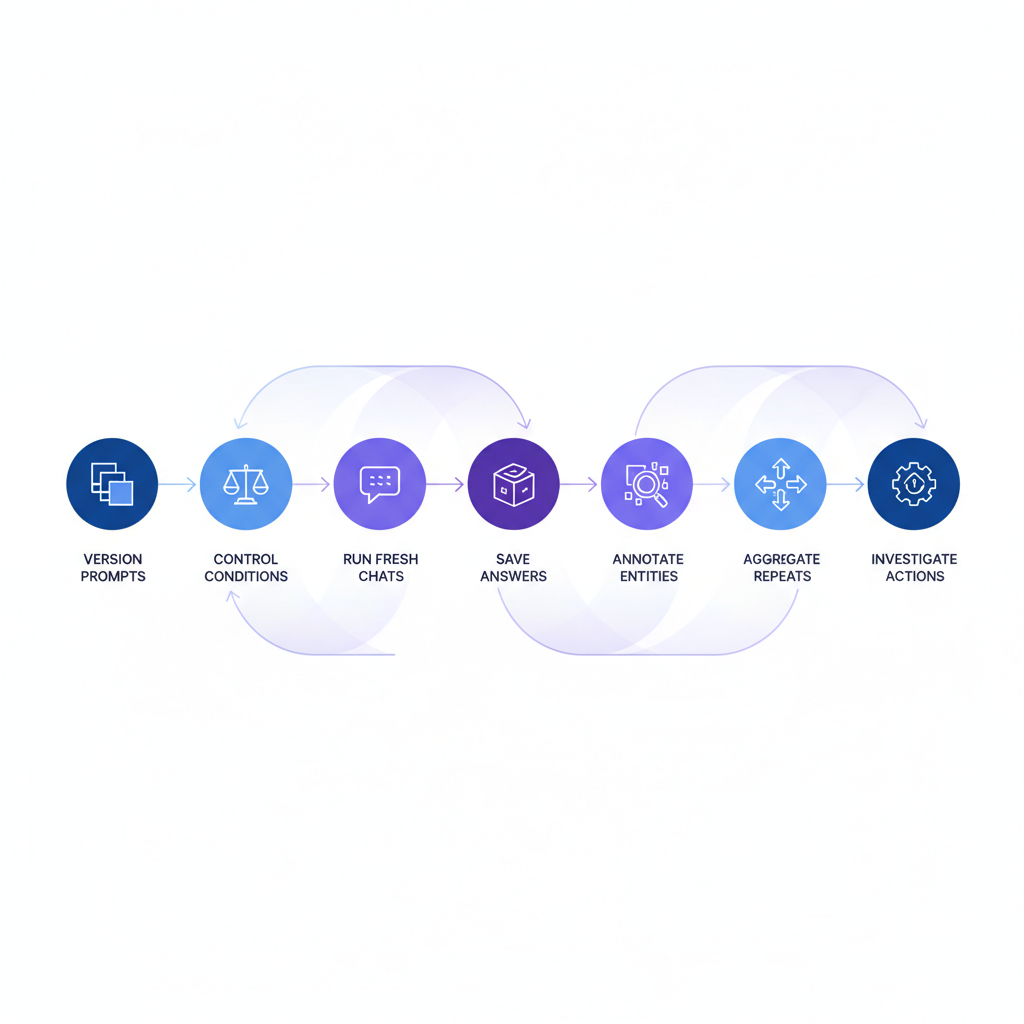
In practice, AI answer monitoring for B2B brands requires a stable observation unit. A practical run ID combines prompt, engine, mode, locale, date, and repetition number. For example, a category prompt checked in a fresh Perplexity session is a different observation from the same wording checked in Claude with Web search enabled.
The minimum response record should preserve the complete answer, not a clipped screenshot. Capture the exact prompt, answer text, visible citations, source URLs, model or mode when exposed, account state, locale, date, time, and reviewer notes. This makes AI answer monitoring for B2B brands more defensible than counting isolated brand appearances, and supports AI visibility tracking.
A useful monitoring program separates three questions: Did the brand appear? How was it described? What evidence was visible to support that description? Those answers can diverge, especially when an assistant names a company without linking a source, or cites a domain without recommending the company.
Why Should Perplexity and Claude Be Measured Separately?
Perplexity and Claude can both help users research B2B categories, but their visible evidence patterns are not interchangeable. Combining their results into one citation rate hides the difference between an answer with inspectable source links and an answer where no source evidence is visible to the reviewer.
Keep the engines in separate reporting lanes.
For AI answer monitoring for B2B brands, separate reporting is a measurement requirement. Perplexity states that each answer includes citations linking to original sources. Claude states that, when Web search is active, it provides direct citations and source links, while users can switch that capability off. Those product behaviors make Claude documentation important to the measurement design, not just background reading.
That boundary is central to AI answer monitoring for B2B brands because citation rates need comparable evidence conditions.
| Signal | Perplexity Measurement | Claude Measurement |
|---|---|---|
| Brand mention | Match the brand or approved alias in the full answer. | Match the brand or approved alias in the full answer. |
| Citation | Capture citation marker, destination URL, and cited domain. | Capture visible citation and source link when Web search is active. |
| Source-limited answer | Rarely applicable when citations are displayed. | Use when the response has no visible source evidence. |
| Recommendation | Mark only explicit endorsement for a stated use case. | Mark only explicit endorsement for a stated use case. |
| Prominence | Record list position or first-occurrence class. | Record list position or first-occurrence class. |
Source visibility is not a quality score. It is an evidence condition. A source-visible answer lets a reviewer inspect which claims have linked support. A source-limited answer may still mention or recommend a brand, but it should not contribute to a citation-rate denominator. For more granular measurement, use citation tracking as a separate visibility layer.
What Counts as a Mention, Recommendation, Comparison, or Citation?
AI answer monitoring for B2B brands becomes unreliable when every favorable appearance is called a citation or every mention is treated as a recommendation. The page should define each signal before reporting it, so marketing, content, and leadership teams interpret the same response consistently across engines and reporting periods.
Use a fixed annotation dictionary.
For AI answer monitoring for B2B brands, use one definition for every reviewer. A brand mention is an explicit reference to the company, approved alias, or adjudicated product name. A recommendation is stronger: the answer endorses or selects the brand for a stated use case. A comparison occurs when the answer evaluates the brand against another option.
A citation is a visible source marker or listed source. A linked citation has an accessible destination URL that a reviewer can open. A sentiment-bearing description is wording that conveys a positive, neutral, negative, or mixed assessment, such as suitability, implementation difficulty, pricing posture, or feature depth.
This distinction lets AI answer monitoring for B2B brands report evidence and endorsement separately. Prominence needs its own field. If an answer produces a ranked list, record the ordinal position. If it does not, record whether the mention appears in the opening answer, a main explanatory section, a comparison, or a closing caveat.
Which Prompts Should B2B Brands Track in AI Assistants?
A strong prompt library reflects how buyers investigate a problem, not just how a company describes itself. AI answer monitoring for B2B brands should therefore cover category discovery, alternatives, comparisons, use cases, objections, implementation, and buying criteria in language a buyer would plausibly use.
Start with a small, versioned prompt taxonomy.
AI answer monitoring for B2B brands needs prompts that represent buyer intent, not a brand’s internal vocabulary.
| Prompt Family | Example Prompt | Primary Signal |
|---|---|---|
| Category Discovery | “What are the leading platforms for this B2B workflow?” | Mention and prominence |
| Alternatives | “What are alternatives for teams that need this capability?” | Inclusion and comparison |
| Comparisons | “How does this option compare with other approaches?” | Relative description |
| Use Cases | “What tools help this role solve this workflow problem?” | Recommendation fit |
| Objections | “What are the drawbacks of adopting this category?” | Risk and sentiment |
| Implementation | “How should a B2B team implement this capability?” | Product relevance |
| Buying Criteria | “What should buyers evaluate before choosing this software?” | Evidence and positioning |
Give each prompt a stable ID, such as BUY-CRITERIA-04, and update the version whenever meaning changes. Changing “for enterprise teams” to “for mid-market teams” is a new prompt, not a minor edit. A small prompt set keeps AI answer monitoring for B2B brands focused on comparable evidence. Teams that need to build that library can start with prompt research before they automate checks.

What Should a Reproducible Monitoring Record Include?
The core discipline in AI answer monitoring for B2B brands is reproducibility. A team should be able to hand a run to another reviewer and let them understand exactly what was asked, where it was asked, which settings could influence the response, and why the result received its final annotation.
Document conditions before interpreting results.
AI answer monitoring for B2B brands should preserve conditions before it produces a dashboard score. Each record needs the exact prompt and prompt version, engine, mode or model when exposed, timestamp and timezone, locale, response language, account state, personalization status, complete response, visible citations, cited URLs, and reviewer annotations.
Preserve the surrounding phrase for every material brand reference. NIST’s generative AI guidance recommends documenting variance in applied metrics and reviewing sources and citations during ongoing monitoring. That makes a NIST framework a useful basis for treating response capture as evidence rather than a casual screenshot.
The record gives AI answer monitoring for B2B brands a reviewable audit trail:
| Field | Example Entry |
|---|---|
| Entity Match | Approved product alias |
| Prominence | Ranked position 2 |
| Surrounding Phrase | Full sentence containing the reference |
| Sentiment | Neutral, with positive capability qualifier |
| Recommendation | Yes, for the stated use case |
| Cited Source | Visible marker, destination domain, and URL |
| Reviewer Decision | Approved, rejected, or ambiguous |
Use fresh chats for baseline prompts. Follow-up conversations are useful for customer-journey research, but their memory makes them a separate test class. Documenting these differences supports multi-engine signals without implying that two engines have identical retrieval or personalization behavior.
How Should Teams Repeat Runs and Aggregate Results?
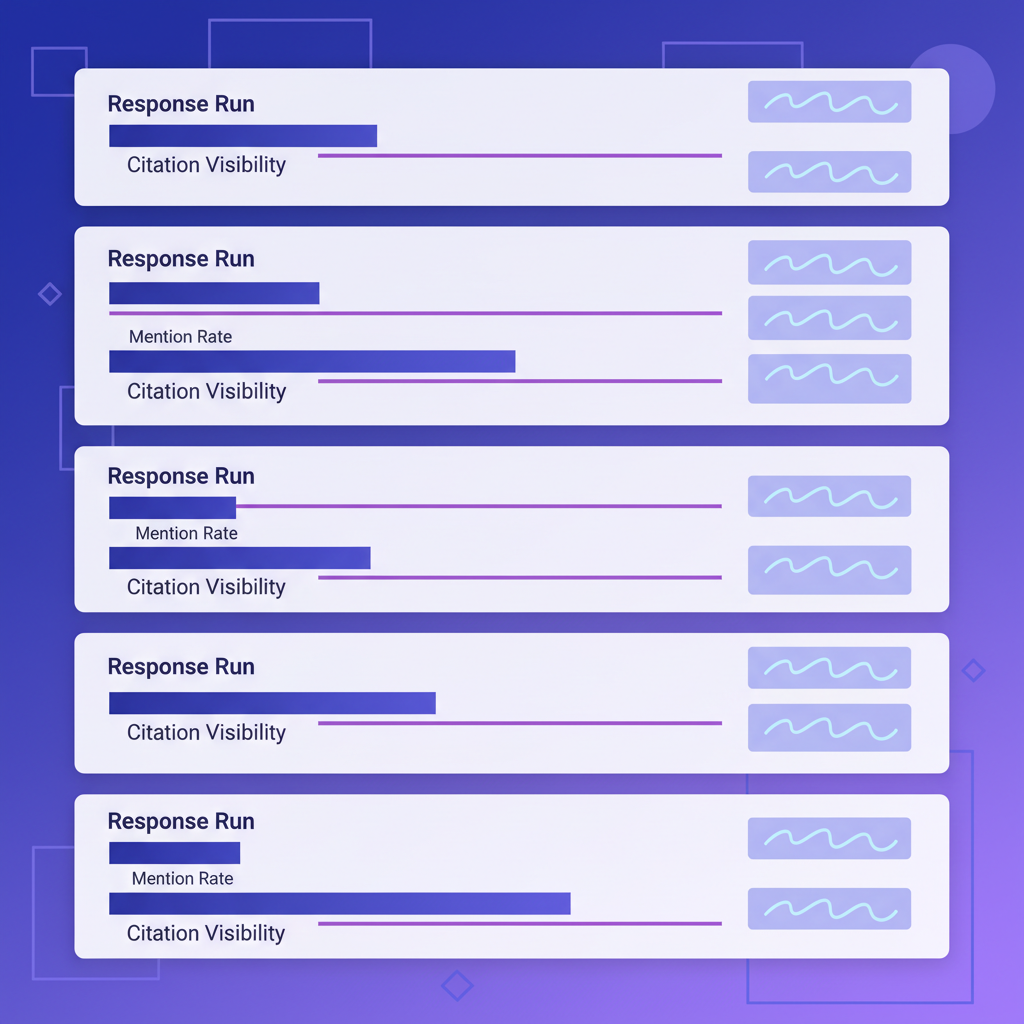
Repeated runs convert a single answer into a measurable pattern. AI answer monitoring for B2B brands should use five independent fresh-chat runs per prompt, per engine, per reporting window. Check high-value buyer prompts weekly, then rerun the full taxonomy monthly or when category conditions materially change.
Aggregate by engine, prompt, and evidence condition.
For AI answer monitoring for B2B brands, do not let one response establish a visibility trend. Five runs are a documented operating rule, not a claim that every model becomes stable after five attempts. Research on LLM repeatability distinguishes consistency under identical conditions from reproducibility under changed conditions, supporting the need to review distributions rather than one-off outputs in repeatability research.
In AI answer monitoring for B2B brands, granularity matters more than a blended score. Calculate mention rate as approved matches divided by valid runs. Calculate recommendation rate as explicit recommendations divided by valid runs. Calculate citation rate only among source-visible runs. For ranked lists, report median position. For unranked prose, report a prominence class instead of inventing a rank.
Use this simple repeatability rubric:
- Volatile: Zero of five valid runs contain the signal.
- Emerging: One or two of five valid runs contain the signal.
- Recurring: Three or four of five valid runs contain the signal.
- Consistent: All five valid runs contain the signal.
This model leaves room for meaningful changes. A new mention in one run may be worth investigating, but it is not enough evidence to claim sustained visibility. Align the cadence with buyer prompt discovery, especially for questions closest to an active purchasing decision.
How Do You Prevent False Positives and False Negatives?
False positives and false negatives are normal data-quality risks in AI answer monitoring for B2B brands. An exact string match may refer to an unrelated company, while a valid product reference may use a spelling variation or generic shorthand. The remedy is not more automation alone. It is documented matching rules plus human adjudication.
Review ambiguous references before they reach reporting.
AI answer monitoring for B2B brands needs human review when entity context is uncertain. Use canonical brand names, approved aliases, product names, former names, common misspellings, spacing variations, and recognized acronyms. Require surrounding context to approve an acronym or shared name. Keep references to other platforms in a separate entity field so their mentions cannot be mistaken for the monitored brand.
A practical decision sequence is straightforward: first, did a matching string appear? Second, does the nearby context identify the correct company or product? Third, if context remains unclear, can a reviewer resolve it using the response and cited source? If not, label it ambiguous and exclude it from core mention rates.
This prevents AI answer monitoring for B2B brands from mistaking text similarity for a valid entity match. False-negative review matters too. Sample responses marked as no-match, inspect citations and comparison tables, and check whether the assistant described the product category without using the brand name. A documented adjudication log supports accurate sentiment decisions and complements AI sentiment architecture.
What Actions Follow Missing Mentions or Weak Citations?
The purpose of AI answer monitoring for B2B brands is not to chase a dashboard score. It is to choose the right investigation after a pattern appears. Missing mentions, incorrect descriptions, absent owned-domain citations, and competing-platform dominance are distinct findings that call for different content or technical reviews.
Treat each pattern as a diagnostic signal.
AI answer monitoring for B2B brands becomes useful when each result triggers a distinct investigation.
| Monitoring Finding | Investigation Before Changing Content |
|---|---|
| Missing Mention | Check whether category and use-case pages clearly address the buyer question. |
| Incorrect Description | Verify first-party claims, product documentation, and public entity facts. |
| Weak Owned-Domain Citation | Inspect cited sources, page accessibility, topical evidence, and claim clarity. |
| Competing-Platform Dominance | Compare buyer-criteria coverage, source relevance, and supporting evidence. |
| Volatile Results | Preserve conditions, expand the sample, and avoid declaring a trend early. |
For AI answer monitoring for B2B brands, action should follow evidence rather than reaction. Do not respond to one unfavorable answer with broad rewrites. First compare the exact prompt, answer wording, source evidence, and repeated-run rate. Then assign a targeted content, technical, entity, or source-quality investigation.
How Can PageLens.ai Help with AI Answer Monitoring for B2B Brands?
PageLens.ai is designed for marketing, growth, SEO, and content leaders who need a defensible record of how an AI assistant describes their company. It helps turn scattered checks into a versioned monitoring practice, so teams can see what changed, review the underlying response, and decide whether a content, technical, or entity investigation is warranted.
Put the workflow in one operating record.
PageLens.ai supports AI answer monitoring for B2B brands by using the PageLens Platform to centralize prompt versions, response captures, citations, entity rules, and human-review decisions across the questions buyers actually ask. The value is not a promise that an assistant will say one predetermined thing. It is a cleaner operating record: what appeared, under what conditions, how often, and what a team can responsibly investigate next. If your team needs help turning that record into a visibility workflow, compare the evidence before changing pages, claims, or technical controls, then Book a demo
FAQs on AI Answer Monitoring for B2B Brands
These answers define mentions, citations, source-limited responses, rerun cadence, and separate engine reporting for B2B teams that need repeatable AI visibility evidence across changing conditions.
Use the same definitions and conditions across every reporting period.
Is a Brand Mention the Same as a Citation?
No. A mention is a reference in the answer. A citation identifies a source used or shown for the response. Measure both because one does not prove the other.
Can Perplexity Mention a Brand Without Citing Its Website?
Yes. An answer can name a brand while citing third-party sources or category references. Track brand presence and an owned-domain citation separately to avoid conflating visibility with evidence.
Should Uncited Claude Answers Count Toward Citation Rate?
No. Classify answers without visible source evidence as source-limited. They may count toward mentions or recommendations, but exclude them from the citation-rate denominator for accurate reporting.
How Often Should B2B Teams Rerun AI Monitoring Prompts?
Run high-value buyer prompts weekly and the full library monthly. Use five independent fresh-chat runs for each engine, then compare recurring patterns rather than isolated answers.
Why Should Perplexity and Claude Be Reported Separately?
Their visible source behavior, modes, and answer conditions differ. Separate reporting preserves evidence quality, avoids misleading citation rates, and helps teams investigate changes responsibly over time.
References
These primary and scholarly sources support the platform behavior and measurement claims in this article. They let readers inspect current documentation directly, distinguish stated capabilities from the recommended operating method, and revisit underlying source material whenever product settings, models, availability, response modes, or visible citation behavior change over time.
Source list: