
Which Profound Alternative Can Replace It Fast?
Compare enterprise AI answer-tracking replacements by evidence fidelity, category benchmarks, contract friction, and a seven-day migration plan.

Which Profound Alternative Can Replace It Fast?
AI visibility is now a reporting discipline, not a dashboard experiment. On August 31, 2026, Google completed its worldwide rollout of dedicated generative-search reporting in Search Console, according to a Google update.
A fast enterprise AI answer-tracking replacement must recreate the prompts, engines, locations, competitor set, citations, full responses, sentiment rules, and historical baseline your team relies on. Judge each option separately on usable-data speed, evidence fidelity, benchmark comparability, and procurement friction, then validate both systems on the same prompt panel before switching.
This comparison explains what to preserve, how to assess replacement paths fairly, and how to reach a defensible cutover decision in seven days.
Replacement Criteria for an Enterprise AI Answer-Tracking Replacement
Speed starts with scope. A platform can open an account immediately and still leave your team without a usable report if it cannot match your prompt taxonomy, supported engines, markets, brand aliases, or peer set.
Before comparing dashboards, define the evidence record you need to preserve. Our citation workflow starts with the exact prompt and answer, then keeps the supporting URL and surrounding language available for review. That record is what allows a content lead to distinguish a missed citation from a weak recommendation or an incorrect entity match.
- Prompt parity: Preserve prompt wording, versions, taxonomy, owner, intent, and priority.
- Engine And Location Parity: Match the answer engines, countries, languages, and cadence that matter to your market.
- Competitive Context: Recreate competitor names, aliases, domains, and inclusion rules before comparing share of voice.
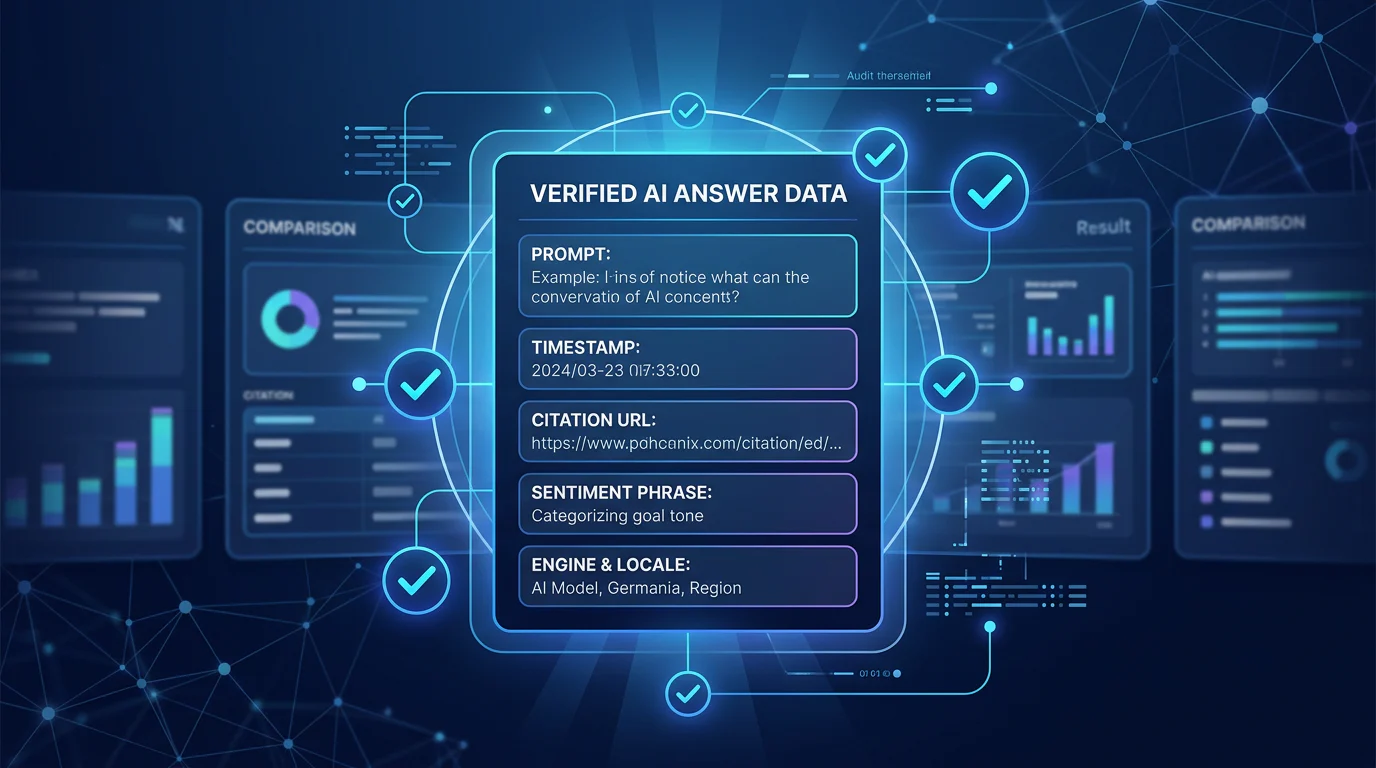
- Answer Evidence: Retain full responses, cited URLs, collection timestamps, and engine or model metadata when available.
- Sentiment Evidence: Keep the exact phrase and the classification rationale, not only a positive, neutral, or negative label.
- Trend Continuity: Label imported history, recreated baselines, and unavailable fields separately.
This approach follows the principle that repeatable measurement requires documented methods, uncertainty, and known limitations. NIST guidance specifically calls for recording what cannot be measured, which is why an honest historical-gap register matters more than a polished trend chart.
Compare Replacement Paths Before You Buy
A fair comparison separates a prebuilt category baseline from tracking your own new prompt panel. The former may be useful on day one, while the latter is often the only way to preserve the questions, markets, and competitors that drive your actual reporting.
We recommend that enterprise teams score every option against the same row structure rather than treating price as a proxy for readiness. Our enterprise tracker options explain why a lower entry price can still create a costly handoff if evidence, reporting, or execution remain disconnected.
| Replacement Path | Access And Contract | Verified Entry Price | Setup And First Usable Report | Main Migration Limitation |
|---|---|---|---|---|
| Our Enterprise Plan | Published monthly plan, confirm procurement requirements | $1,499 per month | 200 tracked prompts daily and up to 1,400 AI answers daily across seven listed engines | Confirm exports, retention, aliases, and historical-import terms during evaluation |
| Prebuilt Benchmark Path | Self-service monthly path | $199 per month | Existing category data can provide an immediate baseline, while custom prompts require configuration | Prebuilt prompt history may not match your taxonomy or locale |
| Custom-Prompt Tracking Path | Self-service monthly path | $50 per month for 2,500 checks | Data begins after your prompt, engine, location, and cadence choices are configured | No prior history for a newly created prompt panel |
| Sales-Led Enterprise Path | Contract and security review | Not publicly stated | Timeline depends on onboarding, permissions, and implementation scope | Do not treat a sales commitment as a usable-data guarantee |
Our published pricing lists 200 daily prompts, 1,400 daily answers, and seven answer engines on the Enterprise plan. Price and included scope should always be checked on the purchase date, especially when prompt checks, locations, or exports affect the actual workload.
Evidence Fidelity Decides Whether Sentiment Is Auditable
Mention totals can tell you that something changed. They cannot tell your team what the model said, which source appeared beside the statement, or whether a sentiment label reflects a genuine recommendation. Evidence fidelity is the difference between a score that looks useful and a record an editor, analyst, or executive can challenge.
What Pass Looks Like
A pass means a reviewer can open the underlying response and see the full text, prompt, timestamp, engine, location, cited URLs, entity decision, and sentiment rationale. The practical standard is not whether a dashboard has a sentiment tab, but whether the team can retrieve the phrase that produced the score.
We use a verbatim sentiment audit to keep qualitative language connected to its evidence. That makes it possible to identify qualifiers such as “best for,” “only if,” or “less suitable,” which an aggregate label can hide.
What Partial and Fail Look Like
A partial result shows some answer text or some citations, but leaves a missing timestamp, inaccessible raw response, unexplained classification, or unclear retention policy. A fail is a raw mention count with no response-level proof, because no one can determine whether the mention was favorable, current, or even relevant.
Model behavior also changes over time. OpenAI notes that outputs are variable and can change between model snapshots, which is why evidence should include the available model identifier and collection date. OpenAI documentation
How to Test a Claim
Ask each candidate to run the same 20-prompt evidence sample before your broader parallel run. Require your team to inspect full responses, citation URLs, timestamps, engine metadata, and sentiment phrases manually. A platform passes only when the evidence can be reviewed without relying on a sales demonstration or an aggregate metric.
Benchmark Methods Need Different Decisions
Raw mentions, peer share of voice, and category averages answer different questions. Treating them as interchangeable is one of the fastest ways to misread an apparent visibility gain.
A category comparison is useful only when everyone is measured against the same prompts, engines, locations, dates, and cohort rules. Our category benchmark method keeps those inputs visible so a favorable percentage does not become an unsupported leadership claim.
| Metric | What It Measures | Best Use | What Can Distort It |
|---|---|---|---|
| Raw Mention Count | Number of sampled answers naming a brand | Detecting volume changes | Larger prompt panels create larger counts |
| Selected-Peer Share Of Voice | Share of mentions among the chosen brands | Comparing a defined buying set | Adding or removing a peer changes the denominator |
| Category Average | Average mention rate across a documented cohort | Assessing relative category position | Unclear cohort rules or blended markets |
| Custom Peer Benchmark | Performance against a strategic competitor group | Account, segment, or launch planning | It is not a category-wide result |
Use category averages when the business question is, “Are we above or below the relevant market?” Use share of voice when the question is, “How do we compare with the competitors buyers repeatedly name?” Keep both, but never label one as the other.
Run a Seven-Day Parallel Migration
The seven-day plan is a readiness process, not a promise that every provider will produce mature history in one week. Its job is to prove whether your new environment can sustain reporting before you switch off the current one.
Days One and Two: Export and Map
The measurement lead exports active prompts, versions, taxonomies, aliases, competitor sets, locations, citations, response dates, sentiment fields, and reporting definitions. The SEO or content lead then maps the customer’s top 100 active prompts into the new taxonomy, or uses the entire active set if it is smaller.
Days Three Through Five: Rebuild and Compare
The platform owner recreates projects, engines, locations, aliases, and peers. Run both systems on the same 100-prompt panel, then compare mentions, cited URLs, answer language, and benchmark calculations. Our cross-engine method keeps engine and market choices fixed so the comparison measures the platforms, not a changed sample.
| Day | Owner | Dependency | Planned Duration And Proof | Acceptance Criterion |
|---|---|---|---|---|
| 1 | Measurement Lead | Export permissions | One business day, timestamped export | Prompts, taxonomies, citations, and trends logged |
| 2 | SEO Or Content Lead | Complete export | One business day, mapping sheet | Controlled prompt panel and locales approved |
| 3 | Platform Owner | Account access | One business day, configuration record | Projects, aliases, peers, engines, and locations recreated |
| 4 | Analyst | Initial results | One business day, evidence sample | Required answer-level fields reviewed |
| 5 | Analytics Lead | Both systems active | One business day, comparison workbook | Like-for-like prompt results compared |
| 6 | Governance Lead | Gap register | One business day, signed review | Retention, security, export, and history gaps accepted |
| 7 | Executive Sponsor | Validation packet | One business day, cutover decision | Pass, partial, or fail recorded |
Days Six and Seven: Document the Gap and Decide
A pass preserves the required evidence and reaches prompt, engine, location, and competitor parity. A partial result can proceed only with a signed gap statement. A fail means the team keeps the existing reporting system active while it resolves missing fields or incompatible methodology.
Keep the citation context attached to every discrepancy. A citation URL without the surrounding claim may point to content work, off-site authority work, or a classification error, and those require different owners.
Why PageLens.ai Fits Evidence-First Cutovers
We built PageLens.ai for leaders who cannot separate measurement from the work that follows it. Our Enterprise plan publishes a $1,499 monthly price, tracks 200 prompts daily, and collects up to 1,400 AI answers each day across seven listed answer engines. We connect prompt research, answer evidence, citations, sentiment, competitor context, content production, publishing, and technical recommendations so an uncovered gap has an accountable next move. That does not remove the need for a controlled validation: your team should still confirm locales, aliases, retention, exports, security, and the history available at cutover. We will help structure the shared prompt panel, document missing fields, and turn the first verified evidence into a prioritized execution queue. Because our work begins with measurable facts, stakeholders can approve a route from a dashboard to responsible content and technical changes. See how our platform works, then Book a demo.
FAQs on Enterprise AI Answer-tracking Replacement
Can a New Platform Provide Historical Trends?
New software can establish a baseline quickly, but it cannot reproduce earlier trends unless answer-level history, taxonomies, timestamps, and scoring definitions were exported, mapped, and retained.
What Should We Compare in a Parallel Run?
Compare identical prompts, engines, locations, competitor sets, response text, citations, timestamps, sentiment classifications, and benchmark formulas. Mention totals alone cannot prove operational continuity, evidence quality, or method parity.
Is a Category Average Better Than Share of Voice?
Neither metric is universally better. Category averages show relative market position, while share of voice compares a selected peer set. Use both only with visible cohorts, denominators, and methods.