


TL;DR
We explain how AI citation tracking separates displayed sources from the language and role assigned to a brand. We show teams how to capture answer evidence, code summaries, comparisons, recommendations, and cautionary language, measure source performance, diagnose losses, and report content changes without overstating causation.
AI answers can show sources without revealing whether they actually favor your product. A 14,000-conversation study of search-enabled AI interactions illustrates why visible citations are only part of the evidence.
We treat AI citation tracking as a record of both the source links an engine shows and the language around a brand. A citation does not establish recommendation: an answer can summarize, compare, caution against, or endorse a product. Reliable analysis retains the full response, prompt, engine, date, cited URL, passage, role, and sentiment.
This guide shows how to classify those signals, compare them across engines, investigate a drop, and turn observations into a measured content workflow.
What Does AI Citation Tracking Show, and What Does It Not Prove?
A mention puts a brand name in an answer. A citation links or attributes a source. Neither signal, by itself, tells us whether an engine thinks the product is a strong choice for the reader. That distinction matters most for SaaS teams tracking buyer prompts, where neutral awareness and active selection are very different outcomes.
| Signal | What It Shows | What It Does Not Prove | Evidence To Keep |
|---|---|---|---|
| Mention | The brand appears in response text | A page was sourced or the brand was favored | Full response |
| Source Attribution | The interface displays a source connected to the answer | The source supports every nearby statement | Source URL and placement |
| Citation | A specific page or domain is linked | The cited brand is recommended | URL and surrounding passage |
| Summary | The answer restates information | The product is preferred | Exact wording |
| Comparison | The answer evaluates options or trade-offs | A selection was made | Compared entities and criteria |
| Recommendation | The answer suggests a product or fit | The citation caused the recommendation | Selection language and role code |
ChatGPT may display inline citations or a Sources panel when it searches the web, which makes source capture possible but does not turn every linked page into a recommendation. Follow the ChatGPT search guidance and preserve what the interface actually showed on that collection date.
This is why we separate brand visibility from source visibility. A product may be named without a source, a first-party page may be cited without naming the product, or an external page may shape the answer’s language. For a deeper source-level workflow, see AI citation sources.
Is an AI Engine Summarizing, Comparing, or Recommending Your Product?
The words around a brand are the decision layer. “Is a platform for” describes. “Works well alongside” compares. “Choose it if” recommends conditionally. A useful analysis records that role before assigning a positive, neutral, mixed, or cautionary sentiment label.
A source can be accurate yet poorly aligned with the claim it appears to support. Research on citation quality has found meaningful gaps between cited materials and surrounding statements, which is why we review the passage rather than counting links alone. That is the practical lesson from citation-alignment research.

Descriptive and Unrelated Appearances
A descriptive appearance explains what a product does without advising a reader to choose it. An unrelated appearance may include a brand or domain in passing but contribute nothing to the buyer’s decision. Both can be useful visibility signals, but neither belongs in recommendation rate.
Comparative Appearances
A comparative appearance places products beside one another and assigns similarities, differences, trade-offs, or fit criteria. Code it as comparative even when the wording is favorable. The analytical question is whether the answer evaluates, not whether the brand appeared in a list.
Recommended Appearances
A recommended appearance contains selection language, such as “best for,” “choose,” “strong option,” or a clear use-case fit. Record whether it is direct or conditional. Conditional recommendations can be highly valuable because they reveal the buyer context that activates selection.
Cautionary Appearances
A cautionary appearance highlights limits, risks, exclusions, or poor fit. Preserve the exact qualifier. A factual limitation is not automatically negative sentiment, but it can change whether an answer helps a buyer move toward or away from the product.
Our phrase-level AI sentiment analysis guide expands this discipline beyond a single positive or negative score.
What Belongs in a Defensible Citation Record?
A defensible record lets another reviewer understand what was asked, what the engine returned, which sources appeared, and why a role label was applied. Save the raw response first, then create structured fields from it. If the original output disappears, your dashboard should still show how the conclusion was reached.
Capture the Response Context
Store the exact prompt, prompt ID, engine, visible model or mode, locale, collection timestamp, and full answer. Keep the collection method too, because a logged-in interactive session and a controlled workflow can produce different evidence.
Capture the Source Evidence
Store the displayed source title, URL, domain, citation marker or panel placement, and the passage nearest to that source. Perplexity describes its answers as summaries with numbered citations, which supports preserving both the answer and source list rather than treating either as complete alone. See its source guidance.
Capture the Classification Decision
Record whether the brand is present, the primary role, optional secondary role, sentiment, recommendation strength, coding confidence, and reviewer. Use an “unclear” state when the language does not support a reliable conclusion.
| Record Group | Required Fields | Why It Matters |
|---|---|---|
| Collection | Prompt, engine, mode, locale, timestamp | Makes periods comparable |
| Response | Full answer, response identifier, collector | Preserves the observable evidence |
| Brand Context | Mention status, role, sentiment, confidence | Separates visibility from recommendation |
| Citation | URL, domain, source title, placement, nearby passage | Connects the source to the response language |
| Audit | Reviewer, rules version, notes | Makes coding repeatable |
This record structure works best when it is applied across a stable prompt set. Our cross-engine AI visibility tracking framework can help teams keep those comparisons consistent.
How Do You Compare Citation, Recommendation, Sentiment, and Source Diversity?
Use a fixed denominator. Citation rate is the share of valid answers that contain a qualifying first-party citation. Recommendation rate is the share of valid answers that classify the brand as recommended. Do not merge those rates, because a source link and a buying suggestion answer different questions.
Source diversity adds another layer. Track the number of unique cited domains and whether a small number of external pages dominate an answer set. Research into search-enabled models shows that retrieval and displayed citations can diverge, so repeated domains are a useful observable pattern, not proof of every source an engine considered. The retrieval-disclosure study supports treating citation logs as evidence with limits.
| Metric | Calculation | Decision It Supports |
|---|---|---|
| Citation Count | Total qualifying first-party citations | Which pages surface most often |
| Citation Rate | Answers with a qualifying citation divided by valid answers | How consistently sources appear |
| Recommendation Rate | Recommended appearances divided by valid answers | Whether the brand is selected |
| Sentiment Mix | Distribution of descriptive, positive, mixed, and cautionary language | How the brand is framed |
| Source Diversity | Unique cited domains and concentration | Which source ecosystems shape answers |
Compare these metrics by engine, prompt group, and collection period before looking at a blended view. That makes it easier to see whether an apparent win is confined to one engine or whether a cited page is actually associated with favorable language. Build the prompt cohort from an AI buyer prompt dataset.

Why Did AI Citations Fall, and How Do You Diagnose the Loss?
A decline is not one diagnosis. It may reflect a changed prompt set, a different engine mode, a source-page shift, a rival brand gaining space, or ordinary variability in how an answer is assembled. Start by testing whether the before and after periods are comparable. Keep AI answer analysis distinct from conventional rank reporting with AI visibility tracking vs SEO monitoring.
Then inspect the loss at the smallest useful unit. A broad brand-level decline can hide a narrow problem, such as one high-value prompt cluster moving from recommendation to comparison. Keep your investigation tied to retained outputs, not assumptions about an engine’s hidden retrieval process.
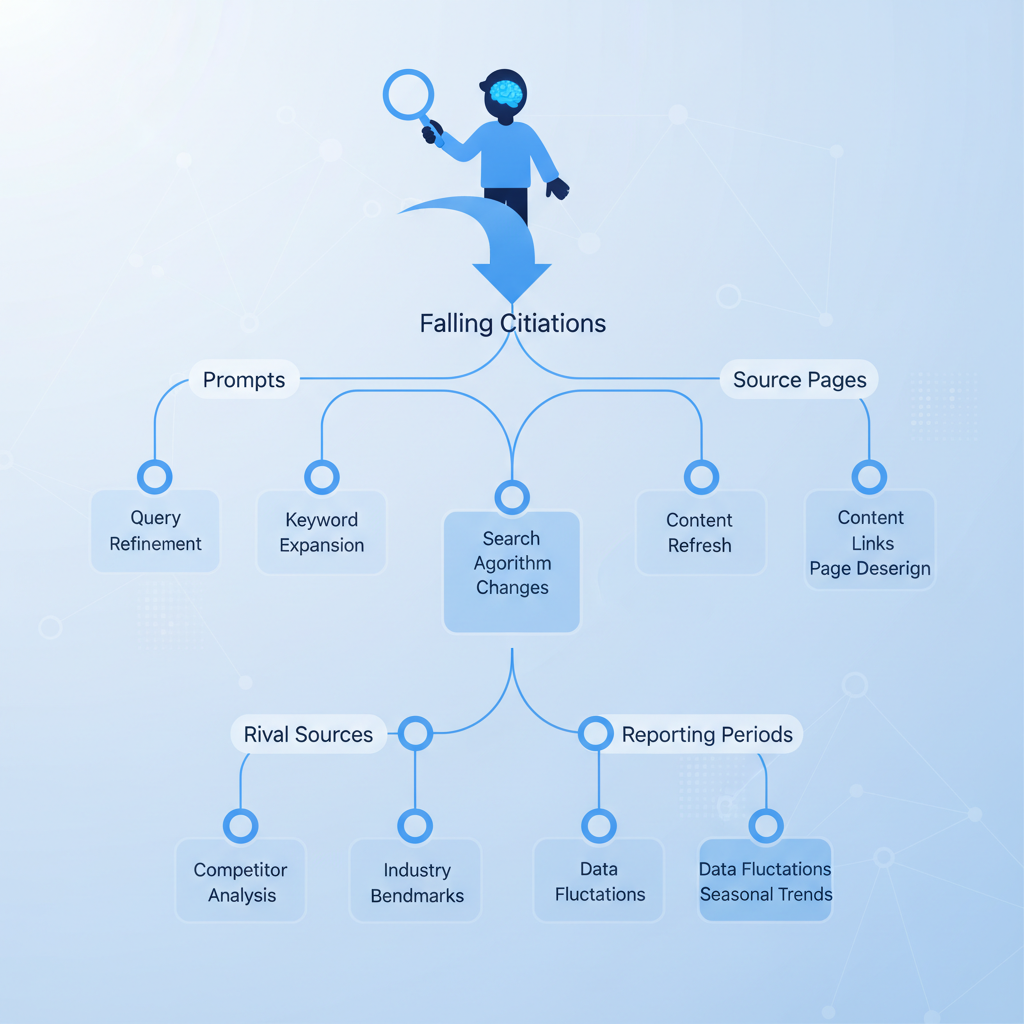
Follow the Evidence in Order
Citation Or Recommendation Rate Declines
├─ Are Prompt Set, Engine, Locale, And Period Matched?
│  └─ No: Recollect A Comparable Cohort.
├─ Is The Change Limited To A Prompt Cluster?
│  └─ Yes: Review Intent, Phrasing, And Role Changes.
├─ Is The Change Limited To One Engine?
│  └─ Yes: Report It As Engine-Specific.
├─ Did A First-Party Source Page Disappear Or Change Role?
│  └─ Yes: Inspect Accessibility, Passage Quality, And Replacement Sources.
├─ Did External Domains Or Rival Brands Gain Share?
│  └─ Yes: Compare Their Claims, Source Types, And Answer Language.
└─ Did Citations Hold While Recommendation Or Sentiment Changed?
   └─ Yes: Treat It As A Context Shift.
A content change may correlate with a later change in visibility, but correlation alone does not establish causation. Controlled GEO research found that visibility interventions can vary by domain, so document what changed and report observed results with uncertainty. Use content optimization beyond monitoring to turn the diagnosis into a disciplined editorial backlog.
How PageLens.ai Turns Citation Context into a Repeatable Workflow
At PageLens.ai, we help marketing, growth, SEO, and content leaders turn inconsistent AI answers into an auditable record. Our workflow keeps the prompt, engine, response, source URLs, and the exact words surrounding every brand appearance together, so a dashboard does not flatten a citation into a recommendation. That matters when a product is mentioned often but described cautiously, or cited rarely yet selected for a specific use case. We also make it easier to review repeated external sources, detect a role shift before it becomes a reporting surprise, and hand content teams concrete passages to investigate. The goal is not to promise control over a changing answer engine. It is to give your team a disciplined way to see what changed, decide what deserves attention, and document the result with context intact across engines. Explore PageLens.ai, then Book a demo
FAQs on AI Citation Tracking
These FAQs clarify common tracking questions.
How Do I Track Sources Used by ChatGPT and Perplexity?
Use a fixed prompt set in every engine, save complete responses and displayed sources, then label each brand appearance by role, sentiment, date, and URL.
Is ChatGPT Recommending or Summarizing My Product?
Recommendation needs selection language or a stated fit. A linked page may only support a summary, comparison, or caution, so save the surrounding passage verbatim.
How Should I Investigate a Citation Drop?
Compare matched periods, prompts, engines, and locales before interpreting a decline. Then inspect source pages, external domains, and shifts in role or sentiment across retained responses.