
AI Visibility Tracking vs SEO Monitoring: Metrics, Data, and Workflow


TL;DR
Learn how AI visibility tracking and SEO monitoring differ, which metrics overlap, and how to report both in one workflow.
AI Visibility Tracking vs SEO Monitoring: Metrics, Data, and Workflow
Search monitoring is not instant: Search Console data is typically available after API availability, usually within 2-3 days. That lag is a useful reminder that every visibility metric has a method, scope, and limitation.
AI visibility tracking and SEO monitoring are related but measure different outcomes. SEO tracks how pages earn rankings, impressions, clicks, and conversions in search results; AI visibility tracks whether answer engines mention a brand, cite its pages, describe it favorably, and include it among alternatives. Use both: SEO measures discoverability and traffic, while AI visibility measures representation inside generated answers.
This AI Visibility Tracking Vs SEO Monitoring guide defines the metrics, shows their denominators, and explains how marketing teams can operate both systems without pretending they measure the same thing.
What Is AI Visibility Tracking and SEO Monitoring?
AI Visibility Tracking Vs SEO Monitoring begins with the same commercial question: can the right people find and trust the brand? The practices diverge at the measurement point. One observes search-result exposure and on-site behavior. The other reviews a defined sample of generated answers, their cited sources, and their language.
Start by naming the object each practice measures.
| SEO Monitoring | AI Visibility Tracking |
|---|---|
| Measures a site’s exposure and performance in search results, including impressions, clicks, positions, sessions, and key events. | Measures brand representation in a versioned sample of prompts, stored answers, citations, and response metadata. |
| Relies primarily on platform reporting and analytics instrumentation. | Relies on scheduled prompts, documented settings, response capture, and review rules. |
| Answers, “Did people see, visit, and act on our pages?” | Answers, “Did this defined answer sample name, cite, and accurately describe us?” |
For AI Visibility Tracking Vs SEO Monitoring, the important distinction is that one record comes from observed search and site systems, while the other comes from a deliberately specified response sample.
AEO means answer engine optimization, the work of making content useful for direct-answer experiences. GEO means generative engine optimization, a related label for work focused on generated responses. Neither term replaces SEO.
A brand mention is an explicit reference to the canonical brand or entity. A citation is a visible source link or source-panel URL. An uncited mention is not a citation, and a linked page is not automatically a brand mention. AI Visibility Tracking Vs SEO Monitoring requires this distinction because prompt research can surface different evidence than a keyword-shaped query.
Answer systems can display inline citations or source panels, but response format varies by surface and query. In AI Visibility Tracking Vs SEO Monitoring, review response source behavior before treating any citation count as a universal measure of reach.
How Do AI Visibility Metrics Differ from SEO Metrics?
AI Visibility Tracking Vs SEO Monitoring becomes practical when every metric states its unit and denominator. Search metrics describe observed search behavior. AI metrics describe observed outcomes in a controlled answer sample. Both can inform decisions, but neither should be translated into the other without preserving what was actually counted.
Use a crosswalk that makes the differences visible.
| Metric | Objective | Unit | Numerator | Denominator | Source | Cadence | Limitation |
|---|---|---|---|---|---|---|---|
| Search impressions | Search-result exposure | Count | Eligible recorded appearances | Not applicable | Search Console | Weekly | Not a visit or answer mention |
| Search clicks and CTR | Search-result interaction | Count and percent | Clicks | Impressions for CTR | Search Console | Weekly | A click is not a conversion |
| Average position | Relative search placement | Average | Recorded topmost positions | Impression count | Search Console | Weekly | Not a universal rank |
| Session key-event rate | On-site outcome | Percent | Sessions with a key event | Total sessions | Analytics | Weekly | Depends on configuration and attribution |
| Mention rate | Brand representation | Percent | Answers naming the canonical brand | Eligible stored answers | Prompt-response dataset | Weekly | A sample estimate, not total platform reach |
| Citation rate | Source inclusion | Percent | Answers citing a verified owned URL | Source-observable eligible answers | Stored responses | Weekly | Use not applicable when sources are unavailable |
| Answer position | Prominence in a response | Ordinal average | First-mention order totals | Answers with a mention | Stored responses | Weekly | Text order is not a search ranking |
| AI Share Of Voice | Competitive representation | Percent | Brand appearances | All counted category-brand appearances | Stored responses | Weekly | Depends on the defined comparison set |
AI Visibility Tracking Vs SEO Monitoring works best when formulas appear beside the dashboard. Mention rate equals answers naming the brand divided by eligible stored answers. Citation rate equals source-observable answers citing a verified owned URL divided by source-observable eligible answers. Share of voice equals brand appearances divided by all defined category-brand appearances in the same response set.
Search Console defines clicks, impressions, CTR, and position using result-type-specific rules. AI Visibility Tracking Vs SEO Monitoring should therefore treat Search Console definitions as the source of truth for SEO reporting. Use multi-engine signals to keep answer-sample metrics separate rather than forcing them into search-rank language.
Which Data Sources Belong in a Unified Dashboard?
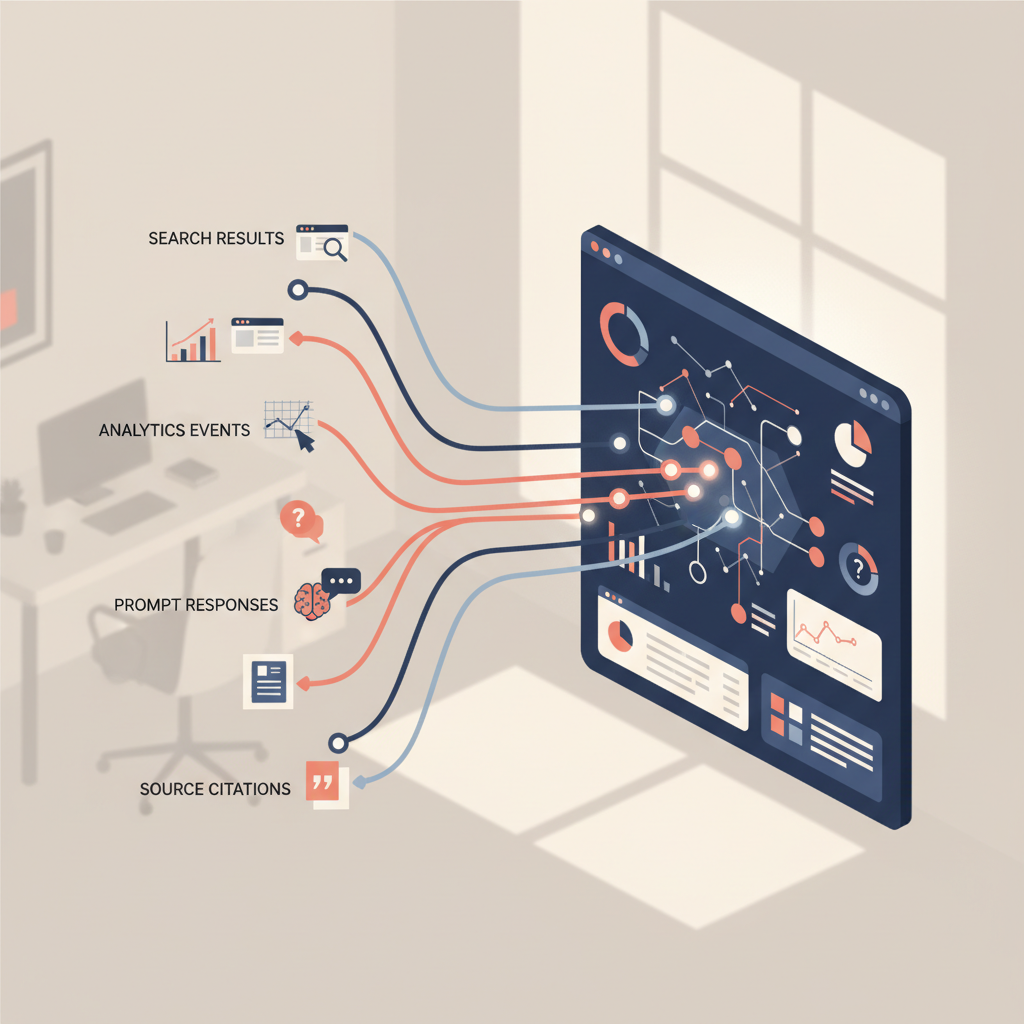
AI Visibility Tracking Vs SEO Monitoring needs shared workflows without collapsing data provenance. Search Console and analytics provide platform and site records. AI visibility tracking provides a documented observation set. The dashboard works when a reader can trace every number back to its source system, time window, locale, and collection method.
Build the reporting view around source clarity.
- Search Performance: Search Console can show impressions, clicks, CTR, queries, pages, country, device, and position. It cannot prove that an answer engine mentioned the brand.
- On-Site Outcomes: Analytics can show sessions, engagement, key events, and configured revenue. It cannot prove why an answer engine selected a source.
- AI Response Review: Scheduled prompts and stored responses can show mentions, citations, answer language, source URLs, and answer order. They cannot prove total answer-engine impressions or causal business impact.
- Technical Diagnostics: Crawling and indexing tools can show access, indexability, response status, and structured-data validity. They cannot guarantee answer inclusion.
In AI Visibility Tracking Vs SEO Monitoring, the source field should identify the system that generated the number, not merely the team that reported it.
A useful AI Visibility Tracking Vs SEO Monitoring dashboard keeps the denominator in the label, not in a footnote:
Weekly Visibility Reporting View

Measurement Contract
Prompt set, engines, locale, response mode, collection date, review rules.

SEO Exposure
Impressions, clicks, CTR, average position, pages, queries.

On-Site Outcomes
Sessions, key events, revenue where configured, attribution scope.

AI Representation
Mention rate, citation rate, answer position, accuracy review, AI share of voice.

Actions
Content owner, technical owner, due date, evidence link, method-change annotation
Google began rolling a dedicated generative-AI reporting view to a subset of sites in 2026, while retaining that data in overall Search Console performance reporting. In AI Visibility Tracking Vs SEO Monitoring, the new reporting view is useful for Google Search activity, but it does not replace stored response evidence from other answer experiences.
Why Are the Disciplines Related but Not Interchangeable?
AI Visibility Tracking Vs SEO Monitoring reveals different failure modes because its measures answer different questions. A page can earn more search visibility without appearing in generated answers. A brand can be accurately mentioned in answers without producing measurable referral traffic or conversions.
Treat overlap as diagnostic, not equivalence.
For AI Visibility Tracking Vs SEO Monitoring, answer outputs can vary with prompt wording, locale, account state, model changes, personalization, and whether the system decides to retrieve sources. Some systems rewrite a question into several targeted searches, which makes prompt wording part of the measurement contract.
Use this decision rubric:
- Can Buyers Discover And Visit This Page?: Prioritize impressions, clicks, and sessions. Use prompt coverage and citation presence as supporting evidence.
- Does An Answer Describe The Brand Correctly?: Prioritize mentions, accuracy review, and sentiment. Use source-page search visibility as supporting evidence.
- Did The Site Produce Attributable Outcomes?: Prioritize key events and revenue. Use AI visibility as diagnostic context.
- Did A Change Cause An Answer Outcome?: Prioritize controlled before-and-after sampling. Use SEO and analytics trends without causal claims.
AI Visibility Tracking Vs SEO Monitoring requires the documented prompt, locale, and response context before a team compares one answer sample with another. Read the official search behavior details before calling a single response representative.
A citation can support a claim, fail to support it, or appear without naming the brand. AI Visibility Tracking Vs SEO Monitoring therefore needs citation tracking that retains the response text, cited URL, date, prompt, and reviewer decision together.
Which Foundations Support Both Search and Answer Visibility?
AI Visibility Tracking Vs SEO Monitoring depends on shared foundations because answer experiences still rely on accessible, understandable, useful information. Technical eligibility, clear entities, accurate brand facts, helpful content, and structured data can support both practices. They are prerequisites and signals, not guarantees of a ranking, mention, or citation.
Fix the common ground before chasing isolated metrics.
- Crawlability: Ensure important pages are publicly accessible, return successful responses, and contain indexable content.
- Entity Clarity: Use the same canonical company, product, and category facts across key pages and trusted profiles.
- Useful Content: Publish complete answers, evidence, explanations, and original expertise that a reader can verify.
- Structured Data: Mark up visible information accurately to provide explicit meaning, not to manufacture a rich result.
- Source Authority: Earn reputable references through work worth citing, not through unsupported claims.
For AI Visibility Tracking Vs SEO Monitoring, this shared foundation should be checked before teams diagnose a short-term change in mentions or citations.
Google lists crawler access, a successful HTTP response, and indexable content as its basic technical requirements. AI Visibility Tracking Vs SEO Monitoring often benefits from semantic SEO guide work that improves how plainly a page identifies its subject and evidence.
What Do Three Worked Scenarios Reveal?
AI Visibility Tracking Vs SEO Monitoring should explain what changed, what did not change, and what evidence would justify the next action. Worked scenarios prevent teams from celebrating the wrong movement. The examples below are intentionally qualitative, so they do not imply customer outcomes or universal benchmarks.
Apply the same logic to your own documented measurement contract.
SEO Improves While AI Visibility Does Not
A revised guide earns more impressions and clicks from relevant searches, but the fixed answer sample continues to omit the brand. The next step is not to declare failure. Review whether the prompts require comparison language, whether the answer surface uses sources differently, and whether the page directly resolves the buyer question.
AI Mentions Improve Without Referral Traffic
AI Visibility Tracking Vs SEO Monitoring may show more explicit brand mentions and accurate descriptions while analytics shows no measurable traffic from that answer experience. The appropriate conclusion is representation improved in the measured sample. It is not evidence of visits, revenue, or broader demand. Use a verbatim sentiment review to inspect the exact wording.
A Technical Fix Supports Both Channels
A blocked or non-indexable page becomes accessible, then search performance and answer citations are monitored separately over time. In AI Visibility Tracking Vs SEO Monitoring, the fix can restore eligibility, but no one should claim it caused a citation increase without repeated observation and a stable prompt set.
Analytics reports traffic through session-scoped sources and configurable attribution, so use analytics attribution to distinguish actual recorded visits from representation observed in answer samples.

How Do Teams Run One Weekly Workflow?
AI Visibility Tracking Vs SEO Monitoring needs one operating rhythm while preserving distinct measures. The workflow should assign owners for source data, answer review, content action, technical fixes, and reporting. The goal is not more dashboards. The goal is a repeatable decision process that withstands scrutiny.
Run the following six steps each week.
- Freeze The Measurement Contract: Record the prompt set, canonical brand aliases, comparison set, engines, locale, response mode, and review rules. Owner: growth lead.
- Pull SEO Diagnostics: Review Search Console pages, queries, countries, devices, and analytics outcomes. Owner: SEO lead.
- Capture Answer Evidence: Store prompts, timestamps, response text, source URLs, engine metadata, and run identifiers. Owner: AI visibility analyst.
- Review Representation: Validate mentions, citations, answer order, accuracy, and sentiment before reporting change. Owner: content lead.
- Assign Actions: Route work to content, SEO, engineering, or brand-fact owners based on the evidence. Owner: marketing operations.
- Report Uncertainty: Show denominators, response counts, method changes, and correlation language. Owner: reporting lead.
AI Visibility Tracking Vs SEO Monitoring turns the weekly review into a shared record of decisions rather than a collection of disconnected reports. Use an optimization stack to prioritize changes that improve the underlying page, not just a short-lived response pattern.
Does AI Visibility Tracking Replace SEO Monitoring?
AI Visibility Tracking Vs SEO Monitoring does not mean that AI visibility tracking replaces SEO monitoring. SEO still measures discoverability and on-site outcomes. AI visibility tracking measures representation within a disclosed answer sample. Together, they show where a brand is found, how it is described, and whether visitors take measurable action.
Keep the final decision disciplined.
AI Visibility Tracking Vs SEO Monitoring uses SEO monitoring when the decision concerns indexing, search-result visibility, traffic, conversion paths, or page performance. It uses AI visibility tracking when the decision concerns prompt coverage, mention quality, citation presence, response accuracy, and competitive representation.
AI Visibility Tracking Vs SEO Monitoring should be used together when planning content, because a source page may need to serve searchers and answer systems without making inflated promises. Structured data can help systems understand page meaning, but correct markup does not guarantee a search feature or answer inclusion.
Google’s structured data guidance makes that limitation explicit. A reliable AI Visibility Tracking Vs SEO Monitoring report annotates model changes, locale, prompt revisions, citation availability, and any change to the review rubric.
How Can PageLens.ai Help?
PageLens.ai is for teams that want one accountable measurement practice, not another score detached from the work. It can bring a documented prompt set, stored answer evidence, citation review, and conventional search performance into the same operating conversation. That helps leaders see whether a change belongs with content, technical SEO, brand facts, or measurement design.
Use that shared evidence to make the workflow operational.
The useful output is not a promise that every answer will mention the brand. It is a shared record of what was measured, what changed, and which action has an owner. Start small: define the questions buyers actually ask, connect search and analytics sources, review material response changes, then keep the denominator visible in every report. If your team needs a practical system for that workflow, explore the PageLens Platform and Book a demo.
FAQs on AI Visibility Tracking vs SEO Monitoring
What's the Difference Between Tracking AI Visibility and Traditional SEO Monitoring?
SEO monitoring measures search-result exposure, visits, and outcomes. AI visibility tracking measures whether a defined sample of generated answers names, cites, and accurately describes the brand.
What Is AI Visibility Tracking and How Is It Measured?
Measure a versioned prompt set across stated engines, locales, and response modes. Count explicit mentions and verifiable citations, then display every rate with its denominator.
How Do AI Visibility Metrics Differ from SEO Metrics?
SEO metrics record impressions, clicks, positions, sessions, and key events. AI metrics record mention rate, citation rate, answer order, accuracy, sentiment, and share of voice.
Can AI Visibility and SEO Share One Dashboard?
Yes. Keep source systems separate, but align them around pages, prompts, locales, dates, owners, and annotations. Never merge unlike denominators into a single score headline.
Does AI Visibility Tracking Replace SEO Monitoring?
No. SEO monitoring remains necessary for exposure and attributable site outcomes. AI visibility tracking adds evidence about how a brand appears inside generated answers today.