
What Buyers Ask AI About Your Category: B2B AI Buyer Prompt Research


TL;DR
At PageLens.ai, we do not treat private AI conversations as accessible research data. We build B2B AI buyer prompt research panels from observed first-party questions, public language, search proxies, modeled variants, and repeatable engine tests. This guide shows how to score evidence, map buyer intent, and validate prompts without overstating what any dataset proves.
What Buyers Ask AI About Your Category: B2B AI Buyer Prompt Research
In a 2026 B2B survey, 51% of buyers said they start software research with an AI chatbot more often than Google. That makes buyer-question research a content and positioning problem, not just a keyword exercise.
You generally cannot see the exact private prompts buyers type into AI chat products. In B2B AI buyer prompt research, we combine sales calls, support tickets, site search, public discussions, search-question data, and structured prompt expansion. The output is a defensible panel of plausible prompts, not a log of private conversations.
Here is how we separate evidence from assumptions, turn the right questions into content priorities, and validate the panel across major AI engines.
Can You See Private Buyer Prompts?
Private conversations are not a market-research export. OpenAI business privacy documentation says business inputs and outputs are not used for training by default, and workspace analytics do not create a category-wide view of what outside buyers ask. We should therefore be precise about what a dataset represents. For a fuller explanation, see what tools can show.
| Signal | What It Shows | What It Does Not Show |
|---|---|---|
| Private AI chats | Usually unavailable to category marketers | A complete record of buyer prompts |
| Referral data | A visit may have come from an AI product | The buyer’s original prompt |
| Sales, support, and site search | A question someone asked on an owned channel | Proof it was typed into an AI chat |
| Autocomplete and People Also Ask | Search-language patterns | Private AI-chat behavior |
| Synthetic prompts | Plausible prompt wording | Actual user frequency |
| Repeated engine tests | Current answers, citations, and gaps | What private users asked |
Referral reporting can show an originating product, but it cannot convert a visit into a prompt record. Under the browser referrer default, cross-origin referrals usually provide only the origin. We label that evidence as a referral signal, then keep it separate from observed buyer language.
Which Evidence Makes B2B AI Buyer Prompt Research Defensible?
Evidence gets stronger as it gets closer to a buyer speaking in a channel we own. That does not mean an observed sales question predicts the exact wording of a private AI prompt, but it deserves more weight than generic model output. We retain the evidence class with every question, following the approach in our buyer-prompt data sources.
| Source | Evidence Class | What We Actually Observed | Starting Confidence |
|---|---|---|---|
| Sales calls and proposal replies | Observed first-party | A prospect’s question and buying context | High |
| Support tickets and owned chat | Observed first-party | A customer’s written concern | High |
| Site search | Observed first-party | A visitor’s query on our property | High |
| Reviews and communities | Public-language evidence | A public concern or comparison | Medium |
| Autocomplete and People Also Ask | Search-derived proxy | Search phrasing and adjacent topics | Medium |
| Synthetic expansion | Modeled prompt | A plausible variation | Hypothesis |
| Engine testing | Tracked test prompt | A documented AI response | Validation signal |
Observed First-Party Questions
Sales calls reveal objections, decision criteria, and the language buyers use when a purchase is real. Support tickets add implementation and risk questions that matter before a buyer commits. We preserve the wording, buyer role, date, stage, and source rather than rewriting every concern into polished marketing language.
Public-Language Evidence
Reviews, practitioner communities, and public discussions expose recurring terms that a private call may miss. Google autocomplete guidance confirms that predictions reflect real Google searches while also considering context such as location and trends. That makes autocomplete useful evidence of search behavior, not proof of AI-chat demand.
People Also Ask belongs in the same proxy category. It can broaden a cluster, but it cannot tell us who asked the question, why they asked it, or whether the phrasing came from an AI interface. That distinction is central to prompt research versus keyword research.
Modeled and Tracked Prompts
We use models to expand an evidence-backed seed with useful constraints, such as company size, security requirements, migration risk, budget sensitivity, or integrations. Those candidates remain modeled until recurrence, buyer interviews, or testing supports them. This keeps generated prompt ideas useful without presenting them as observed demand.
How Do We Build a Buyer-Question Panel?
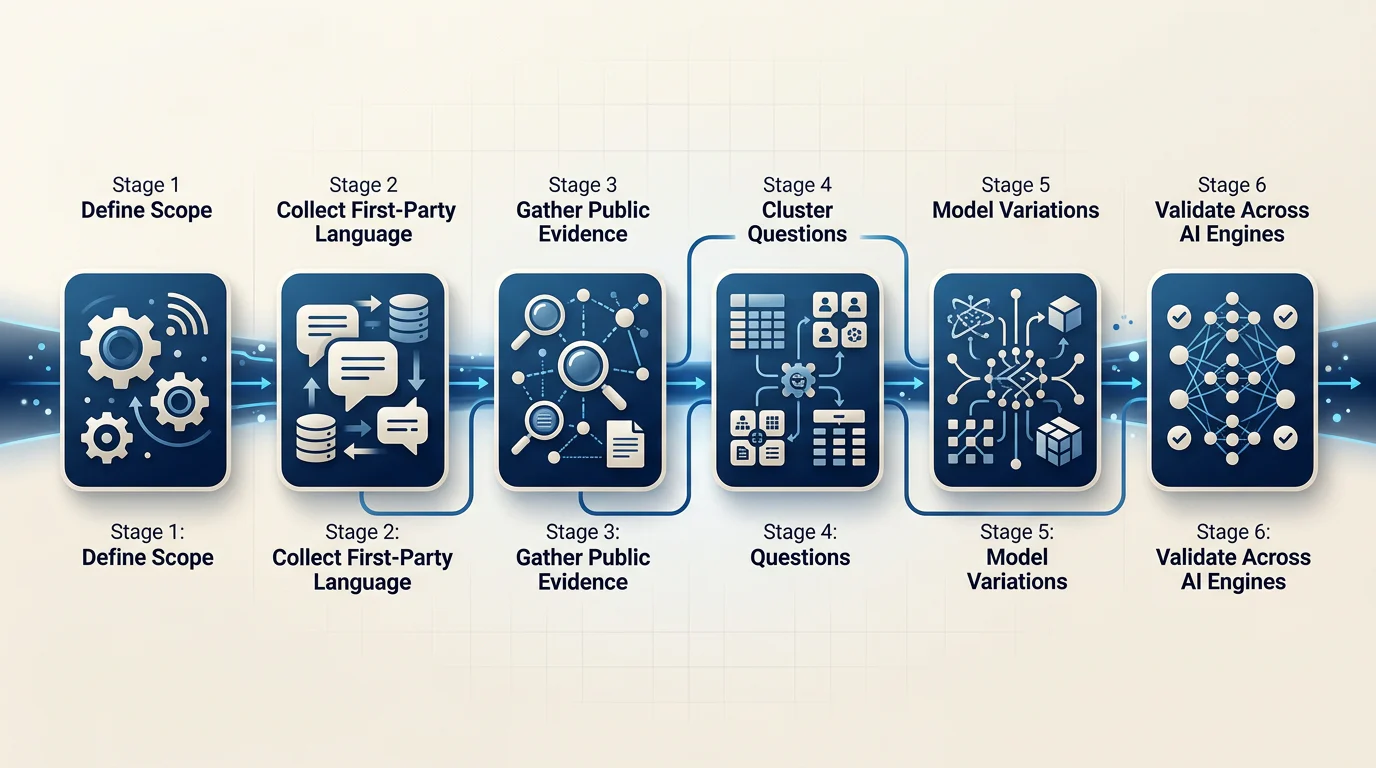
A reliable panel starts with collection discipline, then adds expansion and testing in that order. We do not begin by asking a model for one hundred questions because that produces plausible language without a trail back to buyer evidence.
Set Scope and Collect Original Language
- Define the category, ICP, market, period, and data-handling rules.
- Extract verbatim questions from calls, support, owned chat, site search, reviews, and relevant communities.
- Record the buyer role, date, source type, and surrounding context.
This order gives B2B AI buyer prompt research an auditable foundation before the team begins clustering or modeling possible wording. Our B2B buyer prompt research workflow keeps the original signal visible throughout.
Expand and Cluster the Evidence
- Add search-derived variants from autocomplete and People Also Ask.
- Deduplicate equivalent questions, then cluster them around one buyer problem, decision, or risk.
- Create modeled variants only when the parent evidence and the added constraint are both documented.
Search data can strengthen a cluster, but it has privacy limits too. Search Console privacy rules suppress low-volume queries, so missing data is not evidence that a buyer concern does not exist. We use it to validate themes and phrasing, not as the sole gate for B2B content.
Test and Validate the Priority Panel
For each priority question, we run consistent tests across ChatGPT, Claude, Perplexity, Gemini, and customer interviews. We save the full prompt, date, engine, model or mode, location, sources cited, answer language, and whether our category or brand appeared. That structure turns scattered checks into cross-engine AI tracking.
Which Prompt Types and Stages Matter?
Prompt type explains what the buyer wants to resolve. Funnel stage explains where that question may sit in a buying journey. We track both because a comparison can be early exploration for one buyer and a final procurement check for another.
| Prompt Type | Buyer Need | Likely Stage |
|---|---|---|
| Problem | Diagnose a frustrating or costly outcome | TOFU |
| Category | Understand solution types and criteria | TOFU or MOFU |
| Comparison | Evaluate trade-offs between options | MOFU |
| Objection | Resolve price, fit, switching, or complexity concerns | MOFU or BOFU |
| Risk | Check security, compliance, reliability, or lock-in | MOFU or BOFU |
| Implementation | Estimate migration, integrations, and ownership | BOFU |
| Decision | Make or justify a shortlist choice | BOFU |
A prompt that starts with “How do I” is not automatically top of funnel, and a question beginning “Is this better than” is not automatically purchase-ready. We identify the underlying job, then map the cluster to a content format that can answer it with proof. An AI buyer prompt dataset should retain both intent and stage so writers do not build generic pages for precise commercial concerns.
How Do We Validate and Score the Panel?
Prompt-research and visibility tools should disclose how a question entered the system. A credible workflow distinguishes imported first-party language, public evidence, modeled variants, manually supplied prompts, and tracked test prompts. Without provenance, a polished dashboard can make a hypothesis look like a fact.
Score Confidence Before Visibility
We score each candidate out of 100 before deciding whether it deserves content, testing, or more research.
- Source Proximity: Up to 35 points for closeness to a buyer’s original language.
- Recurrence: Up to 25 points for independent repetition across sources.
- Recency: Up to 20 points for current language and current category conditions.
- Commercial Relevance: Up to 20 points for ICP fit and decision significance.
A score of 80 or more earns priority for publishing and testing. Scores from 60 to 79 need another validation source. Lower scores remain labeled hypotheses, even if the wording sounds compelling.
Test Answers, Not Imagined Demand
We run the same wording repeatedly with controlled conditions, then compare the answer, cited sources, recommendations, and omissions. ChatGPT search guidance warns that search results and citations can be incomplete, outdated, or incorrect, which is why a one-time answer is never a durable conclusion.
Turn Validated Questions into Actions
The final panel should tell a content team what to do next: publish a direct answer, add a comparison table, improve a product page, collect missing proof, or monitor a volatile result. We connect those decisions to AI citation tracking so the team can see whether a stronger answer changes what engines cite and how they describe the category.
Why PageLens.ai Fits This Workflow
At PageLens.ai, we turn a buyer-question panel into a repeatable AI visibility workflow. We help marketing, growth, SEO, and content leaders keep evidence, modeled variants, and test results in one operating view, so a plausible prompt never masquerades as a private user query. Our work starts with the questions your buyers have actually voiced, then connects them to content gaps, tracked answers, citations, and ownership.
That matters when a launch team needs to decide what to publish first, what claims need better proof, and which unanswered buyer concerns are blocking consideration. Instead of relying on a single visibility score, we keep the source type, test conditions, answer language, and next action visible. You can use the result to brief writers, inform product marketing, and revisit the same panel as your category changes. If you need help turning this method into an accountable program, Book a demo
FAQs on B2B AI Buyer Prompt Research
Can Marketers See Real ChatGPT User Queries?
No. Marketers can observe questions on their own properties and see some referral sources, but neither source reveals the exact private prompts users enter into ChatGPT.
Are Search Questions the Same as AI Prompts?
Not necessarily. Autocomplete and related search questions reveal wording and demand themes, but they remain search-derived proxies unless separate buyer evidence directly confirms the concern.
How Often Should We Retest a Prompt Panel?
Retest priority prompts when the category, product, or buyer context changes, then use a consistent cadence that preserves engine, model, location, and date comparisons over time.
What Makes a Modeled Prompt Useful?
A modeled prompt is useful when it extends observed language with explicit constraints, keeps its hypothesis label, and gains support from recurrence, testing, or interviews.