


TL;DR
Learn where AI buyer-prompt data comes from, what tools can observe, and how to validate buyer questions without confusing hypotheses with demand.
AI chat research matters because 49% of U.S. adults reported using an AI chatbot in Pew’s February 2026 survey, but the conversations themselves are not an open market-research database.
No legitimate prompt-research tool can reveal the private questions people type into ChatGPT at category scale. AI buyer-prompt data instead combines consented first-party conversations, customer research, search and community language, model-generated variants, and observed AI answer patterns. The result is a prioritized hypothesis set, not a transcript of private demand, with source labels and confidence levels.
This guide explains what each signal can prove, where it stops, and how we turn scattered buyer language into content decisions that can stand up to scrutiny.
Can Tools Observe AI Buyer-Prompt Data?
Private chatbot history is not a dataset that outside tools can browse. Consumer conversations may be subject to user controls, temporary-chat settings, and account-level privacy choices, while business workspace and API inputs are not used for training by default under OpenAI’s business data policy. A responsible research workflow therefore begins by separating data a company has permission to analyze from private conversations it cannot see.
That boundary changes how we describe evidence. A consented website chat can show that a prospect asked a question. A sales-call transcript can show the language used during evaluation. A public forum post can show a recurring concern. A model-generated prompt can expose a plausible gap. None of those sources, by itself, proves what an unknown buyer typed into a private AI interface.
We use five source labels throughout our research: Observed for direct, consented records; Reported for survey or interview responses; Public for searchable community and search language; Modeled for AI-answer observations and fan-out queries; and Synthetic for generated variants. That vocabulary prevents a polished dashboard from turning an inference into a fact.
The distinction is especially useful when teams compare prompt research vs keyword research. Keywords measure behavior in a search environment. Buyer questions reveal language, constraints, and decision context. They overlap, but neither is a substitute for the other.
Where Does AI Buyer-Prompt Data Actually Come From?
The strongest research stack does not depend on one magical feed. It combines sources with different strengths, then makes their limits visible before anyone decides that a cluster deserves content, sales enablement, or product research.
| Source | Provenance Label | What It Can Prove | What It Cannot Prove |
|---|---|---|---|
| First-party website chat | Observed | A visitor asked this question in your owned experience | Private AI-chat volume or market-wide frequency |
| Sales calls and win-loss interviews | Observed | Real evaluation language, objections, and requirements | That every buyer uses the same phrasing |
| Support tickets | Observed | Post-purchase friction and unclear expectations | Pre-purchase demand by itself |
| Surveys and research panels | Reported | Needs reported by a defined sample at a stated time | Natural wording without open-ended responses |
| Search data | Public | Queries people used in web search and related demand patterns | Conversational AI usage or private prompt volume |
| Forums and public reviews | Public | Community language, complaints, and comparison themes | A representative buyer sample or verified intent |
| Fan-out queries | Modeled | How a system may break a request into subquestions | A person’s original prompt |
| Synthetic prompt variants | Synthetic | Plausible language and coverage hypotheses | Real demand, frequency, or purchase intent |
First-Party Conversations Carry the Clearest Intent
First-party chat, sales calls, support tickets, interviews, and open-ended survey responses are often the best starting point because they preserve buyer language close to the decision. A sales question about implementation risk is not just a topic. It may reveal the condition preventing a deal from moving forward.
We still keep the setting attached. Sales language can be influenced by a demo, support questions arrive after purchase, and website chat often captures early-stage uncertainty. This is why buyer prompt discovery works best when each question retains its source, date, audience, and stage rather than being flattened into a generic topic list.
Research Panels Add Definition and Discipline
Panels and surveys can validate whether a need is common in a defined audience, especially when open-ended questions preserve wording and closed questions prioritize trade-offs. Good research documentation includes the audience definition, sample size, field dates, question wording, mode, and weighting, as recommended in AAPOR guidance.
A survey response is reported evidence, not invisible behavioral data. It can tell us what respondents say they need. It cannot show us the exact wording they would use in an unprompted private conversation.
Search and Community Language Add Public Context
Search data is valuable because it captures what people typed into web search, including recurring qualifiers around price, integrations, compliance, implementation, and alternatives. Google notes that Search Console reports query performance but omits some anonymized queries, so it is useful directional evidence rather than a complete census of demand. See the Search Console guide for those limits.
Public communities and reviews can reveal the language buyers use when they are frustrated, skeptical, or comparing options. They need quality checks, however. We should never present an isolated review, a manipulated testimonial, or a loud community as if it represents the category.

Modeled and Synthetic Signals Are Useful, but Different
Repeated AI-answer testing can reveal which questions produce inconsistent recommendations, missing constraints, or outdated claims. Fan-out analysis can show the follow-up questions a retrieval system may generate when answering a complex request. Modern retrieval systems can decompose a question into focused subqueries, as documented for agentic retrieval, but that behavior is not a record of what a buyer originally asked.
Synthetic variants help us find blind spots. They are valuable for expanding a research brief, designing interviews, and testing page coverage. They become demand evidence only after a direct, reported, or public source corroborates them.
How Do You Collect Buyer Questions Safely?
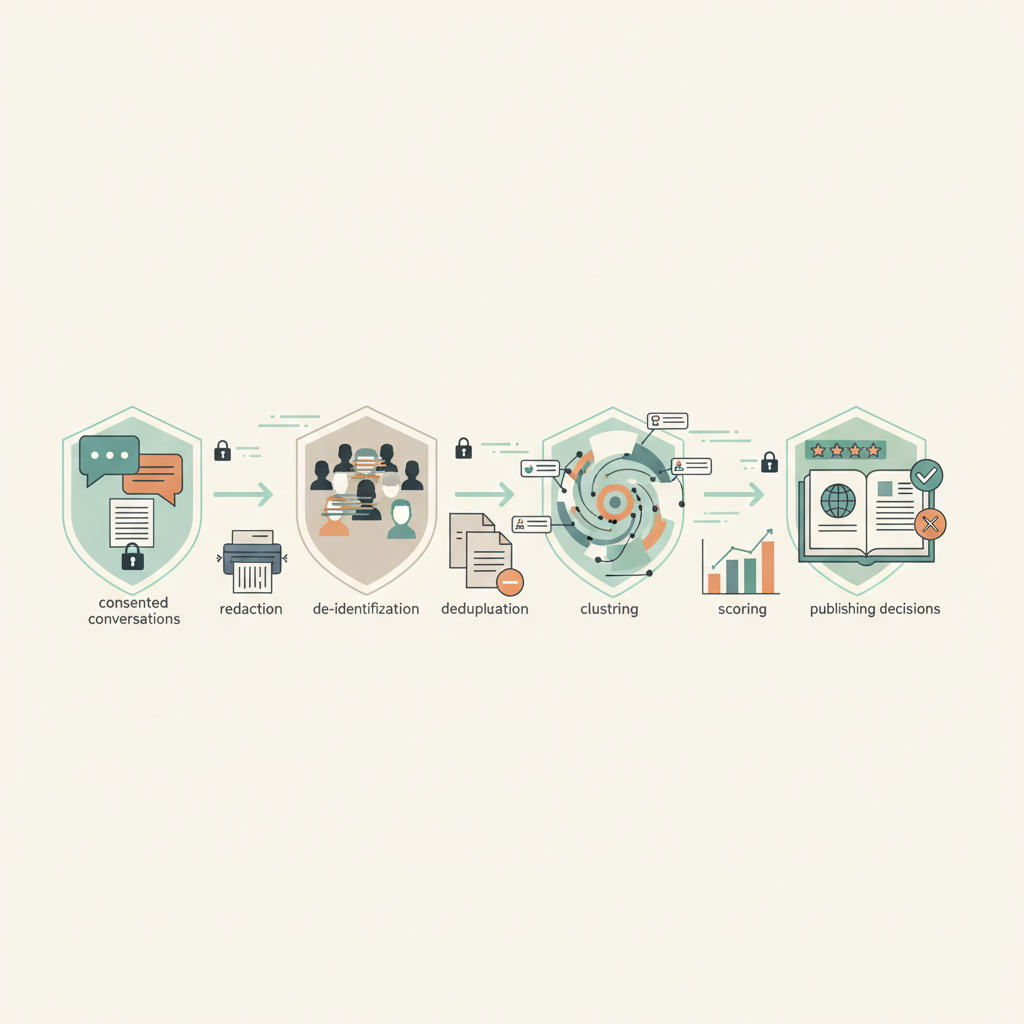
A useful research repository should be detailed enough to preserve meaning and disciplined enough to protect people. We collect only what the work requires, separate source records from working text, and avoid treating simple redaction as a guarantee of anonymity.
Set the Collection Contract First
Before collecting anything, define the category, ideal customer profile, region, time window, approved systems, and sensitive information that must never enter the research workspace. This prevents a broad “find buyer prompts” request from turning into uncontrolled transcript collection.
Each imported record should carry a source type, capture date, buyer stage, permission basis, and internal record reference. The working prompt can be clean and concise, while the original evidence remains restricted to the people authorized to inspect it.
De-Identify Before Clustering
Remove direct identifiers such as names, email addresses, account numbers, phone numbers, and customer-specific URLs. Generalize quasi-identifiers when combinations could expose a person or account, such as replacing an exact company size with a size band or an exact location with a region.
NIST describes de-identification as a way to reduce privacy risk during data processing and sharing, while recognizing that re-identification risk must still be managed. Our exact model language workflow applies the same principle to AI-answer analysis: preserve useful language, but do not expose the person or account behind it.
Deduplicate, Cluster, and Tag the Evidence
Deduplication should collapse meaning without erasing frequency. If five buyers ask about implementation time in different words, we cluster the theme but retain a count and the original provenance labels. We never let a model-generated paraphrase overwrite the evidence that made the cluster credible.
Tag each cluster against the buyer’s decision stage:
- Problem Discovery: The buyer is naming a pain or unmet outcome.
- Requirements: The buyer is defining capabilities, constraints, or stakeholders.
- Comparisons: The buyer is weighing approaches or providers.
- Objections: The buyer is testing cost, risk, complexity, or fit.
- Validation: The buyer wants proof for a company, role, or use case like theirs.
- Purchase Decisions: The buyer is narrowing options and asking what to choose now.
How Do You Validate a Prompt Before Calling It Demand?
Validation is the moment where research gets more useful than prompt brainstorming. Instead of asking whether a question sounds plausible, ask what evidence supports it, how current that evidence is, and whether the question matters to a commercial decision.
We use a simple 10-point rubric so that direct evidence does not get buried beside polished synthetic phrasing. The score is a prioritization aid, not a claim of statistical certainty.
| Criterion | Points | Validation Question |
|---|---|---|
| Directness | 0 to 3 | Was the language observed, reported, public, modeled, or synthetic? |
| Recency | 0 to 2 | Does the evidence reflect the current product and market context? |
| Frequency | 0 to 2 | Does the theme recur across independent records? |
| Commercial Relevance | 0 to 2 | Does it affect requirements, objections, comparison, or purchase choice? |
| Cross-Source Corroboration | 0 to 1 | Does another source type support the same theme? |
Score the Evidence Before Scoring the Topic
Clusters scoring 8 to 10 deserve priority because they combine recent, commercially relevant evidence with directness or corroboration. Scores from 5 to 7 deserve another research pass. Scores below that remain useful hypotheses, but they should not become authoritative page claims.
A single imaginative model output may suggest a valuable niche. It should not outrank a recurring sales objection merely because it is written more cleanly. This is the practical difference explored in our keyword research comparison.
Compare Prompt Language with Keywords Carefully
Keyword data can confirm that people search for a category, feature, or problem in web search. It cannot establish how often people ask the equivalent question in a chatbot. We compare themes, qualifiers, role-specific constraints, and objections instead of claiming that search volume equals conversational demand.
When prompt language and keyword language align, mark the cluster as corroborated. When buyers use richer constraints in first-party conversations than in search, preserve both versions. The broader keyword may guide discovery, while the fuller buyer question may guide the page’s examples, proof, and decision criteria.
Observe AI Answers Separately from Buyer Demand
Run a fixed set of prompts repeatedly when you need to understand answer volatility, brand representation, or cited sources. Log the engine, date, prompt, response, sources, and meaningful differences across runs. That is answer monitoring, not evidence that buyers typed those prompts.
This separation makes AI citation tracking more honest. We can measure what an engine says and cites, while still being clear about what we know about the demand behind the question.

Which Tools Help Turn Signals into Content?
The right tool category depends on the question you need answered. A conversation repository helps us inspect consented evidence. A panel platform helps us test a defined audience. An AI-answer monitor helps us observe what models return. A prompt-expansion tool helps us find hypotheses. None should claim that it can see private category-level chatbot history unless the data was directly contributed with permission.
When evaluating a platform, we look past a prompt count or visibility score and ask whether the evidence can be inspected, exported, filtered, and governed.
| Evaluation Area | What Good Looks Like |
|---|---|
| Source Disclosure | Every prompt carries an observed, reported, public, modeled, or synthetic label |
| Category Filtering | Teams can filter by ICP, category, geography, stage, and date |
| Raw Evidence | Authorized users can inspect de-identified supporting records |
| Exports | Source labels, dates, scores, and cluster details travel with the export |
| Clustering | Related phrasing is grouped without losing count or provenance |
| Privacy Controls | Access roles, retention rules, and redaction steps are documented |
| Monitoring | AI-answer observations are tracked over time and kept separate from demand evidence |
Teams that need this repeatability can pair an evidence repository with multi-engine answer tracking. The monitoring layer shows how answers change, while provenance shows how a cluster entered the plan.
The final step is a prompt-to-page decision, not an endless research archive. Use the evidence to decide whether a page should be created, updated, consolidated, or declined.
| Prompt Cluster | Evidence Status | Content Decision | Page Action |
|---|---|---|---|
| “Which category tool supports a required integration for regulated teams?” | Direct sales language plus public corroboration | Create | Publish a requirements page with integration and compliance proof |
| “Is this category too complex for a small team?” | Support and community evidence | Update | Add onboarding, setup, and role-specific detail to an existing page |
| Several overlapping “best category tool” questions | Search and modeled variants | Consolidate | Build one strong category hub instead of thin near-duplicates |
| An unsupported edge-case prompt | Synthetic only | Decline | Log it as a hypothesis and validate before publishing |
For ongoing work, keep research, content decisions, and answer-quality checks connected. The goal is not to flood a category with pages. It is to publish the answer a verified buyer cluster actually needs, with constraints and proof that an AI system can parse.
See the Evidence with PageLens.ai
At PageLens.ai, we help marketing, growth, SEO, and content leaders turn a messy collection of buyer language into a repeatable, defensible research workflow. We start with the question that most dashboards skip: where did this signal come from? That distinction lets your team separate consented evidence, public language, model observations, and synthetic hypotheses before anyone commissions content or treats a prompt as demand.
Use our platform overview to align research, answer monitoring, and content decisions around a shared evidence standard. Bring your category questions, existing research, and the pages that need attention. We will help you decide which prompt clusters deserve validation, which need clearer source labels, and which should not become content yet. The result is a more disciplined path from buyer questions to trustworthy pages, without pretending private chat histories are available. When you are ready to make that workflow operational, Book a demo.
FAQs on AI Buyer-prompt Data
These questions clarify the difference between useful buyer-question research and unsupported claims about private chatbot activity.
Can Tools See What Buyers Ask in ChatGPT?
Not at category scale. Responsible tools use consented first-party records, public language, research responses, observed model outputs, and generated hypotheses, each labeled with clear provenance and limitations.
Can Search Volume Validate Chatbot Demand?
Search data can corroborate wording and demand in web search, but it does not measure private conversational use. Compare themes and constraints, not volumes alone.
Are Fan-Out Queries Real Buyer Questions?
Fan-out queries show how a retrieval system may decompose one request into subquestions. They are useful coverage clues, but they are modeled behavior, not observed buyer demand.
How Much Evidence Does a Prompt Need?
Use the score, not a fixed count. High-priority clusters usually combine recent direct evidence with corroboration, while synthetic ideas remain hypotheses until independently confirmed by buyers.
How Should Teams Evaluate Prompt-Research Tools?
Ask vendors to disclose sources, sample definitions, raw evidence access, privacy controls, filtering, exports, clustering logic, monitoring method, and whether outputs are observed or generated.