
PageLens.ai Guide to Phrase-Level AI Sentiment Analysis
Learn how phrase-level AI sentiment analysis preserves exact model language, supports review workflows, and avoids misleading aggregate scores.

AI answer monitoring can turn a detailed response into a deceptively simple label. In January 2023, NIST described transparency, accountability, explainability, and privacy as connected characteristics of trustworthy AI.
Phrase-level AI sentiment analysis is the practice of retaining the complete AI answer, connecting each sentiment label to the exact words that support it, and making the record reviewable by prompt, engine, competitor, and date. Aggregate scores help reveal direction, but they cannot prove why a label was assigned.
This guide explains the evidence behind reliable sentiment reporting, a practical human-review workflow, and the questions to ask before relying on a monitoring platform. It also shows how to move from an observed answer to an evidence-backed content decision.
What Is Phrase-Level AI Sentiment Analysis?
Phrase-level analysis separates what an answer says from the dashboard’s interpretation of it. A raw response is the complete output collected for a prompt. Phrase evidence is the precise wording that supports a label. An aggregate score is the summary created after many labels have been counted.
| Capability | What It Preserves | What A Reviewer Can Verify |
|---|---|---|
| Raw Response | Full answer, prompt, engine, and timestamp | The actual context around a brand mention |
| Phrase Evidence | Exact descriptor, clause, or sentence | Why a label was positive, negative, mixed, or uncertain |
| Aggregate Score | Counts, percentages, or trend direction | Whether sentiment moved overall, not why |
A positive score can conceal a material drawback. An answer that calls a product “easy to adopt” but “limited for complex reporting” is not simply positive. It is mixed, and the distinction matters when a content team decides what to clarify, fix, or leave alone. Our sentiment audit guide explains how to keep the language, label, and decision connected.
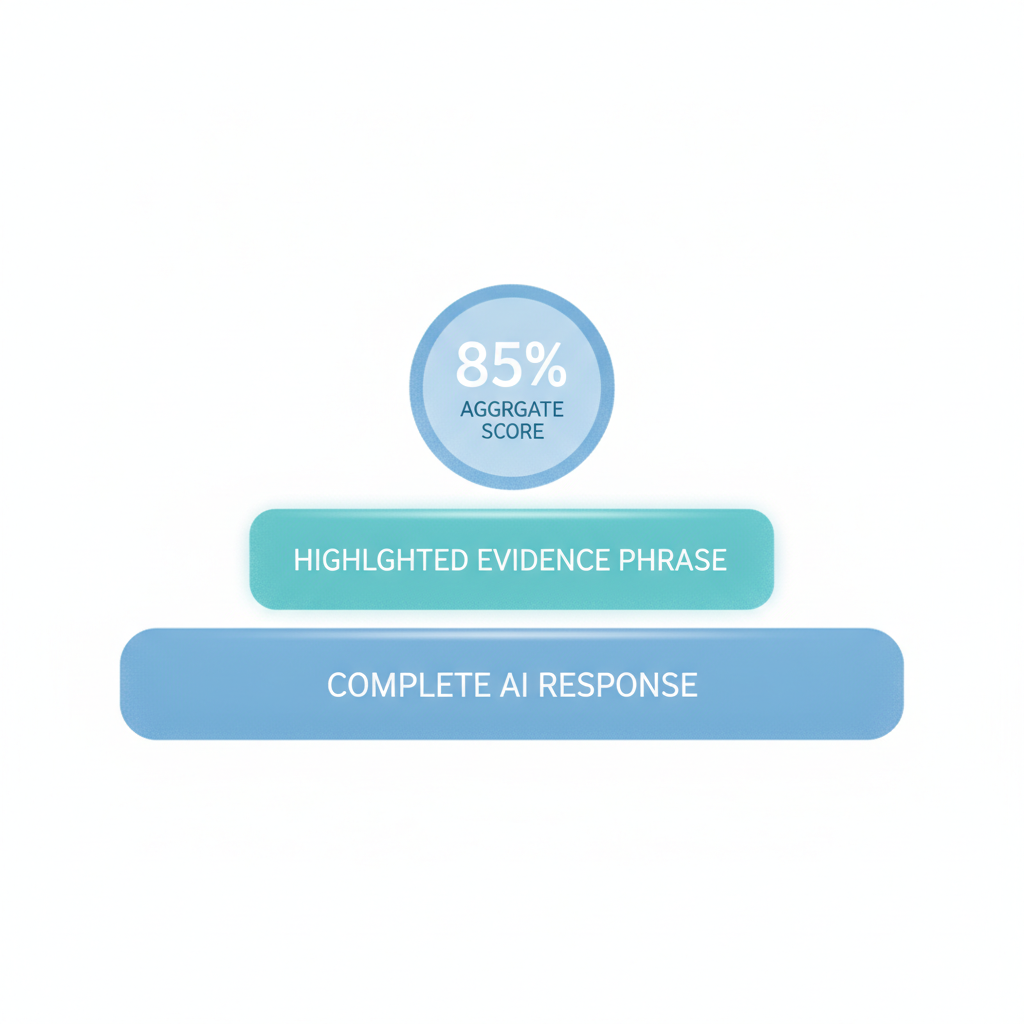
The distinction is grounded in explainable text classification. A rationale survey describes extractive rationales as spans taken from the original text, which is exactly the standard a useful sentiment record should meet. A generated explanation may sound plausible. The original phrase is what lets an analyst check it.
Which Evidence Makes an AI Sentiment Classification Auditable?
Auditability begins with a simple rule: a reviewer should be able to see what was asked, what was returned, what text triggered the label, and who approved the interpretation. If any one of those links is missing, the result may still be useful for discovery, but it is weak evidence for a report or content decision.
Capture the Full Answer and Run Context
Keep the full response with the original prompt, date, answer engine, collection method, and relevant competitor set. That record protects against a common reporting failure, where a dashboard displays a label after the underlying wording has changed or disappeared.
Capturing context does not mean treating one answer as permanent truth. Models and answer surfaces change. It means preserving the observation your team actually reviewed. Our tracking architecture guide shows the handoffs that happen between collection, classification, dashboarding, and action.
Attribute the Label to Exact Language
A phrase should be displayed beside its sentiment label, confidence field, and classifier version. This gives reviewers a way to spot false positives, such as a negative adjective aimed at a category problem rather than the brand itself.
The best review record also allows mixed and uncertain outcomes. Forcing every answer into positive, neutral, or negative can erase useful nuance. The NIST guidance on transparency and explainability supports a workflow that makes results understandable to the people responsible for acting on them.
Filter, Export, and Review the Record
Teams need to filter evidence by prompt, engine, competitor, date, sentiment, confidence, and review status. They also need to export the underlying rows, not merely a chart. That is how a marketing leader can ask, “What changed?” and receive the supporting language instead of a percentage alone.
Use prompt research to build the monitoring set around buyer questions, then treat score changes as a triage signal. The reviewable record determines whether the change is meaningful.
How Do You Turn a Raw AI Answer into Reviewable Evidence?
A sound workflow is deliberately modest. It does not claim that a classifier understands every implication perfectly. It creates a repeatable path for a human to inspect the model language, confirm the classification, and decide whether the finding deserves action.
Start with a Synthetic Example
Imagine a buyer prompt asking which project-management tool is easiest for a small marketing team. A synthetic response says: “Northstar is easy to set up, though its reporting is limited for complex workflows.”
The phrase “easy to set up” receives a positive label with a confidence field. “Limited for complex workflows” receives a negative label with its own confidence field. The reviewer marks the answer as mixed, because the evidence supports both interpretations. No metric is asked to carry more meaning than the response contains.

Follow a Five-Step Audit Loop
- Capture The Observation: Store the prompt, full response, engine, and timestamp.
- Extract The Evidence: Link each label to the smallest phrase that supports it.
- Filter The Context: Compare the result by prompt cluster, engine, competitor, and date.
- Review The Classification: Confirm, amend, or reject the label with a short reason.
- Act On Confirmed Themes: Turn repeated, reviewed descriptors into content, product, or messaging work.
This loop helps teams avoid optimizing for a stray answer. A repeated phrase across related buyer prompts may reveal a positioning gap. A one-off phrase may be a model error, outdated context, or a classification mistake. Our buyer prompt guide can help connect that distinction to the questions real prospects are likely to ask.
Group Themes, Not Just Polarity
Directional sentiment is useful, but recurring descriptors are more actionable. Group approved phrases into themes such as onboarding, support, reporting, implementation, or value. Then compare the theme against the page, proof, or documentation a buyer would need to resolve it.
Before expanding a theme, compare it against the complete answers that produced it. Look for sentence meaning, not just repeated terms. A phrase such as “limited reporting” may describe a missing feature, an implementation constraint, a legacy page, or a generic warning that applied to another product. The reviewer should capture the surrounding sentence and tag the intended subject before grouping it. This is also the point to separate brand language from general category language. Doing so prevents a report from turning an unrelated negative statement into a brand-level finding.
A dependable workflow also keeps the reporting lens separate from the action lens. The first asks what language appeared and how often. The second asks what a buyer would need to see to change that language. Our visibility monitoring guide explains why those two jobs should not be collapsed into a single metric.
That approach makes phrase-level AI sentiment analysis a practical content input rather than another reporting layer. It also keeps human judgment where it belongs, between model output and public-facing action.
How Should Teams Compare Tools for Phrase-Level AI Sentiment?
Compare platforms on evidence quality first, then coverage, reporting, and price. A large answer-engine count cannot compensate for a workflow that hides the language behind its sentiment labels. Similarly, a sophisticated dashboard is not enough if an analyst cannot export the record or send a questionable result to a reviewer.
| Workflow Type | Raw Response Access | Phrase Attribution | Reviewer Decision | Best Use |
|---|---|---|---|---|
| Directional Trend Monitor | Sometimes limited | Usually absent | Usually absent | Early signal detection |
| Evidence-Ready Monitor | Present | Present | Basic review status | Brand and content analysis |
| Full Audit Workflow | Present with metadata | Present with confidence | Approval, notes, and export | Defensible reporting and recurring decisions |
For a fair vendor comparison, verify each capability from current official documentation or a live demonstration. Mark undocumented features as undocumented, not unavailable. Ask to see a raw answer, its highlighted phrase, filters, history, export, and reviewer override in one continuous workflow.
Coverage should follow buyer behavior. If one answer surface drives the relevant conversations, a focused monitoring set may be more valuable than broad coverage without depth. Our single-site monitoring guide explains how to begin with a manageable prompt set before expanding scope.
The next question is what happens after review. A sentiment workflow should point to an evidence-backed action, such as improving a comparison page, clarifying a capability, or publishing a missing proof point. A team should be able to trace that action to a reviewed theme, rather than reacting to one vague score.
How Do You Handle Retention, Privacy, and Reproducibility?
Exact responses can be sensitive records. A disciplined workflow collects only what is needed for the stated monitoring purpose, limits reviewer access, and redacts personal information before evidence is shared more widely. The privacy principles behind data minimisation and storage limitation are a useful baseline for deciding what to retain and for how long.
Reproducibility has a practical meaning here. Preserve the prompt, full response, collection date, engine, and classification record so a reviewer can understand the historical observation. Do not promise that a changing model will reproduce identical wording on demand.

Set clear reviewer roles. Analysts can classify and export. Brand owners can approve messaging implications. Legal or privacy stakeholders can define sensitive-content handling. This structure makes the workflow safer without turning every mention into a compliance exercise.
For teams covering several answer surfaces, our multi-engine signals guide helps distinguish genuine cross-engine patterns from a shift limited to one source.
Book a PageLens.ai Demo
At PageLens.ai, we help marketing, growth, SEO, and content leaders turn AI visibility observations into a practical review loop. Begin with the prompts your buyers use, monitor the answer surfaces that matter to your category, and bring material changes to a person who understands the brand. Our public single-site plans are structured around daily monitoring: Monitor covers 50 prompts on one answer engine, Optimize covers 100 prompts across three engines and includes competitor and sentiment tracking, while Growth expands answer-engine coverage and includes 25 managed content pieces. We will show you the workflow, discuss the evidence your team needs before acting, and help determine whether the plan matches your scope. Bring a recent answer, a difficult classification, or a reporting question. Then leave with a clear next step and a shared definition of proof for your next reporting cycle. Book a demo
FAQs on Phrase-Level AI Sentiment Analysis
What Is Phrase-Level AI Sentiment Analysis?
It preserves the full answer and maps a positive, negative, mixed, or uncertain label to the exact language that prompted it, with run metadata for later review.
Why Is an Aggregate Sentiment Score Not Enough?
A score tells you direction. The underlying wording tells you whether the model praised a capability, repeated an outdated claim, misunderstood context, or triggered a false positive.
What Should an Auditable Sentiment Record Include?
Record the prompt, full response, answer engine, date and time, relevant competitor, extracted phrase, label, confidence, classifier version, reviewer decision, and reviewer note for future audit.
How Long Should Teams Retain AI Answer Evidence?
Retain evidence only for the documented business purpose, review access and retention regularly, redact personal information, and keep excerpts limited to what reviewers need for decisions.