
AEO Tracking Unlimited Client Sites: Agency Pricing Models Compared
Compare flat-fee and per-client AEO pricing for agencies, including 5, 10, and 25-client cost models, white-label fees, and API limits.

AEO Tracking Unlimited Client Sites: Agency Pricing Models Compared
AI search measurement is becoming a practical agency discipline, not a speculative experiment. A foundational GEO study found visibility gains of up to 40% in its experimental setting, although results vary by query, domain, and implementation.
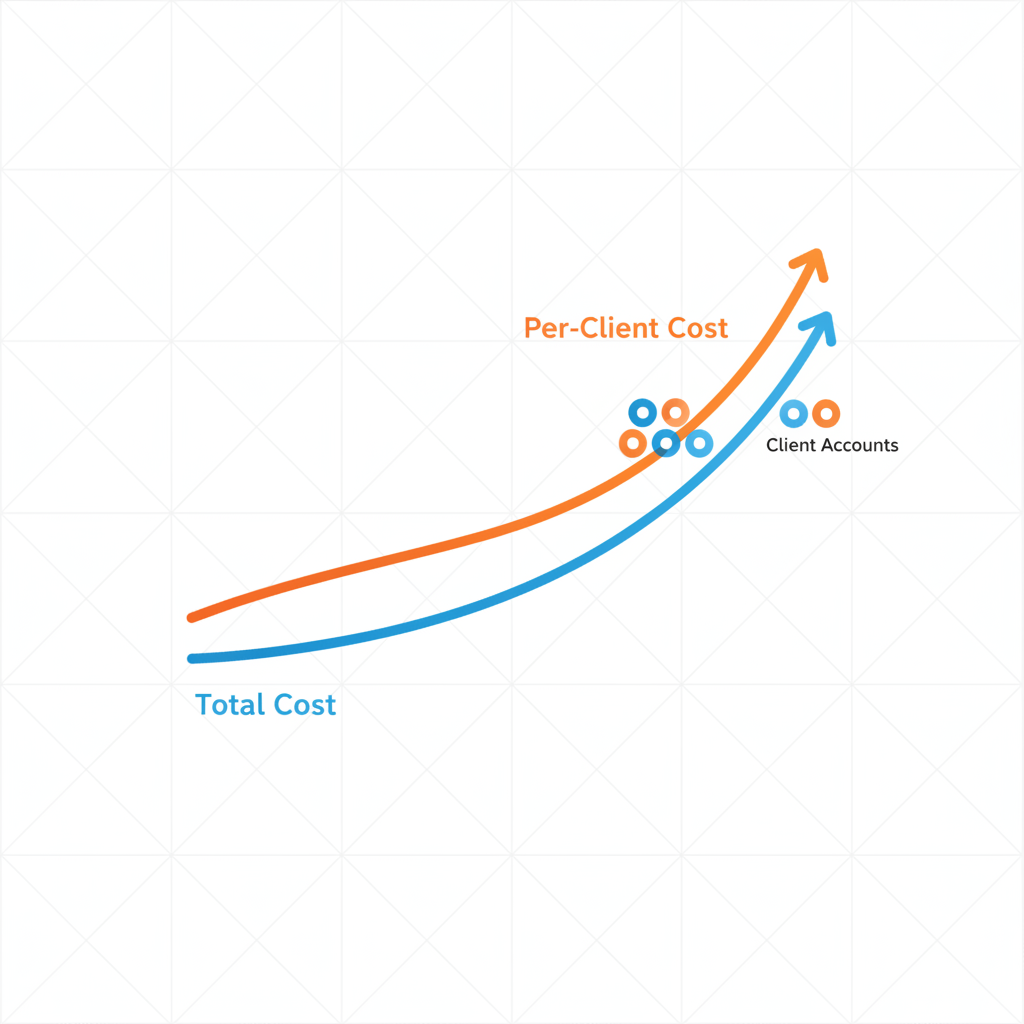
Agencies that need aeo tracking unlimited client sites should choose a fixed-fee, unlimited-account plan when they expect to grow past a handful of clients, provided prompt capacity, reporting, and API terms also fit. Per-client billing can cost less early, but its total rises with every added client and white-label add-on.
This guide compares the economics, capacity checks, and reporting tradeoffs behind aeo tracking unlimited client sites.
Why AEO Tracking Unlimited Client Sites Changes Agency Economics
Agency teams rarely outgrow tracking because a dashboard stops working. They outgrow it because each new client changes the invoice, reporting workload, and available capacity. AEO tracking unlimited client sites removes one variable from the budget, but it does not remove the need to check prompts, users, and delivery limits.
Start with the billing unit, then calculate the portfolio rather than the first client.
A per-client plan is predictable only while the roster is small. Once an agency adds accounts, the recurring fee, branded reporting cost, and extra-seat charges can all expand at once. A fixed plan keeps the software line item stable, which makes it easier to protect margin when a retainer is added.
The practical question is not whether aeo tracking unlimited client sites sounds attractive. It is whether the plan has enough daily prompts, answer-engine coverage, client workspaces, and reporting capacity to serve every account properly. PageLens Platform is positioned around a multi-client agency workflow, including unlimited client sites and reporting under the agency’s brand.
Define a Client Site Before Comparing Plans
A client site sounds simple, but it is often the most important undefined term in an agency contract. One provider may count a root domain, while another counts a regional subdomain, a separate workspace, or an additional report. That difference can materially change the true cost of aeo tracking unlimited client sites.
Use a written definition before you compare any headline price.
Ask each vendor whether one client allocation covers a single root domain, multiple country versions, a staging environment, client viewers, and separate prompt sets. Also ask whether the platform pools prompts across the portfolio or reserves capacity for every account.
This is where prompt research matters. An agency that tracks the same generic prompts for every client may use fewer credits, but it will produce less useful evidence. Distinct client accounts need distinct buyer questions, category terms, and comparison prompts.
Pricing Comparison for Agency Portfolios
Public pricing can reveal the shape of agency costs even when vendor names must remain out of the article. The comparison below uses documented monthly list prices captured on July 21, 2026. It includes white-label reporting when it is separately priced, but excludes taxes, annual discounts, custom contracts, usage packs, and extra seats.
Compare the recurring total and the cap together.
| Tool | Agency Plan Structure | Client Site Limit | Cost At 5 Clients | Cost At 10 Clients | Cost At 25 Clients | White-Label Available | API Access |
|---|---|---|---|---|---|---|---|
| PageLens.ai | Fixed agency quote | Unlimited client sites | Same agency quote | Same agency quote | Same agency quote | Included | Confirm scope |
| Documented Flat-Fee Plan | $999 per month | 50 websites | $999 | $999 | $999 | Included | Full access included |
| Documented Per-Client Plan | $499 includes 3 clients, then $119 per client | Paid expansion, enterprise for larger portfolios | $836 | $1,431 | $3,216 | $99 per month extra | Enterprise or custom |
The most important comparison is not the entry price. It is the cost of serving the actual client roster with the features clients expect. For aeo tracking unlimited client sites, also confirm that answer-engine coverage is consistent across accounts. Multi-engine tracking helps teams distinguish prompt volume from meaningful coverage.
AEO Tracking Unlimited Client Sites Cost Calculator
A static calculator makes the break-even point visible before a platform becomes embedded in client reporting. It also prevents an agency from comparing a white-label fixed plan with a per-client plan that requires a separate branding fee. The resulting number is more useful than a feature checklist alone.
Use the table as a planning model, not a contract quote.
The documented per-client model costs $499 for three clients, plus $119 for every additional client. Its white-label option adds $99 monthly. The documented flat-fee plan remains $999 until its 50-site cap. A fixed quote for aeo tracking unlimited client sites remains unchanged as the portfolio grows.
| Client Sites | Capped Flat Plan | Per-Client Plan, No White-Label | Per-Client Plan, With White-Label | Difference Versus Capped Flat Plan |
|---|---|---|---|---|
| 5 | $999 | $737 | $836 | Per-client is $163 lower |
| 10 | $999 | $1,332 | $1,431 | Per-client is $432 higher |
| 25 | $999 | $3,117 | $3,216 | Per-client is $2,217 higher |
At six clients, the white-label per-client model totals $955. At seven, it reaches $1,074, which is higher than the $999 fixed plan. That is the documented break-even point before seats, usage packs, or negotiated discounts. A single-site workflow can be useful for validating a tracking process before scaling it across a portfolio.
Hidden Costs That Change Agency Margins
The visible subscription price is only one part of the operating cost. White-label reporting, client viewers, API access, prompt limits, scan caps, and staff seats can each alter the economics of aeo tracking unlimited client sites. Agencies should model these items before promising a reporting cadence to a client.
Treat each add-on as part of the platform’s effective monthly price.
- White-label reporting: Include the branding fee in every scenario where clients receive reports or dashboard access.
- Additional seats: Check whether strategist, analyst, and client-viewer accounts are treated differently.
- API access: Confirm whether API access is included, rate-limited, or reserved for a custom agreement.
- Pooled prompts: Divide total prompt capacity by active accounts, then leave room for new campaigns and investigations.
- Usage packs: Ask whether additional scans, pages, exports, or prompts have fixed prices or require a plan upgrade.
Citation evidence matters as much as a visibility score. Citation tracking can help teams show which sources appear in AI responses and where a client has an evidence gap.
Measure AEO Tracking Unlimited Client Sites with a Repeatable Workflow
A scalable agency workflow should use the same reporting standard for every client while preserving client-specific prompts, competitors, and conversion goals. That is how aeo tracking unlimited client sites becomes an operating system for account management rather than another monthly spreadsheet.
Measure, explain, assign, then repeat.
Google says its generative features remain rooted in core Search ranking and quality systems, and recommends useful content, crawlability, and technical clarity over shortcuts. Google’s guidance makes the implication clear: tracking should lead to better pages and better evidence, not just prettier dashboards.
Build a weekly cycle for each account:
- Measure visibility: Record recommendations, citations, sentiment, and competitors across the relevant answer engines.
- Explain movement: Identify whether the change came from a prompt shift, missing source, content gap, or technical issue.
- Assign an action: Give one owner a specific page, source, or reporting task.
- Review client impact: Connect the work to the client’s category, buyer journey, and existing retainer.
Use sentiment architecture to make sure a positive mention is not mistaken for a recommendation. The report should distinguish how often a client appears, how it is described, and whether the answer actually steers a buyer toward that client.
Turn AEO Tracking Unlimited Client Sites into Client Deliverables
Agencies retain clients when reporting creates a credible next action. AEO tracking unlimited client sites provides the portfolio structure, but the deliverable still needs to answer what changed, why it changed, and what the agency will do next. Those answers should be concrete enough for a client leader to approve.
Turn evidence into a focused monthly narrative.
Start with the buyer questions that shape a category, then turn repeated evidence gaps into owned work. Content optimization helps teams connect monitoring findings to pages, briefs, technical updates, and publication workflows that can be reviewed in the next reporting cycle.
A strong client report should include the tracked prompts, the engines checked, the client’s recommendation or citation pattern, the most material source gap, and the next action. Avoid claiming that a score guarantees placement. The value is a measurable workflow that reduces guesswork and documents progress.

PageLens.ai for Agency-Scale AI Visibility
PageLens.ai is built for teams that need to see how answer engines describe every client, prioritize the sources and prompts that matter, and turn findings into publishable work. The agency approach is practical: keep client reporting under your brand, monitor recommendation, citation, and sentiment changes, then assign the next content or technical action before the monthly review becomes a retrospective.
The next step is a direct fit check.
Use the platform to standardize how strategists scope new accounts, how analysts report progress, and how content teams turn recurring buyer questions into useful pages. It supports a growth workflow without asking an agency to rebuild its reporting process for every added client. Bring client-service and content leads to the conversation. If you want to evaluate coverage, workspace structure, and fit for your current portfolio, start with a focused conversation and Book a demo
FAQs on Aeo Tracking Unlimited Client Sites
Use these pre-purchase questions to define client allocations, white-label billing, and break-even costs before selecting an agency platform or promising a reporting workflow to new accounts.
Start with the contract language.
What Counts as a Client Site?
A client site usually means one managed domain or brand workspace. Confirm whether subdomains, regional versions, staging environments, separate reports, or client viewers use additional allocations.
Do White-Label Features Cost Extra?
Sometimes. Some agency plans include branded reports, while others add a monthly fee. Include branding, client portals, report delivery, and viewer seats in your total.
When Does a Flat Fee Beat Per-Client Pricing?
With white-label reporting, the documented per-client model reaches $1,074 at seven clients, above a $999 fixed plan. Check seats, usage packs, taxes, and discounts before committing.