
How Do You Find Real Buyer Prompts? An Evidence-First B2B Buyer Prompt Research Workflow


TL;DR
Real buyer prompt research starts with verbatim questions captured in sales calls, support conversations, owned chat logs, site search, and public discussions. We preserve the original wording, cluster it by buying intent, and test recurrence; AI-generated prompts can broaden the set but stay hypotheses until independent evidence validates them. This guide shows how to rank evidence and turn validated clusters into content and monitoring.
B2B buyers increasingly blend AI research with human checking. In a survey of 645 B2B buyers, 45% reported using generative AI during a recent purchase process, primarily to research vendors and products, according to a Gartner survey.
Real buyer prompt research starts with verbatim questions captured in sales calls, support conversations, owned chat logs, site search, and public discussions. We then preserve the original wording, cluster it by buying intent, and test recurrence. AI-generated prompts can broaden the set, but they remain hypotheses until independent evidence validates them.
This guide explains what teams can actually know, how to rank evidence, and how to turn validated question clusters into content and monitoring work. For the broader shift from terms to conversations, see our prompt research guide.
What Can You Know About Private Buyer Prompts?
Private prompts entered into third-party AI assistants are not a public research feed. Unless a buyer shares a prompt with you, or it exists in an owned workspace where you have permitted access, you cannot verify that a specific person typed it into an assistant.
That limit is useful because it forces cleaner research claims. You can say, “Prospects repeatedly asked this in sales calls,” or “This question appears in public community discussions.” You should not say, “Buyers are typing this into AI assistants,” unless you hold direct, permissioned evidence.
AI providers also design business products around customer control. OpenAI states that business inputs and outputs are not used to train models by default, which reinforces why other organizations’ conversations cannot be treated as open marketing data. Read the relevant privacy terms before defining what your team can collect and retain.
The practical distinction is simple:
- Observed Question: A verbatim question with a known source, date, context, and evidence record.
- Inferred Prompt: A suggested wording from an AI assistant, fan-out exercise, keyword source, or modeled dataset.
- Validated Cluster: A group of related questions that meets your evidence and business-value standard.
This is not a reason to stop researching conversational demand. It is a reason to be precise about the difference between what buyers demonstrably said and what a system predicts they might ask.
Which Evidence Should B2B Teams Trust First?
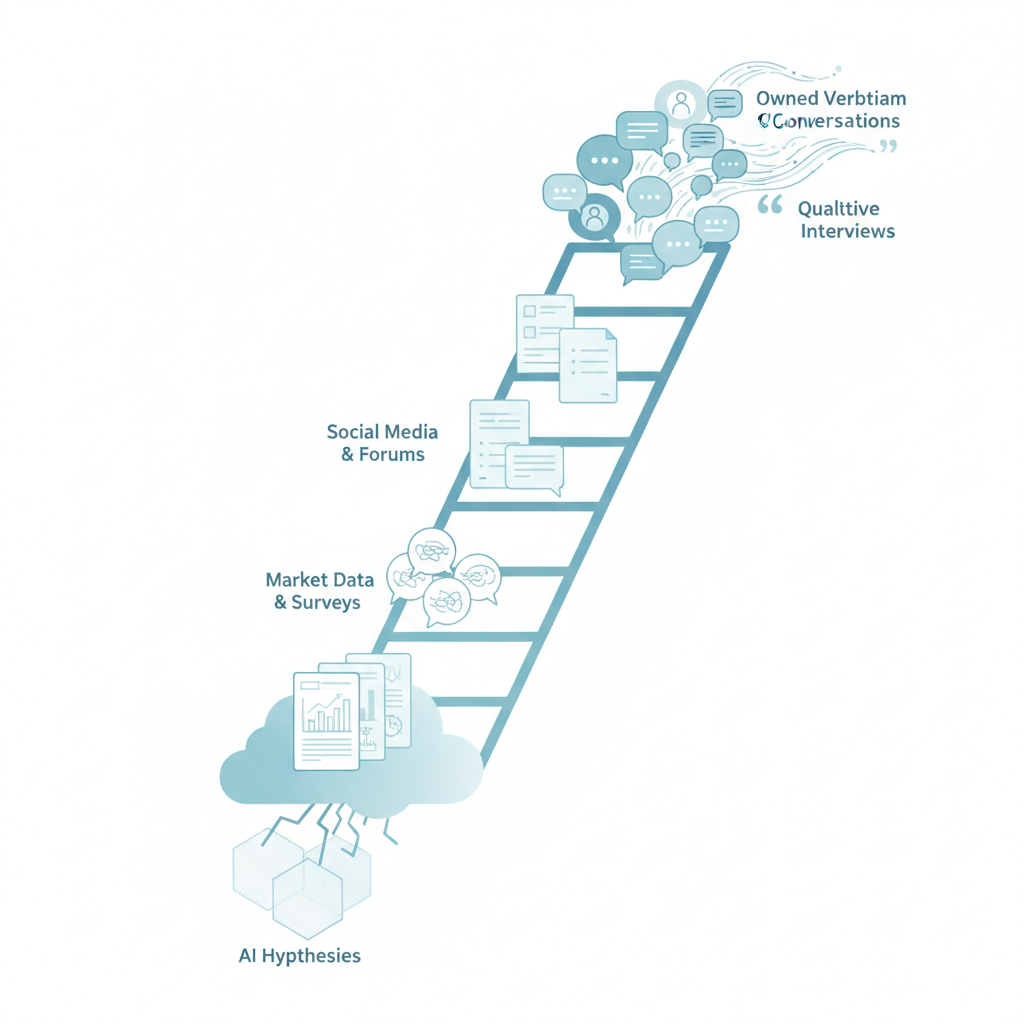
A good research program does not force every signal into one spreadsheet column called “prompt.” It records how each item was found, what it proves, and what it cannot prove. That prevents an appealing AI suggestion from outranking a repeated sales objection.
| Evidence Level | Source | What It Proves | Required Record | Limitation |
|---|---|---|---|---|
| 1 | Owned verbatim conversations | A buyer or customer said it | Transcript, date, role, stage | Not proof of a private AI prompt |
| 2 | Owned behavioral data | A visitor searched or asked it on your properties | Query event, date, page or chat context | Intent may be incomplete |
| 3 | Public discussions | People use this language publicly | URL, date, community, context | May not represent the market |
| 4 | AI Suggestions And Fan-Out | A model finds the question plausible | Model, date, seed, output | Not observed demand |
| 5 | Modeled Datasets | A provider estimates a pattern | Method, sample, freshness, definitions | May not expose raw evidence |
What Belongs at Evidence Levels One and Two?
Sales calls, demo transcripts, support tickets, onboarding chats, site search, and owned chatbot logs are the strongest starting points. They contain buyer language in the context of a real problem, a purchasing decision, or post-purchase friction.
Preserve the whole question, including constraints that might look messy in a keyword tool. “Can our lean team implement this without engineering help?” carries more commercial meaning than “easy implementation.” It reveals role, resourcing, objection, and desired outcome in one sentence.
Build this source base before expanding it. Our buyer prompt research workflow can help teams organize those records without flattening original language into generic marketing terms.
How Should You Handle Public Evidence?
Public community questions, review comments, and discussion threads can surface phrases that do not yet appear in your CRM. They are useful for widening coverage across use cases, role-specific problems, and objections.
Treat public language as public evidence, not as a universal demand estimate. Save the link, date, community, and context. One detailed thread may inspire a useful hypothesis, but recurrence across sources is what makes it a stronger content candidate.
When Is Modeled Evidence Useful?
Modeled datasets, AI suggestions, and fan-out outputs are valuable for exploring adjacent decision criteria. They are weak evidence for claiming exact buyer behavior. Ask any provider or internal analyst whether the source is raw, sampled, anonymized, synthetic, inferred, or a mixture.
The same discipline used in AI evaluation applies here. NIST identifies validity, reliability, accountability, and transparency as central characteristics of trustworthy systems in its AI framework. For prompt research, that means documenting how a candidate entered your dataset before you prioritize it.
How Do You Collect Verbatim Buyer Questions?
Collection works best when sales, support, marketing, and product agree on a shared definition of a usable record. The goal is not to create perfect transcripts. It is to preserve the buyer’s meaning while making related questions easy to find later.
Start with a defined ICP, purchase stage, category, geography, and research window. Redact personal information, follow your organization’s data-handling rules, and capture only material that your team is authorized to use.
- Set The Scope: Define the audience, buying stage, data sources, and review period.
- Export Owned Records: Pull sales calls, demos, support conversations, site search, and chatbot transcripts.
- Extract Question Spans: Save exact questions and nearby context instead of paraphrasing them into topics.
- Attach Provenance: Record source type, date, buyer role, account stage, and evidence level.
- Normalize For Matching: Remove obvious filler for deduplication while retaining the original phrase separately.
- Tag The Record: Add intent, use case, constraint, and buyer-stage fields.
- Review Recurrence: Group related records, then decide whether they warrant expansion or validation.
A simple record structure is enough: original question, normalized question, source type, date, buyer role, stage, evidence level, intent tag, recurrence count, and notes. The original field is non-negotiable because it keeps the content team close to the buyer’s actual framing.
Once you collect model-output snapshots during monitoring, store them separately from buyer questions. That separation makes an exact language audit more useful because your team can distinguish what a model says about the category from what buyers said they need.

How Should You Expand and Validate Prompt Ideas?
Expansion begins after you have a small, evidence-backed seed set. Use AI assistants to generate adjacent constraints, follow-up questions, and alternate phrasings, but label every generated result as inferred until another evidence source supports it.
You can also run representative questions through relevant AI interfaces and capture related questions, cited pages, decision criteria, and recurring omissions. That reveals how an answer engine frames a topic today. It does not reveal a hidden archive of buyer prompts.
Tag Questions by Buyer Intent
A useful taxonomy preserves the question’s commercial purpose. One phrase can receive more than one tag, but teams should identify the dominant decision behind it.
- Problem: “Our reporting process breaks when the team grows. What should we change?”
- Category: “What should we look for in this type of platform?”
- Comparison: “Which approach works better for our team and constraints?”
- Objection: “Is switching worth it if our current process mostly works?”
- Implementation: “How long will setup take, and who needs to be involved?”
- Risk: “What are the privacy, security, migration, or compliance risks?”
- Brand: “Does this provider support our required workflow and integration?”
Use Fan-Out as a Content Hypothesis
A primary question often implies additional buying criteria. A comparison prompt may lead to questions about integrations, implementation effort, pricing logic, security, or support. Those follow-ups can improve a brief, but they should remain clearly labeled as suggested coverage until you observe supporting evidence.
Run a small set of validated questions repeatedly, record the model and date, and compare the cited sources with your current content. Use single-site checks to establish a repeatable baseline rather than treating one response as a final verdict.
Test AI-Generated Candidates Against Evidence
For every inferred candidate, look for corroboration in an independent evidence type. A model suggestion about security becomes stronger when it also appears in sales objections, public discussions, site search, or support conversations.
Reject candidates that do not fit the ICP, do not map to a real decision, or cannot be answered accurately. Content should reflect buyer demand and product truth, not merely plausible prompt wording.
Preserve the Source Label Through Every Stage
Do not overwrite “inferred” with “observed” when a phrase becomes popular internally. The label should remain visible in your worksheet, content brief, and monitoring program. That traceability is what keeps buyer prompt research credible as more teams use AI to expand their topic lists. It also gives you a durable set of monitoring prompts for reviewing model answers over time.
How Do You Turn Validated Clusters into Content and Monitoring?
Validation is where a long list becomes a useful editorial roadmap. Cluster questions around the buyer’s decision, not only similar words. For example, “Do we need engineering support?” and “Can a small team set this up?” belong together because both test implementation effort.
Score each cluster on five criteria from zero to five. This is an editorial framework, not a claim about market volume. It helps your team decide what should become content, what should stay in monitoring, and what should be dropped.
| Criterion | 0 Points | 3 Points | 5 Points |
|---|---|---|---|
| Recurrence | Inferred only | Repeated in one evidence source | Repeated across independent sources |
| Commercial Relevance | General curiosity | Decision criteria appear | Active evaluation, risk, switching, or implementation signal |
| Audience Fit | Outside the ICP | Adjacent segment | Core buyer role and use case |
| Answerability | No defensible answer | Answer needs material caveats | Current, accurate evidence supports the answer |
| Current Visibility | No current check | One documented check | Repeated cross-engine checks show a clear gap or opportunity |
We use a 25-point total. A practical publication gate is 18 or higher, with at least three points each for recurrence and answerability. A lower-scoring cluster may still be worth monitoring, but it should not outrank a repeated question your team can answer clearly and accurately.
Here is an illustrative path from a single buyer question to a content brief:
- Capture The Verbatim Question: Save the sales-call wording, source, buyer role, and date.
- Create The Cluster: Group it with related implementation-effort questions while preserving every original phrase.
- Add Inferred Variants: Generate alternate phrasings and label them as hypotheses.
- Validate The Cluster: Score recurrence, commercial relevance, audience fit, answerability, and current visibility.
- Build The Brief: Specify the buyer decision, required proof, comparison criteria, FAQ, and source pages.
- Monitor The Prompt Set: Record the answer, cited sources, visibility, and factual accuracy over time.
The output is not just a blog topic. It is a decision-ready content map that can route implementation questions to documentation, risk questions to trust materials, and comparison questions to evidence-backed decision pages. Use citation tracking to connect the prompt cluster with the sources answer engines surface.

How Can PageLens.ai Operationalize Buyer Prompt Research?
PageLens.ai turns an evidence-first prompt list into an operating system for AI visibility. We help your team maintain distinct fields for verbatim questions, inferred variants, intent, source provenance, answer quality, and monitoring status, so a dashboard never treats a prediction as proof. Our workflow supports repeatable testing across AI answers, captures the sources shaping those answers, and gives marketers a clearer way to assign a content owner or correction task.
You still control the research standard. We do not replace sales-call review, invent buyer demand, or make private prompts visible. We help you retain the distinction, document decisions, and revisit important clusters as the category changes. That makes it easier to connect research with content briefs, source updates, and quarterly planning. Teams can use those records to prioritize evidence-backed answers before publishing pages that must withstand buyer scrutiny. Explore the PageLens platform, then Book a demo.
FAQs on Buyer Prompt Research
These answers clarify the evidence standard behind a practical research workflow.
Can Tools Show What Buyers Ask AI Assistants?
Tools can analyze owned chat logs, public discussions, and modeled datasets, but they cannot verify unaffiliated users’ private assistant prompts without direct, permitted access to underlying records.
How Do B2B Teams Discover Conversational Buyer Questions?
Start with sales, support, demos, site search, and owned chats. Preserve source and wording, then add public evidence and AI-generated candidates as separately labeled hypotheses.
How Should AI-Generated Prompt Ideas Be Validated?
Validate each idea for recurrence, commercial relevance, audience fit, answerability, and current visibility. Publish only after observed evidence supports the topic and its claims in market.
What Makes a Prompt Cluster Worth a Content Brief?
A strong cluster preserves original phrasing, combines independent evidence, identifies a real decision, and gives your team enough current, accurate material to answer confidently now.