
PageLens.ai Buyer Prompt Research: How to Find What Buyers Ask AI


TL;DR
Find buyer questions for AI search with a source-ranked method that separates observed language, inference, and simulations.
PageLens.ai Buyer Prompt Research: How to Find What Buyers Ask AI
Buyer research now happens inside private chat interfaces, not a public query log that marketers can browse. For example, Google says temporary chats and chats with activity disabled are retained with an account for 72 hours, not exposed as a market-research feed, in its privacy hub.
You cannot directly observe private prompts entered into public AI assistants unless people share them or a provider supplies an appropriately aggregated dataset. To do buyer prompt research well, combine consented conversations, onsite questions, search and community evidence, qualified category data, and controlled simulations, then label each prompt by source, intent, audience, confidence, and buying stage.
We will show you how to build that evidence base, turn it into a validated prompt library, map it to B2B content, and measure whether the work improves AI visibility and commercial conversations.
Buyer Prompt Research Begins with a Source Hierarchy
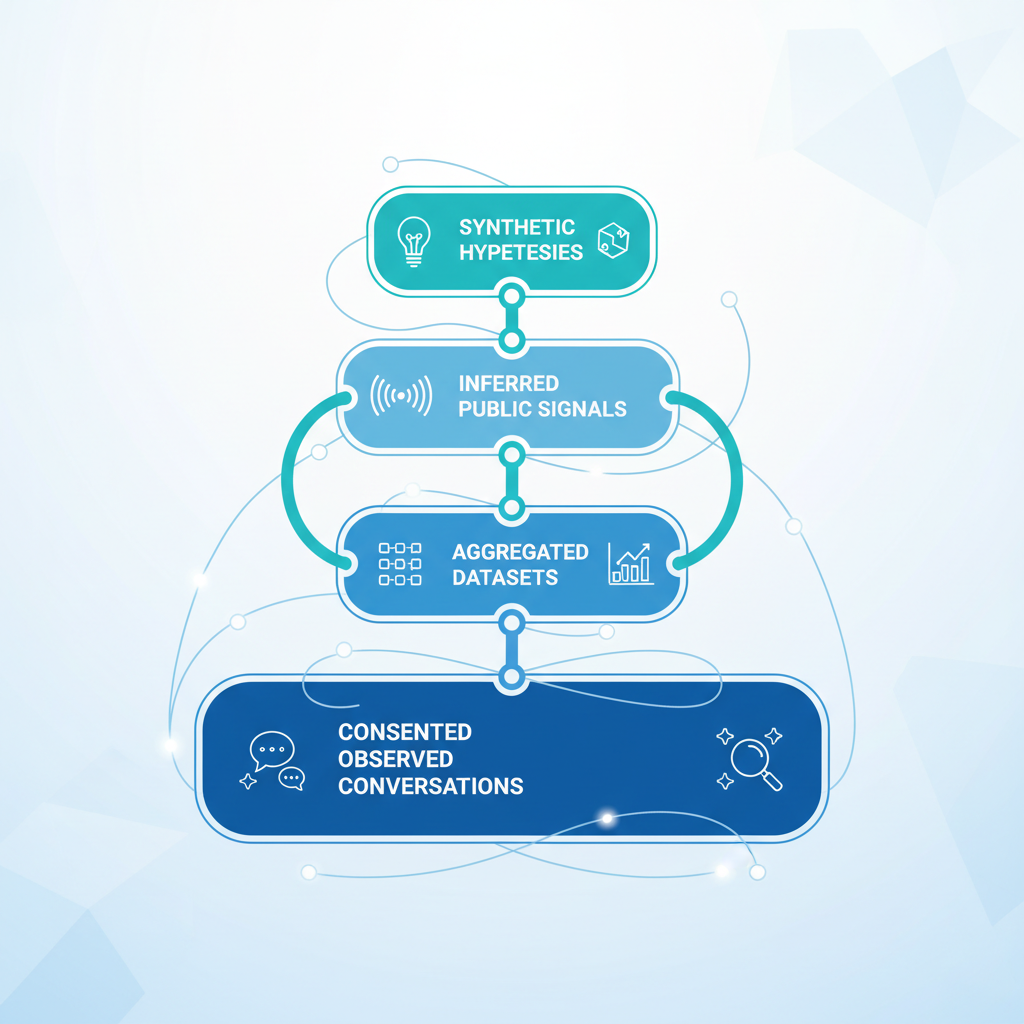
The first rule is simple: never let a useful signal pretend to be stronger than it is. A support ticket may contain exact customer language. A search query may reveal a phrasing pattern. A simulated assistant prompt may uncover a plausible objection. All three matter, but they answer different questions.
Tools can capture conversations your organization has permission to use, analyze a provider’s documented aggregate dataset, and test the answers an AI assistant produces. They cannot give you a reliable feed of private prompts across public chat interfaces. That boundary protects research quality as much as it protects privacy. Prompt research vs keyword research: what is the difference? explains why conversational demand needs a different evidence model than traditional query research.
| Source | Status | Privacy Need | Strength | Limitation |
|---|---|---|---|---|
| Consented sales calls and support tickets | Observed | High | Preserves real buyer wording and objections | Skews toward people who reached your company |
| Onsite search and chatbot logs | Observed | High | Captures in-the-moment questions on your property | Misses research happening elsewhere |
| Documented category datasets | Aggregated observed | Vendor review | May show recurring conversational phrasing and frequency | Coverage and sampling can vary |
| Search and public community discussions | Inferred | Medium | Reveals language, needs, and comparison patterns | Not evidence of private AI prompts |
| AI response and citation audits | Inferred | Low | Shows how assistants frame and support answers | Shows outputs, not buyer input volume |
| Controlled prompt exercises | Synthetic | Low | Generates testable hypotheses quickly | Cannot prove buyers asked the question |
Pseudonymisation is not a permission slip to reuse everything. If additional information could reconnect a record to a person, it remains personal data, according to EDPB guidance. Keep the source label visible in every dashboard, brief, and content decision so a synthetic idea never becomes an invented customer fact.
Use Four Evidence Labels
Use OBSERVED for a verbatim question from a consented internal source. Use AGGREGATED only when a dataset provider clearly documents how records are grouped and protected. Use INFERRED for patterns from search, public discussions, and answer audits. Use SYNTHETIC for prompts generated in a controlled exercise.
These labels do not rank ideas as good or bad. They make the next action clear. Observed language can inform copy immediately, subject to privacy review. Inferred language can guide research. Synthetic language should earn promotion only after independent evidence supports it.
Record What Each Signal Can Prove
Every prompt record needs a source system or URL, collection date, audience, source label, confidence, and validation status. Add a verbatim_flag so an analyst can distinguish an exact buyer statement from a normalized cluster name.
That small discipline lets us answer a question many teams skip: “What do we know, and what are we predicting?” It also gives sales, legal, and content teams a shared way to challenge weak claims before they become published positioning.
Mine the Conversations You Are Allowed to Use
The strongest starting point is usually language already shared with your organization: discovery calls, support tickets, win-loss notes, onsite search, and chatbot conversations collected under appropriate notice and permissions. These records reveal how buyers describe the job, the stakes, the constraints, and the objections in their own words. Start with What is buyer prompt discovery for B2B SaaS? if your team needs a shared definition before collecting evidence.
Do not export every transcript into a research tool just because it is available. Data protection principles call for information to be used for specific purposes, limited to what is necessary, secured, and retained no longer than needed, as summarized in UK guidance. Build the research workflow around those constraints from day one.
Prepare a Minimal Research Set
Create a narrow extraction rule. Pull the buyer question, the relevant surrounding context, the source type, and the event date. Remove names, email addresses, account identifiers, credentials, and sensitive information before researchers can access the record.
Restrict access by role, keep a deletion schedule, and log who can view raw material. The prompt library should usually hold redacted language and metadata, while the raw source stays in the approved system of record.
Preserve Verbatim Language Before Clustering
Ask sales and support teams to flag phrases without polishing them. Awkward wording can be valuable because it exposes the buyer’s mental model. A question about “getting approval without adding another dashboard” carries a different content need than a generic request for “reporting features.”
Then group close variants under a normalized cluster without deleting the original phrasing. Preserve both fields: the verbatim source helps writers sound like buyers, while the normalized cluster helps analysts count and prioritize.
Separate Prospects from Customers
A pre-purchase question can signal evaluation criteria, while a customer question may expose onboarding friction or a product gap. Both can become useful content, but they belong in different stages of the journey.
Add fields for buyer role, account segment, lifecycle status, and likely stage. A revenue leader comparing alternatives, an administrator asking about implementation, and a new user seeking configuration help should not be treated as one undifferentiated “prompt theme.”
Define the Prompt Record
Use a consistent record so the research survives handoffs between growth, product marketing, SEO, and sales.
- Prompt text: Keep the verbatim version and a separate normalized version.
- Source detail: Record the system, source type, collection date, and public or consented basis.
- Audience context: Capture role, segment, use case, geography when relevant, and lifecycle status.
- Research status: Store evidence label, confidence, redaction status, source count, owner, and next review date.
Our AI Sentiment Tracking Architecture can help teams connect exact answer language to a measurement workflow after the library has a sound evidence base.
Add Search, Community, and Category Evidence Carefully
Internal conversations tell you what people who reached your company asked. They do not tell you every category question being explored elsewhere. To expand coverage, use search data, public community discussions, review themes, and qualified category datasets as supplementary evidence.
Search data is especially useful for modifiers. It can reveal the role, budget, urgency, integration, geography, or implementation constraint attached to a broad category need. But it is not a substitute for AI-chat data. Google describes Search Console queries as terms that led people to a site, and notes that some rows are omitted or truncated for privacy and system limits in its query documentation.
Treat Public Language as Context, Not Census Data
A public discussion can show how someone frames a pain point. It cannot establish how often the category thinks that way. Record the date, original context, and relevance to your ICP, then use the finding as an inferred signal.
Search Console is similarly directional. Look for recurring modifiers and changes over time, not a false promise of complete demand coverage. Its branded and non-branded query filter began on March 11, 2025, so reporting history and availability can differ across properties.
Vet Aggregate Dataset Claims
A category dataset can be helpful when it documents provenance, aggregation, geography, update cadence, sampling limits, and privacy controls. The best providers can surface patterns such as intent, sentiment, comparison entities, and conversational phrasing. The responsible use is to treat those as aggregate evidence, not as an individual-level transcript feed.
Ask five questions before adding a dataset to the library: Where does it come from? What population does it represent? How are records aggregated? What is excluded? How recently was it updated? If the answer is vague, lower the confidence score rather than repeating a precise-looking claim.

Use the Evidence to Expand, Not Replace, Internal Research
When an inferred phrase appears in search and public discussions, bring it back to sales and support for confirmation. When an observed objection appears repeatedly in calls, look for adjacent modifiers in search and category data. This loop prevents a narrow internal sample from setting the entire roadmap.
For a practical comparison of these disciplines, see Keyword Research vs Prompt Research: What Changes When AI Evaluates Products. The useful overlap is language and intent. The crucial difference is what each source can honestly prove.
Use AI Testing for Hypotheses and Answer Audits
AI assistants are excellent at generating candidate constraints, comparisons, and follow-up questions. They are also useful for seeing how a category is described in current answers. Neither result proves that a buyer entered the exact prompt you tested.
Treat testing as hypothesis generation and answer auditing. Start with a documented category, ICP, use case, and a small set of observed themes. Run the same test in fresh sessions, record the model, date, locale, and instructions, then compare the output with your prompt library.
Run Controlled Hypothesis Tests
Ask for likely decision criteria, objections, and implementation concerns for a defined buyer scenario. Capture the resulting prompts as SYNTHETIC, without an assumed frequency score. The purpose is to widen the validation queue, not to create fake customer research.
A candidate becomes stronger only when it finds corroboration in observed language, a qualified aggregate source, search patterns, or public community evidence. If it does not, keep it as a monitored hypothesis or discard it.
Audit the Answers Buyers May Receive
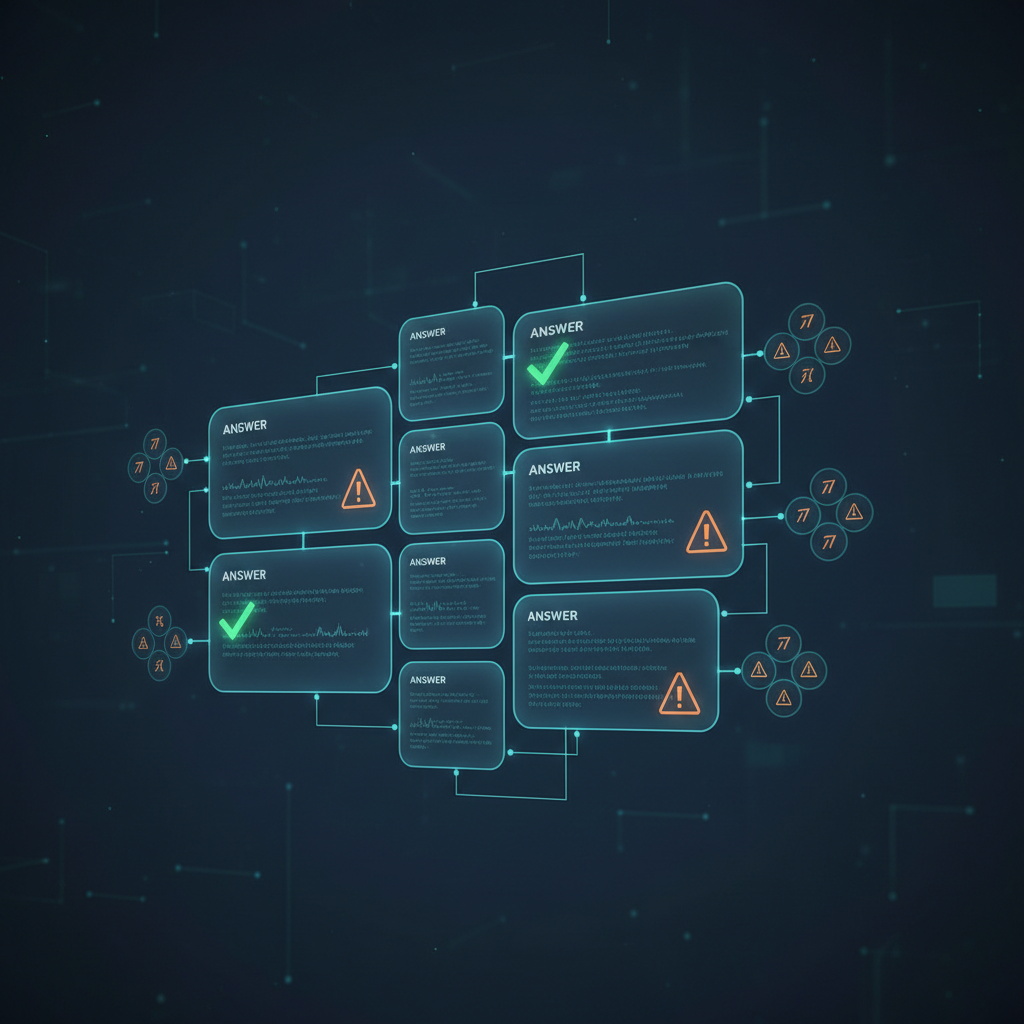
Run priority prompts repeatedly and record whether your site is mentioned, cited, accurately described, or missing. Save the cited URLs and the exact answer excerpt, then compare the claims against current product and category facts.
This exposes a different problem from prompt discovery: answer quality. A page can be visible but inaccurate, or accurate but absent. Citation Tracking for Claude and Gemini helps frame those as separate visibility layers worth measuring.
Document the Test Conditions
Model output can change with context, product updates, model updates, and the open web. A credible test set therefore needs versioned prompts, date stamps, locale, response settings where available, and a consistent scoring rubric.
NIST recommends documenting test sets, metrics, methods, uncertainty, and repeatable validation processes in its AI risk framework. Apply that discipline here: a screenshot without its test conditions is an anecdote, not a reliable performance record.
Score, Cluster, and Validate the Prompt Library
A prompt library earns its value when it helps a team decide what to investigate, publish, update, or stop doing. Use a transparent score instead of an opaque “opportunity” number. We recommend five equally weighted criteria, each scored one through five, for a 25-point total. Teams that need to turn this evidence into a manageable site structure can use AEO for 50-Page Product Sites.
| Criterion | 1 Point | 5 Points |
|---|---|---|
| Evidence Strength | Uncorroborated synthetic idea | Multiple qualified sources support it |
| Commercial Intent | Broad curiosity | Clear evaluation, objection, or decision |
| Frequency | Isolated occurrence | Repeats across qualified evidence |
| Category Relevance | Adjacent topic | Directly tied to the ICP and category |
| Answerability | Needs unavailable proof | Can be answered accurately with accessible evidence |
Prioritize clusters scoring 20 to 25 for creation or major refreshes. Scores from 15 to 19 need more validation or a supporting asset. Lower scores can stay in the monitored backlog. This approach gives rare but high-intent objections room to matter without letting a single flashy phrase dominate the plan.
Map Clusters to the Buying Journey
Use the decision being made, not the opening words, to classify a prompt. Awareness prompts ask what a category solves. Consideration prompts compare requirements. Comparison prompts weigh options against constraints. Objection prompts challenge fit, risk, or implementation. Decision prompts seek approval, proof, pricing, or a next step.
Map each cluster to the asset that can answer it best: an explainer, use-case page, transparent comparison table, documentation page, implementation guide, or FAQ. This turns a source-ranked library into a content plan that serves both early research and late-stage evaluation.
Close the Validation Loop
Track the priority prompt set over time, then connect AI answers and citations to website behavior, conversions, and sales feedback. Add a content-change date so the team can distinguish a meaningful trend from a coincidental shift.
Sales should review priority clusters monthly: Are prospects using this language? Did an objection disappear, evolve, or become more urgent? Growth and SEO should reassess the score quarterly, after material product changes or citation shifts. AI Visibility Tracking vs SEO Monitoring can help keep these measures distinct while still connecting them to one operating rhythm.
The goal is not to claim perfect knowledge of private conversations. The goal is to build a more honest, more useful research system that steadily improves the questions your content can answer.
See Buyer Prompt Research in PageLens.ai
Buyer prompt research becomes useful only when the evidence remains traceable after the first spreadsheet is built. We help growth, SEO, and content leaders turn scattered prompts into a governed workflow: source labels, repeatable test sets, citation checks, and feedback from the people who hear objections every day. Our platform lets your team see how AI answers describe a category, whether your site is cited, and where the answer is incomplete or inaccurate. That makes it easier to connect research to a content brief, a page update, and a commercial outcome without pretending that synthetic prompts are observed demand. We built PageLens.ai for teams that need AI visibility guidance, not a vanity score. Bring one category, a list of buyer questions, and your evidence. We will help you establish a testable baseline, choose the next content action, and create a review rhythm your team can sustain. Book a demo
FAQs on Buyer Prompt Research
Can a Tool Show Private Prompts Buyers Type into AI Assistants?
No. Private prompts are not a public research feed. Treat consented submissions or documented aggregated datasets as observed, and label all other signals by evidence type.
Which Data Sources Are Strongest for B2B Buyer Prompt Research?
Sales calls, support tickets, onsite search, chatbot logs, and win-loss notes work best when permissions, redaction, access controls, retention rules, and source metadata accompany each record.
Can We Use Synthetic Prompts in Our Content Research?
Use synthetic prompts to surface constraints, comparisons, and objections. Do not assign frequency or buyer intent until observed, aggregated, or inferred evidence independently corroborates them.
How Often Should We Validate Our Prompt Library?
Review priority clusters monthly with sales and support, then reassess scores quarterly. Re-run tracked AI responses consistently after material content, prompt, or product changes occur.