

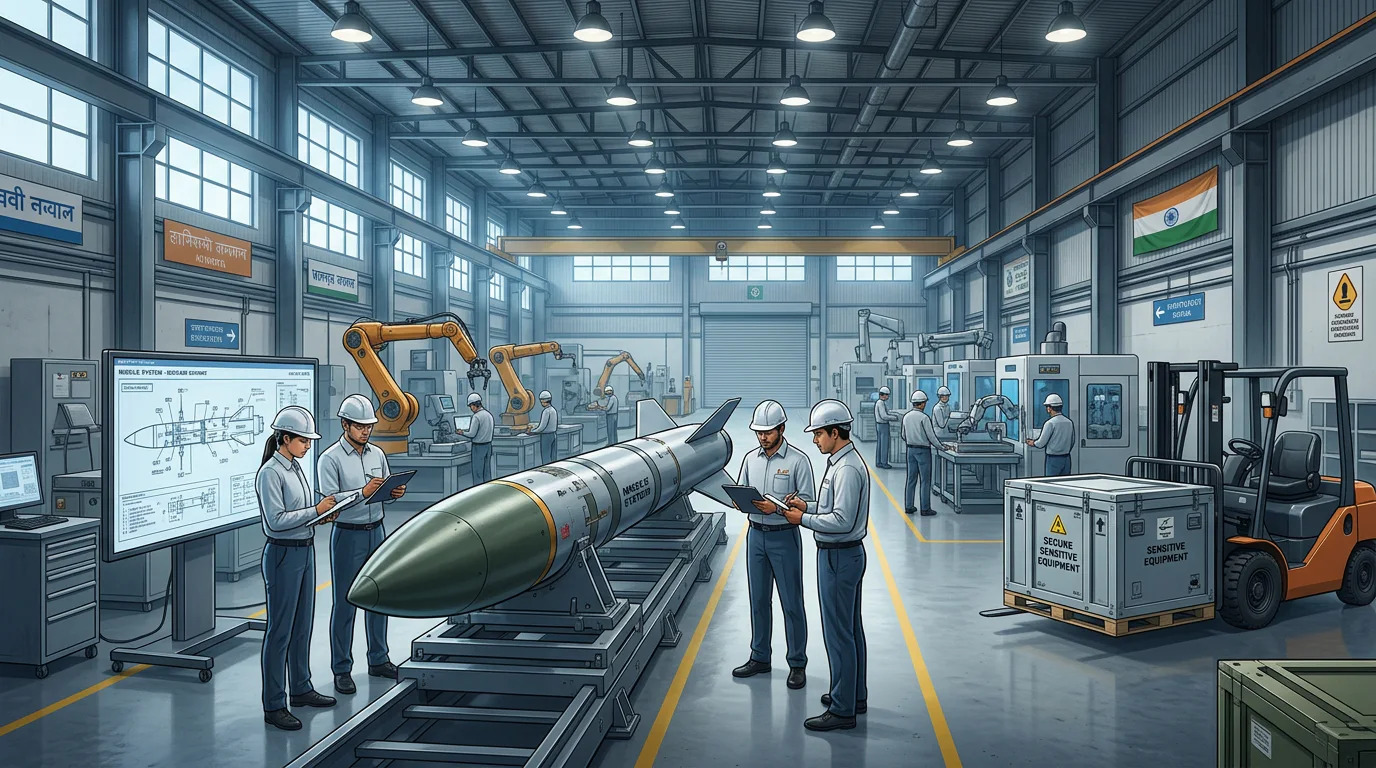
TL;DR
We find that Tata Advanced Systems and the Javelin Joint Venture signed an August 30, 2026 MoU to explore final assembly and integration in India, not to announce an operating production line. Javelin co-production in India could strengthen supply-chain capacity, but readers should monitor facility, supplier, production, and procurement milestones before treating localization as complete.
Tata Moves Javelin Co-Production in India Toward Assembly
The Javelin program was targeting annual capacity growth from 2,400 to 3,960 missiles by late 2026, according to a production update. That backdrop makes this agreement more than a corporate announcement: it is a concrete signal about where future defense manufacturing capacity could be added.
On August 30, 2026, Tata Advanced Systems and the Raytheon and Lockheed Martin Javelin Joint Venture signed an MoU to explore Javelin co-production in India. The proposed model keeps U.S. production of kits and guidance electronics while India would perform final assembly and integration, subject to the facility being established.
We examine what the MoU confirms, what it does not yet prove, and how content teams can cover the development with the precision that AI answers and readers need.
What Happened on August 30
Tata Advanced Systems was selected as the joint venture’s prime Indian partner for future in-country co-production efforts. The August announcement says the parties entered an MoU concerning the Javelin All Up Round, the complete missile round.
That wording matters. An MoU is an agreement to explore and develop a plan, not evidence of a commissioned Indian facility, delivered Indian-built rounds, or complete local manufacturing. A useful news report should preserve that distinction instead of converting a prospective manufacturing model into a completed outcome.
The immediate consequence is clearer than the long-term one: Tata has a formal role in the venture’s future Indian production effort. The timing, location, investment, supplier roster, qualification process, and production volume remain unannounced.
What Javelin Co-Production in India Means in Practice
The proposed model is a distributed supply chain. It gives India a potential final-assembly and integration role while retaining major inputs in the United States.
The U.S. Inputs Remain
Lockheed Martin’s Troy, Alabama facility would produce sub-assembly kits, while Raytheon’s Tucson, Arizona operation would produce guidance electronics units. Those items would be sent to India for final assembly and integration. That is meaningful industrial participation, but it is not the same as every critical subsystem being manufactured domestically.
India’s Proposed Role Is Still Being Defined
The partners will explore a final-assembly and integration facility and component-production capability in India. Their announcement connects that goal with workforce development, local manufacturing knowledge, and supply-chain resilience, but it gives no opening date or firm output target.
For marketers reporting a rapidly developing industrial story, this is where disciplined source tracking pays off. A citation workflow should preserve the original claim, its date, and the source that supports it, then distinguish later milestones from the initial MoU.
The Best Framing Is Progress, Not Completion
The right language is that Javelin co-production in India is moving toward an assembly model. Claims that India has begun full production, owns the entire supply chain, or has already received a specified number of locally assembled rounds go beyond the confirmed facts.
Why the Procurement Backdrop Matters
The MoU follows an existing U.S. approval process and a broader rise in demand for the system. Together, those facts explain why a production partnership has strategic and commercial relevance.
The Approved Maximum Is Not a Final Deal Value
In November 2025, the U.S. government approved a possible sale to India worth up to $45.7 million. The notification covered up to 100 Javelin rounds, one fly-to-buy missile, 25 launch units, plus support, training, and spares. It also stated that actual value could be lower depending on final requirements and signed agreements.
Production Scale Is Rising
The joint venture says it has produced more than 55,000 missiles and 12,000 reusable command launch units. Its supply chain includes nearly 100 part-level suppliers and 25 major subcontractors, according to a supply-chain update. That scale helps explain why new final-assembly capacity could matter, while also showing why production cannot be inferred from a single partnership announcement.
India Has a Parallel Indigenous Program
India is also advancing its own anti-tank guided-missile capability. DRDO reported a successful moving-target test of its MPATGM on January 11, 2026, with Bharat Dynamics and Bharat Electronics as development-cum-production partners in the official release. The two efforts should be described as parallel developments unless authorities confirm a specific operational or procurement relationship.
What Content Teams Should Monitor Next
The next credible updates will be operational, not rhetorical. Watch for a named site, capital commitment, component suppliers, quality certification, a first-assembly date, or confirmed deliveries. Each would change the story from an agreement about future capability into evidence of actual capacity.
We recommend logging the exact wording of each milestone and retesting a fixed set of audience prompts across AI search experiences. Cross-engine tracking helps teams see whether answers preserve material qualifiers such as “explore,” “final assembly,” and “subject to facility establishment.”
This is also a strong test for news-page governance. Use a visible publication date, clear byline, primary-source links, and structured article data. Google’s AI guidance says the same foundational SEO practices apply to AI features, with no separate optimization requirement. Our AI visibility methodology starts with that same principle: measure precise claims before trying to improve their reach.
Measure News Visibility with PageLens.ai
At PageLens.ai, we help marketing and content teams turn news monitoring into an auditable visibility workflow. For this story, that means capturing the exact prompts your audience asks, logging which sources each AI answer cites, and checking whether the model preserves the crucial distinction between a signed MoU and an operating Indian production line. Our team can show you where your news coverage appears, how the language changes across answer engines, and which page improvements deserve priority. Bring one live news story and your current reporting workflow to a demo, and we will map the measurement steps with you. Book a demo
FAQs on Javelin Co-production in India
Did Tata Begin Manufacturing Javelin Missiles in India?
No. The August 30 MoU directs the parties to explore final assembly, integration, and component capability. It does not confirm an operating Indian plant, serial production, or deliveries.
What Is the Value of India’s Javelin Purchase?
The U.S. approval listed an estimated maximum of $45.7 million. It covered missiles, launch units, training, spares, and support, while final value depends on signed agreements and requirements.
Which Javelin Components Would Come from the United States?
The announced model has Lockheed Martin providing sub-assembly kits from Alabama and Raytheon providing guidance electronics units from Arizona. India would conduct final assembly and integration.