


TL;DR
At PageLens.ai, we track AI search rankings through controlled, repeated buyer prompts, measuring mentions, recommendations, citations, defined answer position, and framing rather than claiming a fixed universal rank. This guide shows marketing, growth, SEO, and content leaders how to choose experiences, control samples, calculate trends, set alerts, and turn verified losses into page-level priorities.
How Do You Track AI Search Rankings?
Google says AI Overviews now reaches more than 2.5 billion monthly users. For marketing, growth, SEO, and content leaders, that makes answer visibility a measurement problem, not a curiosity.
We track AI search rankings by repeatedly testing a controlled set of buyer prompts and recording answer-level outcomes: whether a brand is mentioned, recommended, cited, accurately framed, and placed in a defined ordered answer. Because generated results vary, we report rates and trends across comparable observations instead of claiming one permanent rank.
This guide explains what to measure, which experiences to include, how to preserve evidence, and how to turn a confirmed decline into a page-level content priority.
What Do AI Search Rankings Actually Measure?
An AI answer can surface your brand without recommending it, recommend it without citing your site, or cite a page without naming the brand. Treating those outcomes as one score hides the reason a buyer may or may not encounter you.
Google’s own reporting shows why position needs care. An AI Overview occupies one search-result position, and every supporting link in that Overview inherits it. AI Mode uses Search-style position rules, while the observed position can still vary by context, including location and search history. Those Google position rules are useful for Google reporting, but they are not a universal ordering system for every answer experience.
| Signal | What Counts | Why It Stays Separate |
|---|---|---|
| Mention | Your normalized brand or product name appears | Measures basic presence |
| Recommendation | The answer actively suggests your brand for a stated need | Measures buyer-facing endorsement |
| Citation | An owned-domain URL appears as a visible source | Measures source attribution |
| Defined Answer Position | Your brand appears in a clearly ordered list or comparable structure | Measures relative placement only where order exists |
| Framing | The language around your brand is positive, neutral, negative, or qualified | Measures how the answer describes you |
A useful AI visibility record keeps those signals together for each prompt, then aggregates only like-for-like observations. Our multi-engine signals guide is a helpful companion when a dashboard needs to show the components behind a headline score.
Which AI Search Experiences Should You Track?
Track the experiences your buyers actually use at discovery, comparison, and decision points. A broad engine list looks complete, but it wastes effort if it does not match how your category is researched.
Start with discovery prompts that define a problem, comparison prompts that narrow a category, and decision prompts that test proof, implementation, price, risk, or fit. Google notes that AI Overviews do not trigger for every query, while AI Mode is designed for deeper exploration and complex comparisons in Google AI guidance. A non-triggering result should remain a recorded outcome, not be silently removed from the sample.
| Experience | Include It When | Record for Each Run | Measurement Caution |
|---|---|---|---|
| Google AI Overviews | Buyers begin research in Google Search | Trigger state, answer text, owned links, Search position | Supporting links can share one Overview position |
| Google AI Mode | Buyers ask exploratory or comparison questions | Answer, links, follow-up state, cited pages | Follow-ups are new queries |
| ChatGPT Search | Buyers research conversationally | Mention, recommendation, sources, framing | Preserve the Sources panel when available |
| Gemini Apps | Buyers use an assistant instead of a results page | Mention, related links, source availability | Not every response includes links |
| Microsoft Copilot With Web Search | Buyers work in Microsoft-led research flows | Answer, generated query when shown, source URLs | Web search settings can change the result |
For prompt selection, begin with observed buyer language rather than a keyword export. Our buyer prompt research process helps separate prompts that merely describe a topic from prompts that reveal an active evaluation.
Source visibility also differs by experience. ChatGPT may show citations and a Sources panel, but its own OpenAI search guidance warns that results and citations can be incomplete, outdated, or incorrect. That is why source capture belongs in the workflow, not in a later spot check.
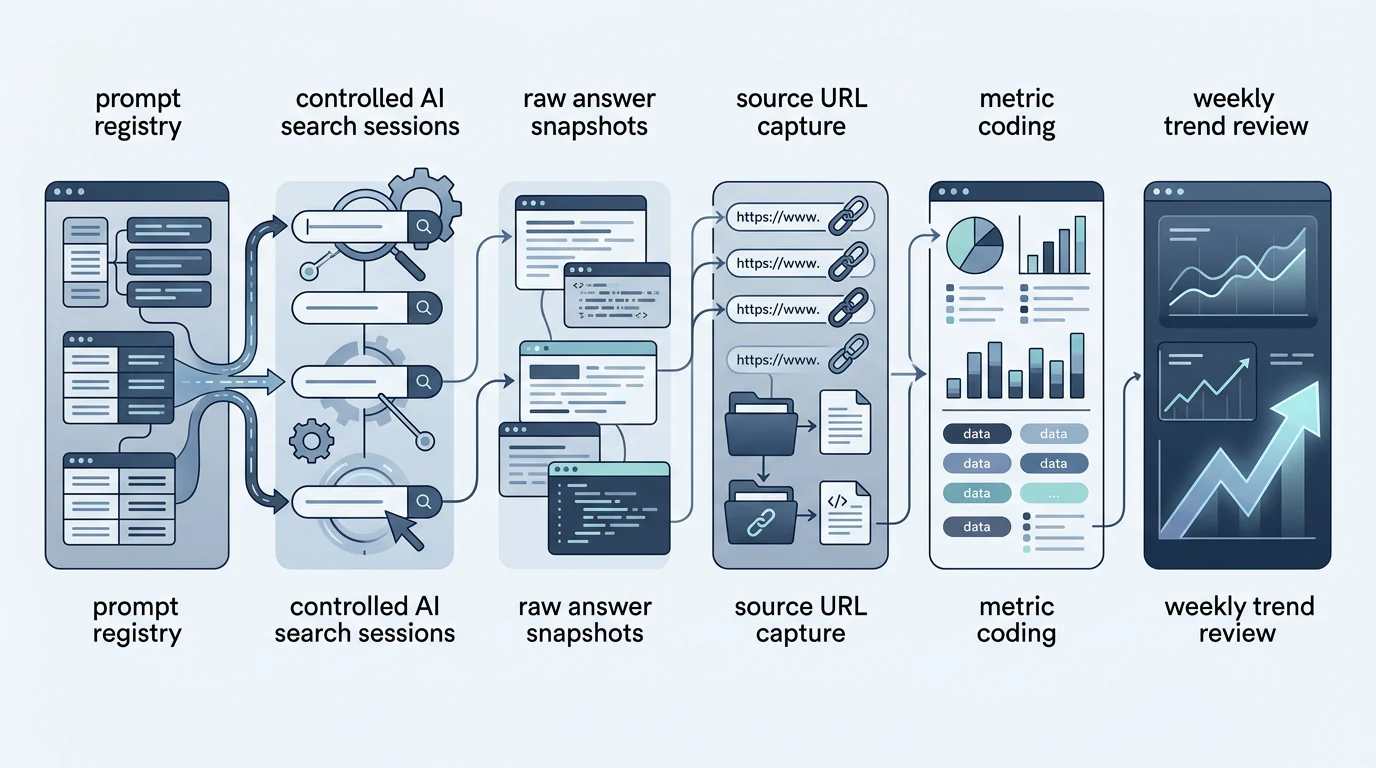
How Do You Build a Controlled Seven-Step Tracking Workflow?
A repeatable workflow makes changes explainable. If the model, market, language, or account state shifts between runs, you may be measuring the test setup rather than an answer change.
Set the Contract and Coverage
- Define the entities: List approved brand names, product names, owned domains, and common false positives.
- Choose the experiences: Map each one to a discovery, comparison, or decision moment in the buying journey.
A peer set should also be fixed before the first baseline. Adding or removing peer entities later changes share-of-voice denominators and can make a stable result look like a movement.
Build Stable Prompt Cohorts
- Create prompt groups: Freeze exact prompts into discovery, comparison, and decision cohorts, each with an ID, intent label, market, language, and business priority.
Do not rewrite a prompt because an answer disappoints you. Create a new versioned prompt if buyer language changes, then compare it as a new series. Our multi-engine method explains how to keep cross-experience prompt records comparable.
Lock Controls and Collect Raw Answers
- Record controls: Save model or version when visible, mode, web-search state, geography, language, device, account status, personalization setting, and collection time.
- Run and preserve evidence: Capture the full answer, visible source URLs, answer format, and any follow-up context.
When available, use an unpersonalized session. ChatGPT Temporary Chat lets users choose an unpersonalized mode that does not use memory, custom instructions, or plugins, according to its Temporary Chat controls. Our methodology keeps those controls connected to the evidence collected for each run.
Code, Compare, and Prioritize
- Code every valid answer: Apply the same entity, recommendation, citation, position, and framing rules.
- Compare controlled cohorts: Review meaningful deltas against the baseline, inspect the raw answer, and assign an owner only after verification.
This sequence separates observation from interpretation. It also makes a later audit possible when an answer changes layout, removes a source panel, or introduces a new peer.
How Do You Calculate AI Search Rankings from Answer Signals?
The goal is not a prettier composite score. It is a scorecard that shows exactly what changed, where it changed, and what evidence supports the conclusion.
Define Qualifying Events
A mention qualifies when the answer contains an approved brand entity. A recommendation qualifies only when the language actively suggests that brand for the user’s need. A citation qualifies when an owned URL appears in the answer’s visible sources.
For position, use an ordinal only when an answer has a genuine ordered structure, such as a numbered shortlist. Do not infer rank from the order of a narrative paragraph. That distinction aligns with Google performance guidance, which describes position as a context-dependent metric.
For a consistent multi-experience view, use our cross-engine method to keep source availability, answer structure, and control settings distinct.
Use a Metric Definition Table
| Field | Formula | Interpretation | Caveat |
|---|---|---|---|
| Mention Rate | Brand-mentioned observations divided by valid observations, multiplied by 100 | How consistently the brand appears | Review aliases and false positives |
| Recommendation Rate | Recommendation observations divided by valid observations, multiplied by 100 | How often the answer actively suggests the brand | A mention is not automatically a recommendation |
| Citation Rate | Observations with an owned source URL divided by source-observable observations, multiplied by 100 | How often the site is visibly sourced | Keep unavailable source panels out of the denominator |
| Average Defined Position | Sum of qualifying ordinal positions divided by observations with a defined order | Relative placement in ordered answers | Use not applicable for narrative answers |
| Sentiment Score | Sum of claim labels, positive, neutral, or negative, divided by coded brand-bearing claims | Direction of answer framing | Retain the claim-level evidence |
| Share Of Voice | Target qualifying mentions divided by all fixed-peer qualifying mentions in the same cohort, multiplied by 100 | Visibility within the defined peer set | It is not market share |
Work from Snapshots, Not Scores
Suppose a comparison answer names your brand in narrative text but provides no source link and does not recommend it. Code a mention, no citation, no recommendation, neutral framing, and no defined position. That single record is more useful than forcing it into an invented rank.
When citations do appear, retain the exact page URL and the surrounding answer language. Our citation tracking workflow helps teams connect source-level evidence to the pages they control.
How Do You Monitor AI Search Rankings over Time?
Weekly monitoring works when it compares the same prompt cohort under the same controls. The history should preserve enough evidence for another reviewer to reproduce the conclusion without trusting a chart alone.
| Week Ending | Prompt Cohort | Engine Control ID | Valid Runs | Mention, Citation, Recommendation Rates | Defined Position | Raw Answer Record | Source URLs | Change Review |
|---|---|---|---|---|---|---|---|---|
| Current Week | Discovery, Comparison, or Decision | Experience, Mode, Market, Language | Count of Valid Observations | Separate Rates | Value or Not Applicable | Saved Answer Snapshot | Captured Visible URLs | Verified or Pending |
Use alerts as a request to investigate, not an automatic verdict. A mention or citation loss should trigger when a pre-approved threshold is crossed across repeat controlled runs. A material factual error deserves immediate review, while a new peer appearance should be confirmed against the entity rules before it becomes a content brief.

Keep alerts specific:
- Visibility Loss: Trigger after a verified decline in mention or recommendation rate across repeated controlled observations.
- Citation Loss: Trigger after a verified decline in owned-domain source visibility, then compare the previous and current source sets.
- New Peer Appearance: Trigger after a new approved peer entity appears repeatedly in a stable cohort.
- Factual Error: Trigger immediately for a material incorrect claim, then capture the exact wording and source context.
- Format Change: Trigger when source panels, ordered lists, or expected fields disappear often enough to break comparison.
For a confirmed source decline, use an AI citation loss audit before changing content. The audit should distinguish a source-panel change, an entity-matching error, and a true visibility loss.
How Can PageLens.ai Help You Act on AI Search Rankings?
At PageLens.ai, we help marketing, growth, SEO, and content leaders turn a weekly answer record into an accountable operating rhythm. We start with the prompts that map to your buying journey, then keep the engine, market, language, and session controls clear enough that changes can be challenged. Our work keeps the underlying answer, cited URLs, language used about your brand, and the page most likely to resolve the gap connected in one reviewable workflow. That matters when a dashboard score moves but the underlying answer has changed format, lost sources, or simply produced a noisy run. We use the evidence to separate a true mention loss from a citation loss, a framing problem, or a content opportunity. Our methodology helps teams make the review repeatable. If your team wants a method it can audit and a backlog it can ship, start with PageLens.ai and a guided first review: Book a demo
FAQs on AI Search Rankings
These answers clarify the measurement rules that keep an AI visibility program comparable over time. They are designed for teams that need evidence they can review, not a score they must simply accept.
What Counts as an AI Search Ranking?
An AI search ranking is a repeatable record of whether an answer mentions, recommends, cites, frames, or clearly orders your brand for a controlled prompt.
How Often Should We Monitor AI Search Rankings?
Monitor on a consistent weekly cadence for established cohorts, then add matched repeat runs when a meaningful change appears, because isolated answers can reflect formatting or session variation.
Do Citations Prove a Recommendation?
No. A citation shows that an answer visibly sourced a page, while a recommendation requires language that actively suggests your brand for the user's stated need.
Can We Compare Results Across Engines?
Yes, when prompts, markets, language, and scoring rules stay stable. Keep each experience separate because source availability, answer structure, and personalization controls differ materially over time.