LLM Tracking for Marketing Teams: Owner, Cadence, Change Log
LLM tracking for marketing teams needs a named owner, a prompt set frozen for a quarter, a fixed review rhythm and a change log.

By Harjot Chopra, Co-Founder, PageLens.ai · Updated 16 Nov 2026

Key takeaways
- LLM tracking for marketing teams needs a named owner, a prompt set frozen for a quarter, a fixed review rhythm and a change log. The tool supplies the readings and nothing else.
- Treat one answer as an anecdote. SparkToro and Gumshoe found less than a 1 in 100 chance that ChatGPT or Google's AI returns the same list of brands when asked the same prompt repeatedly, and roughly 1 in 1,000 for the same list in the same order, so report the share of repeated runs that name you.
- Name one owner for the number, who signs off the prompt set and presents the monthly reading. Other roles can be shared in a small team; the owner cannot.
- Count a movement as real only when it is larger than your own noise range and holds at the next review. Log each site change on the day it ships.
In this article
- 1What does LLM tracking for marketing teams need besides a tool?
- 2Who should own LLM tracking on a marketing team?
- 3Why can one answer not stand in for a reading?
- 4How often should a team review LLM tracking, and what counts as a real change?
- 5What should the first 30 days of LLM tracking look like?
- 6Where do visits and conversions from AI answers show up outside the tracker?
- 7How does PageLens.ai fit this setup?
- 8What should you decide before you buy a tracker?
- 9Frequently asked questions
A tracking tool will give your team a visibility number on day one. It won't tell you who answers for that number, how often anyone should look at it, or which of last month's site changes moved it.
That gap matters because large language model (LLM) products such as ChatGPT, Gemini and Perplexity write a fresh answer each time they are asked. LLM tracking means asking them the same buyer questions, called prompts, again and again, and recording whether and how they name your brand. A number built on one answer is not a measurement.
This page gives you the part tool comparisons skip: a role table, a review rhythm, a change log and four tests with pass and fail lines. It also gives the evidence for why each exists.
What does LLM tracking for marketing teams need besides a tool?
It needs four things a tool cannot supply: one named owner, a prompt set that stays frozen for a quarter, a review rhythm, and a change log. The tool then supplies readings. A reading is the share of repeated answers, across your fixed prompts, that name your brand.
Each of the four removes a specific failure:
- The owner stops the number from belonging to nobody.
- The frozen prompt set keeps this month's reading comparable with last month's.
- The rhythm stops both overreaction to a bad day and months of neglect.
- The log is the only way to connect a movement to something your team did.
Who should own LLM tracking on a marketing team?
One marketing lead should own the number, and four other roles should each have a single name beside them. In a small team one person holds several roles. The owner is the one role that cannot be shared.
This is our recommended split:
| Role | Does | Never does |
|---|---|---|
| Owner of the number | Signs off the prompt set, presents the monthly reading, decides what the team fixes next | Reports a movement from a single run |
| Prompt-set keeper | Holds the prompt list, tags each prompt by buying stage, runs the quarterly review | Swaps prompts mid-quarter to improve the number |
| Fixer (content or SEO) | Changes pages in response to gaps and records the date | Ships a change without a log entry |
| Web analyst | Reads Google Analytics 4 for visits and conversions from AI assistants, and Google Search Console (Google’s free report on how your site appears in search) for overall search traffic, where Google includes AI Overviews and AI Mode | Counts a crawler's page fetch as a visitor |
| Executive reader | Reads one monthly page and asks for change dates | Asks for a screenshot of a single answer |
The prompt-set keeper has the hardest job, because a poor prompt list ruins every reading after it. Choose prompts from real buyer questions, not from your own product vocabulary. Our guide to choosing AI prompts worth tracking covers how.
Why can one answer not stand in for a reading?
The same prompt returns different brands from one run to the next, so one answer records one draw, not a rate. In a study of 600 volunteers and 2,961 runs across ChatGPT, Claude and Google AI, SparkToro and Gumshoe found less than a 1 in 100 chance that ChatGPT or Google's AI returns the same list of brands when asked the same prompt repeatedly, and roughly 1 in 1,000 for the same list in the same order (SparkToro and Gumshoe, fieldwork November and December 2025).
SparkToro and Gumshoe suggest that visibility percentage across many runs may be a more useful measure than rank or list. One cancer hospital appeared in 69 of 71 ChatGPT responses (97%), but ranked first in only 25 of them. On that evidence, the rate is a better unit to track than the list or the rank.
A second, independent study points the same way. It asked 60 Dutch-language buying questions 8 times each through APIs (the programmatic access developers use, not the chat window) to ChatGPT, Gemini and Perplexity.
Brand overlap between repeat runs was 47% for ChatGPT, 52% for Gemini and 38% for Perplexity. In a second set of 20 questions run 20 times per engine, an estimate from three runs deviated by more than 20 percentage points from the twenty-run estimate for roughly 19 to 26% of brands per question (Timmermans Media, measured September 26, 2026).
Both studies are industry research, not peer reviewed. The SparkToro study used 12 prompts, and the Timmermans study used Dutch-language questions through APIs. They differ in language, engines and month, yet both show that one answer is not a reading, and Timmermans adds that three runs are too few for many brands. Timmermans says its study sets no fixed minimum number of runs. Our guide to how many answers make an AI citation number real covers the counts.
For a team, this turns into a measurable baseline: your noise range, which the noise test below sets. Any later movement smaller than that range tells you nothing.

How often should a team review LLM tracking, and what counts as a real change?
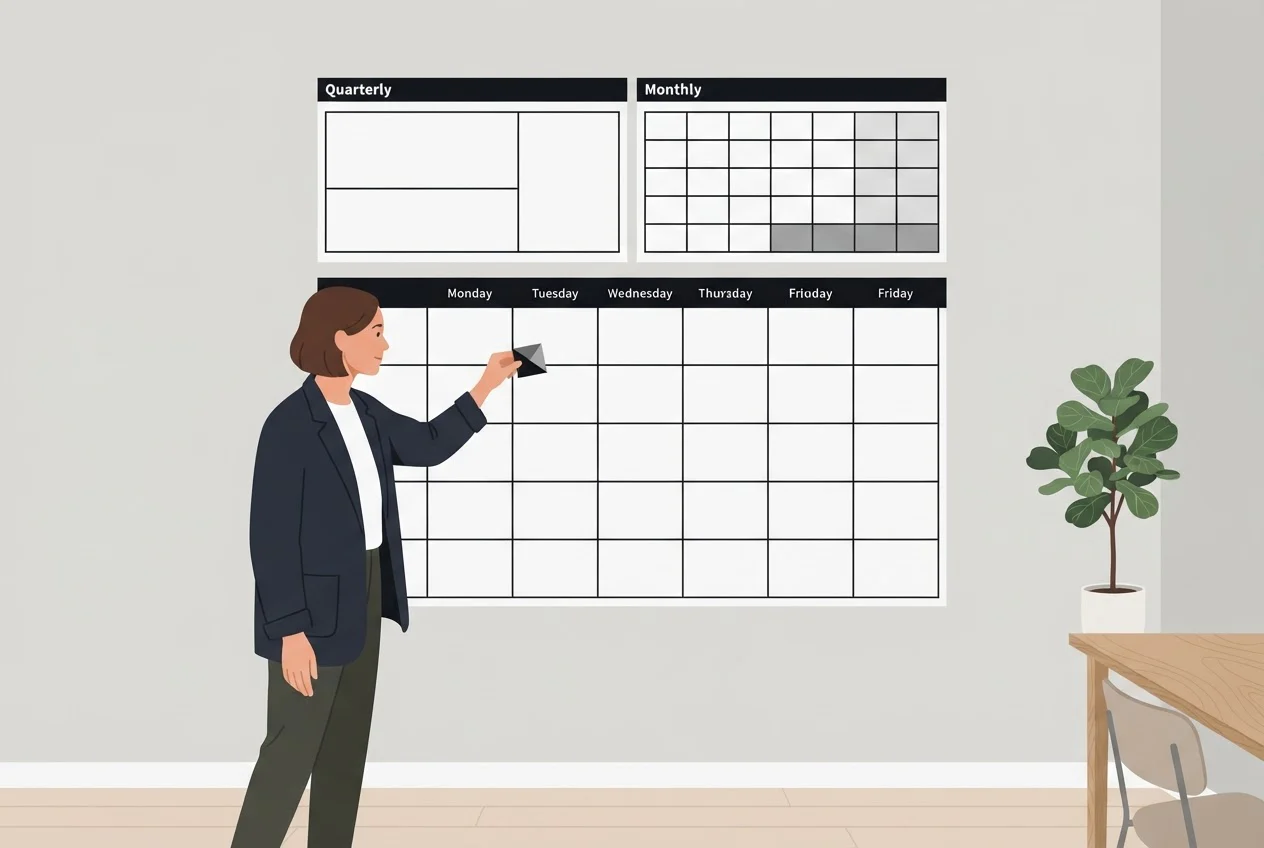
Check weekly for breakage, hold a read-out monthly, review the prompt set quarterly, and call a movement real only when it is larger than your noise range and holds at the next review. The rhythm is our recommendation: weekly catches broken or failed runs while they are still fresh, monthly leaves time for page changes to be re-read before you compare readings, and quarterly matches the prompt freeze so the list changes only once a quarter.
| Rhythm | Who | What happens | Output |
|---|---|---|---|
| Weekly, short | Prompt-set keeper | Open the tracker, look for failed runs and sudden drops, log any site change shipped that week | Log entries only, no report |
| Monthly | Owner, with fixer and analyst | Compare the reading with the noise range, review the change log, choose next fixes | One page for the executive reader |
| Quarterly | Prompt-set keeper and owner | Review the prompt list against real buyer questions, then freeze the new version | Versioned prompt set |
Four tests keep the rhythm honest. Each can be run in an afternoon:
- Noise test
Run the full prompt set three or more times in one week with no site changes, and note how many answers sit behind each reading. The widest gap between any two readings is your noise range. Two readings give only one gap, which may itself be luck. Pass: all readings, their answer counts and the noise range are written down. Fail: you have fewer than three readings. To check a monthly change against the margin your answer count allows, use the formula in How to Measure AI Search Visibility.
- Change testTreat a monthly movement as real only if it exceeds the noise range and is still there at the next reading. Pass: the log records both readings beside the change. Fail: it moved once and you reported it.
- Frozen-set testCompare the prompt list's version number at the start and end of the quarter. Pass: the version is unchanged, or every edit has a dated log entry. Fail: prompts were swapped with no record.
- Run-count testWrite the number of answers behind every reading beside it. Our calculation in the AI citation guide linked above puts a rate within roughly ten percentage points at about 100 answers per engine, and treats anything under 30 answers as a direction only. Timmermans found that a three-run estimate was more than 20 percentage points off a twenty-run estimate for 19 to 26% of brands per question, so pool answers across prompts instead of reading a rate from a few runs of one prompt. Pass: each reading shows its answer count per engine, and any reading under 30 answers is labeled a direction. Fail: the count is missing, or a rate rests on a few runs of one prompt.
Use this change log. One row per change, kept in the same file as the prompt list:
Date shipped | Page(s) changed | Prompt group targeted | Reading before (share of runs naming us) | Review date | Reading at review | Beat noise range? (Y/N)
What should the first 30 days of LLM tracking look like?
Name the owner in week one and hold the first monthly read-out in week four. This sequence is our recommendation: the noise test in week two sets the noise range before the first page fix ships in week three, so the read-out has something to compare against.
| Week | Do | Done when |
|---|---|---|
| 1 | Name the owner and put a name beside the other four roles. Build the prompt list from real buyer questions and freeze it as version 1. | Every role has a name and the prompt set has a version number |
| 2 | Run the noise test. | The noise range is written down |
| 3 | Ship one page fix and log it on the day it goes live. | One log row with a date |
| 4 | Hold the first monthly read-out. | One page for the executive reader |
Where do visits and conversions from AI answers show up outside the tracker?
In Google Search Console and Google Analytics 4 (GA4). Google counts traffic from AI Overviews (the summary above regular results) and AI Mode (Google's conversational search) in the Search Console performance report under the Web search type, and suggests tracking conversions and time on site in a tool such as Google Analytics (Google Search Central).
Keep the two kinds of data apart. A tracker reading measures what engines say about you, and analytics measures what visitors do. The web analyst owns the second, and must not count a crawler fetching your page as a visitor arriving from an answer. Our walkthrough of tracking AI traffic in GA4 covers the channel setup and a test for the rules.
How does PageLens.ai fit this setup?
We give you the first look for free and the repeated tracking on a paid plan. Our Free AI Visibility Audit shows in about 30 seconds how engines including ChatGPT, Claude, Gemini, Perplexity and Google AI describe your brand, with no signup and no credit card.
It returns a visibility score from 0 to 100, what each engine says, sentiment, and the competitors named in your place. Use it to see which buyer questions to put in your prompt set. Treat it as the opening question, not your baseline reading.
For ongoing tracking, as of November 2026 our plans are:
- Launch, $299 a month: ChatGPT, Google AI Mode and Perplexity, with 100 visibility prompts a day across 10 categories.
- Growth, $699 a month: adds Gemini and Grok.
- Enterprise, from $1,499 a month: seven engines, adding Claude and Copilot.
The full list is on our pricing page. Whatever tool you choose, ask how many times it runs each prompt per reading, because your noise range depends on that number. If you are still choosing, AI Visibility Tools: 10 Compared on Price, Engines, Publishing compares ten side by side.
What should you decide before you buy a tracker?
Start with the owner, not the tool. If you can name one person who signs off the prompt set and presents the monthly number, you can begin this week with a spreadsheet and our free audit. If you cannot, no dashboard will fix that, so settle it first.
At every read-out, apply one rule: a movement that sits inside your noise range, or has not held at a second reading, goes in the log as a question, not in the report as a result.
Before you pay for any tracker, ask how many answers sit behind each reading and whether you can open the saved answers themselves. To see how the owner, rhythm and log would work on your own buyer prompts, Book a demo.