

TL;DR
StartBlue announced a 12-company marine technology cohort on September 1, 2026, with its first in-person program session scheduled for September 14. We explain the confirmed companies, the federal commercialization context, and the practical monitoring steps marketing leaders can take as the cohort progresses toward its November showcase.
Marine Technology Startup News: StartBlue Names 12 Teams
The U.S. marine economy employs about 3.7 million people, a reminder that ocean technology sits inside a far larger network of maritime operations, infrastructure, and coastal businesses. New accelerator cohorts matter when they expose which problems founders and institutional partners are preparing to commercialize next.
On September 1, 2026, UC San Diego’s StartBlue Ocean Enterprise Accelerator announced a 12-company marine-technology cohort. The first in-person session begins September 14, and the program combines commercialization support with competitive non-dilutive funding opportunities, creating a near-term signal for ocean-data buyers, partners, and investors.
We separate the confirmed news from the implications. We also identify the milestones that will show whether attention becomes customer, funding, or product-validation progress.
What the New Marine Technology Startup News Confirms
StartBlue’s September 1 announcement names five early-stage Launch companies and seven Scale companies. The cohort includes Center for Environmental Imaging, Cetocean, Deep Anchor Solutions, Magnesis Robotics, and Watts on Water in Launch. AquaPoro Technologies, Benchmark Labs, Hawaii Ocean Power Solutions, Lucendi, Scoot Science, SpaceTime Industries, and Sub Sea Sonics make up Scale.
The distinction matters because the two tracks reflect different commercial readiness. Launch companies are generally building prototypes and refining market opportunities, while Scale companies are further along in operations, business development, or early market activity. Participation does not itself demonstrate product-market fit, customer adoption, or an investment round.
For marine technology startup news readers, the useful signal is the breadth of the selected work: environmental imaging, sea-surface temperature data, marine infrastructure, water systems, weather intelligence, fisheries software, and underwater operations. It is a concentrated view of the ocean-industry problems now entering a structured commercialization program.
The Cohort Maps to Three Buyer Problems
This group is not a single technology category. It brings together software, sensing, infrastructure, and operational systems that address the same underlying challenge: turning difficult marine environments into decisions that organizations can act on.
Observation Data Must Become Useful Decisions
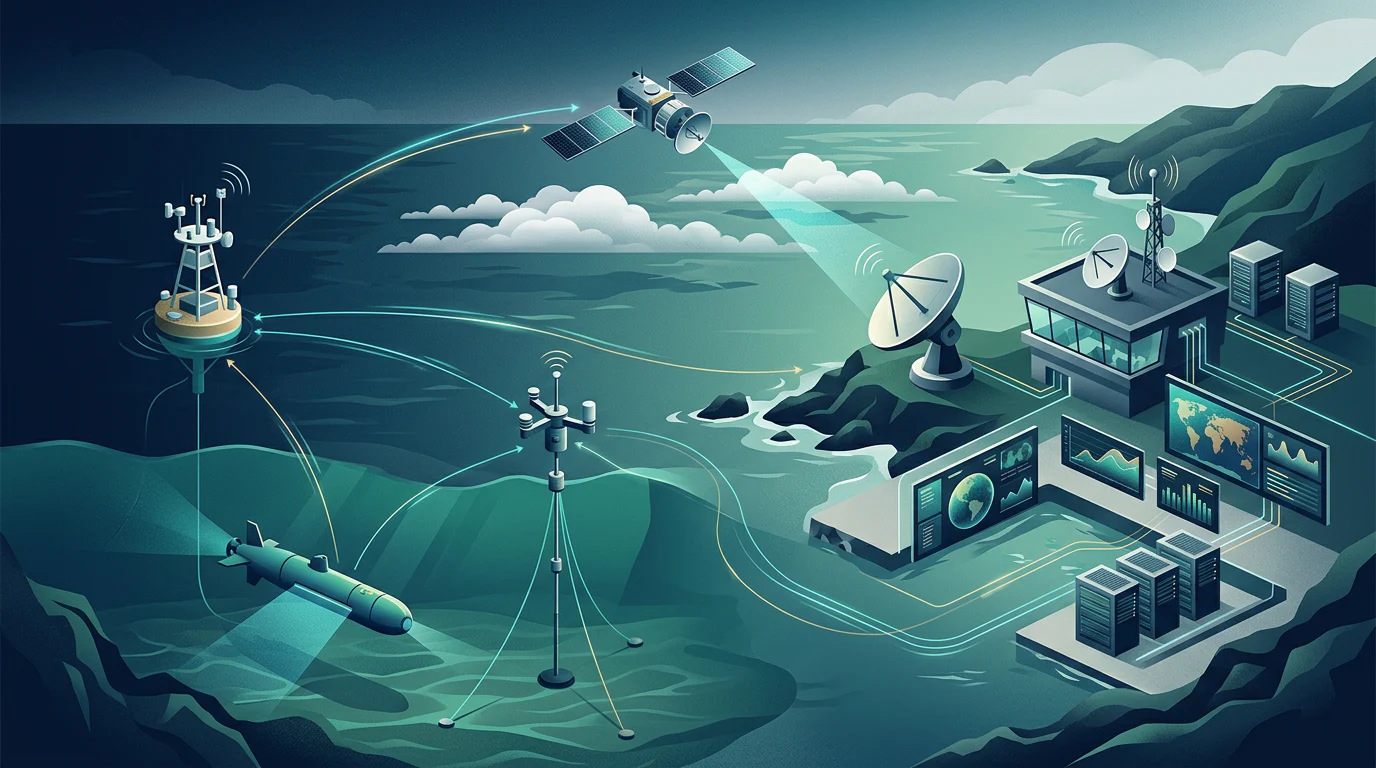
Several companies focus on collecting, improving, or interpreting information about water and marine conditions. That includes high-resolution environmental imagery, sea-surface temperature data, site-calibrated weather intelligence, and automated characterization of material in water. The commercial question is not only whether data can be captured, but whether it is credible, timely, and usable by operators.
For content teams, this means entity descriptions need precision. A vague “AI ocean platform” label loses the buyer problem, while an accurate description can connect a company to environmental monitoring, aquaculture, weather risk, or maritime operations. Our AI brand recommendation audit is a useful framework for checking whether those distinctions survive in AI-generated answers.
Physical Deployment Is Part of the Product
The cohort also includes technologies for offshore anchors, quieter underwater propulsion, aquatic solar infrastructure, wave-powered data gathering, and underwater equipment recovery. These are reminders that marine technology commercialization has a physical layer: installation, durability, maintenance, safety, and cost all affect whether an innovation becomes operational.
StartBlue’s program terms show why the tracks differ. Launch companies can apply for up to $20,000 in non-dilutive funding after completion, while Scale companies can apply for up to $150,000, subject to eligibility and competitive review.
Resilience and Security Are Visible Demand Themes
Water availability, harmful-algal-bloom detection, marine weather, infrastructure protection, and autonomous operations all appear in the cohort’s stated missions. That does not prove each company has a contract or pilot, but it does show where commercialization narratives are clustering.
The stronger editorial approach is to follow the evidence trail. Report a product announcement when it happens, identify the specific buyer problem, and wait for independently confirmable deployment, customer, or funding milestones before treating a stated mission as traction.
Federal Support Sets the Commercialization Context
The cohort sits within a larger public-private effort to commercialize ocean observation technology. NOAA announced a $13.5 million award for StartBlue in December 2024 as part of a $54.3 million Phase 2 commitment across four accelerator organizations.
That funding context explains why this is more than a campus program. NOAA’s Ocean Enterprise initiative is designed to support new technologies and services relevant to coastal management, water quality, aquaculture, shipping, ports, offshore energy, and related marine industries. The link between research, product development, and commercialization is the story worth tracking.
We would still avoid turning public support into a shortcut claim about business success. The relevant evidence comes later: whether a team earns a competitive award, signs a buyer, publishes a deployment result, or brings a verified capability to market. Our AI citation source tracking approach helps teams preserve those supporting pages as the news cycle develops.
What to Monitor Through November
The program calendar provides a practical reporting window. StartBlue lists programming from September through December, with in-person sessions in September and November and a November 19 showcase on its official calendar.
Establish a Baseline Before New Claims Spread
Before the program reaches its showcase, marketing leaders can record how AI systems describe the companies and their categories. Use a consistent set of branded, category, and buyer-problem prompts, then retain the full answers and cited sources. That creates a defensible before-and-after record.
Separate Announcements from Outcomes
Watch for new milestones that change the underlying evidence: pilots, customer agreements, technology validations, competitive awards, regulatory approvals where applicable, and showcase announcements. A cohort list is a starting point. Each later milestone should be documented with its date, primary source, and practical consequence.
Measure Accuracy Alongside Visibility
More mentions are not automatically better if the description is wrong or disconnected from the buyer need. Teams should compare how often they appear, which sources AI answers cite, and whether the surrounding language accurately reflects the product. Our guide on measuring AI search visibility provides a repeatable way to turn that review into an operating process.
Turn This News into an Auditable Signal with PageLens.ai
At PageLens.ai, we help marketing and content teams turn moments like this into evidence rather than a fleeting news alert. We can establish a pre-program baseline for the companies, buyer categories, and questions that matter, then retain the actual answers and cited pages as the September to November story develops. That makes it easier to spot whether a new announcement improved accurate discovery, changed recommendation language, or introduced a misleading description that needs a factual response. Our workflow is built for teams that need a repeatable record across AI search, not a screenshot that cannot be audited later. Book a demo
FAQs on Marine Technology Startup News
When Does StartBlue’s 2026 Program Run?
StartBlue says the program runs from September through December 2026. In-person sessions are September 14 to 18 and November 16 to 20, with a November 19 showcase.
How Many Startups Are in the New Cohort?
The 2026 cohort includes 12 startups: five in Launch for early-stage businesses and seven in Scale for companies with more developed operations and market readiness.
Does Cohort Selection Guarantee Funding?
No. Eligible companies may apply for non-dilutive awards after completion, but selection does not assure an award. Funding depends on eligibility and competitive merit review.