
Is AI Recommending Your Brand or Summarizing It? An AI Brand Recommendation Audit


TL;DR
We explain how to distinguish an AI recommendation from a neutral summary, classify the exact language, and trace visible citations behind each claim. We also give teams a prompt panel, source-loss audit, and recurring review template so they can track endorsement, warning, and sentiment changes over time.
AI answer visibility can look healthy while buyer-facing language becomes less useful. In a peer-reviewed evaluation, only 51.5% of generated sentences were fully supported by their citations.
An AI engine is recommending your brand when it expresses preference, fit, or selection for a buyer’s decision. It is summarizing when it neutrally restates what you do. An AI brand recommendation audit captures the exact language, prompt, alternatives, evidence, caveats, and visible sources so your team can measure whether each answer improves or harms consideration.
We will show you how to classify answer intent, design a useful prompt panel, trace visible sources, and investigate citation loss. The result is a review process that makes sentiment measurable without pretending a mention count explains buyer perception.
Is AI Recommending Your Brand or Summarizing It?
A brand mention is not automatically a recommendation. “Company A provides analytics software” is a description, even if it appears in a high-intent answer. “Company A is a strong choice for lean teams that need weekly reporting” is a recommendation because it connects the brand to selection and fit.
The difference matters because buyers read the surrounding language, not your dashboard definition of visibility. Search-enabled answers may show inline citations or a source panel, according to ChatGPT Search documentation, but the citation alone does not reveal whether the model praised, qualified, or merely named you.
Use this decision tree before scoring an answer:
Does the answer name the brand?
├─ No: No mention
└─ Yes: Does it compare, select, or state buyer fit?
   ├─ No: Description or summarization
   └─ Yes: Does it express preference, fit, or selection?
      ├─ Yes: Recommendation
      └─ No: Comparison or neutral mention
- Recommendation: The answer directs a buyer toward your brand through preference, fit, or selection.
- Summarization: The answer restates what you do without advising a buyer to choose you.
- Comparison: The answer contrasts capabilities, audiences, or tradeoffs without necessarily naming a winner.
- Warning: The answer flags a limitation, uncertainty, risk, or negative condition.
Our guide to recommendation language helps teams keep those labels consistent when answers blend praise with caveats.
What Intent Is the Model Expressing?
Intent lives in the wording around the brand name. A useful audit records the smallest phrase that carries judgment, then preserves enough surrounding context to show whether a caveat changes its meaning.
The table below is the core classification rubric. It prevents a team from calling every positive adjective an endorsement or every citation a proof point.
| Class | What Qualifies | Signals To Capture | Human Review Question |
|---|---|---|---|
| Description | Restates attributes or positioning | “is,” “offers,” “helps with” | Is there any buyer-directed judgment? |
| Mention | Names the brand without a substantive claim | Brand name only | Does nearby text imply sentiment? |
| Comparison | Contrasts options or tradeoffs | “whereas,” “unlike,” “better for” | Is the comparison balanced and relevant? |
| Recommendation | Expresses preference, fit, or selection | “choose,” “best for,” “good fit” | Would a buyer read this as a selection cue? |
| Warning | Expresses a limitation or concern | “may not,” “limited,” “depends” | Is the caution material and evidenced? |
| Citation | Shows a visible supporting source | Inline marker, source card, URL | Does the source support the nearby claim? |
For each row, record engine, date, prompt, exact phrase, class, context, confidence, visible URL, reviewer, and rationale. That structure gives us a defensible citation sentiment record instead of a score that cannot be explained.
Which Prompts Reveal Recommendation Language?
A homepage-style branded prompt often produces a clean description because it asks the model to explain your company. That is useful, but it cannot tell us whether the engine would include or recommend us during a real purchase decision.
We use a prompt panel that separates different decision contexts while holding market, engine settings, and follow-up behavior steady. AI systems can reinterpret a request into targeted searches, which is why preserving the original prompt and run conditions matters.
| Prompt Panel | What It Tests | Example Prompt Pattern |
|---|---|---|
| Branded | Existing description and reputation | “What does this brand do, and who is it for?” |
| Category | Category inclusion | “What are the best platforms for this use case?” |
| Comparison | Relative positioning | “Which option fits this team’s needs?” |
| Objection | Cautions and friction | “What are the limitations for this use case?” |
| Purchase Intent | Selection language | “Which platform should this buyer choose?” |
Start with the prompts buyers already use, then add category, comparison, objection, and purchase-intent variants. Our buyer prompt discovery workflow is useful here because it keeps the panel tied to decisions rather than a pile of loosely related keywords.
How Do You Run an AI Brand Recommendation Audit?
An audit should capture the answer as it appeared, not an analyst’s memory of it. Save the entire response, the exact prompt, the date, the engine and mode, visible citations, and the market or locale used for the run.
A repeatable review asks five questions: what did the answer say, what intent did it express, what evidence did it present, how certain was its wording, and what should a human conclude? That is more work than counting mentions, but it gives marketing and content leaders a record they can act on.
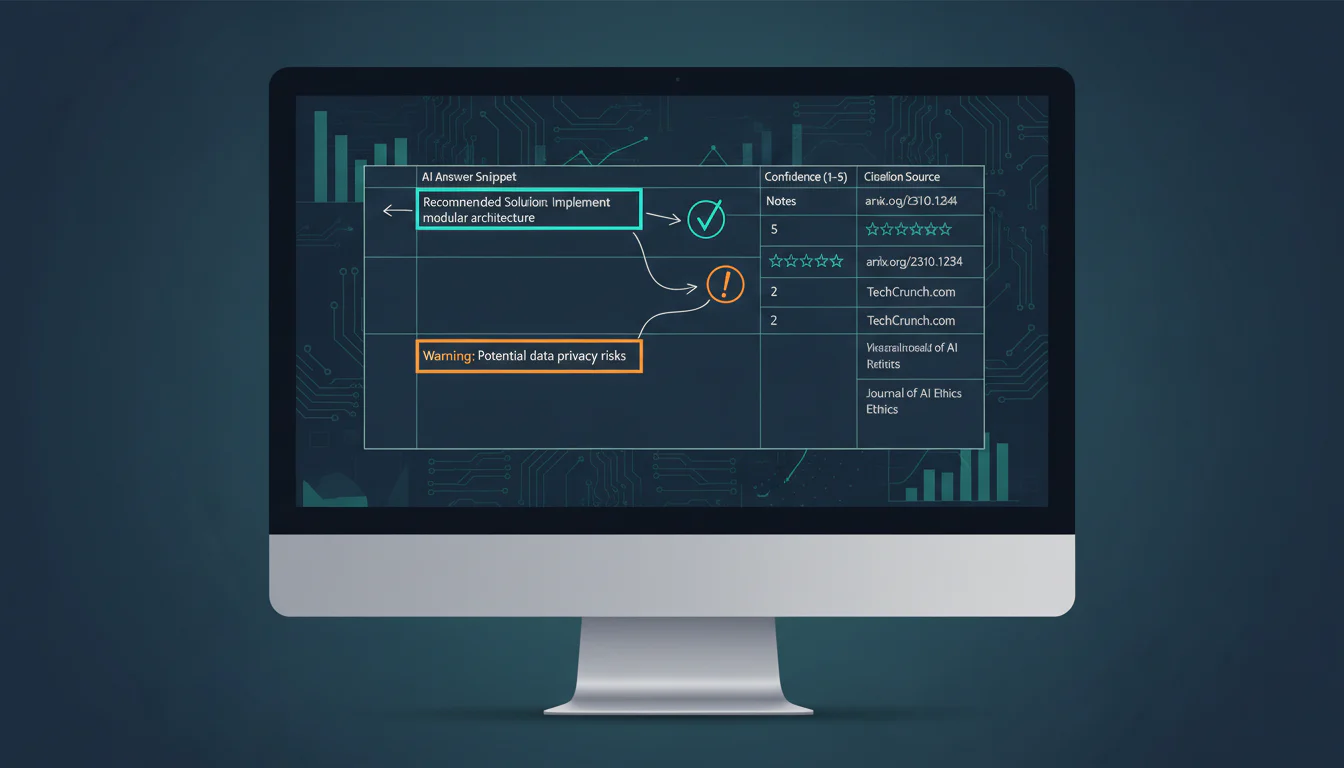
Capture the Complete Answer
Copy the full answer before extracting a phrase. A sentence that sounds positive can reverse meaning when the next sentence says the product is only suitable for a narrow situation. Capture the surrounding answer, cited URLs, and any comparison set before assigning a label.
Extract the Exact Brand Phrase
Quote the smallest phrase that conveys sentiment or selection, then classify it. “Good fit for distributed teams” is different from “supports distributed teams,” even if both appear beside the same brand. Our verbatim sentiment analysis method keeps the exact language available for later review.
Test Evidence and Uncertainty
Mark whether the answer supplies a visible citation, then check whether the source supports the nearby claim. The NIST evaluation framework treats claim-to-source mapping as a requirement for verifiable machine-generated reporting.
Preference language also needs an uncertainty label. “Best choice” is stronger than “may be a good option,” while “depends on your workflow” may convert an apparent recommendation into a conditional comparison.
Require a Human Decision
Use high, medium, or low confidence for each classification. A human reviewer should resolve mixed praise and warning language, weakly supported comparisons, and phrases that depend on buyer context.
We also recommend a second review for low-confidence rows. A sentiment-score audit is only credible when another person can see the wording, context, and logic behind the label.
How Do You Trace Sources and Citation Loss?
Visible citations are the evidence an answer gives its reader. They are valuable for source tracing, but they are not a complete retrieval log or a window into every model input. Treat them as auditable answer evidence and say clearly what they cannot prove.
For each answer, log the cited domain, exact URL, source type, claim it appears to support, and result of your support check. Useful source types include owned pages, third-party reviews, directories, reference profiles, earned editorial coverage, and alternative-provider pages.
Build a Visible Source Inventory
A visible source inventory connects language to the pages that may be shaping it. Perplexity states that its answers include citations linking to original sources, as described in its citation documentation, which makes URL-level capture practical for answer audits.
Use a source-tracing workflow to group source URLs by type and compare them with recommendation, warning, and neutral-description outcomes.
Compare Source Mix with Language
Ask whether particular source types repeatedly coincide with endorsements or caveats. If third-party reviews appear beside warnings, read the cited passages before assuming the engine is wrong. If owned pages appear only in descriptions, the issue may be positioning language rather than lack of visibility.
Run a Citation-Loss Audit
Compare the same prompt and engine across matched periods. Start with formerly cited URLs, identify what replaced them, and then check whether the answer language shifted with the source change.
| Prompt | Prior Visible URL | Current Visible URL | Replacement Source Type | Language Shift | Review Action |
|---|---|---|---|---|---|
| Purchase-intent prompt | Former owned page | New third-party page | Review or directory | Recommendation to warning | Verify claim and update response plan |
| Category prompt | Former editorial page | New owned page | Owned content | No mention to description | Review positioning and prompt context |
| Comparison prompt | Former reference page | New alternative-provider page | Alternative-provider content | Neutral to comparative | Check tradeoff framing and evidence |
Separate Answer Evidence from Traffic Data
Referral traffic can validate that some clicks occurred, but it cannot reveal uncited mentions or every answer a buyer saw. OpenAI says publishers can track ChatGPT referral traffic when they allow its search crawler, according to its publisher guidance.
Use traffic and Google data as supporting signals. Google’s AI performance report includes AI Overview and AI Mode impressions for eligible properties, but answer-language auditing still requires your own prompt-level captures. Our multi-engine monitoring approach keeps those evidence types separate.
How We at PageLens.ai Make Reviews Repeatable
At PageLens.ai, we built this workflow for marketing, growth, SEO, and content leaders who need evidence they can inspect, not a vague visibility score. We structure reviews around a fixed buyer-prompt panel, captured answer wording, recommendation and warning labels, and visible source URLs. That turns a citation dip into a reviewable question: which prompt changed, what did the answer say, and which sources replaced the prior evidence? Our approach supports a disciplined recurring review, so your team can distinguish a neutral description from language that moves a shortlist forward or creates doubt. Start with the audit fields in this article, agree on human-review rules, and use the resulting record to guide content, earned-media, and positioning work. It gives every stakeholder a shared evidence trail. When you want a more repeatable operating system for that review, Book a demo.
FAQs on AI Brand Recommendation Audit
How Can We Tell Whether AI Is Recommending Our Brand or Summarizing It?
We classify an answer as a recommendation when it expresses buyer preference, fit, or selection. A neutral restatement of product facts is summarization, not advice.
How Do We Audit Brand Language in ChatGPT?
We save the full response, prompt, date, engine, exact brand phrase, nearby caveat, citations, confidence, and reviewer decision, then compare that record over time consistently.
Can We Find Sources ChatGPT Cites About Our Product?
We open inline citations or source panels, log each visible URL, and test whether it supports the nearby claim. Visible sources are not a full retrieval record.
Why Can Citation Volume Fall While Mentions Remain?
We compare the same prompt and engine over matched periods, then inspect replacement URLs, exact wording, and warnings. A drop can reflect source or answer changes.