


TL;DR
We believe AI brand sentiment scores are auditable only when every label links to verbatim model output, prompt context, engine, timestamp, and a documented decision trail. This guide explains the monitoring pipeline, failure modes in aggregate scoring, an eight-field evidence record, a five-level rubric, and an audit procedure marketing teams can apply.
Small wording shifts can alter a sentiment label: a peer-reviewed study found that accounting for negation improved precision by 2.23 percentage points on texts containing negated words.
AI brand sentiment scores can be audited only when each classification links to the exact model response, prompt, engine, timestamp, and scoring method. A label alone is not enough. We also need the supporting phrase, surrounding context, confidence or review status, and a documented correction path to reproduce the result.
This guide explains how sentiment monitoring works, why aggregate scores can mislead, and how we would evaluate the evidence behind any reported trend. It gives marketing, growth, SEO, and content leaders a practical standard for challenging a score before acting on it.
Can AI Brand Sentiment Scores Be Audited?
Yes, but the audit target is the recorded observation, not a promise that an engine will produce identical wording later. Generative answers can change with model updates, prompt framing, retrieval, location, or sampling, which is why the NIST framework emphasizes documentation, transparency, monitoring, and accountability.
We treat AI brand sentiment scores as a chain of evidence. A defensible score lets a second reviewer locate the exact answer, see what the model said about the brand, inspect the classification rule, and understand whether a person confirmed or corrected the label.
A dashboard percentage can still be useful, but it is a report, not the evidence itself. If it cannot be traced to phrases and context, it should be treated as a directional signal rather than a decision-ready finding. For multi-engine programs, our cross-engine answer tracking guide helps frame the observation before anyone starts aggregating it.
How Does AI Answer Sentiment Analysis Work?
A sound workflow starts with a scheduled prompt and ends with a report, but the useful work happens in the record between those points. We first preserve the submitted prompt and captured response, then identify brand mentions, extract the relevant language, classify that language, and aggregate only after the underlying records are available for review.
What Should Stay Fixed?
Record the exact prompt, locale, engine, available model version, timestamp, run parameters, and sample number. Google notes that even fixed-seed generation is only a best effort, and model or parameter changes can alter output, according to its generation guidance.
For the systems view, see our AI sentiment tracking architecture, which follows the movement from captured answer to reviewable reporting evidence.
What Should the Classifier Label?
The classifier should label a brand-relevant phrase, not simply the whole answer. A practical taxonomy includes positive, neutral, mixed, negative, and unclassified. The classification rationale should explain why the phrase received that label.
What Should the Report Aggregate?
Publish the aggregation rule with the result. That means defining the denominator, treatment of mixed labels, duplicate handling, exclusions, reporting window, and share of records reviewed by people. Without those rules, two teams can derive different trends from the same answer set.
Why Can Aggregate Scores Fail an Audit?
A document-level score can hide the exact statement a buyer would act on. An answer may recommend a brand for one use case, warn against it for another, quote a third party, or use a qualifier that changes the meaning of an otherwise positive phrase.
Research on polarity shifts identifies negation and contrast as central sentiment problems. “Reliable, but difficult to implement” is not a clean positive label. It is mixed evidence with a valuable warning attached. For an operational view of this workflow, read how AI brand sentiment tracking works.
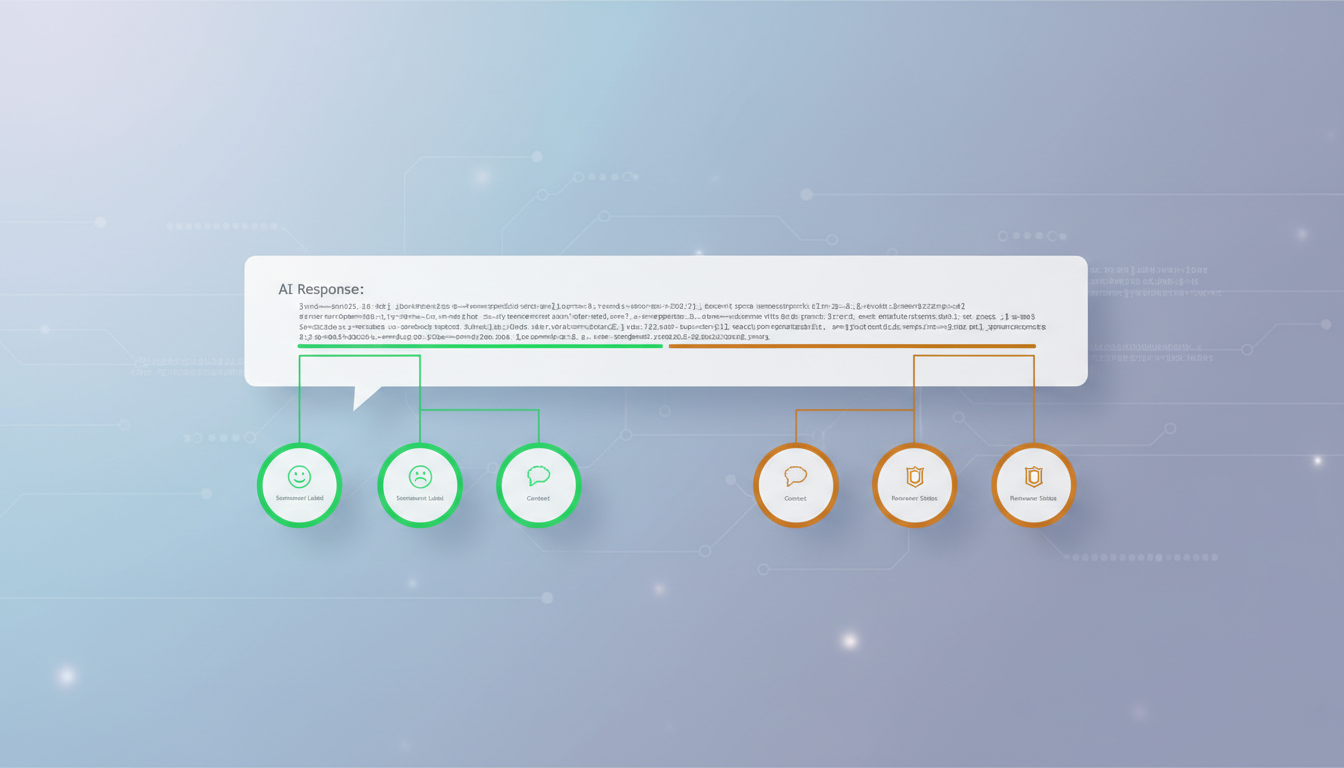
What Does Phrase-Level Review Look Like?
Consider this fictional response:
[sample response] “The platform is reliable for complex reporting, but smaller teams may find setup difficult.”
The phrase “reliable for complex reporting” supports a positive classification. “Smaller teams may find setup difficult” supports a negative classification with an audience qualifier. The contrast word “but” matters because it prevents us from reducing the response to an uncomplicated endorsement.
This is why our phrase-level analysis approach treats the sentence as context and the phrase as the decision unit. It gives teams a way to see both the recommendation and the caveat.
What Evidence Record Makes a Score Reproducible?
The minimum useful record is compact enough to review but complete enough to recreate the decision. We call it a sentiment-evidence record, and every aggregate value should be able to drill into one.
What Are the Eight Required Fields?
| Field | Required Content | Why It Matters |
|---|---|---|
| Exact text | Verbatim brand-relevant phrase | Shows what was classified |
| Surrounding sentence | Full sentence containing the phrase | Preserves qualifiers and contrast |
| Prompt | Exact submitted question | Recreates the generation context |
| Engine | Engine and available model version | Separates platform behavior |
| Timestamp | UTC capture time | Establishes when it was observed |
| Label | Positive, neutral, mixed, negative, or unclassified | Makes the decision inspectable |
| Confidence | Score or review-priority band | Identifies uncertainty |
| Reviewer status | Unreviewed, confirmed, corrected, or excluded | Preserves the correction path |
We recommend retaining the full answer in a controlled evidence store, then exposing only the minimum excerpt needed for routine reporting. The ICO guidance says personal data should be adequate, relevant, and limited to what is necessary, so access controls, retention rules, redaction, and deletion policies belong in the methodology.
For a practical walkthrough of that evidence trail, see our guide to exact model language.
Which Evidence Level Should a Team Require?
| Evidence Model | Can Trace to Full Answer? | Preserves Local Context? | Supports Correction History? | Audit Strength |
|---|---|---|---|---|
| Aggregate-only dashboard | No | No | Rarely | Level 1 |
| Raw-answer archive | Yes | Whole answer only | Sometimes | Level 2 |
| Sentence-level evidence | Yes | Yes | When versioned | Level 3 |
| Phrase-level evidence | Yes | Yes | Yes, with reviewer state | Level 4 |
| Token-level attribution | Partly | Technically granular | Varies | Level 5 only with phrase context |
A platform comparison should ask whether the product exposes raw answers, exact phrases, exports, corrections, and methodology dates. We recommend applying the same standard to PageLens.ai and every other platform. Our guidance on citation context helps teams make that evaluation without confusing a theme chart for auditable proof.
How Should Corrections Work?
A reviewer should be able to confirm, revise, exclude, or escalate a record. Preserve the original label, revised label, reason, reviewer, timestamp, and methodology version. Then recalculate affected reports and mark the reporting period as revised rather than silently overwriting history.
How Do You Audit an AI Sentiment Score?
Start with one disputed dashboard value and work backward until you either reach phrase-level evidence or identify the gap. The following protocol turns that review into a repeatable process for AI brand sentiment scores.
What Is the Five-Level Evidence Rubric?
- Opaque aggregate: A percentage appears without answer-level evidence.
- Answer traceable: The full model response can be opened.
- Context preserved: The prompt and containing sentence are available.
- Decision reproducible: Phrase, rule, engine, timestamp, and confidence are recorded.
- Governed and correctable: Version history, human review, adjudication, and change logs are retained.
What Should the Audit Checklist Test?
- Evidence completeness: Confirm all eight fields exist for the sampled record.
- Label consistency: Apply the published taxonomy to the same phrase independently.
- Context preservation: Check qualifiers, comparison language, negation, and quotations.
- Prompt stability: Confirm the submitted prompt matches the stored version.
- Engine identity: Verify the engine and available model version are recorded.
- Sampling coverage: Check whether repeated samples support the reported trend.
- Human-review coverage: Identify how many records were confirmed or corrected.
- Change control: Inspect dated prompt, classifier, taxonomy, and aggregation changes.
Use fixed prompts, repeated samples, version records, adjudication rules, and dated change logs. Our guide to validate sentiment provides a practical review sequence.
Why Work with PageLens.ai on Auditable Sentiment?
PageLens.ai helps marketing, growth, SEO, and content leaders move from an unexplained sentiment percentage to an evidence-led review conversation. In a demo, we can start with the prompts your buyers use, show how answer capture, source context, and brand language fit into a monitoring workflow, and map the questions your team needs answered before trusting a score. Bring one disputed answer, a current reporting view, or a list of prompts. We will use it to discuss the evidence trail, review ownership, change controls, and reporting cadence that suit your process. You will leave with a practical standard for evaluating any platform, including ours, and a clearer way to distinguish a useful signal from a number that cannot be challenged. That makes the conversation concrete before you commit budget or executive attention to a visibility report. It keeps analysis grounded when teams track brand in ChatGPT amid wording changes. Book a demo
FAQs on AI Brand Sentiment Scores
These questions cover the audit standard in practical terms. They are concise by design, but each points back to the evidence record, methodology, and review trail described above.
What Makes an AI Sentiment Score Auditable?
An auditable score links each label to verbatim output, prompt context, engine, timestamp, classification method, confidence, reviewer status, and a preserved record of subsequent corrections.
Why Is a Full Response Not Enough?
Full responses help, but a phrase and its surrounding sentence reveal whether a brand mention is qualified, comparative, negated, quoted, or mixed with opposing evidence.
How Often Should We Review the Methodology?
Review the methodology whenever prompts, engines, classifier rules, aggregation logic, or retention practices change. Review disputed labels promptly, and publish dated change records alongside reported trends.
Can a Score Be Reproduced Later?
Later runs may differ because generative systems vary. Reproduction means rebuilding an observation, then testing repeated samples with documented prompts, parameters, engine, and version conditions.