

TL;DR
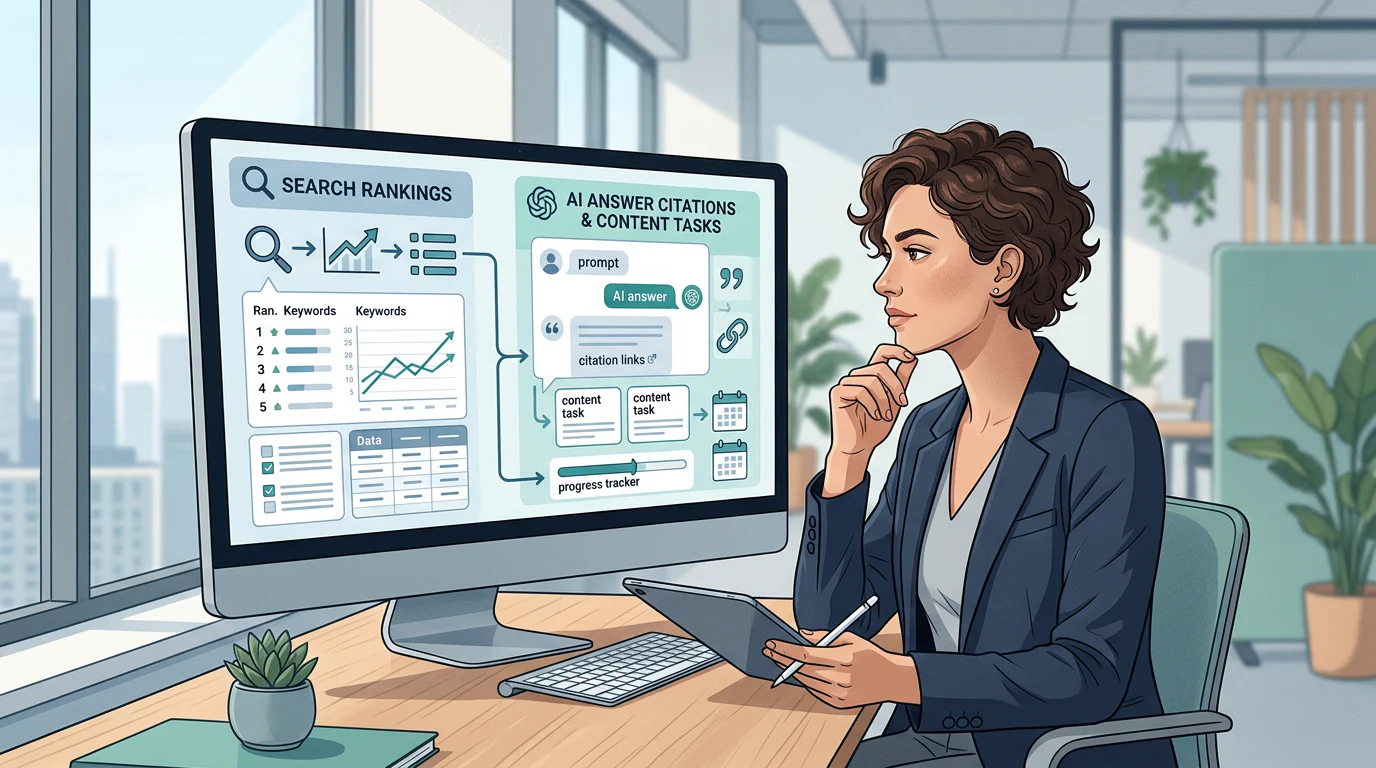
Yes, add a dedicated AEO tool only when three needs persist: controlled buyer prompts, repeatable answer and citation evidence, and a named owner for the resulting work. Semrush or Ahrefs can cover occasional research and focused prompt tracking. Use a second workflow when your team needs stable reporting across engines, markets, competitors, and content actions.
Yes, add a dedicated AEO tool only when three needs persist: controlled buyer prompts, repeatable answer evidence, and a named action owner. For occasional research, Semrush or Ahrefs can already track AI visibility alongside your SEO work.
Use This Decision Table
Use the same buyer prompts for 30 days before adding software. Our rule of thumb is simple: buy a second workflow only when your existing suite cannot support a decision your team must make repeatedly.
| Team Situation | Required Output | Start With | 30-Day Test |
|---|---|---|---|
| Quarterly AI research | Topics and cited pages | SEO suite only | One shared report |
| 25 daily prompts | Prompt-level visibility | Semrush AI Visibility | Three content actions |
| 20 to 30 buyer prompts | Answer and citation log | Suite-only pilot | Weekly review |
| Multi-market reporting | Engine and locale evidence | Dedicated AEO workflow | Named report owner |
| SEO plus content backlog | Rankings and answer gaps | Combined workflow | Owned task queue |
| No action owner | Baseline evidence | Manual audit | Assign one owner |
The table is about operating needs, not product status. A dedicated AEO tool earns its cost when it makes a repeatable program easier to run, inspect, and act on.
What Semrush and Ahrefs Already Do
Semrush and Ahrefs are no longer limited to keywords, backlinks, and rank tracking. Both offer AI-search data that can be enough for teams with a focused monitoring need.
Semrush AI Visibility
Semrush’s AI Visibility toolkit tracks mentions from ChatGPT, Google AI, Gemini, and Perplexity. It also includes competitor analysis, prompt research, citations, sentiment, share of voice, and AI-readiness site auditing. Semrush’s feature guide documents those features.
The published Base plan costs $99/mo per domain, billed annually. It includes 25 custom prompts with daily AI rankings, one domain for Brand Performance analysis, and daily, weekly, and monthly data updates.
That makes Semrush a sensible starting point when your team already works in its SEO environment and needs a contained AI-search program. Semrush also connects AI reporting with keyword research, position tracking, technical audits, and reporting tools.
Ahrefs Brand Radar
Ahrefs Brand Radar combines a large AI-visibility index with custom prompt tracking. Its custom-prompt setup lets teams choose the AI assistant, location, and refresh cadence from monthly to daily. Ahrefs’ setup guide defines one check as one prompt execution, one LLM, and one location.
Ahrefs includes monthly custom-prompt allowances on paid Lite, Standard, and Advanced plans. Its additional prompt packages are Basic, $50/month for 2,500 checks, Growth, $100/month for 7,000 checks, and Scale, $250/month for 25,000 checks. Ahrefs’ published pricing also lists Brand Radar access at $199/month per index or $699/month for all platforms, including 2,500 custom prompt checks.
Ahrefs suits teams that want AI visibility tied to search-backed prompts, SEO demand, cited domains, and broader web signals. Its Brand Radar documentation also separates broad index discovery from monitoring the exact prompts your team selects.
When AI Visibility Tracking Becomes a Separate Job
A dedicated AEO workflow becomes useful when someone must answer the same questions every week: Which buyer prompts changed? Which competitors gained citations? Which source influenced the answer? What language did the model use about our brand? Which page or task should the content team own next?
That work needs more than a single score. It needs a record that preserves:
- The exact prompt and buyer stage
- The engine, locale, and test date
- The raw answer and cited URLs
- The competitor and entity rules
- The classification of mention, citation, recommendation, or sentiment
- The action owner and retest date
Prompt research is not keyword research with longer queries. Buyer prompts often include the constraints that determine which vendor an AI answer recommends. Use our guide to buyer prompt discovery for B2B SaaS when your current prompt list is still a keyword list rewritten as questions.
Our rule is to avoid comparing visibility scores across vendors. Semrush uses a proprietary AI Visibility Score, while Ahrefs calculates visibility from its own prompt population and measures such as mentions, citations, impressions, and AI Share of Voice. Those numbers can support decisions inside each system, but they do not share one denominator. Semrush explains its score, and Ahrefs defines its metrics.
When a Combined SEO and AEO Workflow Makes Sense
Keep your SEO suite when it already powers keyword demand, rankings, site audits, backlinks, and standard search reporting. Add a dedicated AEO workflow when AI-answer evidence needs its own prompt cohort, review process, and content backlog.
A combined workflow has four owners:
- The SEO lead owns organic visibility, crawlability, and technical priorities.
- The AEO lead owns prompts, engines, locales, competitors, and answer evidence.
- The content lead owns briefs, revisions, approvals, and publishing.
- The developer owns production changes, quality assurance, and release control.
Semrush’s AI-readiness audit can identify blocked AI crawlers and technical barriers. It does not replace the engineering work needed to diagnose, deploy, and validate a site change. Semrush’s audit documentation makes that distinction useful for planning ownership.
AI citations also need source-level review. A cited page can explain why an answer favors a competitor, while a missing citation can reveal a content, positioning, or evidence gap. Our guide to tracking sources in AI answers shows how to turn that review into an actionable record.
Run a 30-Day Evaluation Without Duplicating Work
A short evaluation should test the operating model, not produce two dashboards with the same charts.
-
Choose 20 to 30 prompts. Include category, comparison, use-case, and objection prompts. Use buyer language from sales calls, support questions, and existing search research.
-
Set the cohort once. Record the engine, location, language, competitor set, and prompt wording. Changing all five during a trial destroys the trend.
-
Collect answer evidence. Save the prompt, timestamp, answer, cited URLs, and whether the brand was mentioned, recommended, cited, or described negatively.
-
Review once each week. Assign one person to identify one content action, one source opportunity, or one technical investigation from the evidence.
-
Track actions separately from scores. A content brief, page revision, technical ticket, or source outreach item needs an owner and a retest date.
-
Decide on day 30. Stay suite-only if the existing workflow produced useful evidence and completed work. Add dedicated AEO software if the team needs more controlled coverage, clearer evidence retention, or a better path from answer gap to owned action.
A one-time audit can establish the first baseline. Ongoing tracking earns its place when the same prompt cohort supports repeated decisions. See when an AI visibility audit becomes ongoing tracking for the boundary between those two jobs.
Questions to Ask Before Adding Another Tool
Ask these questions in the buying meeting, with the person who will use the output present:
- Which engines and locales shape our pipeline?
- Which 20 to 30 buyer prompts matter this quarter?
- Does the platform retain raw answers and cited URLs?
- Can we export prompts, dates, entity rules, and historical evidence?
- How does the vendor count multi-engine and multi-location checks?
- Who turns a missed citation into a content, technical, or outreach task?
- Who approves that task and who retests the result?
The answers reveal whether you need another product or simply a clearer operating process. For a structured test, use our AI visibility tool trial checklist.
FAQs
Can Ahrefs Track Prompts That Are Not in Its AI Visibility Index?
Yes. Ahrefs Custom Prompts lets your team add the exact questions you want to monitor. You can select the engines, locations, and cadence for those checks. Ahrefs’ custom-prompt guide explains the setup and check calculation.
Does AI Visibility Replace SEO Rank Tracking?
No. AI visibility measures how a brand appears in generated answers, while rank tracking measures a page’s position in search results. Teams need both when buyers use search engines and AI assistants during the same purchase journey.
Can One Prompt Be Measured in Multiple Countries?
Yes. Configure each location as a separate test condition and record it in the reporting cohort. Ahrefs counts each prompt, LLM, and location combination as a separate check, which makes multi-market scope a real capacity decision.
Should Agencies Give Every Client the Same Prompt Set?
No. Each client needs prompts that reflect its category, buyers, market, and competitors. Agencies can standardize the reporting method, but a shared prompt list creates misleading comparisons between different purchase journeys.
Build the Workflow That Turns Evidence into Work
At PageLens.ai, we suit marketing, growth, SEO, and content teams that need controlled buyer-prompt tracking tied to citation, sentiment, share-of-voice, and content action. Our Launch plan is $299/mo, billed monthly, with 100 tracked prompts weekly, while Growth is $699/mo, billed monthly, with 100 tracked prompts daily. See PageLens.ai pricing.
Our Content Engine finds pages AI cites instead, creates a source-led brief, drafts and publishes approved content to your domain, then tracks the citations it earns. Book a demo when your team is ready to turn AI-answer evidence into an owned content workflow.