


TL;DR
At PageLens.ai, we treat AI brand sentiment tracking as an evidence-first audit: capture repeatable answers, isolate brand-specific passages, label them consistently, and keep the full response behind every score. This guide explains a seven-step pipeline, five-label rubric, aggregation rules, quality controls, privacy safeguards, and the review routine marketing leaders need to act on AI perception.
AI answers increasingly shape the way buyers first encounter a category and its vendors. NIST’s AI Risk Management Framework organizes trustworthy AI work into four functions: Govern, Map, Measure, and Manage.
AI brand sentiment tracking repeatedly captures answer-engine responses, isolates passages about a brand, labels their tone and claims, and aggregates results by prompt, engine, comparison brand, and date. Reliable systems retain the exact supporting language beside every label, so reviewers can separate praise or criticism from neutral descriptions, mixed statements, quotation errors, and unsupported model wording.
This guide explains the complete pipeline, the label rules that make results comparable, and the evidence controls that keep a dashboard from becoming an opaque percentage.
How Does AI Brand Sentiment Tracking Work?
The process starts with a stable set of buyer-relevant prompts, then treats every captured answer as an auditable record. We do not consider a response useful merely because it names a brand. We need to know what it says, where the claim appears, whether it is recommendation or description, and whether the wording is sufficiently clear to label.
A credible program samples the same prompt cohorts across engines and time periods. That preserves comparability when marketing leaders ask why a narrative changed. Our buyer prompt dataset guide can help teams build a set that reflects genuine category, use-case, comparison, and objection questions. Evaluation should also use a business’s own test set, not only generic benchmarks, as Google’s evaluation guidance recommends.
-
Version The Prompt Set: Record the prompt text, intent, target market, comparison set, language, and prompt version before collection begins.
-
Schedule Repeatable Captures: Run each prompt on a stated cadence and record the engine, available model identifier, timestamp, locale, session conditions, and collection method.
-
Save The Full Response: Preserve the whole answer, displayed sources, response order, and an artifact ID or hash. A snippet alone cannot show whether a later sentence qualifies an earlier claim.
-
Resolve The Brand Entity: Match approved brand names, product names, and aliases. Flag ambiguous names, misspellings, and references that point to a different entity.
-
Extract Attributable Passages: Select the smallest complete passage that makes a claim about the brand, while linking it to its full-response context.
-
Label Tone And Claim Type: Apply a fixed rubric for polarity, recommendation strength, factual description, criticism, theme, citation status, and reviewer confidence.
-
Aggregate With Drill-Down: Report sentiment by prompt, engine, comparison brand, theme, and date, but let every metric open the underlying evidence.
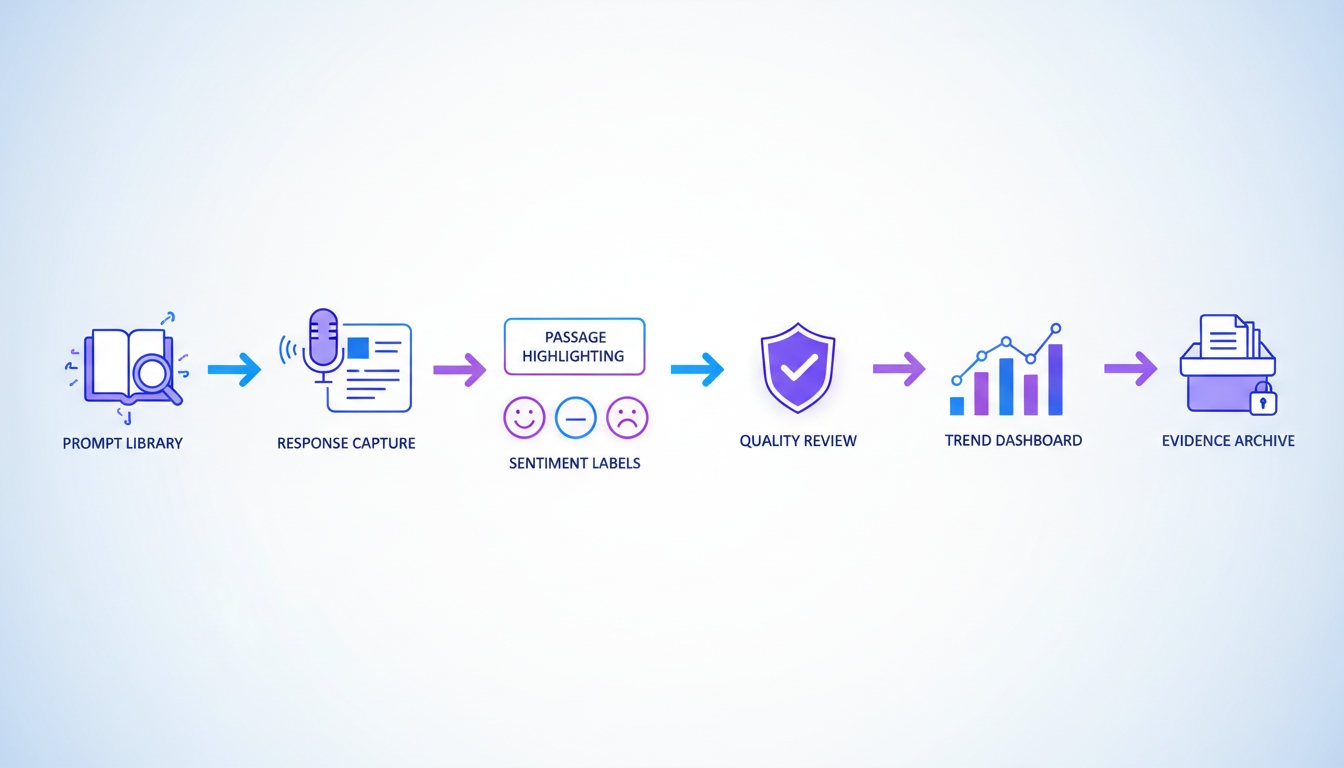
Multi-engine reporting matters because an answer pattern can differ by model, retrieval behavior, or prompt framing. Use multi-engine tracking to compare like-for-like prompt cohorts instead of combining unlike answers into a single headline number.
How Do You Isolate and Label Brand-Specific Passages?
The unit of analysis should be a brand-specific passage, not the emotional tone of the entire answer. A single response can recommend a brand for one use case, warn against it for another, and include neutral factual detail in between. Whole-answer labels bury that distinction.
Fine-grained sentiment methods distinguish targets, opinion terms, and polarity. That is why an aspect-based sentiment approach is useful here: the label must stay attached to the named brand and the exact claim about it.
How Do You Separate a Brand Passage from Context?
Extract the shortest passage that remains understandable on its own, then retain the complete answer behind it. If a sentence says a brand is “strong for small teams,” the nearby sentence may add “but unsuitable for regulated use.” Both statements belong in the audit, and neither should be clipped to make the score look cleaner.
Our phrase-level analysis approach uses passage boundaries to preserve that relationship. Entity resolution should also distinguish a company from a similarly named product, person, or unrelated term before a label is allowed into reporting.
What Do the Five Sentiment Labels Mean?
| Label | Definition | Include When | Exclude When |
|---|---|---|---|
| Positive | Explicit praise, advantage, or favorable recommendation | The brand is credited with a benefit, fit, or strength | Generic upbeat wording unrelated to the brand |
| Neutral | Factual or descriptive brand statement | The answer identifies a feature, category, history, or use case without evaluation | A fact clearly framed as superiority or weakness |
| Negative | Explicit criticism, limitation, risk, or unfavorable comparison | The passage links the brand to a drawback or warning | A neutral trade-off without judgment |
| Mixed | Material favorable and unfavorable claims apply to the same evaluative unit | Both sides affect a buyer’s interpretation | Separate passages that should receive separate labels |
| Uncertain | Meaning, entity, attribution, or support cannot be confidently resolved | The passage is ambiguous, misattributed, quoted unclearly, or unsupported | A clear but hedged positive or negative claim |
Recommendation tone is not the same as a factual description. “Recommended for this use case” is positive, while “serves this use case” is neutral. Criticism receives a negative label when it is attributable to the brand. Omission is not neutral sentiment at all, it is a separate coverage code showing that the brand did not appear where it was in scope.
What Should an Annotation Record Include?
A record should make a reviewer capable of tracing a chart point back to the exact answer without reconstructing the collection process.
| Field | What The Record Preserves |
|---|---|
| Run And Prompt IDs | Prompt text, prompt version, and collection run |
| Engine Context | Engine, available model identifier, locale, timestamp, and session settings |
| Brand Resolution | Brand, aliases considered, comparison set, and entity-confidence result |
| Evidence | Full-response artifact ID, hash, exact passage, and passage location |
| Classification | Label, claim type, theme, citation status, and confidence |
| Review History | Rubric version, reviewer, disagreement state, and adjudication rationale |
Why Must Every Score Retain Verbatim Evidence?
An aggregate score is useful for detecting a change, not for explaining it. If a negative rate rises, leaders need to know whether the shift came from a recurring limitation, a single inaccurate answer, a change in the prompt mix, or an annotation mistake. Verbatim evidence is the audit layer beneath the trendline.
We recommend presenting raw language and aggregation as complementary layers. Our guide to exact model language shows why an evidence trail is more actionable than a score that cannot be inspected.
| Reporting Layer | Primary Question | What It Retains | What It Misses Alone |
|---|---|---|---|
| Aggregate Metric | Is sentiment changing? | Counts, rates, filters, and trends | The language that caused the movement |
| Verbatim Passage | What did the answer say? | Exact claim, label, and citation status | Whether the pattern is widespread |
| Full-Response Context | Was the claim qualified? | Answer order, nearby caveats, and sources | Cross-run trend magnitude |
| Combined Audit | Can we trust and act on this? | Metrics plus inspectable evidence | Nothing essential, if capture is complete |
A worked audit does not need invented model quotes. A reviewer can open a saved answer, isolate a recommendation passage and a limitation passage, apply separate labels, check the surrounding context, and then see how each record contributes to a prompt and engine cohort. That approach prevents a mixed answer from being flattened into a misleading positive or negative percentage.
NIST’s risk framework emphasizes documented measurement and ongoing monitoring, which is the standard we apply to AI answer reporting. Citation presence should be recorded, but it should not automatically validate a claim. An answer can show a source without accurately representing it, and a generated claim can appear without any visible source at all.
For reporting, break results down by prompt cluster, engine, comparison brand, theme, label, and date. Pair that view with citation context, because the sources shown beside a response may help explain a repeated narrative without proving that every sentence is correct.
How Do You Quality-Control and Safeguard the Data?
Quality control protects against false matches, label drift, and confident-looking conclusions that do not survive review. It is especially important when automated classifiers help process volume. Automation can prioritize records, but it should not erase the ability to inspect a difficult label or reverse an error.
How Should Teams Review Confidence and Disagreement?
Set a confidence threshold that reflects your own risk tolerance, then route low-confidence, ambiguous, or high-impact records to human review. Sample records across every label, double-review escalation cases, and record why adjudicators resolved a disagreement.
NIST calls for human-oversight processes to be defined, assessed, and documented. This oversight principle supports a practical rule: do not silently convert uncertain records into neutral ones simply to improve dashboard neatness.
What Does a Reproducibility Checklist Look Like?
-
Version Control: Freeze the prompt library, rubric, alias list, taxonomy, and classifier configuration for each reporting period.
-
Comparable Cohorts: Compare the same prompts, engines, locales, and date windows before declaring a trend.
-
Review Sampling: Double-review a representative sample and every material escalation, then retain disagreement and adjudication notes.
-
Evidence Integrity: Store the full response, passage location, capture metadata, and artifact identifier together.
-
Method Change Notes: Mark model changes, rubric revisions, or collection changes directly on trend reporting.
For an operational view of these moving parts, use our tracking architecture guide. It helps teams assign ownership across collection, classification, review, and reporting rather than treating sentiment as a dashboard-only task.
How Should Captured Model Outputs Be Handled Safely?
Collect only the output needed for the stated monitoring purpose, redact personal data where it appears, apply role-based access, and set deletion rules before data collection scales. The UK regulator’s ICO guidance describes data minimization as collecting only what is necessary and storage limitation as keeping it only as long as needed.
Retention also varies by provider and endpoint, so treat it as a configuration and contract question rather than a universal assumption. For example, the Responses API has a default 30-day application-state period under its API retention rules. Our enterprise monitoring guidance can help teams include access, retention, and review controls in their operating model.
How PageLens.ai Helps Teams Audit AI Sentiment
At PageLens.ai, we believe a sentiment dashboard earns trust only when a marketer can open a changing score and read the language behind it. We help marketing, growth, SEO, and content leaders turn a monitoring requirement into a working review routine: choose buyer prompts, preserve answer context, set an evidence rubric, and route meaningful changes to the people who can investigate them. Bring a few real category prompts, your priority comparison set, and the questions that have created uncertainty. In the conversation, we can use the framework in this guide to discuss what a useful audit trail, reporting cadence, and stakeholder handoff should look like for your team. That keeps decisions tied to observable AI answers rather than a black-box percentage. We keep evidence, disagreement, and ownership visible in every review. When you are ready to make the methodology operational, Book a demo.
FAQs on AI Brand Sentiment Tracking
Does Tracking Only Scrape Model Outputs?
No. Capture begins the process. Reliable programs resolve brands, extract attributable passages, apply a versioned rubric, record confidence, and preserve full-answer context so reviewers can audit findings.
Why Keep Exact Passages Behind a Score?
Scores reveal direction, not cause. Exact passages let teams determine whether movement reflects endorsement, criticism, ambiguity, a quotation error, or an incorrect classification requiring review and correction.
Is a Missing Brand Mention Neutral Sentiment?
No. Omission is a coverage finding, not a sentiment label. Record it separately, then check whether prompt scope, engine behavior, timing, or entity rules explain absence.
How Can Teams Make Results Reproducible?
Use a fixed prompt set, capture complete responses and metadata, label attributable passages, review low-confidence records, and compare equivalent prompt, engine, locale, and date cohorts consistently.