
What Do AI Citations Say About Your Brand? AI Citation Sentiment Analysis


TL;DR
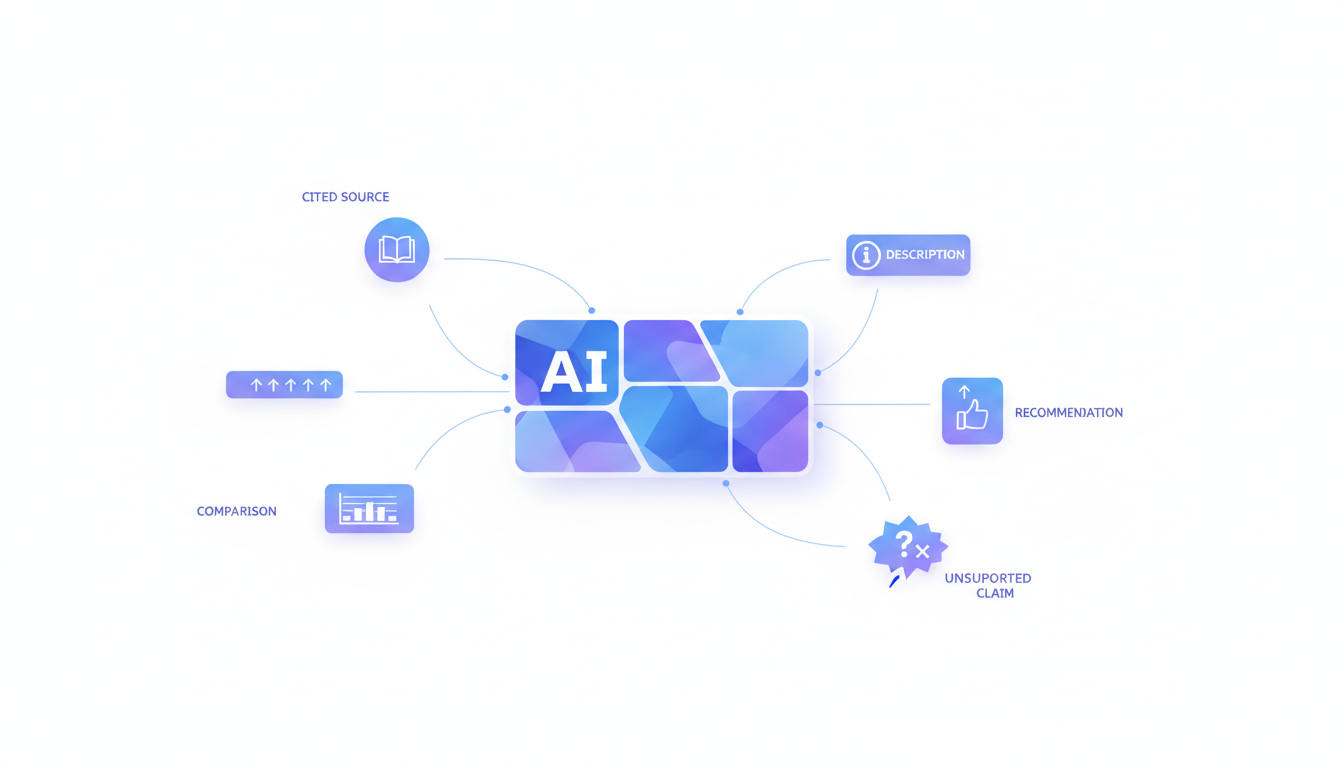
We use AI citation sentiment analysis to determine whether an answer describes, recommends, compares, warns about, or makes an unsupported claim about a brand. In this guide, we show how we capture sentence-level evidence, diagnose citation loss, prioritize high-intent risks, and retest corrective work across AI engines.
A 14,000-conversation study found that visible citations can represent only part of the web material an AI system considered. That makes citation count useful, but incomplete, when you need to know what an answer actually tells a buyer about your product.
AI citation sentiment analysis shows whether an AI answer uses sources to describe, recommend, compare, warn about, or make an unsupported claim about your brand. We capture the exact language, surrounding context, cited page, prompt, engine, and date, then compare those records over time to identify what shapes buyer-facing AI answers.
This guide explains how we turn AI citations into a practical evidence trail, distinguish homepage summaries from independent recommendations, investigate lost citations, and prioritize corrections.
What Does AI Citation Sentiment Analysis Reveal About Your Brand?
A brand mention tells you that your name appeared. A citation tells you that the engine displayed a source link. Neither answer tells you whether the surrounding wording is neutral, favorable, unfavorable, or unsupported until you inspect the sentence itself.
We treat each appearance as an evidence record, rather than a visibility score. That is the difference between knowing that an answer included your brand and understanding whether it helped a buyer evaluate you. For a deeper record design, see our citation context guide.
| Brand Role | What The Answer Is Doing | Evidence To Capture | Best Next Action |
|---|---|---|---|
| Description | States what the brand is or does without judgment | Exact claim and source URL | Confirm factual accuracy |
| Recommendation | Suggests the buyer choose or consider the brand | Buyer-fit language and cited evidence | Preserve and strengthen proof |
| Comparison | Positions the brand against alternatives | Relative claim and every visible source | Check fairness and support |
| Warning | Raises a limitation, risk, or poor-fit condition | Warning language and source relevance | Correct errors or address concern |
| Unsupported Claim | Makes a claim with no relevant evidence | Exact wording and citation state | Investigate and retest |
What Is a Mention?
A mention is the appearance of a company, product, or category name in an answer. It can be favorable, neutral, or negative, and it may appear with no link at all. Mentions are useful for measuring conversational presence, but they do not prove that your content shaped the response.
What Is a Citation or Source Attribution?
A citation is a visible source link attached to an answer or listed in its sources panel. Source attribution is the next step: checking whether that page genuinely supports the nearby claim. ChatGPT Search can show inline citations or a Sources panel, which makes this review possible when search is used. Search documentation
What Is Recommendation Sentiment?
Recommendation sentiment is buyer-directed language. “Useful for small teams” can be a recommendation when it is presented as fit advice, while “supports small teams” is usually description. “Not suitable for regulated workflows” is a warning, even if the answer also accurately describes the product.
A durable audit needs a shared system for retaining each classification and the evidence behind it. Our sentiment architecture keeps role, source, and answer language connected for later review.
What Evidence Should You Record for Every AI Answer?
AI answers change with prompt wording, engine behavior, available sources, and context. A repeatable audit begins by saving the answer exactly as it appeared, not by relying on a later summary or a remembered impression.
For every tracked prompt, record the prompt and version, engine and mode, date and time, exact brand sentence, one sentence of context on either side, role, sentiment, visible citations, cited page title, source type, and a judgment on whether the source supports the claim.
Google notes that AI Overviews and AI Mode can use different models and techniques, meaning their supporting links and answers may vary. Record the engine alongside the answer so you do not mistake a cross-engine difference for a content change. Google guidance
Use a screenshot or export as supporting evidence, particularly for warnings and comparisons. Keep the source URL even when it is an owned page, a review, editorial coverage, a forum, a competitor page, or no citation at all. This lets us separate a change in brand language from a change in source mix. Our buyer prompt dataset workflow keeps the prompt set tied to real buyer language instead of generic category terms.
Is ChatGPT Recommending Your Product or Just Describing It?
The fastest test is to look for a buyer-directed judgment. Description answers “what is it?” Recommendation answers “should I consider it?” Comparison answers “how does it differ?” Warning answers “where might it fail?” Unsupported claims make any of those assertions without relevant proof.
Do not treat a positive adjective as independent validation automatically. If the wording closely repeats your homepage, only owned pages are cited, and no buyer-fit rationale appears, the engine is likely summarizing your positioning. That can still be useful visibility, but it is not the same as an independently supported recommendation.
Apply the Language Test
Use the verb and the buyer context to classify the sentence.
- Description: “Offers,” “includes,” “is used for,” and “provides” usually state product facts.
- Recommendation: “Choose,” “consider,” “good fit,” and “best for” give buyer-directed advice.
- Comparison: “More suitable,” “less flexible,” “instead of,” and “better for” position alternatives.
- Warning: “May not suit,” “limited,” “risk,” and “not ideal” signal a constraint.
Check Whether the Source Supports the Claim
A source link does not automatically validate every phrase in the answer. Review the cited page for the specific claim, then label it as supported, partly supported, irrelevant, or unavailable. Answer engines can synthesize information from multiple web sources, so we save every visible citation before assigning credit. Official explanation
| Source Type | Brand Role To Test First | What It Can Support | Review Risk |
|---|---|---|---|
| Owned Pages | Description | Product facts, documentation, positioning | Homepage language mistaken for endorsement |
| Reviews | Recommendation Or Warning | Reported fit and user experience | Limited sample or stale details |
| Editorial Coverage | Comparison | Independently reported market context | Outdated product information |
| Forums | Warning Or Comparison | User objections and edge cases | Anecdotes treated as general truth |
| Competitor Pages | Comparison | Category framing | Self-interested positioning |
| Uncited Claims | Unsupported Claim | Nothing until verified | Plausible but unsupported assertion |
Distinguish a Homepage Summary from Independent Recommendation
We classify an answer as likely homepage summarization when its phrasing mirrors owned positioning and the cited evidence is entirely owned. We classify it as an independently supported recommendation when the answer gives fit advice and relevant third-party evidence substantiates the reason.
That distinction prevents a common reporting error: counting every favorable mention as a recommendation. Our phrase-level audits preserve the language that made the classification, including the sentence that changed its buyer-facing meaning.
How Do You Identify Lost AI Citations and Replacement Sources?
A lost citation is not simply a decline in referral visits. It is a documented difference between a baseline answer record and a later controlled run of the same prompt in the same engine or mode. Compare the brand’s presence, role, sentiment, cited URL, and source type before assuming the loss has one cause.
| Loss Pattern | What Changed | Likely Interpretation | Investigation |
|---|---|---|---|
| Citation Lost, Mention Remains | Brand remains but source link disappears | Attribution weakened or answer changed | Check whether role changed |
| Owned Citation Replaced By Review | Source type shifts to third party | Independent experience now shapes framing | Validate recency and accuracy |
| Favorable Source Replaced By Warning Source | Sentiment shifts with source mix | Buyer risk became more prominent | Apply severity rubric |
| Citation Persists, Role Changes | Same source, different brand framing | Prompt interpretation or synthesis changed | Review exact language |
| Brand And Citation Disappear | No appearance in comparable answers | Visibility loss or changed answer scope | Identify replacement sources |
The practical question is not only “Did we lose a citation?” It is “Which page now explains the answer’s language?” When a review replaces an owned page, the remediation may require an evidence correction. When an editorial source replaces a page, the work may be a content gap or a factual update. Use recommendation monitoring to preserve this buyer-facing context over time.
Visible citations are not a complete retrieval log, so we describe the event precisely as lost visible attribution. This guards against overclaiming what happened behind the answer and keeps the investigation focused on the buyer-facing output.
Which AI Brand Claims Should You Fix First?
Not every odd sentence deserves the same response. A neutral, low-intent description that appears once is usually less urgent than an inaccurate warning that recurs in buyer-evaluation prompts. We prioritize based on impact, confidence, recurrence, and buyer intent.
Score each factor from one to five. Impact measures likely commercial, reputational, or compliance harm. Confidence measures how certain we are that the sentence, context, and source review are correct. Recurrence measures how often the same framing appears in controlled records. Buyer intent measures how close the prompt is to product selection.
| Total Score | Priority | Response |
|---|---|---|
| 16 To 20 | Urgent | Assign an owner and begin corrective work |
| 11 To 15 | High | Address in the current evidence cycle |
| 7 To 10 | Monitor | Collect more controlled answer records |
| 4 To 6 | Low | Log and reassess if risk increases |
NIST describes confabulation as an inaccurate or false response that can appear plausible, which is why a polished AI answer still needs evidence review. NIST profile We store this scoring beside cross-engine records so urgency is tied to documented evidence rather than a vague negative sentiment label.
The remediation loop has four steps:
- Correct The Source: Update stale, unclear, or inaccurate owned information where the evidence itself is wrong.
- Close The Content Gap: Create a direct, qualified answer to the buyer question the engine cannot currently support well.
- Strengthen Third-Party Evidence: Address a lack of independent corroboration through legitimate reviews, documentation, or editorial coverage.
- Retest Under Control: Reuse the saved prompt, capture the new output and sources, then compare role and sentiment with the baseline.
Use this workflow to focus corrective work on the underlying evidence, then preserve the controlled retest record for the next review cycle.
Put PageLens.ai to Work
PageLens.ai gives marketing, growth, SEO, and content leaders a repeatable way to inspect the language AI engines use about their product. We help teams keep the prompt, engine, answer, cited source, role, sentiment, and date together, so an apparent visibility change becomes an evidence-backed decision rather than a dashboard fluctuation. That matters when a product is neutrally described in one answer, recommended in another, and inaccurately framed in a third. Our content remediation workflow makes those differences visible, supports consistent review across teams, and leaves a record of what changed after you corrected a source or improved a page. Use it to focus scarce content effort on buyer-facing claims that are inaccurate, negative, recurring, or high intent. When you want a practical way to put this audit into an operating rhythm with our team for your category, Book a demo
FAQs on AI Citation Sentiment Analysis
These answers clarify how we classify AI language and turn citations into evidence. Use them to align content, growth, and SEO teams on the same review standard.
What Is the Difference Between an AI Citation and an AI Recommendation?
A citation is a visible source link. A recommendation gives buyer-directed advice, stating or implying that your product fits a defined need or use case.
How Can I Tell Whether ChatGPT Is Describing or Recommending My Product?
Capture the exact sentence and nearby context, then test whether cited sources support buyer-fit language. If only owned pages support it, treat it as description first.
How Do I Track a Lost AI Citation?
Compare a controlled baseline with later answer records. Check whether the brand, role, cited URL, or source type changed, then investigate the replacement evidence first.
What Makes an AI Brand Claim Urgent?
Score impact, confidence, recurrence, and buyer intent from one to five. Prioritize inaccurate or negative claims with high scores, then retest after correcting the evidence.