


TL;DR
At PageLens.ai, we separate visible AI citations from the recommendation language that determines how an engine positions your SaaS. This guide provides a five-class rubric, source matrix, answer-audit record, monitoring workflow, and remediation actions so marketing, SEO, and content leaders can measure summaries, recommendations, warnings, and omissions accurately.
AI answers can look well sourced while still leaving crucial brand language unproven. A 2025 conversation-log study examined roughly 14,000 search-enabled LLM interactions and found a meaningful gap between pages used and pages visibly credited.
AI citations and recommendation language should be tracked separately. A citation identifies a visible source, while recommendation language reveals the role an engine gives your product. Classify each appearance as descriptive, favorable, cautionary, comparative, or explicitly recommended, then record the prompt, passage, citation, source type, engine, model, date, sentiment, and competing context.
This guide explains how to turn scattered AI-answer checks into a response-level audit that shows whether your SaaS is being summarized, recommended, criticized, or left out.
How Do AI Citations and Recommendation Language Work Together?
A mention tells you that your brand entered the answer. A citation tells you that the engine displayed a source. Neither result, by itself, tells you whether the engine thinks your product is a strong fit for a buyer. That requires reading the language around the brand and the citations near it.
| Appearance | What It Proves | What It Does Not Prove | What To Record |
|---|---|---|---|
| Mention | Your brand appears in the response | Source influence or approval | Mention present |
| Citation | A URL or domain is visibly surfaced | That every nearby sentence came from it | Cited URL and source type |
| Summary | The engine repeats facts or positioning | Buyer fit or preference | Facts repeated |
| Comparison | The engine contrasts products or criteria | A preferred choice | Compared-on criterion |
| Recommendation | The engine selects a product for a use case | Universal endorsement | Recommended-for use case |
| Endorsement | Strong approval language appears | Accuracy or source support | Evidence status |
An answer can cite your homepage and still only summarize it. It can name your product without citing it. It can recommend your product based on a third-party review. It can also make favorable claims without showing a source that supports them. Treating all of these outcomes as “visibility” hides the action you need to take.
For a practical starting point, track AI citations at the response level. Save the output first, then classify what it says. That order matters because dashboards can count appearances, but the original passage is what proves whether the engine described, compared, recommended, or criticized your product.
How Do You Classify Recommendation and Sentiment Language?
A reliable audit needs categories that different reviewers can apply consistently. We use five language classes, then add a separate evidence-status field. That prevents a visible citation from being mistaken for praise, and praise from being mistaken for a recommendation.
| Language Class | Decision Rule | Example Pattern | Evidence Field |
|---|---|---|---|
| Descriptive | States what the product is or does without judgment | “It helps teams monitor…” | Exact passage |
| Favorable | Expresses a positive attribute without advising selection | “It is especially useful for…” | Citation-backed or unsupported |
| Cautionary | States a limitation, risk, criticism, or uncertainty | “It may be less suitable when…” | Caveat and cited source |
| Comparative | Contrasts options, scope, price, or fit | “Compared with other options…” | Compared-on criterion |
| Explicit Recommendation | Advises selection for a defined use case | “Choose it if…” | Recommended-for use case |
What Counts as Unsupported Praise?
Unsupported praise is positive wording with no visible evidence that supports the claim. “Leading,” “best,” “more accurate,” and “ideal” may sound valuable, but they should be marked as unsupported until the response shows a nearby source that directly supports the statement.
This is not a minor distinction. OpenAI guidance cautions that confident model language is not the same as reliability, and important claims should be verified. Your audit should therefore score tone and support separately.
What Makes a Statement an Explicit Recommendation?
A statement becomes an explicit recommendation when it tells a buyer to select a product, or clearly assigns the product to a particular use case. Look for language such as “choose,” “best for,” “recommended for,” “use when,” or a direct fit conclusion.
A brand listed among options is a mention. A product described as capable is descriptive. A product called useful is favorable. Only a clear selection or fit instruction should raise the recommendation flag.
How Should You Score Comparisons and Warnings?
Capture qualifiers exactly. “A fit for smaller teams,” “better when documentation matters,” and “not ideal for complex reporting” each carry more decision value than a generic sentiment label. Record the criterion, the buyer context, and whether your brand is preferred, neutral, or disadvantaged.
For teams that need finer review standards, our phrase-level sentiment guide helps turn exact model wording into consistent labels without flattening a nuanced answer into positive, neutral, or negative.
Is ChatGPT Recommending Your SaaS or Summarizing Its Homepage?
The fastest way to answer this question is to inspect the passage, not just the source link. If an engine cites an owned page and repeats your category definition, feature list, or homepage positioning without advising a buyer, classify it as a summary.
If it ties your product to a defined need, constraint, team type, or selection decision, classify it as a recommendation. Then inspect whether the evidence is your homepage, documentation, editorial coverage, reviews, or no visible source at all.
Use the Homepage-Summary Test
Ask four questions while reading the answer:
- Is an owned page the only nearby source?
- Does the passage restate product facts or positioning?
- Does it identify a specific buyer use case or constraint?
- Does it tell the reader to choose, consider, or prefer the product?
A “yes” to the first two and “no” to the last two means the engine is summarizing. A clear buyer-fit instruction means it is recommending, even if the citation belongs to a third-party source.
Capture the Response as Seen
Save the exact prompt, full answer, visible citations, engine, model or mode, locale, date, and account conditions. This is essential because ChatGPT Search may rewrite a prompt into targeted searches, and source displays can vary by answer.
| Audit Field | Example Review Outcome |
|---|---|
| Exact prompt | Preserves the buyer question tested |
| Response passage | “A good fit for teams with recurring audits” |
| Language class | Explicit recommendation |
| Sentiment | Favorable |
| Nearby source | Visible linked source, if present |
| Source relationship | Directly supports, related, or unsupported |
| Competing context | Other products named or compared |
| Reviewer conclusion | Citation-backed recommendation |
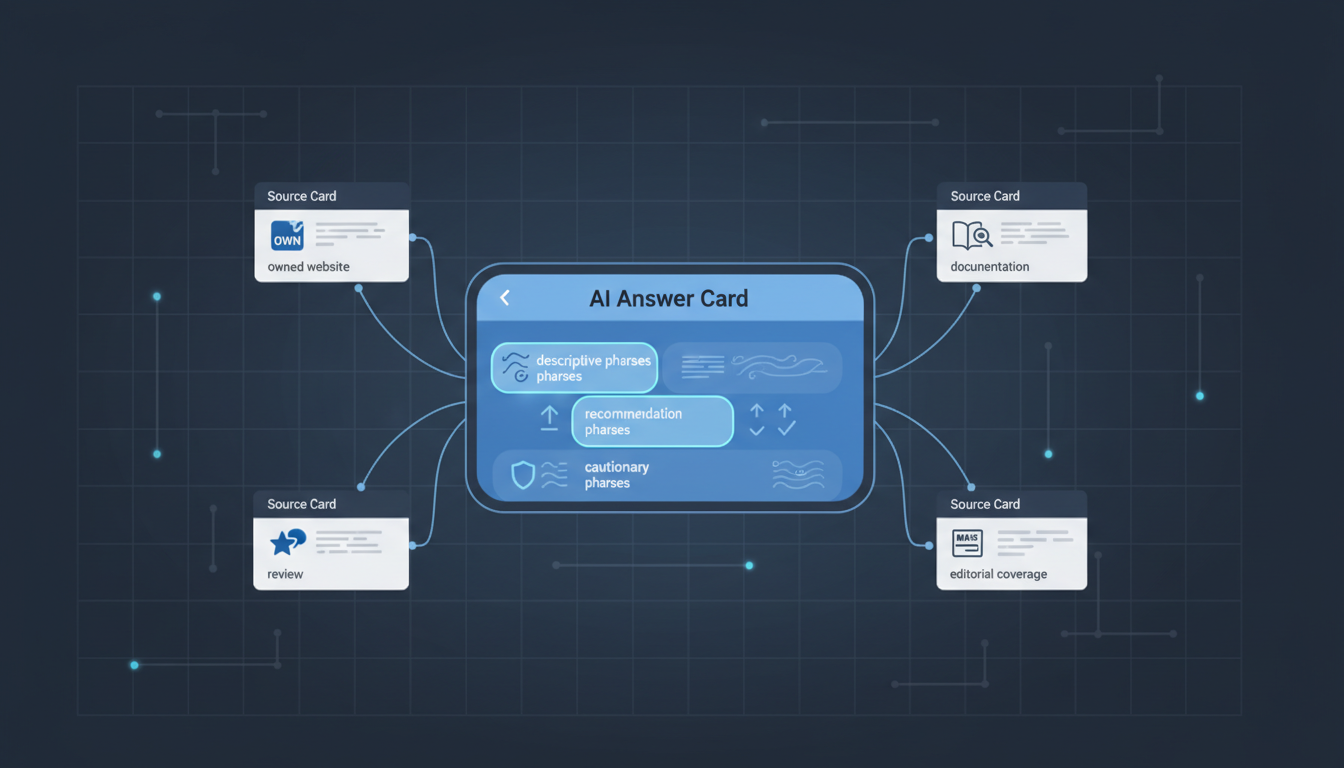
Keep Source Evidence Separate from Language
A source next to a passage can directly support it, provide only background context, or fail to support it at all. Use those three labels instead of assuming that every citation proves the entire surrounding paragraph.
Our exact model language workflow is built around that discipline. It keeps the response passage, sentiment label, recommendation role, and source evidence together so the team can verify a conclusion later.
Which Sources Shape the Language Around Your Product?
Source tracking becomes useful when you separate source types. An owned page may shape product descriptions, while third-party reviews may shape positive or cautionary framing. Documentation often supports precise capability claims, and forums may introduce implementation complaints or anecdotes.
| Source Category | What To Log | Language Effect To Test | Review Question |
|---|---|---|---|
| Owned Pages | URL and page type | Product descriptions and capabilities | Is the engine summarizing us? |
| Third-Party Reviews | Publisher and publication date | Praise, caveats, and fit language | Is favorable wording supported? |
| Editorial Coverage | Publisher, author, and date | Category narrative and authority | Is coverage current and accurate? |
| Forums | Thread date and participant role | User experience and criticism | Is an anecdote generalized? |
| Documentation | Version and feature page | Technical accuracy and constraints | Does the claim match reality? |
| Aggregators | Listing details and update date | Category membership and comparisons | Is stale profile data shaping the answer? |
A response-level audit should connect every important passage to its nearby source, then mark the relationship as directly supported, contextually related, or unsupported. If the answer has no visible citation, classify the language but leave provenance unknown. Do not infer source influence from traffic, rankings, or assumptions about training data.
Some engines make visible attribution easier to inspect than others. Perplexity documentation says each answer includes numbered citations to original sources, which gives reviewers a practical starting point for source-to-passage checks.
Use source tracking guidance to organize source classes across your priority topics. The goal is not to prove a hidden retrieval chain. It is to document what the buyer can see, what the engine says, and which sources appear to support that language.
How Do You Monitor Citation Loss and Fix Failure States?
Citation loss becomes actionable only when you preserve the prior answer and compare like with like. Monitor the same prompt set on a consistent cadence, grouped by topic, engine, page, and competing source. A lower citation count may reflect a changed prompt, model, mode, locale, source mix, or answer format, so record those variables before changing content.
Referral traffic is a useful secondary signal, not proof of citation share. GA4 referral reporting identifies the domain immediately preceding a visit, but it cannot show every answer where your page was cited or explain the language the buyer saw.
Follow a Six-Step Monitoring Workflow
-
Build The Prompt Set: Use buyer questions, category prompts, comparisons, and problem-led requests. Our buyer prompt dataset framework can help keep that set connected to real buyer intent.
-
Set Test Conditions: Record engine, model or mode, language, location, account state, and cadence before each run.
-
Archive Each Answer: Save the full response, visible source URLs, quoted passages, and named alternatives before classifying anything.
-
Apply The Rubric: Tag mention status, citation status, language class, sentiment, recommendation use case, and evidence relationship.
-
Compare Over Time: Break changes down by page, topic, engine, and replacement domain.
-
Validate And Assign Action: Recheck material changes manually, identify the failure state, assign an owner, and rerun the same prompt after work is complete.
| Failure State | Evidence Required | Corrective Action | Retest |
|---|---|---|---|
| Inaccurate Description | Incorrect passage and source evidence | Correct owned facts and documentation | Same prompt and engine |
| Negative Framing | Cautionary passage and cited source | Address factual issues or publish clarifying evidence | Topic and comparison prompts |
| Missing Citations | Brand appears without owned-source citation | Improve evidence-rich pages and technical accessibility | Informational prompts |
| Displaced Source | Previous source replaced by another domain | Compare freshness, claim coverage, and source type | Page and topic trend view |
| Weak Recommendation Language | Description or praise without buyer fit | Clarify evidence-backed use cases and criteria | Use-case prompts |
| Omission | No brand mention or citation | Recheck prompt coverage and source ecosystem | Full fixed prompt set |
Keep citation monitoring distinct from conventional search reporting. AI visibility tracking should show who is cited, what language appears, and what buyers are told to do. That is the evidence needed to decide whether to update a page, correct a narrative, improve documentation, or seek stronger third-party validation.
How Can PageLens.ai Support Response-Level Audits?
At PageLens.ai, we help marketing, growth, SEO, and content leaders turn scattered AI-answer checks into a repeatable review process. We keep the prompt, response wording, visible sources, cited-page type, engine, model, date, sentiment, and competing context together, so a citation chart does not hide a weak narrative. Our multi-engine tracking approach helps teams see whether products are merely described, compared fairly, explicitly recommended, or framed with caution across answer experiences. Start with buyer prompts, establish a baseline, and assign every loss to an owner with evidence attached. You can then focus editorial, product-marketing, documentation, and earned-media work on language that needs correction or stronger support. We make the response, not a blended score, the unit your team reviews. If your team needs a scalable audit workflow rather than another disconnected score, Book a demo.
FAQs on AI Citations and Recommendation Language
How Do You Track AI Citations?
Track a fixed set of buyer prompts, save each complete response, log visible source URLs and quoted language, then compare results by engine, topic, page, and date.
How Can I Tell Whether AI Recommends My Product?
Look for selection language tied to a defined use case, team, or buyer need. A mention, favorable description, or source link alone does not qualify.
Is ChatGPT Recommending My SaaS or Summarizing Its Homepage?
Inspect the response wording and visible sources. Classify it as a summary unless it assigns your SaaS to a specific buyer need, preference, or selection decision.
How Do You Audit Sentiment in AI Answers?
Review the exact passage, then classify it as descriptive, favorable, cautionary, comparative, or explicitly recommended. Record the citation and whether it directly supports that claim.
Why Are My Pages Losing Citations in ChatGPT and Perplexity?
Test the same prompts regularly, then isolate changes by cited page, topic, engine, and replacement source before updating content, documentation, or product positioning where evidence shows it is needed.