
AI Visibility Platforms with Managed Execution: Alternatives That Execute Work
Compare AI visibility platforms with managed execution that turn gaps into briefs, approved content, technical fixes, publishing, and remeasurement.

AI Visibility Platforms with Managed Execution: Alternatives That Execute Work
AI answer surfaces have become a serious discovery channel. Google reported that AI Overviews reached 1.5 billion monthly users in 200 countries and territories in 2025, which makes visibility data useful only if a team can act on it.
AI visibility platforms with managed execution do more than identify missing mentions or citations. They turn evidence into accountable briefs, page updates, new articles, technical fixes, or carefully scoped off-site work, name who completes each task, and measure the same prompt set after publication. Teams should compare outputs and approvals, not dashboards alone.
We explain the execution threshold, the work that should be delivered, the controls that protect quality, and how PageLens.ai connects an observed gap to a published, measurable change.
What Counts as AI Visibility Platforms with Managed Execution?
A platform qualifies only when the work continues after the dashboard identifies a gap. Monitoring can show a missing mention, a weak citation pattern, or an unfavorable answer, but it cannot write, approve, publish, or deploy anything by itself. Execution begins when the provider or an assigned operator accepts a defined deliverable and can show what happened next.
That distinction matters because AI-search optimization should still rest on useful, reliable content and sound technical foundations. Google’s current guidance recommends applying core SEO practices and measuring generative-search visibility without treating third-party scores as internal ranking data. We therefore treat a category benchmark as context, not a substitute for prompt-level evidence. Our category benchmarks guide explains what a comparable benchmark needs to disclose.
| Delivery Model | Monitoring | Recommendations | Briefs | Writing | Technical Implementation | Off-Site Work | Publishing | Post-Publication Measurement |
|---|---|---|---|---|---|---|---|---|
| Monitoring-Only Software | Yes | Sometimes | Customer-Owned | Customer-Owned | Customer-Owned | Customer-Owned | Customer-Owned | Yes |
| Recommendation-Led Platform | Yes | Yes | Sometimes | Customer-Owned | Customer-Owned | Customer-Owned | Customer-Owned | Usually |
| Assisted Production Platform | Yes | Yes | Yes | Shared | Shared | Scoped | Shared | Yes |
| Managed Execution Program | Yes | Yes | Yes | Vendor-Owned | Vendor Or Shared | Scoped | Coordinated | Yes |
| PageLens.ai Published Scope | Yes | Yes | Included | 25 To 100 Pieces Monthly | Enterprise Includes Audit And Fixes | Growth And Enterprise Scope | Customer Domain Included | Included |
Our pricing publishes the current production allowance and plan boundaries. A useful comparison should still ask what happens when the approved work exceeds that allowance, which tasks need customer access, and whether the service has a written revision process.
Which Deliverables Are Completed, and Who Owns Them?
The most valuable comparison is not feature by feature. It is deliverable by deliverable. A buyer should be able to point to every requested action and identify the accountable producer, the approval owner, and the evidence that marks it complete.
Content Production and Refreshes
A good brief names the prompt, missing information, cited context, affected page, intended reader, source requirements, and success measure. The writer then turns that brief into a reviewable draft, while the customer retains authority over product claims, legal exposure, and final brand voice. We document that chain in our methodology, so an insight does not masquerade as a completed page.
AI can accelerate research and structure, but it cannot replace factual accountability. Google’s guidance says automatically generated material still needs accuracy, quality, relevance, and original value. That is why a production workflow needs review before publication, rather than a volume target alone.
Technical Fixes and Schema
Technical work needs its own scope because diagnosing a problem is different from deploying a repair. A technical finding should include the affected URL, observed evidence, proposed remedy, acceptance condition, deployment owner, and verification step. The customer, developer, or authorized agent must approve and release production changes.
Our Enterprise plan lists technical audit and fixes, while lower plans distinguish technical recommendations from implementation. That boundary helps teams avoid paying for a vague promise that a dashboard issue has been solved when it has only been identified.
Off-Site Citation Work
Off-site work can include research, outreach support, profile correction, or contribution planning, but no responsible provider should guarantee a citation or a specific answer placement. External publishers and answer engines make their own decisions.
- Factual Review: Confirm sources, product claims, dates, and material assertions before approval.
- Brand Voice Review: Apply the customer’s terminology, proof standards, and regulated-language rules.
- Duplication Review: Check that the new or refreshed page adds original value instead of repeating a near-identical asset.
- Human Approval: Record who can authorize publication, technical deployment, and any external outreach.
How Does a Visibility Gap Become a Published Change?
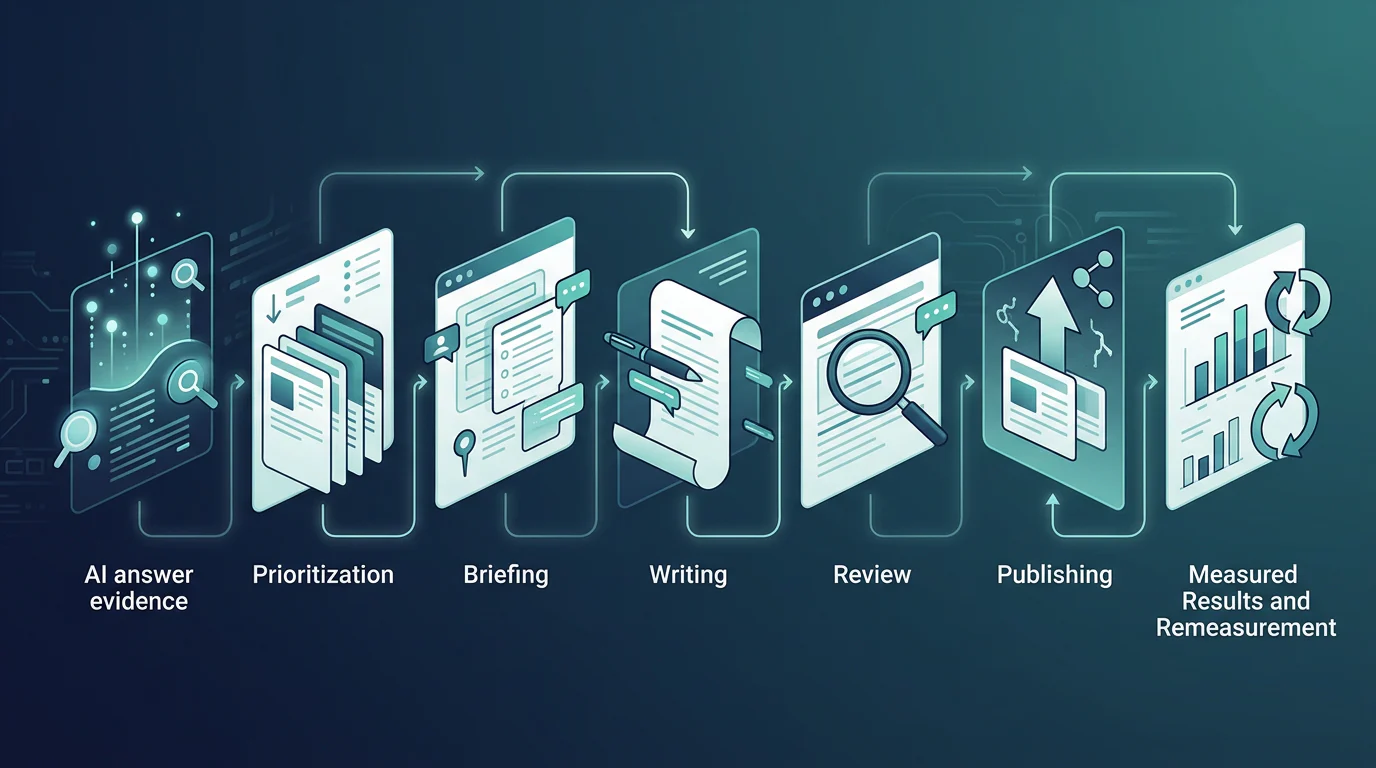
A useful program follows the same evidence from the first detected gap through the post-publication check. That produces an audit trail a marketing leader, writer, and developer can all use, even when each owns a different part of the process.
Detect and Prioritize
First, capture the buyer prompt, returned answer, cited sources, market, date, and category context. Next, prioritize the work by business relevance, recurrence, evidence confidence, expected effort, and dependencies. A raw mention count is not enough because it does not explain the denominator, the prompt mix, or the action that could change the result.
Brief and Approve
The team then chooses the smallest defensible response: a new page, a refresh, a technical ticket, an off-site action, or no action. The selected task becomes a brief with an accountable owner, required evidence, review criteria, and publication route. Our closed-loop workflow keeps the observed answer connected to that work order.
Publish and Remeasure
After approval, the content is published or the technical change is deployed through the agreed CMS and release process. We then rerun the original prompt set and retain the citation evidence, rather than claiming success because an asset went live. Search Console and Analytics serve different purposes here: Search Console measures Google Search performance, while Analytics shows what people do after arriving.
How Should Buyers Compare Commercial Scope and Controls?
Price matters, but the cheapest subscription can become expensive when a team must supply writers, editors, subject-matter experts, developers, and publishing coordination around it. The right comparison puts the service boundary beside the stated monthly fee and production allowance.
| Buying Question | Evidence To Request | Why It Matters |
|---|---|---|
| What Is Included Each Month? | Prompt, answer, site, and content limits | Reveals the actual operating capacity |
| Who Produces The Work? | Named writer, strategist, developer, or customer owner | Separates advice from delivery |
| What Requires Approval? | Review and publishing workflow | Protects claims, voice, and compliance |
| How Do Revisions Work? | Revision policy and turnaround terms | Prevents surprise production bottlenecks |
| What Happens At Capacity? | Overage and prioritization rules | Makes the commercial model predictable |
| How Is Progress Measured? | Original prompts, evidence retention, and rerun cadence | Connects activity to outcomes |
Our published plans provide a clear starting point: Launch lists 25 content pieces monthly at $299, Growth lists 50 at $699, and Enterprise lists 100 at $1,499. The right buying decision still requires written confirmation of commitments, revisions, turnaround, overages, technical access, and publishing responsibilities.
Eligibility is also not a guarantee of placement. OpenAI says sites must permit its search crawler for search eligibility, while ranking and source selection remain variable. That is why we measure the original prompts again after publication.
Which Execution Model Fits Your Team?
The best operating model depends on the work your team can actually complete, not the number of charts it can view. We recommend assigning ownership before comparing plans, particularly when content, legal, development, and regional marketing teams work on different timelines.
Teams with No Content Staff
| Need | Best-Fit Requirement | Watch For |
|---|---|---|
| Content Production | Provider-owned briefs and drafts | A tool that only exports recommendations |
| Approval Support | Defined customer review step | Unclear publishing authority |
| Technical Work | Evidence-backed handoff or scoped implementation | A generic audit with no owner |
| Measurement | Same-prompt reruns after release | Publication counts presented as success |
Internal Content Teams
| Need | Best-Fit Requirement | Watch For |
|---|---|---|
| Prioritization | Prompt and source evidence attached to briefs | Broad topic suggestions without proof |
| Production | Clear handoff into the existing editorial process | Duplicate drafts outside the content calendar |
| Benchmarking | Comparable prompt set and denominator | Raw mention totals without context |
| Measurement | Page-level and prompt-level follow-up | A single blended score |
Distributed Global Owners
| Need | Best-Fit Requirement | Watch For |
|---|---|---|
| Market Coverage | Named markets and language ownership | One global score masking local variation |
| Governance | Regional review and approval rules | Unclear rights to publish |
| CMS Workflow | Documented draft and release handoff | Assumed access across regions |
| Reporting | Comparable evidence by market and period | Inconsistent prompts or date ranges |
Our CMS integration guidance helps teams confirm the publishing route before a content queue turns into an approval bottleneck.
Why Choose PageLens.ai for Managed Execution?
At PageLens.ai, we built our managed execution program for marketing, growth, SEO, and content leaders who need more than a visibility report. We capture answer evidence, prioritize the work that matches a buyer question, and turn approved opportunities into content or a clearly scoped technical handoff. Our plans publish content on your own domain, while you retain authority over claims, brand voice, and release approval.
Our public plans show the production allowance alongside monitoring coverage, so teams can assess the operational workload before buying. We also keep the distinction between a recommendation, an approved change, and a verified result visible. Use our website-fix method when the question is whether a page needs remediation rather than more reporting. Our team can explain published plan boundaries and the actions that require your written approval. If you need a practical walkthrough of scope, ownership, and the next publication cycle, Book a demo
FAQs on AI Visibility Platforms with Managed Execution
Does a Recommendation Count as Execution?
No. A recommendation becomes execution only when an accountable producer accepts the work, it passes review, and a published or deployed outcome can be verified later.
Who Reviews Content Before Publication?
We keep customer approval explicit because the customer owns product claims and publishing authority. A qualified program also assigns factual, brand, legal, and duplication checks before release.
Can Any Provider Promise Citations?
No provider can credibly promise a citation or a placement. Eligibility, source selection, and answer wording change, so measure the original prompt set after release.
What Does a Single-Site Team Need?
Use a one-site plan when it states domain, prompt, answer, production, and publishing limits. Compare monthly output and approval workload before accepting a larger contract.
How Do We Audit a Visibility Change?
We preserve the prompt, returned answer, cited URL, and publication date so a visibility change remains auditable for the teams that approved the work after release.