.png)
Google Expands Generative UI Beyond AI Mode Into AI Overviews - Search Engine Journal


TL;DR
At PageLens.ai, we explain what the reported Google generative UI expansion into AI Overviews means, separating confirmed product announcements from rollout observations. We show marketing, SEO, and content leaders how to measure cited sources, brand language, answer layouts, and qualified outcomes while keeping their content strategy grounded in Google’s published guidance.
Google Expands Generative UI Beyond AI Mode Into AI Overviews - Search Engine Journal
Google says AI Mode has surpassed one billion monthly users, making changes to its AI search experience consequential for brands that depend on discovery, authority, and qualified demand.
Google generative UI is moving beyond AI Mode into AI Overviews, according to reporting published August 19, 2026. Google’s public materials confirm the broader summer rollout for Search, but do not confirm a universal AI Overviews launch. Teams should monitor cited sources, brand language, and interface changes rather than assume every overview has the new experience.
Here is what the development means, what is confirmed, and how we would turn the signal into a practical AI visibility workflow.
What Is Confirmed About the Reported Expansion
The cleanest reading is that the August 19 report identified generative interface elements appearing in AI Overviews. That is a meaningful observation, but it is not the same as an official statement that every overview, market, device, or query type now receives a custom-generated interface.
Google did publicly announce the underlying direction on May 19, 2026. Its Search announcement said Search could assemble visual tools, tables, graphs, simulations, and custom layouts in real time, with generative UI capabilities planned for Search during summer 2026. The announcement did not specifically define an AI Overviews rollout date or coverage threshold.
The product path is also clear. In January, Google made Gemini 3 the default model for AI Overviews globally and let users continue an overview with a follow-up conversation in AI Mode, according to its January update. A dynamic interface inside the overview is therefore a logical product extension, but it still needs to be described as an observed rollout unless Google confirms the scope.
For our purposes, that distinction protects decision-making. We would log the surfaced experience, preserve the prompt and market conditions, then use AI visibility monitoring to determine whether the appearance repeats and affects the pages or sources associated with your brand.
How Google Generative UI Changes AI Overviews
The practical change is not that Google suddenly stops linking to the web. It is that an answer may become a purpose-built experience, with the explanatory format selected for the query rather than constrained to a standard block of text and links.
For a comparison query, that could mean a grid. For a complex process, it could mean a visual model or interactive tool. For a research task, it could mean a richer arrangement of source-supported information. In each case, visibility becomes partly about whether your expertise is selected as support for the answer and partly about whether your brand is represented accurately within the answer’s composition.
| Search Surface | Confirmed Role | Measurement Implication |
|---|---|---|
| AI Overview | Fast answer and a path to supporting sources | Track whether your pages and brand are present in the answer surface |
| AI Mode | Deeper exploration, reasoning, and comparisons | Track follow-up prompts, source persistence, and recommendation language |
| Generative UI | Dynamic layouts, visual tools, graphs, tables, or simulations | Record interface type and whether it changes source prominence or interaction |
Google’s documentation says AI Overviews and AI Mode can use different models and techniques, and their links can vary. Both may also use query fan-out, meaning the system can retrieve information across related subtopics instead of relying only on a single literal query. That makes cross-engine answer tracking more useful than a one-off keyword check.
This is also why the right response is not to chase a new formatting trick. Google still frames its generative features as rooted in Search systems that retrieve relevant, current content from its index.
Measure AI Visibility Beyond a Single Appearance
A dynamic answer layout can change where a citation appears, how much supporting context a user sees before clicking, and how easily a brand is named. It does not make the traditional metrics irrelevant. It makes them incomplete.
Google’s generative-AI reporting in Search Console provides impressions, pages, countries, devices, and time-based views for AI features in Search. Its official report covers AI Overviews and AI Mode together, so it is useful for confirming a broader generative-search signal but cannot independently prove that an individual impression came from a particular interface format.
Track the Evidence Behind Each Answer
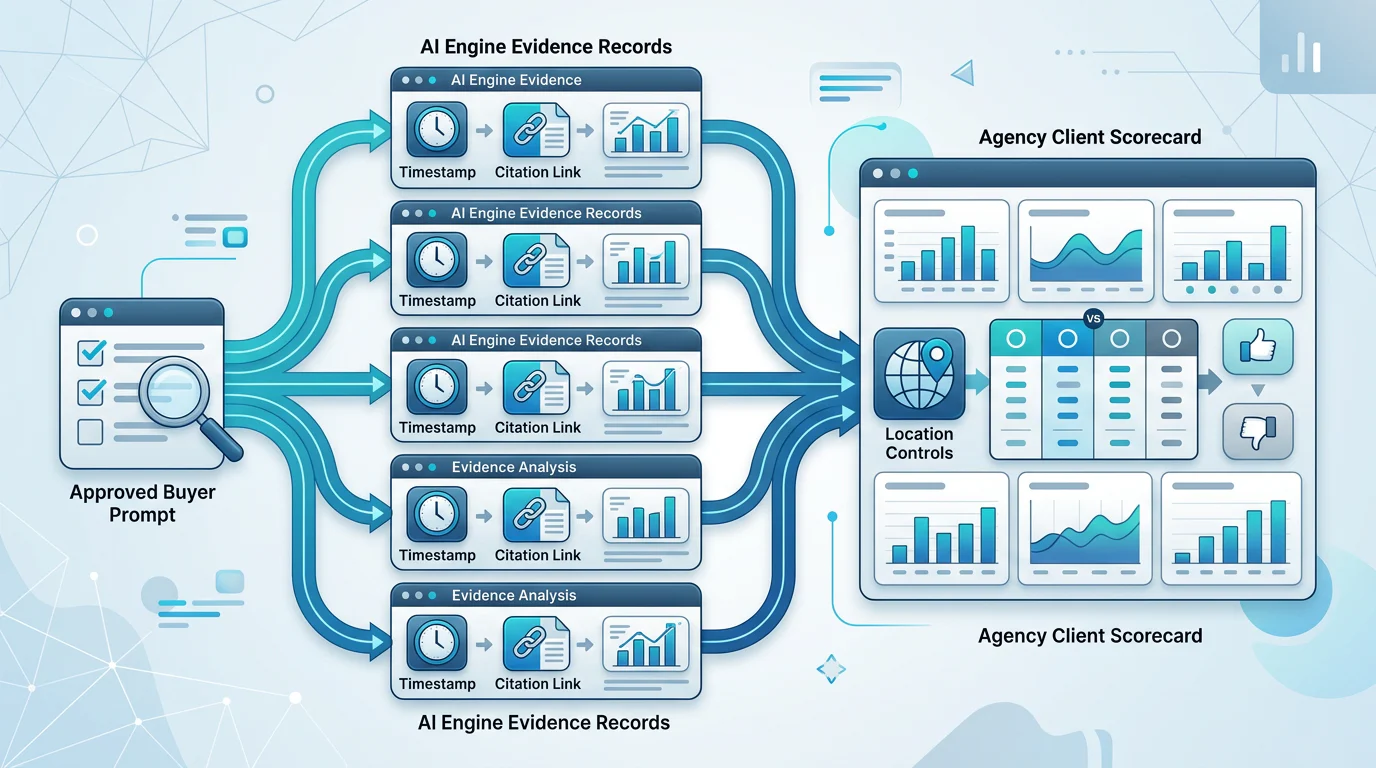
We recommend recording the exact prompt, date, country, language, device, answer type, cited URLs, brand mention, and visible recommendation wording. This turns screenshots into evidence that content, SEO, and leadership can review together.
A page citation and a favorable brand mention are different outcomes. A page can be cited without the brand being recommended, or a brand can be mentioned without a supporting page being visible. Our citation context framework keeps those outcomes separate.
Classify the Interface, Not Just the Result
Label the observed response as standard overview, overview with expanded source treatment, visual layout, comparison grid, generated tool, or another repeatable category. The purpose is not to predict Google’s interface. It is to identify whether a changing layout changes the source and brand signals you care about.
| Signal | What To Capture | Why It Matters |
|---|---|---|
| Appearance rate | Prompts that return an AI answer | Shows where the surface is relevant |
| Source presence | Cited domains and URLs | Connects visibility to specific pages |
| Brand representation | Mentions, qualifiers, and omissions | Reveals whether the answer describes you accurately |
| Interface type | Text, grid, visual, tool, or simulation | Identifies layout-driven changes |
| Business outcome | Qualified sessions and conversions | Keeps the program tied to demand, not novelty |
Read Recommendation Language Closely
A named mention is not automatically a positive outcome. “Suitable for,” “best for,” “limited by,” and “not recommended for” can point to very different commercial implications. Teams should review the exact wording beside the cited source, then validate patterns before changing a page or messaging position.
Our recommendation language approach helps turn that review into an auditable record instead of an anecdotal score.
Run a Repeatable 30-Day Validation Workflow
The first month should produce a baseline, not a grand conclusion. Interface tests, location, and query reformulations can all change what Search shows, so the workflow needs enough discipline to distinguish a temporary presentation shift from a recurring discovery opportunity.
Build a Stable Prompt Set
Start with 25 to 50 prompts that map to your buyer journey: category questions, alternatives, use cases, comparison questions, implementation concerns, and branded questions. Keep the country, language, device, and date visible for every check.
Prioritize questions buyers are likely to ask before they shortlist a solution. Avoid adding prompts simply because they produce an impressive-looking AI response.
Capture a Weekly Surface Audit
Run the same prompt set weekly. Save the result, list cited sources, note whether your brand appears, and classify the layout. If a new visual or interactive format appears, mark it as an observation and compare it with prior runs instead of treating it as a confirmed permanent feature.
Use buyer-prompt research to assess whether the prompts reflect genuine buyer questions rather than an internally convenient keyword list. This gives each observation a clearer relationship to demand and content priorities.

Validate the Pattern Before Acting
After several checks, look for repeated changes to source inclusion, wording, or qualified traffic. A page that appears only once may reflect an experiment. A page repeatedly cited for a valuable prompt deserves closer analysis, content protection, and stronger internal support.
Validate the language before reporting a trend to executives. That step matters most when a change could influence positioning, content investment, or a high-value page.
Keep Content Strategy Grounded in Search Fundamentals
Generative UI does not create a separate shortcut around quality, crawlability, or relevance. Google says pages need to remain eligible for normal Search, and that it does not require special AI markup, AI text files, or a new schema type to appear in its generative features.
The work is more practical than exotic: make important claims available as text, preserve clear internal paths, ensure structured data matches visible content, and publish information that adds knowledge or experience a generic summary cannot provide. Google’s published guidance also warns against scaled content created mainly to chase every possible fan-out variation.
For content leaders, that means strengthening the pages most likely to support a decision. Give comparisons clear criteria, explain limitations as well as benefits, substantiate claims, and keep first-party details current. Use a content fix method to prioritize changes that close a measured evidence gap rather than changes made for an assumed interface preference.
Put This into Practice with PageLens.ai
At PageLens.ai, we turn this shift into a disciplined operating rhythm. We help marketing, growth, SEO, and content teams define the prompts that matter, capture what Google and other answer engines actually show, and classify the sources, mentions, recommendation wording, and pages behind each answer. That gives your team an evidence trail instead of a single opaque score. We then use repeated observations to separate a temporary layout experiment from a durable content gap, so owners know whether to protect a cited page, improve an unsupported claim, or build coverage for an unanswered buyer question. Our workflow keeps country, device, date, and prompt context visible, making handoffs between SEO, content, and leadership more credible. If you need a repeatable way to turn changing AI answer surfaces into prioritized work with brand sentiment validation and clear next actions for every team, Book a demo
FAQs on Google Generative UI
Here are concise answers to the questions marketing, SEO, and content leaders ask as this rollout develops.
Is Google Generative UI Available in Every AI Overview?
No. Google has not confirmed every AI Overview receives a generated interface, so treat individual appearances as rollout observations and validate them separately by market.
What Should Teams Measure After This Change?
Track appearance rate, cited URLs, brand mentions, recommendation wording, interface type, country, device, and qualified outcomes. Compare the same prompt set repeatedly before drawing a conclusion.
Do We Need Special AI Markup to Appear?
No. Google says crawlability, helpful content, accurate visible structured data, and images remain relevant. No special markup or AI text files are required to appear.