
How to Monitor Brand Visibility in AI Search
AI brand visibility monitoring for prompts, multi-engine collection, citations, metrics, and content decisions.

Manual checks make AI visibility feel manageable until prompt volume, engines, and markets multiply. A 2026 measurement study analyzed 2,961 identical-prompt runs and found that recommendation lists rarely repeat exactly.
AI brand visibility monitoring automates a fixed library of buyer prompts across selected answer engines, records each response, and measures mentions, citations, recommendation position, sentiment, and competitor share of voice over time. We preserve prompt-level evidence and separate brand mentions from linked citations, so teams can identify visibility gains and the pages influencing AI answers.
We cover how to design a representative prompt portfolio, collect answers across ChatGPT, Perplexity, Claude, Gemini, and other relevant surfaces, interpret volatility, and connect findings to content and reporting decisions. The goal is not a prettier spreadsheet. It is a repeatable operating model your team can trust.
What Does AI Brand Visibility Monitoring Measure?
A brand appearing in an AI answer is not one event. An engine can name a company in passing, recommend it for a specific use case, or link to a page from its website as evidence. Treating those as the same signal produces misleading reports and weak content decisions.
| Signal | What We Record | What It Does Not Prove |
|---|---|---|
| Mention | Exact brand-name occurrence and surrounding language | A source link, endorsement, or traffic |
| Citation | Linked URL, cited domain, page title, and context | That the brand is recommended |
| Recommendation | Explicit shortlist, fit statement, or positive selection | That the answer linked to the brand |
| Position | Visible list order or shortlist order | A stable rank across runs |
| Sentiment | Positive, neutral, negative, or qualified language | Customer sentiment or conversion intent |
| Share Of Voice | Brand appearances within a defined tracked cohort | Market share or demand |
Source behavior varies by engine. ChatGPT search responses can show inline citations or a Sources panel, which is why we record a citation only when the response visibly links to an eligible source, not when it merely names a company. OpenAI’s search guidance
The useful question is not, “Did we show up once?” It is, “How often do we show up, how are we described, and which owned pages influence answers for the buyer prompts that matter?” That distinction also keeps AI monitoring separate from traditional keyword tracking. For a fuller comparison, see AI visibility tracking.
How Do You Build a Buyer Prompt Portfolio?
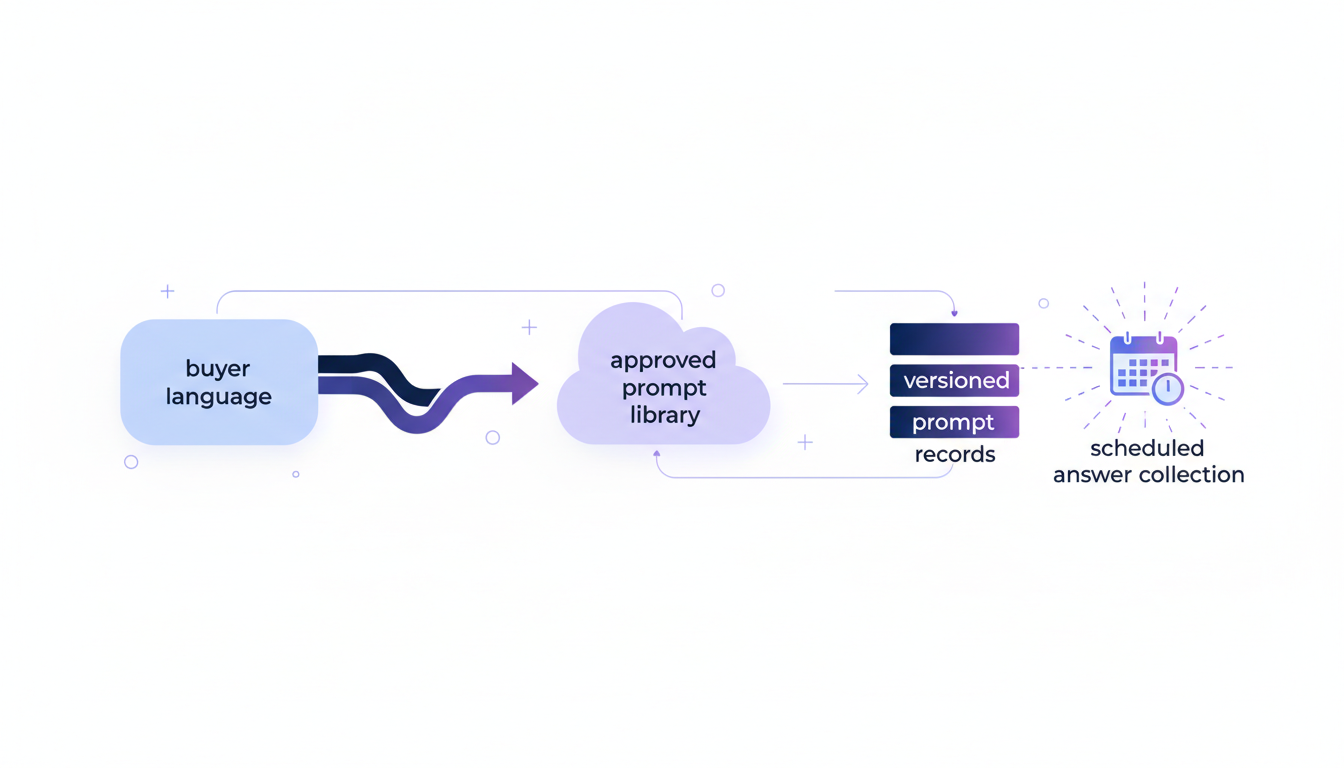
A useful portfolio reflects how buyers ask for help before they know the exact solution, while they compare options, and when they are ready to choose. We start from customer language, sales calls, support patterns, product positioning, and category research. We do not start with a large list of loosely related keywords.
Start with Three Intent Groups
Discovery prompts reveal whether the category and problem space associate with your brand. Comparison prompts test whether the answer includes your company when a buyer weighs options. Purchase prompts test whether the engine sees your offer as a fit for a defined requirement, company type, or constraint.
| Intent | Prompt Template | Required Metadata |
|---|---|---|
| Discovery | “How do B2B teams solve [problem] when [constraint]?” | ICP, category, geography, language |
| Comparison | “What are the best [category] options for [use case], and how do they differ?” | Comparison set, stage, priority |
| Purchase | “Which [category] is best for [company type] with [requirement]?” | Decision criterion, owner, market |
Version Prompts Like Research Instruments
Every prompt needs an ID, exact wording, version, intent, language, location, priority, owner, source rationale, and effective date. When wording changes, create a new version rather than silently replacing the old one. Otherwise, a movement in visibility could reflect a changed question instead of a changed answer landscape.
Keep a Stable Core and an Exploratory Set
The stable portfolio supports trend reporting. The exploratory set captures new buyer language, launch messaging, seasonal use cases, and emerging objections. Keep the two sets separate so experimentation does not distort your executive dashboard.
For a practical framework to source and organize these questions, use our AI buyer prompt dataset. It helps connect prompt selection to real buyer intent rather than generic category terms.
How Does Scheduled AI Answer Collection Work?
Scheduled collection runs each approved prompt across selected engines and stores the response as evidence. One record should represent one exact prompt version, one engine configuration, one time, one market, and one completed response. That makes the data reviewable when an answer changes later.
For every run, capture the prompt ID, raw response text, timestamp, engine and visible mode, search state where visible, language, location, cited URLs, cited domains, detected brands, recommendation context, list position when shown, and error status. Preserve a screenshot or rendered answer alongside the structured record so reviewers can inspect the source material.
Google notes that AI Overviews and AI Mode may use query fan-out, issuing several related searches across subtopics and sources. That is one reason a short buyer question can produce answers and citations that shift across runs. Google’s AI documentation
Standardize the Conditions You Can Control
Use a defined country, language, device or browser policy, session approach, prompt version, and run cadence. Record deviations such as a changed model label, a new interface, a local result, or a search-disabled workspace. A visible change in method is a break in the series, not proof that visibility improved or declined.
Use Repeated Runs to Measure Frequency
One response can be useful qualitative evidence, especially when it contains incorrect or negative language. It is not enough for a trend. Repeated prompt runs turn volatility into a measurable appearance rate, provided the portfolio and collection conditions stay consistent.
Retain the Full Citation Trail
Store the cited URL, page title, domain, and nearby answer text. We then classify whether the citation is an owned page, a third-party page, or an unrelated source. That evidence lets content teams see which pages are influencing answers rather than guessing from a dashboard total.
Our guide to multi-engine tracking signals explains how to keep engines separate while still reporting a useful combined view.
What Metrics Matter for AI Brand Visibility?
The headline metric should answer a clear business question. Mention rate measures category association. Citation rate measures whether owned pages are visibly linked. Recommendation rate measures whether an engine explicitly presents the brand as a fit. Each needs the same denominator: eligible completed responses in a defined cohort.
| Metric | Calculation | Decision Use |
|---|---|---|
| Mention Rate | Responses naming the brand ÷ eligible completed responses | Category awareness |
| Citation Rate | Responses linking an eligible owned URL ÷ eligible completed responses | Source influence |
| Recommendation Rate | Explicit recommendations ÷ eligible completed responses | Purchase-intent visibility |
| Median Visible Position | Median order, with range and sample count | Diagnostic only |
| Sentiment Mix | Positive, neutral, negative, or qualified labels | Messaging review |
| Citation-Page Coverage | Unique cited owned pages by prompt cohort | Content planning |
| Competitor Share Of Voice | Brand appearances ÷ tracked-brand appearances | Relative visibility |
| Completion Rate | Usable responses ÷ attempted runs | Data quality |
Position belongs in the evidence record, but it should not become a standalone ranking claim. AI answers can change their shortlist order even when the underlying set of recurring brands remains similar. Use position to inspect a response, then use rates and sample size to report the trend.
Referral traffic is also an outcome metric, not a substitute for visibility. GA4 can attribute visits arriving through links on third-party domains, but an unclicked mention does not create a referral event. GA4 referral documentation
When we see citations without traffic, we investigate link placement, prompt intent, and answer format. When we see mentions without citations, we investigate whether the brand has category association but lacks pages the engine can visibly use as sources. For deeper citation analysis, read citation tracking context.
How Do Teams Build a Monitoring Workflow and Choose a Tool?
Enterprise AI brand visibility monitoring needs a workflow around the data, not just collection. The program should define who owns prompt governance, who reviews response evidence, who receives alerts, and how insights become content work. Without those decisions, automation simply creates more unreviewed output.
Build a Dashboard for Decisions
Segment reporting by engine, prompt intent, geography, language, prompt version, competitor set, and time period. Show completion rate and run count beside every percentage. A dashboard should make it easy to answer which prompts lost visibility, which pages gained citations, and which markets need a human review.
For dashboard design and governance, use our enterprise monitoring guide. It helps teams tie collection requirements to review ownership before a reporting process becomes difficult to audit.
Set Alerts with Evidence Attached
Use thresholds your team agrees in advance, such as a sustained decline in purchase-intent recommendation rate, a newly negative descriptor, or the loss of a frequently cited page. Every alert should open the exact response, prompt version, timestamp, engine settings, and cited sources.
Preserve Evidence and Access Controls
Retention matters when stakeholders ask why a number changed. Keep raw responses, screenshots, source URLs, classification decisions, reviewer notes, and export logs. Some enterprise workspaces can restrict web search or use cached search behavior, which can materially affect source freshness and results. Workspace search controls
Evidence is not a record-keeping chore. It is the connection between a dashboard movement and the content, positioning, or governance action that follows. Our content optimization stack shows how to prioritize that action after monitoring identifies a gap.
Compare Manual and Automated Effort
| Input | Manual Check | Automated Program |
|---|---|---|
| Prompt Count | Enter approved prompts | Enter approved prompts |
| Engine Count | Enter selected engines | Enter selected engines |
| Run Frequency | Enter runs per week or month | Enter scheduled cadence |
| Checks Per Period | Prompt count × engine count × run frequency × repeats | Same |
| Team Hours | Collection, tagging, QA, and reporting time | Review, QA, and action time |
| Labor Cost | Team hours × loaded hourly cost | Review hours × loaded hourly cost |
| Total Program Cost | Labor cost | Labor cost plus approved platform cost |
| Evidence Quality | Manual notes and screenshots | Prompt-level records, sources, and exports |
Use the worksheet before locking a cadence. It makes the tradeoff visible: automation does not eliminate review work, but it replaces repetitive collection with structured evidence that content and analytics teams can reuse. The calculation should include the time required to select prompts, launch runs, capture screenshots, review citations, label response context, resolve errors, prepare stakeholder updates, and turn findings into assignments.
A platform evaluation should include evidence retention, exports, access controls, and quality assurance. Those requirements matter as much as raw prompt capacity because a team cannot defend an insight it cannot trace back to a specific response and collection condition. Consider the workload over a full reporting cycle, including follow-up questions from leadership and content owners. The cost of a tool is only meaningful alongside the labor it removes and the decision quality it makes possible.
For a practical evaluation framework, see our manual-tracking comparison. It helps teams weigh workload, coverage, governance, and reporting needs before selecting an approach.
How Can PageLens.ai Help You Run AI Brand Visibility Monitoring?
At PageLens.ai, we help marketing, growth, SEO, and content leaders build a monitoring program they can defend in a planning meeting. Our starting point is a governed prompt portfolio, repeatable collection rules, and evidence that reviewers can inspect, not a black-box score. We work from the questions buyers ask, define the engines and markets that matter, and set reporting thresholds before anyone draws a conclusion. That makes it easier to distinguish a genuine change from a model update, a location difference, or a thin sample. If your team needs to replace recurring manual checks with a practical, auditable operating model, we can walk through the controls, metrics, and rollout decisions relevant to your workflow. Together, we review governance needs, content ownership, export expectations, and the way visibility findings should reach analytics and executive reporting. When the time is right, Book a demo.
FAQs on AI Brand Visibility Monitoring
How Do You Monitor Brand Visibility in AI Search?
Run a fixed, versioned set of buyer prompts on defined engines and schedules. Preserve each response, then compare mention, citation, recommendation, and share-of-voice rates within stable cohorts.
Is an AI Mention the Same as a Citation?
Not necessarily. A mention shows that an answer names your brand. A citation links to a source, while a recommendation explicitly presents your brand as a fit.
Why Do Repeated Prompt Runs Matter?
AI responses can vary even when the wording stays unchanged. Repeated runs reveal appearance frequency and response patterns, while a single answer only provides anecdotal evidence.
Can Analytics Measure AI Brand Visibility?
Analytics can measure referral visits when users click source links. It cannot measure unclicked mentions, recommendations, or cited pages that do not produce a visit.
How Often Should B2B Teams Review AI Visibility?
Review priority purchase and reputation prompts on a steady schedule, then assess aggregate results monthly. Keep collection conditions stable so reported changes remain interpretable over time.