
PageLens.ai vs Self-Serve Software: A Fintech AEO Platform Comparison
Compare managed fintech AEO with self-serve software, including share of voice, buyer prompts, content controls, publishing, and total cost.

PageLens.ai vs Self-Serve Software: A Fintech AEO Platform Comparison
Fintech content has to win attention without creating a review problem. For SEC-registered investment advisers, the Marketing Rule includes seven prohibitions that include material claims an adviser cannot substantiate on demand.
For a fintech team that needs AI share-of-voice reporting and managed content delivery, our Growth plan is the better fit when 25 managed pieces, daily multi-engine tracking, and your review process match the work required. Self-serve software fits teams that chiefly need draft generation and can own editing, approvals, and publishing internally.
This fintech AEO platform comparison explains the operating-model difference, a defensible share-of-voice method, fintech publishing controls, and the total cost behind each option.
How Does This Fintech AEO Platform Comparison Separate Software from Delivery?
A feature grid can make two very different operating models look similar. The meaningful distinction is whether your team receives a dashboard and drafting tools, or a connected workflow that turns buyer-prompt evidence into reviewed, approved, and published content.
We built our Growth plan for the second situation. It combines daily visibility tracking with managed production, while a self-serve platform gives an internal team software to research, draft, optimize, and publish with its own people. Understanding that split makes visibility tracking easier to evaluate.
| Capability | Our Growth Plan | Self-Serve Platform |
|---|---|---|
| Operating Model | Managed content workflow with client review before publication | Software-assisted research, drafting, and optimization |
| Share Of Voice | Tracks recommendation share against selected competitors | Typically reports a brand’s presence across tracked answers |
| Prompt Discovery | Surfaces buyer questions in your category | May provide prompt research and estimated demand |
| Managed Production | 25 managed content pieces | No equivalent managed editorial delivery stated |
| Content Generation | We draft AI-optimized pieces for review | AI article allowances and writing tools |
| Technical Work | Technical audit and fixes | Audits and automated recommendations may vary by plan |
| Publishing | Approved pieces are published | Internal team remains responsible for final approval and publishing |
| Engine Coverage | Seven named answer engines with daily refresh | Three engines on listed self-serve tiers, broader coverage on custom enterprise plans |
| Fintech Controls | Confirm source, review, revision, and approval terms in writing | Do not infer a compliance workflow from software features alone |
Our current Growth plan lists 100 tracked prompts, daily refresh, seven named answer engines, 25 managed content pieces, and technical audit and fixes. We draft the pieces, your team reviews them, and approved pieces are published. That creates a practical loop between multi-engine signals and content execution.
The public plan page does not set a turnaround promise, revision count, content-type mix, or regulated-industry compliance workflow. Those are purchase-critical details, so your agreement should state them plainly before work begins.
What “Managed” Should Mean in Practice
Managed production should mean more than receiving an AI draft. It should include topic selection from visibility evidence, a source-led brief, editorial production, a review handoff, tracked changes, approval, publishing responsibility, and post-publication measurement.
A self-serve article allowance can be useful for teams with an established content operation. It is not automatically equivalent to a reviewed, publish-ready fintech article. That distinction matters when your buyer questions include rates, eligibility, security, fees, investment outcomes, or regulated product claims.
What to Confirm Before Signing
Ask both providers to document who owns the work at each stage:
- Source Standards: Define which first-party, regulatory, and third-party sources are acceptable for material claims.
- Review Ownership: Name the marketing, subject-matter, legal, and compliance approvers.
- Revision Terms: Set the included revision rounds, response windows, and escalation path.
- Publishing Rights: Confirm CMS access, final publishing authority, rollback access, and asset ownership.
- Claim Handling: Specify how unsupported, prohibited, or outdated claims are flagged and removed.
How Should Fintech Teams Measure AI Share of Voice?
Share of voice is only useful when its denominator is clear. A report that says a brand has 30 percent visibility without showing the prompts, engines, location, repeat runs, and competitors may hide more than it reveals.
Our recommended approach begins with buyer-prompt discovery, not a keyword export. Build a 100-prompt set across category, alternatives, problem, feature, comparison, and risk intent. Then keep the prompt wording stable long enough to observe real movement.

Use a Transparent Denominator
Calculate a brand’s AI share of voice as its counted recommendation or mention occurrences divided by all counted brand or category-recommendation occurrences across completed prompt runs. Keep zero-mention answers in the sample. Report citations separately because an answer can cite a page without recommending its brand.
Run every prompt across the engines your buyers use, then show engine-level results before publishing a blended figure. Google’s reporting update confirms that generative search visibility can be segmented by pages, countries, devices, and dates. That is a useful model for transparent reporting.
Repeat, Segment, and Explain
AI answers can vary. We recommend three repeated runs per prompt and engine, a fixed language and country, daily collection, and weekly plus 28-day reporting. State the competitor set, include “no brand recommended” as an outcome, and document any changes to prompts or markets.
This method turns prompt research into a measurement system rather than a collection of screenshots. It also makes it easier to explain why a score moved: a new prompt, a different engine response, a competitor gain, or a real increase in recommendation frequency.
Treat Citations as Evidence, Not a Victory Lap
Citation analysis should identify the domains and URLs answer engines rely on, the prompts that trigger each citation, and the pages your brand is missing from. It should never imply that one citation guarantees traffic, conversion, or recommendation.
Use citation tracking to connect cited sources to the content gaps worth addressing. The outcome is a prioritized editorial queue based on what buyers ask and what answer engines actually return.
Which Content Workflow Is Safer for Fintech Publishing?
Fintech teams need an editorial process that can withstand scrutiny after publication, not just a fast path to a draft. A workflow should preserve the source behind every material claim, make the approver visible, and prevent an unsupported statement from reaching the CMS.
FINRA Rule 2210 requires covered communications to be fair and balanced and not omit material facts or qualifications that would make them misleading. Its content standards are a useful reminder that a disclosure link cannot rescue a claim that is misleading on its face.
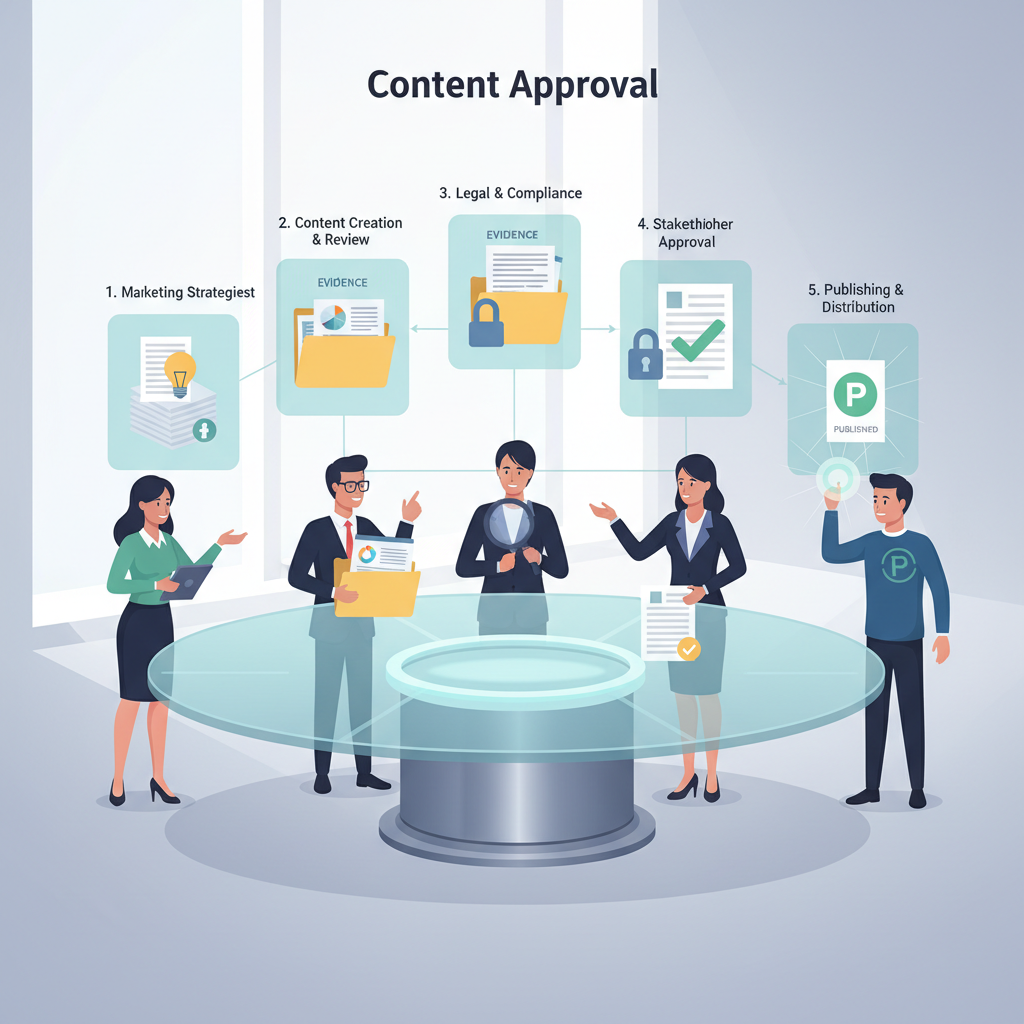
Step 1: Prioritize Buyer Questions
Select prompts where your brand is absent, misdescribed, or weakly cited. Define the reader, product, geography, and claim-risk category before drafting. This creates a content brief with a reason to exist, rather than a generic article produced because an allowance is available.
Step 2: Build an Evidence-First Brief
Attach approved product documentation, regulatory guidance, disclosure language, dates, and claim owners. Give writers a source hierarchy and a clear instruction to avoid unapproved savings, security, performance, eligibility, or outcome claims.
Step 3: Draft, Edit, and Substantiate
Map each material factual statement to an approved source. Edit for the buyer’s question, not just a search phrase. This is where our optimization stack matters: technical clarity and answer-ready structure should support evidence, never replace it.
Step 4: Capture Subject-Matter and Compliance Approval
Route the draft through the people accountable for product accuracy and regulatory review. Retain version history, reviewer comments, and the final approval record. If a claim cannot be substantiated, remove or rewrite it before publication.
Step 5: Publish and Monitor
Publish only the approved version, then watch for citation changes, answer-engine mentions, product changes, and source updates. Update or retire content when the evidence no longer supports the page.
How Do Costs Compare for 25 Pieces?
The price comparison starts with a verified subscription number, but it cannot end there. A lower software subscription can be the right choice when internal capacity is already available. It can also become more expensive when senior editors, subject-matter experts, compliance reviewers, and publishing owners must build every article around the draft.
Our listed Growth price is $599 per month for 25 managed content pieces. A current self-serve baseline lists $199 per month when billed annually for 25 AI articles, 100 prompts, and 300 daily answers. The difference is not simply $400, because the outputs and responsibilities are different.
| Cost Line | Managed Plan | Self-Serve Baseline |
|---|---|---|
| Listed Subscription | $599 Per Month | $199 Per Month, Billed Annually |
| Monthly Content Allowance | 25 Managed Pieces | 25 AI Articles |
| Internal Editing | Add Your Loaded Hourly Cost | Add Your Loaded Hourly Cost |
| SME Review | Add Review Hours | Add Review Hours |
| Compliance Review | Add Review Hours | Add Review Hours |
| Implementation | Setup Cost Divided By Contract Months | Setup Cost Divided By Contract Months |
| Add-Ons Or Overages | Add Verified Contract Terms | Add Verified Plan Terms |
| Cost Per Approved Piece | Total Monthly Cost ÷ Approved Pieces | Total Monthly Cost ÷ Approved Published Pieces |

Use the table as a worksheet, not a sales formula. Include subscription, unused features, internal editorial time, SME review, compliance review, implementation, overages, and the cost of delayed publishing. Divide by approved published pieces, not drafts generated.
This calculation also clarifies when AEO versus semantic SEO becomes a resourcing decision. If your team already runs a strong regulated-content workflow, software can fit. If the bottleneck is turning measurement into reviewed, published work, managed delivery may create the simpler operating model.
Who Should Choose Managed or Self-Serve AEO?
Choose monitoring only when you already have writers, editors, compliance review, and publishing operations that can act on the findings. In that case, the goal is a stable measurement system with a prompt set your team trusts.
Choose self-serve drafting software when your internal team wants control of the production process and can reliably brief, source-check, edit, approve, publish, and measure the resulting content. It is a software purchase, not an outsourced editorial outcome.
Choose our managed plan when you need measurement and execution in one workflow. We connect prompt evidence, share-of-voice reporting, citation opportunities, managed drafts, your review, approved publishing, and technical fixes. That is the right fit when content execution, not idea generation, is the limiting factor.
The decision should be honest. A team that needs only monitoring should not pay for production it will not use. A team that needs only drafting should not expect software to supply accountable compliance review. A team that needs both measurement and managed execution should evaluate the complete workflow through the PageLens Platform.
Why Choose PageLens.ai for This Fintech AEO Platform Comparison?
Choosing a fintech AEO platform comparison should not end with a feature checklist. It should end with a workflow your team can defend. Here, we connect daily visibility measurement to 25 managed content pieces, then keep your team in the approval loop before publication. That gives marketing leaders one accountable path from buyer prompts to content, citations, and technical fixes. Bring us your priority category, current visibility questions, approval requirements, and the people who own final sign-off. We will help you map the prompt set, measurement method, editorial workflow, and implementation responsibilities before you commit. We will also distinguish subscription cost from your internal editing, compliance, publishing, and overage costs. If you need monitoring only, we will say so. If your team needs managed execution, we will show exactly what we can deliver and what still needs written confirmation. Book a demo
FAQs on Fintech AEO Platform Comparison
These answers clarify the measurement, delivery, and cost distinctions that matter when a regulated marketing team compares AEO operating models.
What Does AI Share of Voice Measure?
AI share of voice measures the percentage of completed sampled answer runs that recommend or mention a brand, using a disclosed prompt set, engine list, geography, and denominator.
What Does Managed Content Include?
Managed content means we turn visibility gaps into drafts, route them through your review, publish only approved pieces, and measure performance afterward. Confirm contractual review details first.
Are AI Article Allowances Equivalent to Managed Articles?
Not necessarily. A listed software allowance can cover AI-generated drafts, while a managed piece may include briefing, sourcing, editing, approval coordination, publishing, and post-publication monitoring.
How Many Answer Engines Should a Fintech Team Track?
Use the engines your buyers actually use, then report each separately before calculating a combined figure. Our Growth plan publicly lists seven named answer engines with daily refresh.
What Belongs in the Total-Cost Calculation?
Include subscription fees, add-ons, unused features, internal editorial time, subject-matter review, compliance review, implementation, and overages. Divide the result by approved published pieces, not generated drafts.