.png)


TL;DR
On 17 August 2026, Mediaproxy announced AI-enabled updates to LogServer ahead of IBC 2026. We explain why auditable on-air brand records can support compliance and sponsorship reporting, why they are not AI-search visibility, and how marketing leaders can track each evidence stream without confusing the two.
AI Broadcast Monitoring Makes Brand Exposure Auditable
As broadcast teams prepare for IBC 2026, AI is moving deeper into compliance logging and live monitoring workflows. The event runs 11 To 14 September in Amsterdam, creating an immediate checkpoint for teams that need better evidence of where and when a brand appeared.
On 17 August 2026, Mediaproxy announced an AI-enabled update to its LogServer broadcast monitoring platform ahead of IBC 2026. For marketing teams, AI broadcast monitoring visibility can yield auditable records of on-air brand exposure, but it does not measure whether answer engines mention, recommend, or cite a brand. Those outcomes require separate, repeatable prompt-level tracking.
We explain what the update changes, where compliance evidence becomes commercially useful, and how to track across engines without treating two different measurements as one.
What Changed in AI Broadcast Monitoring
The announced update brings AI-assisted monitoring to LogServer, a platform used for broadcast analysis and compliance logging. It includes automated checks, real-time event detection, QoE monitoring, and on-demand reporting. The August Announcement also identifies a browser-based multiviewer, Monwall Web, and participation in the Media eXchange Layer initiative.
This matters because a broadcast log can become more than a record of technical faults. When an operational team can identify a brand appearance, time, channel, market, and asset in one reviewable trail, marketing and sponsorship teams gain evidence they can inspect rather than an untested estimate. The announced capabilities should still be treated as product claims until each team validates them against its own streams and workflows.
Where Compliance Logs Become Brand Evidence
Compliance logging has a practical commercial role because broadcasters already have to retain and act on operational evidence. In the United States, the FCC reported at least 1,700 loud-commercial complaints in 2024, compared with about 750 in 2022 and 825 in 2023, in its 2025 Notice on potential CALM Act rule updates.
Audit the Air-Time Record
For a marketing leader, the useful unit is not simply “brand detected.” It is a verified appearance connected to a defined stream, time window, market, creative, and campaign. That record can support a conversation about sponsorship delivery, rights compliance, or a missed placement, but it should retain human review for material decisions.
Separate Detection from Validation
Earlier 2026 reporting described AI tools that automatically identify logos and visual identifiers across channels and regions. That can reduce manual review, but the important operational question is how a team handles false positives, visual variants, partial appearances, and logos that resemble unrelated brands. The April Update makes the value proposition clear, while leaving validation discipline with the user.
Keep the Evidence Useful to Content Teams
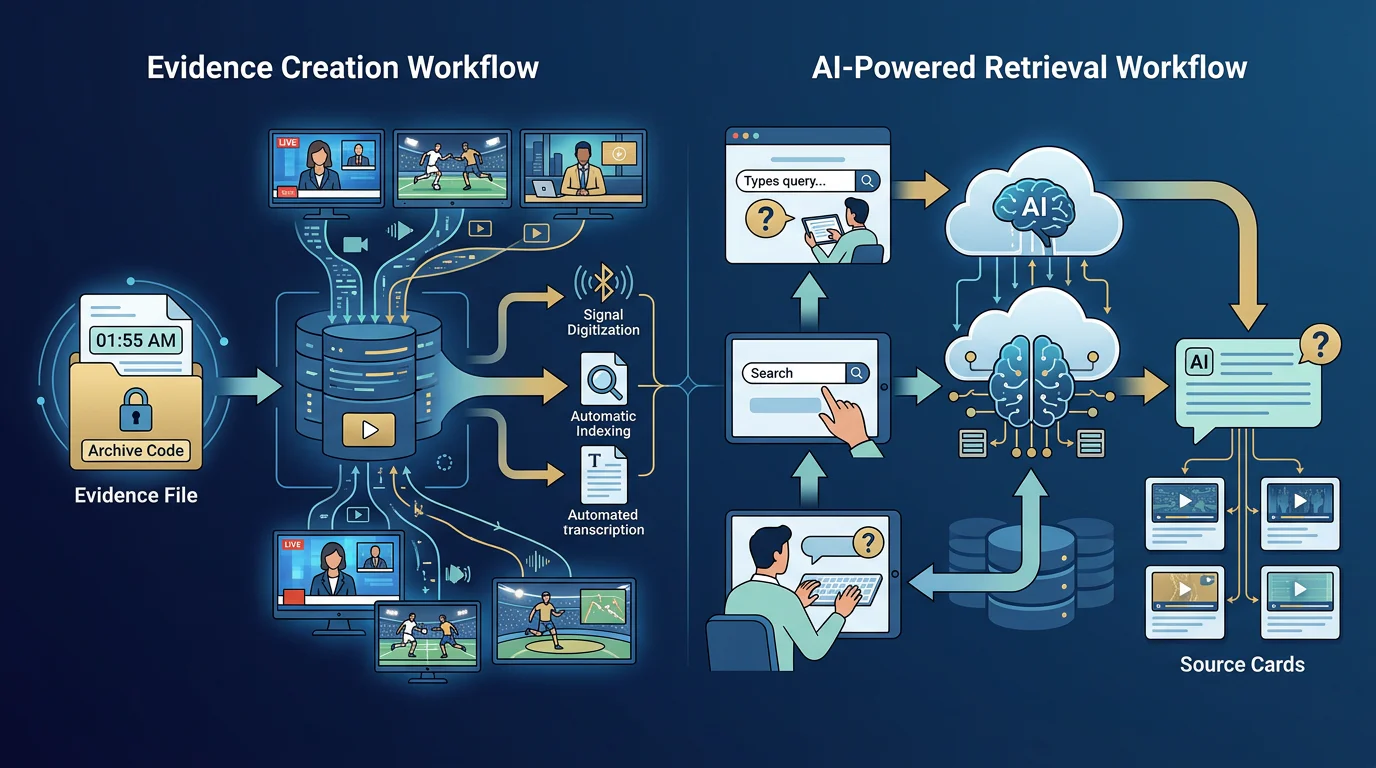
We would keep broadcast evidence alongside, not inside, an AI-answer report. A timestamped appearance may reveal a new campaign, spokesperson, product phrase, or editorial context worth checking in answer engines. It cannot establish that the same brand is present in AI responses. For that, content teams need citation context tied to actual prompts and answers.
Why AI Broadcast Monitoring Visibility Is Not AI Search Visibility
Broadcast monitoring observes a distributed media stream. AI-search monitoring observes an answer produced for a prompt. Google explains that AI Overviews and AI Mode can retrieve indexed pages and use query fan-out to seek supporting information, as outlined in its AI Features Guide. That is fundamentally different from recognizing a logo in video.
The distinction is not semantic. It determines what a team can responsibly report to leadership, and what action it should take next.
| Evidence Question | Broadcast Monitoring | AI-Search Monitoring |
|---|---|---|
| What Happened? | A brand or asset appeared on air | A brand appeared in an answer |
| Core Evidence | Timestamped stream record | Prompt, response, and cited sources |
| Primary Owner | Compliance or broadcast operations | Growth, SEO, and content teams |
| Useful Decision | Verify delivery or an incident | Improve discoverability or coverage |
Measure Separate Outcomes
AI visibility should be measured by answer-level outcomes: mention presence, recommendation inclusion, cited-source presence, response language, engine, locale, and date. We use this separation when helping teams measure AI visibility, because a single blended score can obscure the real cause of a change.
Treat Citations as Evidence, Not Decoration
A citation in an answer can show what source supported a response at a particular moment. A mention without a citation may still matter, especially in recommendation prompts, but it needs its own classification. Neither result proves that a broadcast placement caused the answer outcome.
Do Not Infer Authority from Exposure
A brand can be highly visible on air and still be absent from buyer-facing AI answers. The reverse can also be true. The useful inference is narrower: broadcast evidence may identify content and language worth testing, while prompt-level monitoring shows whether that information actually appears in AI-mediated discovery.
What Marketing Leaders Should Monitor Before IBC
The immediate opportunity is to establish clean measurement before new monitoring capabilities enter the workflow. First, define the brand taxonomy: company name, products, campaign names, sponsorships, accepted variants, and likely false positives. Then decide which appearances require human verification.
Use a short operating checklist:
- Broadcast Evidence: Retain date, time, market, channel, programme, creative, detected brand, and reviewer decision.
- AI-Answer Evidence: Retain prompt, engine, locale, response, cited URLs, mention status, recommendation language, and test date.
- Action Rule: Turn recurring answer gaps into specific content, technical, or source-authority work rather than publishing pages solely to chase AI results.
Google cautions against using generative tools to produce large volumes of low-value pages for search manipulation in its Content Guidance. The better workflow is to test real buyer questions, diagnose the missing evidence, and monitor AI search over time.
Put PageLens.ai to Work
Broadcast logs can show that a brand appeared. They cannot show how an answer engine described it, whether it recommended it, or which sources supported that answer. PageLens.ai gives our customers a repeatable way to test defined buyer prompts across AI engines, retain answer and citation evidence, identify missing or weak coverage, and turn the findings into content priorities. For teams facing this monitoring shift, the practical move is to keep broadcast compliance evidence and AI-answer evidence side by side, with different owners and a shared brand taxonomy. That makes sponsorship reporting more defensible and content decisions more specific. Book a demo
FAQs on AI Broadcast Monitoring Visibility
Is Broadcast Brand Exposure the Same as AI Visibility?
No. Broadcast monitoring records where a logo, advertisement, or asset appeared in a stream. AI visibility records whether a defined answer engine mentions, recommends, or cites it.
What Evidence Should Teams Retain for AI Visibility?
Keep prompts, engines, locales, timestamps, full responses, cited URLs, mention status, recommendation language, and reviewer notes. These fields make comparisons auditable across repeated tests over time.
What Should Teams Ask Before Adopting New Monitoring Tools?
Ask about detection rules, false positive review, retained evidence, reporting exports, supported channels, and latency. Test the workflow against one sponsorship or campaign before rollout.