.png)


TL;DR
We see IHG’s July 28, 2026 conversational-search beta as a concrete signal that property data is becoming a direct AI visibility input, not merely a website-maintenance task. This analysis separates owned-channel discovery from external AI recommendations, explains the commercial implications, and gives marketing leaders a measurable next-step workflow.
IHG AI Search Makes Hotel Data an AI Visibility Lever
IHG had 7,109 hotels in its global estate at June 30, 2026, so a new discovery layer can change how vast volumes of property information become findable by prospective guests. We examine what changed, what it does not prove, and how marketing leaders should respond.
On July 28, 2026, IHG began a U.S. beta of conversational AI search on IHG.com and its loyalty app. Travelers can use ordinary language to find properties with live availability, pricing, maps, and amenity details. For hotel marketers, this makes accurate, rich property data a more immediate AI visibility and booking consideration.
The important shift is not that search now has a chat interface. It is that a traveler can move from a nuanced need to a property recommendation inside a controlled booking environment, with fewer opportunities for incomplete information to be corrected later.
What IHG Launched and Why It Matters
At the product level, this is a U.S. beta, not a completed global rollout. Guests can describe a destination, trip purpose, preferred amenities, and other needs in everyday language, while the existing hotel search remains available alongside the new option.
A More Specific Discovery Path
A traveler no longer has to begin with a rigid destination and filter sequence. Someone can express a need such as a family stay near an attraction, a business trip with a particular workspace requirement, or a points booking with a specific amenity. The system can then surface recommendations alongside property details intended to support comparison and booking.
That changes the practical value of hotel content. Information that was once buried in a generic property page, an image gallery, or a local landing page becomes part of the input that can determine whether a hotel is considered at all.
Rich Property Facts Become More Important
IHG says recommendations are grounded in verified property data and guest reviews. It also plans an AI-optimized hotel content platform that can support richer inputs, including floor plans, video, and updated imagery. That is a clear operational signal: property teams need a defensible source of truth for attributes, not just polished brand copy.
The announced direction extends beyond IHG’s owned sites. Its stated aim is to help properties better present their distinctive features across both its own and third-party digital channels, which raises the stakes for data completeness and consistency.
This Is Not yet a Booking Performance Result
IHG has not published beta adoption, conversion, or incremental direct-booking results. We should therefore treat better discovery as the intended commercial outcome, not an achieved performance claim. The useful lesson is earlier in the funnel: if a system cannot find and interpret the relevant property facts, it cannot confidently match that property to a traveler’s request.
Why Hotel Data Is Becoming an AI Visibility Lever
AI visibility is increasingly shaped by whether a system can locate, understand, and confidently use the details that make an option relevant to a particular person. Google’s AI search guidance reinforces the same foundation for public web visibility: crawlable, useful, technically sound pages remain central, and being eligible to appear does not guarantee inclusion.
Detailed Facts Beat Broad Marketing Copy
A hotel page that only says “ideal for business and leisure” gives a retrieval system little to work with. A page that clearly specifies room types, accessibility details, parking, pet rules, meeting capacity, nearby transport, family amenities, and distinct local context gives the system concrete matching material.
This does not mean adding boilerplate to every page. It means publishing accurate details where travelers and search systems can find them, then keeping the facts aligned when a property changes.
Owned Search Is Not External AI Visibility
IHG controls the conversational experience on its own website and app. That can improve the path from discovery to booking within its digital estate, but it is different from being cited or recommended by a public answer engine. The two may be connected through better underlying data, yet they need separate measurement.
For external AI visibility, we recommend monitoring which domains and pages are actually used as evidence. Our guide to citation sources explains why a brand mention without a traceable source is not enough to diagnose what is influencing the answer.
Governance Becomes a Distribution Decision
Marketing cannot solve this alone. Hotel operations own many of the facts that influence suitability, revenue teams manage availability and commercial rules, and web teams control where information is published. A shared property-data review process is therefore more valuable than a one-time content refresh.
The goal is simple: reduce the gap between what a hotel can offer and what a traveler, or an AI system, can reliably verify.
The Commercial Implication Is Less Friction, Not a Proven Lift
IHG had already launched an app in ChatGPT on June 3, 2026, allowing travelers to search, compare, and explore its portfolio before the owned-channel beta followed. That earlier launch shows a broader strategy to meet travelers in more than one AI-assisted discovery environment.
For hotel owners, the implication is commercial even before a public uplift figure exists. IHG reports that 73% of rooms in its system are franchised, and a typical sample franchise agreement uses a 5 to 6% royalty on rooms revenue, according to its business model. Better matching could matter to owners, but no one should equate that possibility with demonstrated revenue.
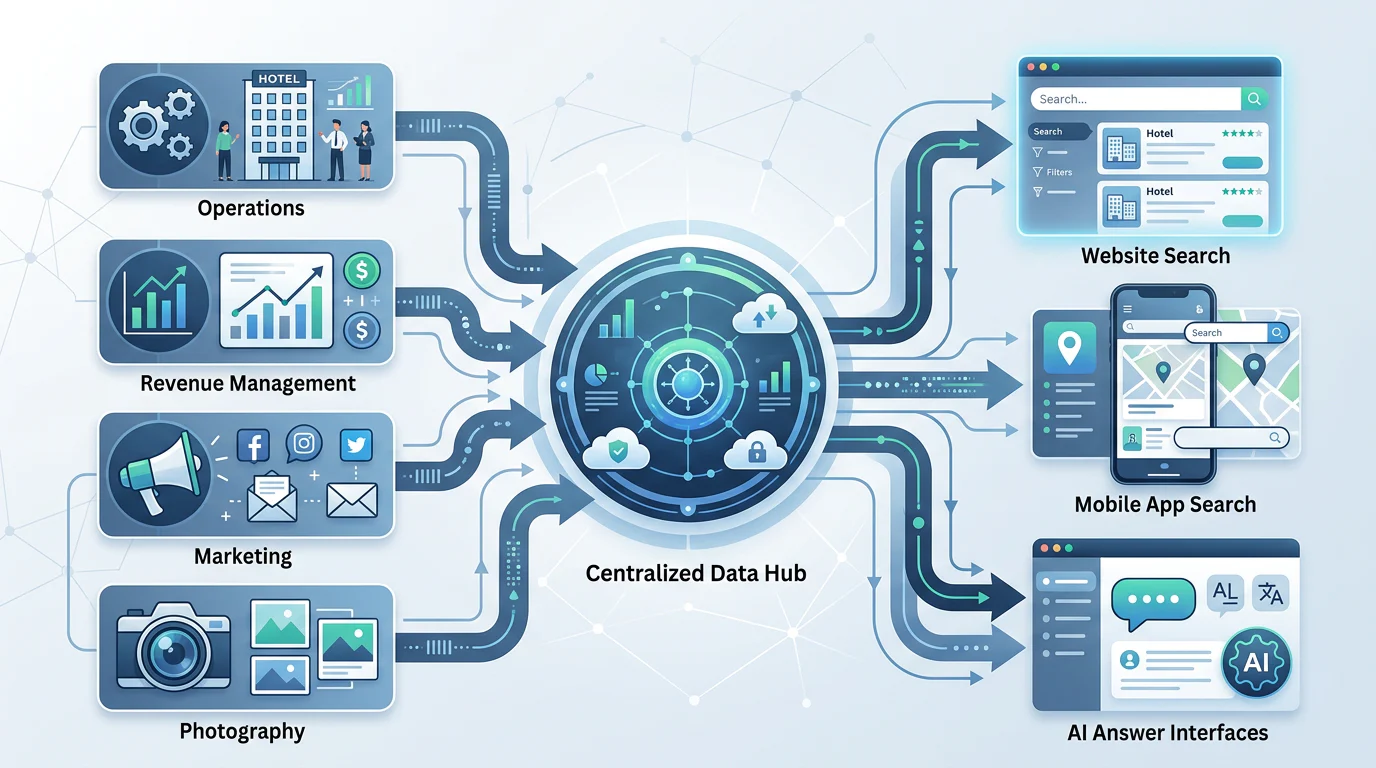
The practical response is to measure the journey rather than assume it works. A useful baseline should include:
- Appearance Rate: How often a priority property, brand, or page appears for a defined set of traveler prompts.
- Attribute Accuracy: Whether the returned information matches the hotel’s current official details.
- Citation Evidence: Which pages or third-party sources support external answers.
- Referral Quality: Whether visitors arriving from AI-assisted discovery engage, search, or book.
- Conversion Outcome: Whether the path produces completed bookings, rather than merely impressions.
A multi-engine tracking method helps separate an owned-site experience from external answer-engine performance, so teams do not mistake one for the other.
What Marketing Leaders Should Monitor Next
The next confirmed development to watch is whether the U.S. beta expands after IHG reviews user behavior and feedback. Teams should also watch for delivery of the announced content platform, more personalized search features, and any future agentic booking capability. Each would change what data needs to be exposed and how close an AI interaction sits to the transaction.
For brands outside hospitality, the same pattern applies. Start by identifying the buyer questions that require detailed comparison, then audit whether your own pages give a system enough verified information to make a useful match. A regular recommendation audit can reveal whether the issue is absence, inaccurate positioning, or a citation gap.
Google has also begun testing dedicated AI performance reports for a subset of sites. That is helpful progress, but it should supplement rather than replace prompt-level monitoring. Visibility can change by engine, location, device, query framing, and available sources.
If a page disappears after a content or technical change, use an AI citation loss audit to compare the underlying evidence before rewriting copy. The most effective next step is usually a measurable correction to data, content, or crawlability, not more generic AI language.
Measure This Shift with PageLens.ai
AI search shifts discovery before a traveler reaches a conventional results page, so measurement has to begin before conversion reporting. At PageLens.ai, we help marketing, growth, SEO, and content teams build a repeatable evidence trail: the prompts that matter, the brands that appear, the pages cited, and the language used in responses. That creates a practical baseline for spotting missing attributes, conflicting claims, and changes after content releases. We can help separate an owned conversational experience from cross-engine visibility, then turn the findings into a prioritized workflow that your team can validate. Ready to make the IHG signal measurable for your own category? Book a demo
FAQs on AI Visibility
What Did IHG Launch?
On July 28, 2026, IHG began a U.S. beta of conversational search on IHG.com and its loyalty app, combining natural-language queries with property and booking information.
Does This Prove Better External AI Visibility?
No. The beta improves discovery in IHG’s owned channels, while external recommendations and citations depend on independent systems, source material, indexing, prompt context, and measurement.
What Should Hotel Teams Measure First?
Measure recommendation appearance, cited sources, property detail accuracy, referral engagement, and completed bookings across priority prompts, markets, devices, and AI search environments over time consistently.