
Is Your Personal Brand Visible to AI? What Forbes Reported, and How to Measure AI Visibility


TL;DR
AI visibility is a repeatable measure of whether AI search systems name, describe, recommend, and cite your personal brand accurately for defined buyer questions. We verify what Forbes reported in February 2026, separate evidence from analysis, and show how marketing teams can collect a defensible baseline, use Google data, and make evidence-led fixes.
AI-assisted discovery is no longer a niche behavior. On June 3, Google said AI Overviews had more than 2.5 billion users per month, while AI Mode had surpassed one billion.
AI visibility is not a one-time prompt check. It is a repeatable record of whether defined buyer questions cause AI search systems to name your personal brand accurately, recommend it when relevant, and show credible sources for those claims. Forbes’s February 2026 point holds, but the practical answer is measurement first, then evidence-led improvements.
We separate what Forbes reported from what current primary sources confirm. Then we show how marketing, growth, SEO, and content leaders can test visibility, interpret the result, and prioritize useful fixes.
What Forbes Reported in February 2026
The relevant event was a Forbes contributor article published February 16, 2026 and updated February 19. The Forbes article argued that professionals need a coherent public identity that AI-assisted research systems can understand and reference.
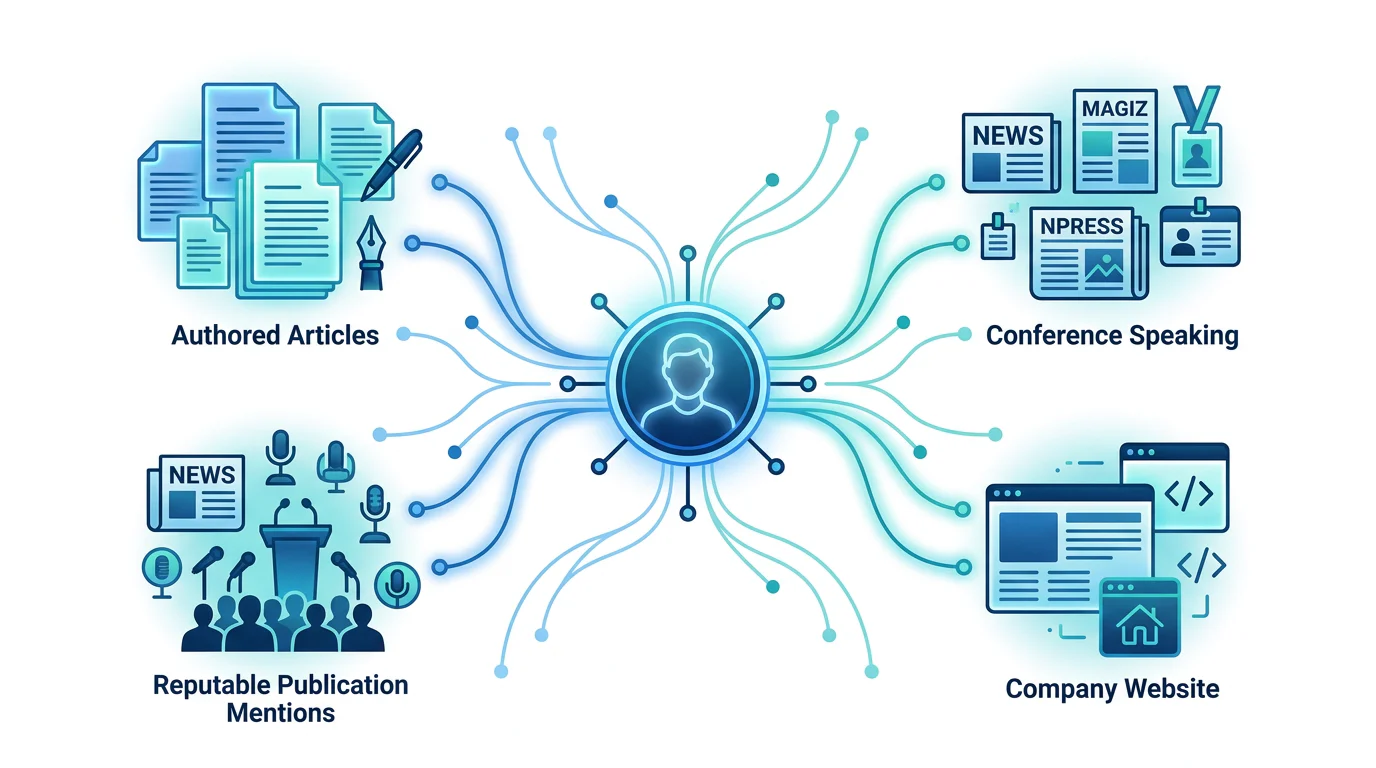
Its core message is sensible. An optimized professional profile, useful owned content, technical SEO, and independent evidence of expertise are stronger foundations than publishing generic material at scale. A person whose site, profile, bylines, and public claims describe different expertise creates an avoidable interpretation problem for both people and machines.
Two numeric claims in the article deserve more care. Forbes attributes an increase of more than 500% in AI-referred sessions and a 70% consumer-use claim to a source it links to, but the accessible article does not provide an independently auditable study design, sample, geography, or methodology. We would report those as attributed claims, not as universal market facts.
That distinction matters because an article can be directionally right while still leaving teams without a measurement method. Our monitor AI visibility workflow starts with evidence that a team can rerun, inspect, and act on.
AI Visibility Needs a Measurable Definition
Visibility is not the same as traffic, ranking, or reputation. A brand can appear in an answer but be described incorrectly. It can be cited without being recommended. It can also be recommended without a clear source trail. Treating every outcome as one score hides the work that actually needs doing.
| Measure | What It Records | What It Does Not Prove |
|---|---|---|
| Mention rate | Whether the brand appears in a defined answer set | That the brand is recommended |
| Recommendation rate | Whether the answer presents the brand as a fit | That the recommendation is accurate |
| Citation rate | Whether a relevant source appears with the answer | That a reader clicked or converted |
| Accuracy rate | Whether the answer describes the brand correctly | That the result will persist unchanged |
Google provides an important technical boundary here. Its AI feature rules say a page must be indexed and eligible for a Search snippet to be eligible as a supporting link in AI Overviews or AI Mode, with no additional technical requirement. Eligibility helps a page participate. It does not guarantee inclusion, recommendation, or commercial results.
For personal brands, that means the audit should examine entity clarity as well as answer presence. Does the system connect the right person to the right company, expertise, audience, and proof? Our AI brand audit framework treats that as a question with inspectable evidence, not a branding impression.
How to Find Out Whether AI Sees Your Personal Brand
The right test starts with buyer intent, not a vanity query such as “Who is [name]?” A useful prompt set asks the questions a potential customer, partner, recruiter, journalist, or analyst would realistically ask before deciding whom to trust.
This is worth measuring because discovery behavior is material, even if it is not uniform. A 2026 Pew survey of 5,119 U.S. adults found that about four in ten adults use chatbots to search for information.
Build a Fixed Buyer-Prompt Set
Use a small set of prompts across several intent types. Keep the wording, audience, country, language, and search setting stable enough to compare later results.
- Category discovery: “Which experts help [audience] solve [problem]?”
- Evaluation: “What should a [role] compare when choosing help with [problem]?”
- Expertise verification: “What is [person or brand] known for, and what sources support that?”
- Use-case fit: “Who has credible experience with [specific business situation]?”
Our buyer-prompt research approach helps teams turn real buyer language into a documented test set instead of guessing from isolated keywords.
Preserve the Whole Answer
For every run, save the complete answer, date, engine and model setting, prompt, country or language context, sources shown, exact description of the brand, and other brands included. A screenshot alone is weak evidence because it often omits the prompt, response conditions, and source trail.
Record the language, not only the outcome. “Mentioned” may mean a passing example, a qualified recommendation, or a warning. Before assigning a score, identify whether the system retrieved current evidence or reused a vague generalization. Note when a source points to the person’s own site, an independent page, a search feature, or no source at all.
Score Outcomes Separately
A practical scorecard should show the four measures from the table, by prompt and by engine. It should also flag whether the answer connects the person to the desired expertise and whether the cited sources are current, relevant, and accurate.
| Audit Signal | Review Question | Useful Next Action |
|---|---|---|
| No mention | Does the prompt match a real discovery need? | Check prompt fit and evidence gaps |
| Incorrect description | Is the public identity inconsistent? | Correct owned pages and source facts |
| Mention without recommendation | Does the answer explain fit or proof? | Add specific expertise and outcomes |
| Citation without owned page | Which source explains the brand? | Review source context and corroboration |
That record prevents teams from treating every visible link as equivalent proof. Our citation context guide explains why the surrounding words are as important as the link itself.
Check First-Party Search Data
For Google surfaces, use the generative-AI performance report when it is available. Google says its performance report is rolling out to a subset of site owners and reports impressions for AI Overviews and AI Mode by page, country, date, and device.
That is valuable baseline data, but it has limits. An impression is not a click, a recommendation, or a conversion. It also does not replace answer-level review across AI search experiences.
What to Improve After You Measure It
An audit should produce fewer priorities, not more. Start with the clearest mismatch between how you need to be understood and how public evidence currently represents you. A vague “improve AI visibility” project is difficult to own. A documented correction, source, or content gap is actionable.
For a broader process, use cross-engine tracking with a stable prompt log and clear definitions. It helps teams distinguish a change in answer behavior from a change in one platform’s presentation or model configuration.
Make the Entity Easier to Verify
Give people and systems one clear account of who the person is, what they do, whom they help, and which public profiles or organizations are genuinely connected. Align names, bios, job titles, author pages, and relevant external profiles where the underlying facts are the same.
Google supports profile-page markup for legitimate person and organization profiles, including author pages and employee pages. Structured data should clarify truthful public information, not invent authority or attempt to force an appearance.
Publish Evidence That Solves a Specific Question
Generic thought leadership is hard to distinguish from every other generic page. Build material that answers a particular buyer question with clear expertise, original analysis, useful examples, and claims that can be checked. Google’s current guidance emphasizes unique, people-first content and cautions against inauthentic mentions or unnecessary AI-specific files.
Use your audit to choose the question before producing the page. Our visibility dashboard resource can help keep that decision tied to measured prompts rather than publishing volume.
Correct Language Before Chasing More Mentions
If AI answers use the wrong category, audience, product description, or qualification, solve that factual problem first. Improving exposure before correcting the description can amplify the wrong message.
We focus on exact model wording so teams can separate an absence problem from an accuracy problem. That protects credibility and makes later visibility changes easier to interpret.
Measure AI Visibility with PageLens.ai
At PageLens.ai, we help marketing, growth, SEO, and content teams turn scattered AI answers into an auditable working record. We begin with the questions buyers actually ask, then preserve the response, source context, exact brand language, competitors that appear, and changes over time. That gives teams a way to distinguish a real visibility gap from ordinary response variation, and to decide whether the next action belongs to technical SEO, source-building, content, or a correction of inaccurate claims. We do not ask teams to chase a universal score or publish generic material. We help them document their baseline, identify the evidence behind it, and assign practical fixes. Our workflow supports accountability before a team changes public pages, profile details, or editorial priorities. Review our brand language audit to see the fit. When you are ready to make this process measurable across your priority prompts, Book a demo.
FAQs on AI Visibility
Does AI Visibility Replace SEO?
No. Search fundamentals still matter. Crawlers must access useful original pages, and public evidence must support the expertise a system may surface in an answer.
Can One AI Answer Prove Visibility?
No. One response captures a single moment, prompt, location, and configuration. Use the same documented questions repeatedly, then compare full answers, sources, and brand language.
What Should We Do After an Audit?
Fix the clearest accuracy or evidence gap first. Then rerun unchanged prompts and compare the new answers with the baseline before assigning a lasting result.