
How to Find Buyer Questions in AI Search: An Evidence-First AI Buyer Prompt Research Method


TL;DR
We use AI buyer prompt research to distinguish observed buyer language from generated ideas, then score each prompt by source, confidence, stage, and specificity. This guide shows where to collect evidence, how to expand and cluster it without losing constraints, and which page type to publish for each validated question.
Many B2B buyers now begin category research by explaining a situation, not typing a short keyword. An OpenAI study found that 49% of ChatGPT messages were information-seeking “Asking” interactions.
AI buyer prompt research does not mean guessing what people type into chat tools. We combine verbatim customer language, public decision discussions, search signals, repeat AI-answer observations, and clearly labeled generated variants, then score each question by provenance, buying stage, specificity, and confidence before it shapes a page.
Below, we show where reliable evidence comes from, how to turn it into useful prompt clusters, and how to publish the answer page each cluster deserves.
What Data Exists on Buyer Questions in AI Search?
Start by naming exactly what a dataset can and cannot prove. A buyer’s sentence from a sales call is real language, but it does not prove that person typed the same sentence into an AI assistant. A repeated prompt run in an AI interface shows how that interface responds, but it does not reveal total human demand.
| Source Type | What It Can Validate | Confidence Ceiling | Main Limitation |
|---|---|---|---|
| First-party verbatim language | A buyer used the wording | Highest | It may not have been typed into an AI assistant |
| Public discussions and reviews | Real concerns and constraints | High | Identity and buying stage vary |
| Search and site-search data | Search wording and interest signals | Medium-High | It is not AI-chat prompt data |
| Repeated AI-answer observations | How an interface responds to a tested prompt | Medium | It measures answers, not demand |
| Generated prompt variants | Coverage hypotheses | Low | It is not evidence of buyer behavior |
AI assistants expose personal histories and privacy controls to their users, but they do not provide marketers with a complete public log of category prompts. For example, privacy controls let people limit model improvement and use temporary conversations, which is one reason complete public query-volume claims should be treated cautiously.
The practical answer is to maintain separate fields for observed language, observed AI answers, and generated ideas. That distinction keeps keyword research useful without pretending that conventional search data and conversational research are interchangeable.

Where Should We Collect Buyer Language?
The highest-value source is language from people who are already trying to solve the problem your category addresses. Sales, support, customer success, and product teams each hear a different part of the buying journey, so collect from all of them before expanding a single phrase.
-
Sales Calls And Demos: Capture objections, comparison criteria, implementation fears, and the language buyers use before committing.
-
Support Tickets And Chat Logs: Capture recurring confusion, setup friction, integration questions, and unmet expectations that may have existed before purchase.
-
Site Search And Forms: Capture the terms visitors use when your navigation or product pages do not answer their question.
-
Win-Loss Interviews: Capture why a buyer advanced, paused, selected another option, or stayed with an existing approach.
-
Public Communities And Reviews: Capture public wording around workflows, budgets, constraints, and dissatisfaction with current tools.
-
Comparison Pages And Cited AI Answers: Capture category frames, feature criteria, and the sources influencing recommendations, while labeling them as external evidence rather than buyer transcripts.
Search data can corroborate a theme, but it remains incomplete. Search Console omits some anonymized queries and does not display every row, so use it to find patterns rather than as a census of buyer language.
For every extract, record the source, date, buyer role, use case, stated constraint, and exact wording. Our guide to buyer-prompt data sources can help teams build that evidence sheet without mixing raw quotes and assumptions.
How Do We Expand Category Language Without Inventing Demand?
A short category phrase becomes useful only when it retains the decision context that made it matter. “AI visibility tool” is a topic. “Which AI visibility tool can show category recommendations for a small B2B team without a large research operation?” is a decision question with audience, outcome, and constraint.
Begin each expansion from a verified phrase. Keep the buyer’s role, company context, current system, budget sensitivity, timing, compliance requirement, and implementation concern attached to the prompt. Then change one variable at a time, so every variation has a traceable parent.

Use transformations that match real decisions:
-
Problem To Process: Turn “we cannot see where AI recommendations come from” into a question about diagnosing that gap.
-
Constraint To Fit: Turn “our team has limited time” into a question about the best category fit for a lean team.
-
Risk To Evaluation: Turn “we cannot lose historical reporting” into a question about migration, continuity, or implementation risk.
-
Comparison To Criteria: Turn a replacement discussion into a prompt that specifies what the buyer must keep, avoid, or improve.
AI interfaces can handle nuanced follow-up and comparison questions, and Google says its AI features may use multiple related searches to build an answer. That makes preserving constraints more valuable than flattening every question into a head term. See AI feature guidance for the underlying behavior, then use buyer prompt discovery to turn verified language into a manageable research set.
How Should We Score AI Buyer Prompt Research?
A prompt library becomes credible when everyone can see why each item is included. We score confidence before we score opportunity, because an attractive prompt with no provenance is still only a hypothesis.
Use Four Confidence Levels
| Level | Definition | Content Use |
|---|---|---|
| Level 4 | Verbatim, attributable buyer question with source, date, and decision context | High-priority page input |
| Level 3 | Normalized or expanded variant supported by independent observed sources | Strong brief input |
| Level 2 | Search signal or repeated AI-answer observation without direct buyer confirmation | Test and corroborate |
| Level 1 | AI-generated or brainstormed variation | Do not prioritize alone |
Level 4 and Level 3 prompts should guide the first content decisions. Level 2 prompts can expose a gap worth testing, while Level 1 prompts belong in an experiment queue until buyer evidence supports them.
Add a Simple Scoring Model
Score source quality, recency, repetition, decision proximity, specificity, and strategic fit from zero to two. A twelve-point total is not a market statistic. It is simply a transparent way to make prioritization consistent across a team.
A high score should not erase the evidence label. A prompt from a recent sales call may be highly specific but appear only once. A broad public discussion may repeat often but lack a clear buying stage. Keep both signals visible in the AI buyer prompt dataset, rather than forcing them into one vague priority label.
Keep Monitoring Separate from Demand
Monitoring helps us observe which prompts produce mentions, citations, recommendation lists, and unstable answers across time. It does not prove how many people typed those prompts. Google explicitly warns that third-party tools do not have internal ranking data and cannot guarantee performance, a standard we apply to AI-answer monitoring as well. Read the Google guidance before treating any visibility score as demand data.
Use answer monitoring to identify patterns, then validate the underlying questions with first-party and public evidence.
How Do We Cluster Prompts Without Losing Intent?
Clustering saves a prompt library from becoming an unruly list of near-duplicates. The mistake is merging questions merely because they share a category term. A question from a self-serve marketer and one from a regulated enterprise can require entirely different proof, content depth, and page type.
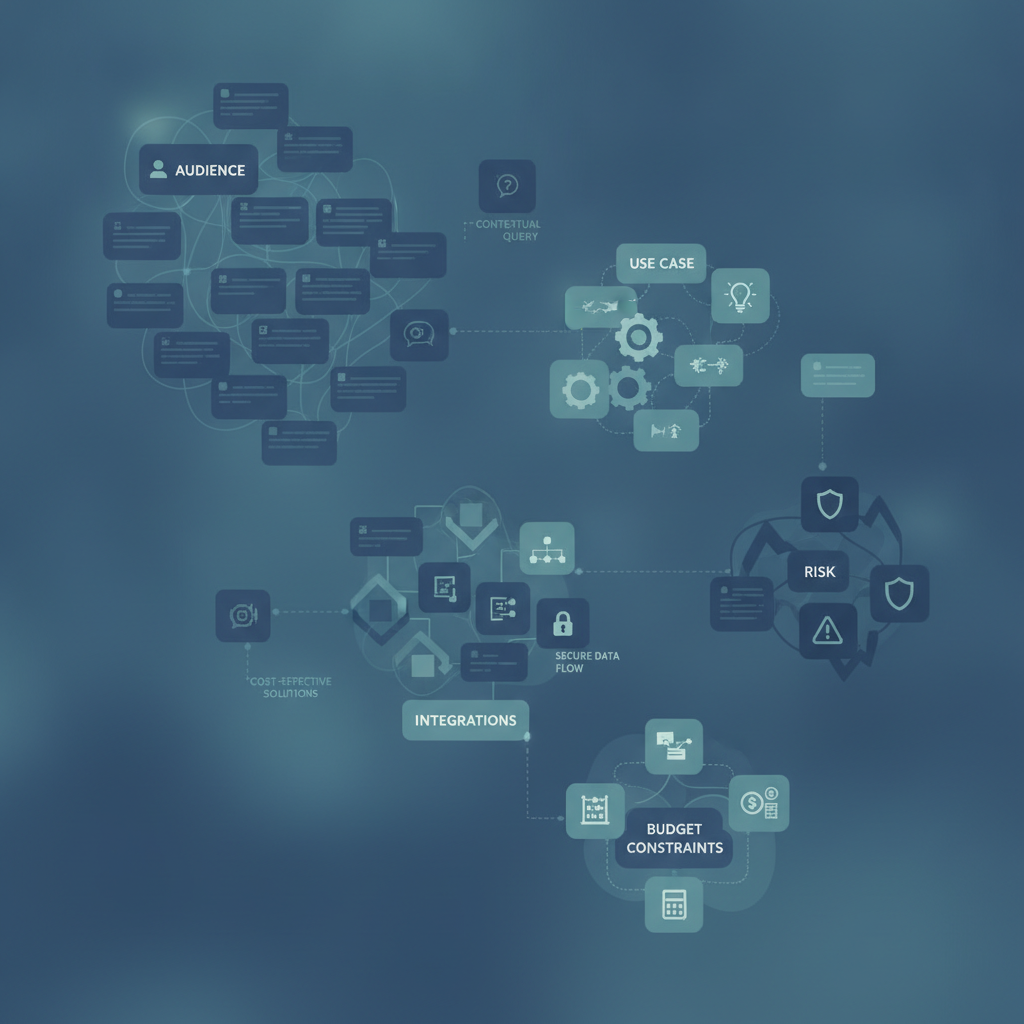
Merge prompts when only surface wording changes. Keep them separate when a role, use case, existing stack, budget, risk, geography, or timeline changes what a useful answer must contain.
-
Merge Similar Wording: “How can we track AI citations?” and “How do I monitor citations in AI answers?” can share a parent cluster if their buyer, use case, and constraint are the same.
-
Keep Different Constraints: “Best option for a small content team” and “best option for a global enterprise team” should remain distinct, even when the category is identical.
-
Preserve Decision Context: “What happens if we switch mid-contract?” is not just an alternatives question. It is a risk and implementation question.
-
Assign A Cluster Owner: Give each cluster an evidence owner who can explain why the prompts belong together and what would justify a split.
This approach keeps a content roadmap focused on meaningful decisions rather than sheer prompt count. It also supports stronger brand mention monitoring, because each published page starts from a clear buyer need instead of a generic topic bucket.
What Should We Publish for Each Validated Cluster?
Publishing follows validation, not the other way around. The opening words of a question can be useful clues, but they are not a funnel-stage shortcut. “How do I” may be early research or an urgent implementation problem. “What happens if” may signal basic education or a late-stage procurement risk.
| Buyer Question Pattern | Likely Stage | What The Buyer Needs | Best Page Type |
|---|---|---|---|
| “How do I solve this problem?” | TOFU | Clear explanation and first steps | Answer page or editorial guide |
| “What happens if we change?” | MOFU | Risks, trade-offs, and process implications | Decision explainer or documentation page |
| “What are the alternatives?” | MOFU to BOFU | Replacement criteria and options | Comparison page |
| “How does this compare with another option?” | BOFU | Decision evidence against stated criteria | Detailed comparison page |
| “What is best for our use case?” | BOFU | Fit, proof, and constraints | Use-case product or solution page |
Publish the Main Answer First
Start each page with the answer that resolves the cluster’s core decision. Then add the proof, definitions, criteria, examples, and next step that the buyer needs to trust that answer. A direct response is easier for readers to scan and easier for answer engines to quote accurately.
Match Evidence to the Page
An answer page needs explanatory evidence. A comparison needs fair criteria and clear limits. A solution page needs use-case proof, implementation detail, and explicit fit boundaries. When a page cannot answer the cluster without hand-waving, it is not ready to publish.
Measure and Refresh the Cluster
Track the exact prompt set that justified the page. Review how AI interfaces describe the category, which sources they cite, and whether the page remains aligned with current buyer language. Use ChatGPT category recommendations alongside a consistent measurement process to distinguish a one-off appearance from a repeatable visibility pattern.
Turn This Method into a Repeatable PageLens.ai Workflow
PageLens.ai helps marketing, growth, SEO, and content leaders turn an evidence-backed prompt set into a repeatable visibility program. We help teams maintain a defined prompt library, observe how relevant AI interfaces answer those questions, and review the sources, wording, and category recommendations that appear over time. That makes it easier to separate a weak content brief from an unstable answer, then assign the right follow-up to content, product marketing, or customer research. We do not treat observed answers as a complete record of human demand. Instead, we pair visibility observation with the first-party and public evidence described in this guide, so your decisions stay tied to buyer language at PageLens.ai. If you need a practical operating rhythm for prompt research, measurement, and content prioritization across the people who own research, publishing, and performance from one shared workflow today, Book a demo.
FAQs on AI Buyer Prompt Research
Can We See Every Question Buyers Ask AI Tools?
No. Public assistants do not publish a complete category query log. Treat monitoring as answer observation and prioritize prompts corroborated by first-party or public buyer language.
Where Should a B2B Team Start Collecting Prompts?
Begin with sales calls, demos, tickets, site search, and win-loss interviews. Record wording verbatim, remove identifying details, then compare repeated themes with public discussions and search data.
Are Generated Prompt Ideas Useful?
Use generated prompts to test language coverage, not to claim demand. Promote a variant only when independent observed evidence confirms the audience, use case, and constraint.
When Should Similar Prompts Stay Separate?
Keep prompts separate when a different role, use case, stack, budget, risk, or timeline changes the answer a buyer needs or the page you publish.
Which Page Type Fits a Validated Cluster?
Use a direct answer page for education, a comparison for evaluation, and a product or solution page for fit. Retain original evidence in every brief.