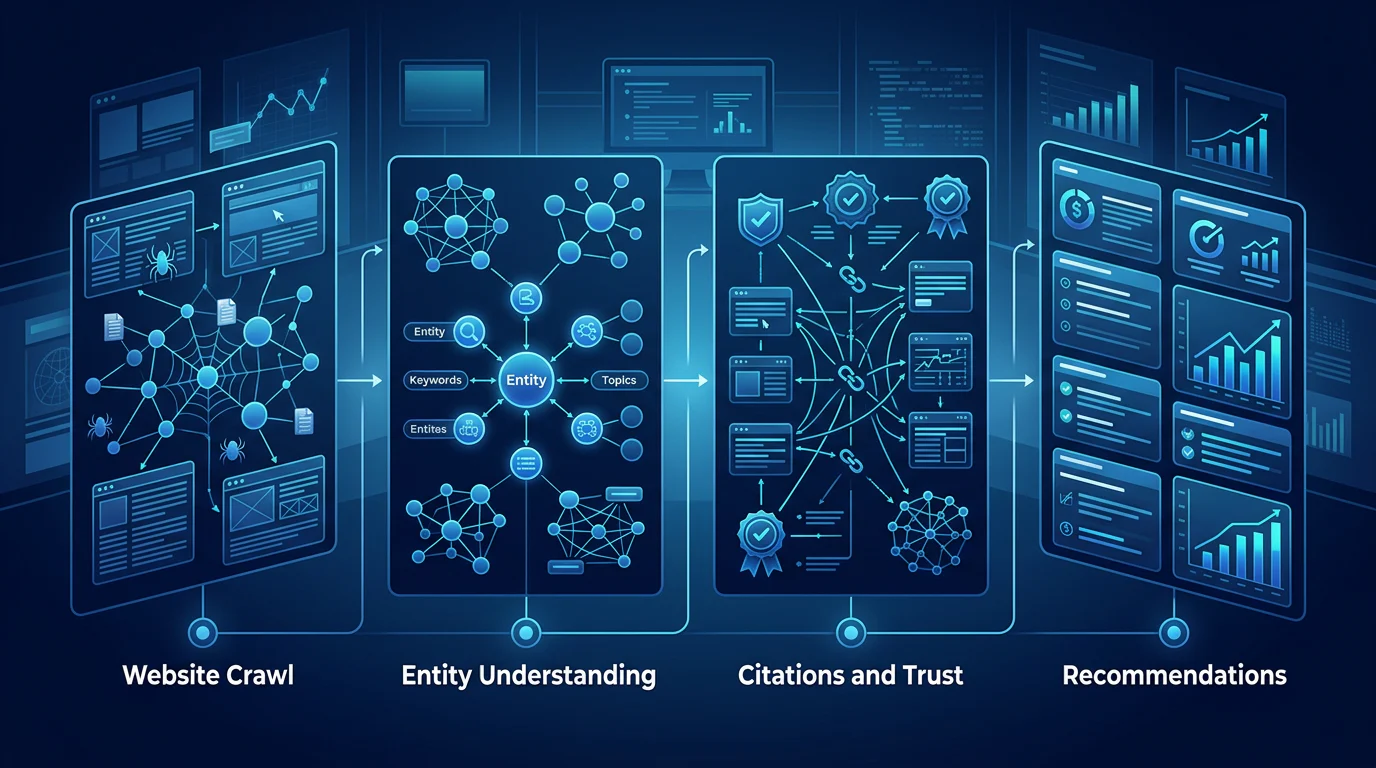


TL;DR
AEO software for brands is best when it covers the engines buyers use, preserves answer-level evidence, and connects findings to approved action. We explain how to compare monitoring, diagnosis, execution, attribution, governance, pricing, and sampling, then show how our PageLens.ai plans fit SMB, ecommerce, established-brand, and enterprise workflows.
Which AEO Software for Brands Is Best?
AI search is now part of how people research: 60% of U.S. adults said they use AI to find information at least sometimes in a 2025 AP-NORC survey. Brands therefore need evidence of how AI answers describe them, not a single unexplained score.
The best AEO software for brands is the platform that covers your priority engines, samples the buyer prompts that matter, preserves answer-level evidence, and turns verified gaps into approved work. For most teams, the choice comes down to whether they need monitoring only, diagnosis, execution, attribution, or governed reporting across markets.
This guide compares those jobs, shows the data a buyer should demand, and explains which of our plans fits each brand stage.
Which AEO Software for Brands Is Best?
There is no defensible best overall choice. A platform that is right for a small team establishing a baseline can be insufficient for a regional brand that needs daily evidence, cross-engine coverage, and approved content action.
-
SMB Baseline: Our Launch plan fits a single brand beginning structured monitoring. It includes 100 tracked buyer prompts weekly, 300 AI answers per week, and coverage of ChatGPT, Google AI Mode, and Perplexity for $299 per month.
-
Ecommerce Measurement: Our Growth plan fits teams that need daily product, category, comparison, and use-case prompt tracking. It includes 100 prompts daily, 500 AI answers daily, and five listed engines for $699 per month.
-
Established Brand Execution: Our Enterprise plan fits teams that need more daily evidence plus technical recommendations, content support, and a dedicated account manager. It includes 200 prompts daily and 1,400 AI answers daily for $1,499 per month.
-
Enterprise Coordination: Our Agency plan fits multi-brand or multi-client teams that need custom volume, flexible tracking, and multiple websites. Pricing and scope are set through a written agreement.
The right shortlist begins with buyer jobs, not a generic feature count. If a team only needs to see whether it appears, it should not pay for execution capacity it cannot govern. If it must move from a lost citation to a reviewed page change, tracking alone will create a reporting backlog.
What Should AEO Software for Brands Measure?
A useful AEO platform separates what an answer says from what a dashboard infers. Our AEO measurement guide treats every result as an inspectable record: a defined prompt, engine, date, locale where set, returned answer, detected entities, and visible sources.
| Capability | What It Measures | Evidence To Retain | What It Does Not Prove |
|---|---|---|---|
| Mentions | Whether the brand appears in an eligible answer | Full answer and entity rule | That the brand was recommended |
| Recommendations | Whether the answer explicitly selects or favors the brand | Exact recommendation language | That the answer drove a visit or sale |
| Citations | Whether an answer visibly links to a brand property | Cited URL and surrounding context | That the cited page caused the recommendation |
| Sentiment | How the answer describes the brand | Exact phrase and classification | Customer satisfaction |
| Share Of Voice | Brand events divided by all defined brand events | Denominator, entity set, and prompt set | Total market demand |
| Content Recommendations | A proposed action tied to evidence | Prompt, answer, source, owner, and approval state | Guaranteed visibility growth |
| Revenue Attribution | A documented connection to business data | Analytics or CRM join and attribution window | Causation from a single AI answer |
Monitoring
Monitoring runs agreed buyer prompts on a repeatable schedule and records which eligible answers mention, recommend, or cite the brand. It must show its prompt count, cadence, engines, locales, and missing-answer treatment, because percentages without those boundaries cannot be compared fairly.
A brand can be visible in one AI surface and absent in another, so an aggregate score should never erase the underlying answer evidence.
Diagnosis
Diagnosis explains the context behind a movement: which competitor was selected, which source was visibly cited, what language framed the brand, and whether the prompt is still relevant. This is where evidence beats a score, especially because AI search citations can be incomplete or inaccurate, as OpenAI notes.
We keep a citation, a mention, and a recommendation separate. That distinction lets a team decide whether it has a source gap, an entity gap, an inaccurate claim, or simply an answer that did not call for a recommendation.
Optimization and Execution
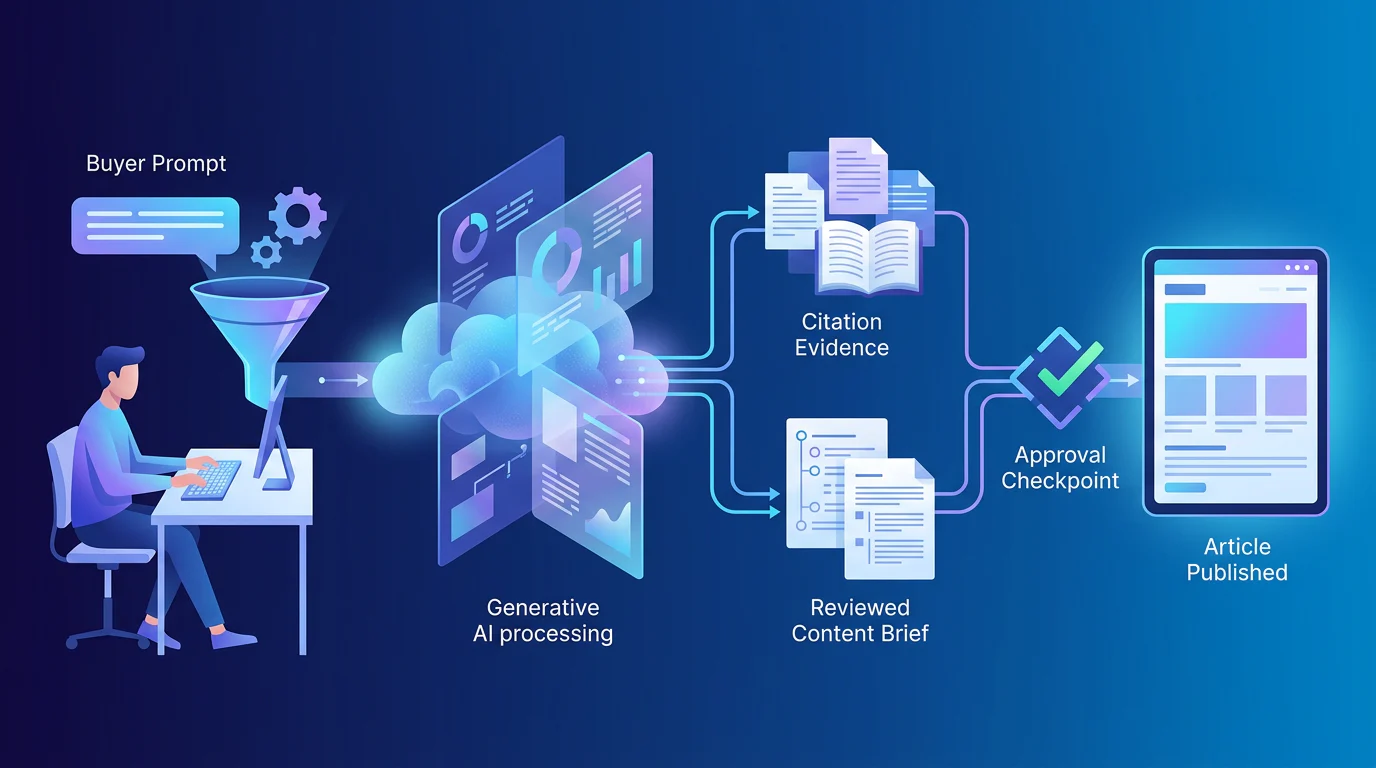
Optimization turns a verified gap into a specific proposed action, such as updating a product page, answering an unanswered buyer question, correcting an outdated claim, or creating a better source page. Execution means a person reviews, approves, publishes, and later observes that work.
Our citation workflow starts with the answer and its visible sources, then gives the relevant owner a reviewable brief. We do not treat automatic publication as proof that a recommendation was correct or that a result will persist.
Attribution
Attribution starts after a visibility event, not inside it. A brand needs a documented method for joining AI-search evidence with tagged destinations, analytics, CRM events, and an agreed reporting window.
Google’s 2026 generative-AI reporting can show impressions, pages, countries, devices, and time trends in Search Console reports. That is useful context for a brand’s wider search measurement, but it is not proof that one AI mention created a sale.
Should You Choose a Standalone Platform or an Existing Suite Add-On?
The decision is practical. An existing-suite add-on can reduce implementation friction when its engine coverage, evidence depth, and reporting permissions already fit the job. A standalone platform is stronger when a brand needs wider engine coverage, a more specific sampling method, or a workflow that connects answer evidence to action.
Our suite comparison can help teams frame that choice. The key is to test whether the platform performs the work your team actually needs, rather than assuming that a broader marketing stack delivers deeper AI-search evidence.
| Buying Question | Choose An Existing Suite Add-On When | Choose A Standalone Platform When |
|---|---|---|
| Engine Coverage | Your priority engines are documented and included | You need engines or surfaces outside the existing scope |
| Data Collection | The suite preserves raw answers and visible citations | You need inspectable prompt-level evidence and sampling controls |
| Action Workflow | Existing owners can act inside the suite | You need a dedicated diagnosis-to-content workflow |
| Attribution | Approved analytics or CRM joins already exist | You need flexible exports or a separate measurement layer |
| Governance | Roles, retention, and security already meet policy | You need distinct access rules, regions, or procurement terms |
Use four inputs when deciding. First, list the engines and markets your buyers actually use. Second, ask to see the prompt sampling method and eligible-answer denominator. Third, test whether the platform preserves raw answers and cited URLs. Fourth, map who owns content, analytics, legal review, and technical implementation after an issue is found. Teams can use multi-engine signals to compare that evidence without flattening engine-level differences.
Which Plan Fits Your Brand’s Stage?
Our public plans are designed around evidence volume and action depth. Every plan includes competitor, citation, sentiment, and share-of-voice reporting, while the higher plans expand daily sampling, engines, recommendations, and managed execution.
| Plan | Best-Fit Audience | Engines | Prompt Sampling | Analytics And Recommendations | Verified Price |
|---|---|---|---|---|---|
| Our Launch Plan | SMB baseline | ChatGPT, Google AI Mode, Perplexity | 100 weekly prompts, 300 answers weekly | Citations, mentions, sentiment, share of voice, content tools | $299 monthly |
| Our Growth Plan | Ecommerce and growing brands | Launch engines plus Gemini and Grok | 100 daily prompts, 500 answers daily | Adds technical recommendations and expanded execution tools | $699 monthly |
| Our Enterprise Plan | Established brands | ChatGPT, Claude, Gemini, Perplexity, Grok, Copilot, Google AI Mode | 200 daily prompts, 1,400 answers daily | Adds technical audit, fixes, outreach support, and account management | $1,499 monthly |
| Our Agency Plan | Multi-brand and enterprise coordination | Seven listed engines | Custom prompt volume and flexible cadence | Multi-site scope and tailored reporting | Custom |
All public plans cover one website or client brand, while our Agency plan supports multiple websites or brands. Public plan details also state up to six tracking markets per site. Seats, API access, default answer-history retention, and final subscription dependencies should be confirmed in writing for any deployment where those details affect procurement.
For ecommerce teams, the important test is whether the prompt set reflects how shoppers compare products, categories, problems, and alternatives. Start with ecommerce visibility requirements, then validate product-level needs during a demo rather than assuming broad monitoring equals shopping-surface coverage.
How Should You Test Governance, Reporting, and Price?
A credible trial should show a brand’s real buyer prompts, not a polished sample dashboard. Use the same prompt set, markets, entity rules, and reporting definition during the test, then audit a sample of classifications manually before relying on movement in a chart.
Security and procurement deserve the same scrutiny as engine coverage. The FTC advises businesses to define security, data use, retention, deletion, and compliance expectations in vendor contracts, then verify compliance rather than simply accepting a claim.
Sampling Method
Ask how many prompts run, how often they run, how answers become eligible, and how failures are treated. A missing or unusable answer should be labeled and excluded from the eligible denominator, not silently counted as a lost mention.
Reporting Layer
Require engine, prompt family, locale, date range, denominator, and exact answer evidence beside every percentage. Our governance guide explains why teams need named owners for entity rules, approvals, and response decisions.
Commercial Terms
Confirm domains, brands, prompt caps, answer caps, cadence, extra engines, overages, support, exports, integrations, and renewal terms. Compare the all-in workflow cost, not the entry price alone. Our current plans and included scope are available on our pricing page.
Decision Process
Run one approved content or technical action from evidence to implementation, then observe later answers without claiming that one intervention caused every change. The NIST framework recommends documenting methods, limitations, and measurement conditions in risk measurement, which is a useful discipline for AI visibility reporting too.
See PageLens.ai in Your Own Buyer Prompts
At PageLens.ai, we help marketing, growth, SEO, and content leaders turn AI answers into a reviewable work queue. We run agreed buyer prompts across selected engines, preserve the evidence behind each result, and separate an absent mention from a source, content, or technical question. Our team can then turn verified gaps into briefs, content, publishing support, or technical recommendations, while your team keeps approval of what goes live.
A demo should help you inspect the workflow, not merely watch a dashboard tour. Bring one domain, the buyer questions that matter, your priority markets, and the reporting outcome you need. We will show the prompt scope, engine coverage, raw-answer evidence, recommendation logic, and plan limits so you can decide whether the fit is real. Then compare the output with your current reporting process and decide who will own each next action. Review our pricing, then Book a demo
FAQs on AEO Software for Brands
What Is AEO Software for Brands?
AEO software repeatedly runs buyer prompts across selected engines, preserves each answer, and reports whether a brand is mentioned, recommended, cited, or described accurately over time.
How Many Prompts Should a Brand Track?
Track buyer prompts covering category, comparison, use case, and problem questions. Report the eligible answer denominator, engines, locales, and cadence beside every percentage to stakeholders.
Does AI Visibility Equal Revenue Attribution?
No. A mention or citation records an answer-level visibility event. Revenue attribution requires documented analytics or CRM joins, a stated measurement window, and explicit reporting assumptions.
What Should an Enterprise Buyer Verify?
Enterprise buyers should verify engine coverage, markets, permissions, raw answer retention, exports, security documentation, support commitments, contract limits, and approval ownership for publishing or technical changes.