


TL;DR
At PageLens.ai, we use a ChatGPT brand-claim audit to record what answers say, whether claims are accurate, and which sources support them. This guide gives marketing leaders a reusable prompt library, response log, five-level rubric, provenance matrix, remediation workflow, and weekly review method for monitoring brand portrayal.
How Do You Audit ChatGPT Brand Claims?
In an OpenAI 2025 evaluation, one model example showed 22% accuracy alongside a 26% error rate, a useful reminder that confident language is not evidence. For brand teams, the risk is not only being absent from an answer. It is being described inaccurately when a buyer is deciding.
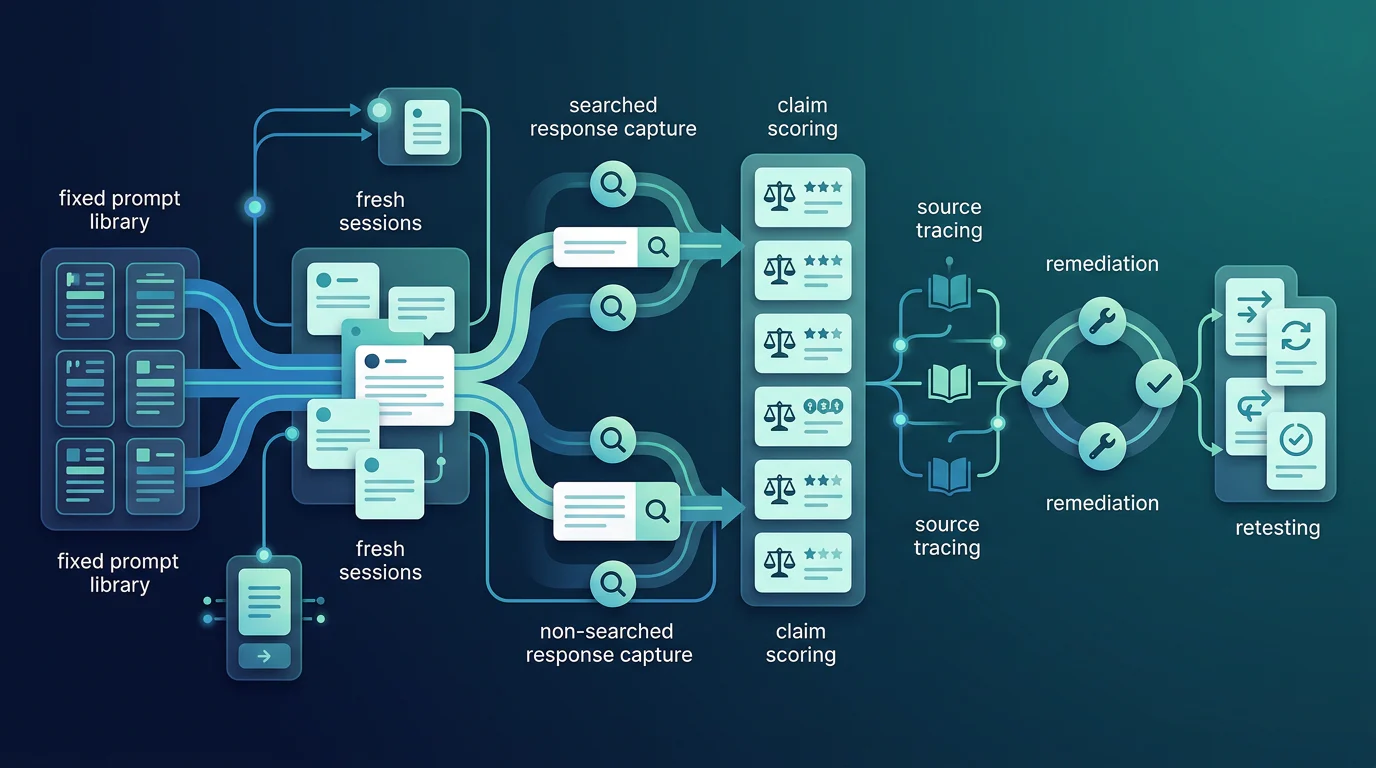
A ChatGPT brand-claim audit uses a fixed library of buyer and branded prompts, fresh sessions, and separate searched and non-searched tests. Save each complete answer, then score presence, recommendation position, sentiment, factual claims, citations, and impact. Investigate unsupported material statements against canonical evidence, assign an owner, and retest after correction.
This guide gives you the tables, scoring method, and escalation workflow to make that work repeatable. It also shows why a mention count alone cannot tell you whether ChatGPT is helping or hurting your brand.
What Does a ChatGPT Brand-Claim Audit Record?
A name check tells you whether ChatGPT can repeat your brand name after you put it in the prompt. An audit answers a stronger question: what would a buyer learn, believe, or rule out after reading the complete response?
Create one workbook with separate tabs for prompts, full responses, claim scoring, source provenance, and remediation. The most important rule is simple: retain the original answer, not merely a dashboard score or a reviewer’s summary. That evidence makes changes explainable later and helps connect this work to AI visibility versus SEO monitoring.
| Field Group | Required Fields |
|---|---|
| Test Context | Date, time, exact prompt, model or mode, Search status, locale, session type |
| Complete Evidence | Full answer text, screenshot, response URL where available |
| Visibility | Brand mentioned, recommendation position, other brands mentioned, recommendation language |
| Brand Portrayal | Sentiment, exact factual claims, claim status, impact |
| Sources | Inline citations, source URLs, source type, source date |
| Accountability | Reviewer, finding ID, owner, next action, retest date |
Treat “recommendation position” as observed order inside one answer, such as second in a five-option list. It is not a search ranking, and it should never be presented as one. The goal is to preserve what the user actually saw, including the wording around your brand.
How Does It Differ from Rank Tracking and Mention Counting?
Traditional rank tracking records where a URL appears in a results list. Mention counting records whether a brand appears at all. A ChatGPT brand-claim audit records the generated answer itself, then tests whether its recommendation, language, factual statements, and sources stand up to review.
This distinction matters because reliable measurement needs more than a single visibility signal. The NIST framework identifies validity, reliability, accountability, and transparency as core traits of trustworthy AI. Your audit should apply the same practical discipline to the answers shaping your company’s discovery.
| Measurement Method | What It Captures | What It Misses | Best Use |
|---|---|---|---|
| URL Rank Tracking | Placement of a page in a results list | Answer wording, brand portrayal, source support | Search performance reporting |
| Mention Counting | Whether a brand appears | Accuracy, recommendation strength, claim risk | Early visibility baseline |
| ChatGPT Brand-Claim Audit | Full answer, claim status, sentiment, sources, impact, and retests | The total universe of all user prompts | Governed brand monitoring |
A mention can still be harmful. If an answer names your company but invents pricing, narrows your use case incorrectly, or describes an unavailable capability as current, a positive mention score hides the real problem. Use AI share of voice as context, then inspect the underlying answer before assigning meaning to the score.
Which Prompts Should You Test?
Start with the questions a prospect would ask before they know your company exists. Then add branded questions that reveal entity confusion, outdated positioning, objections, pricing assumptions, and support risks.
A useful prompt library contains stable core prompts and a smaller set of timely additions. Keep the core wording fixed between audit cycles so a change in answers can be investigated, not dismissed as a prompt rewrite. Use buyer prompt research to expand the library from real buying language rather than internal product terminology.
| Prompt Category | What It Tests | Prompt Pattern |
|---|---|---|
| Branded | Entity recognition and factual description | “What is PageLens.ai?” |
| Category | Unbranded discovery | “What are the best tools for AI visibility monitoring?” |
| Use Case | Fit for a buyer problem | “How can a content team monitor AI answers about its company?” |
| Comparison | Relative positioning | “How should a marketing team compare AI visibility monitoring approaches?” |
| Objection | Perceived risk or limitation | “What are the limitations of monitoring ChatGPT brand mentions?” |
| Pricing | Commercial accuracy | “How much does AI answer monitoring cost for a growing team?” |
| Support | Expectations after purchase | “How do teams investigate an incorrect AI brand claim?” |
Do not use only flattering prompts or prompts that name your brand. Category and use-case prompts reveal whether the brand appears naturally, while objections and pricing prompts reveal whether the answer carries a material claim that could mislead a buyer.
How Do You Make the Audit Reproducible?
A single response is a snapshot. ChatGPT can answer with or without Search, and Search can rewrite queries, use approximate location, and incorporate saved memories in some circumstances, according to OpenAI’s search guidance. Those variables belong in the log because they can change the result.
Run every priority prompt in fresh sessions, preserve the same locale and mode within a test set, and collect repeated samples. The result should be phrased as evidence, such as “mentioned in two of three searched responses,” not as a universal statement about what every user sees.
How Should You Control Context?
Record the account context, model or mode, Search setting, locale, browser, date, and time. Use a fresh chat for every sample, and turn off personalization where the testing environment allows it.
Do not compare a response shaped by earlier conversation with one generated from a clean context. The test is only useful if another reviewer can repeat its essential conditions.
Why Should Searched and Non-Searched Responses Stay Separate?
Searched answers can include current web sources and citations. Non-searched answers may rely on model knowledge that lacks those live sources, so they answer a different measurement question.
Keep the findings in separate columns or separate reports. Combining them can make a citation look like proof for an assertion that appeared only in an uncited response.
What Should a Repeatable Cycle Look Like?
Use three fresh-session samples for each high-priority prompt and mode during the baseline. Repeat the same set weekly, then investigate meaningful changes in wording, sources, recommendation order, or claim status.
For a small team, the manual version is enough to establish the method. Once the prompt set and number of brands grow, ChatGPT mention workflow helps define the evidence that automation still needs to preserve.
How Do You Score Claims and Trace Their Sources?
Score individual claims, not whole answers. A response can contain a correct category description, a useful recommendation, and one false pricing statement at the same time. The claim-level approach makes the material issue visible without throwing away the rest of the evidence.
Use a five-level rubric that separates uncertainty from contradiction. “Ambiguous” is not a softer form of “false.” It means a claim lacks enough precision to verify fairly, while “unsupported” means the review found no adequate evidence for it.
| Claim Status | Evidence Test | Example Finding | Required Action |
|---|---|---|---|
| Verified | Supported by current canonical or authoritative evidence | Current capability accurately described | Retain and monitor |
| Outdated | Previously true but superseded | Retired plan or old positioning | Update the conflicting source |
| Ambiguous | Too broad or incomplete to assess fairly | “Best for enterprise” without criteria | Clarify the canonical explanation |
| Unsupported | No adequate evidence supports it | Uncited feature assertion | Investigate source trail |
| False | Contradicted by current authoritative evidence | Incorrect availability or pricing claim | Escalate and retest |
Status alone does not capture the commercial tone of an answer. Pair the rubric with sentiment validation so reviewers preserve the precise words that turn a neutral fact into a positive or cautionary recommendation.
How Should You Trace Citation Provenance?
Check each cited page, isolate the exact claim it supports, review its publication date, and compare it with your current canonical source before assigning status to findings.
| Source Type | What To Record | Likely Response |
|---|---|---|
| Owned Canonical Page | URL, page title, claim support, update date | Confirm accuracy and improve clarity if needed |
| Third-Party Page | Publisher, URL, quoted claim, date | Request correction or publish a clarifying canonical source |
| Competitor Page | URL, comparison claim, date | Verify fairly and address only factual conflicts |
| Uncited Assertion | Exact answer wording and affected prompt | Classify, investigate, and retest |
Use AI citation source tracking to connect each citation to the sentence it appears to support. That prevents a common error: assuming a source validates an entire paragraph simply because it appears nearby.
How Should You Escalate a Material Error?
Create a finding for every outdated, unsupported, or false material claim. Include the canonical page, conflicting source, required content update, outreach target, owner, due date, and retest date.
Impact should determine urgency. Pricing, availability, security, legal, and comparison claims usually deserve faster review because buyers can act on them immediately. Use claim scoring alongside sentiment review so a warmly worded but inaccurate response does not escape escalation.
What Should Your Team Review Each Week?
- Run the frozen priority prompt library in fresh sessions.
- Keep searched and non-searched responses separate.
- Save full answers, citations, and screenshots.
- Score new or changed material claims.
- Review new sources and conflicting evidence.
- Assign owners to high-impact findings.
- Retest completed corrections and retain the evidence trail.
How Can PageLens.ai Help Your Team?
At PageLens.ai, we turn a one-off manual check into a governed monitoring practice. We help teams preserve the exact prompts and answers behind every visibility signal, so a change in brand portrayal can be reviewed instead of guessed at. Our workflow connects buyer-prompt research, verbatim answer capture, source tracing, claim scoring, and retests, while keeping ownership visible across marketing, content, product, and communications.
That matters when a recommendation disappears, a product detail is stated incorrectly, or an uncited comparison starts shaping discovery. We focus on the evidence trail: what was asked, what was answered, which sources appeared, what changed, and who owns the next action. You can start with the workbook in this guide, then use our methodology to decide which prompts and findings deserve repeatable monitoring. When your team is ready to make that process operational at scale, Book a demo.
FAQs on ChatGPT Brand-claim Audit
Use this method to answer common monitoring questions consistently.
How Do I Monitor What ChatGPT Says About My Brand?
Run fixed buyer and branded prompts in fresh sessions, save full responses, score every material claim and citation, then repeat weekly to detect stable changes.
How Do I Check If ChatGPT Mentions My Brand?
Use unbranded category and use-case questions alongside direct brand prompts. Record whether you appear, recommendation order, surrounding language, cited sources, and named alternatives in each response.
How Do I Audit ChatGPT Claims About My Company?
Compare each material statement with current canonical evidence, classify it as verified, outdated, ambiguous, unsupported, or false, assign impact and ownership, then retest corrections after publication.
Why Separate Searched and Non-Searched Answers?
Search can retrieve current web sources, while non-searched answers rely on model knowledge. Logging them separately prevents citations, freshness, and claim accuracy from being conflated.