

TL;DR
We use an AI visibility audit to connect crawler access, entity clarity, extractable content, and third-party authority to what answer engines actually say about your brand. This guide gives marketing and SEO leaders a repeatable prompt baseline, technical checks, scorecard, and owner-based remediation loop that we can monitor and retest.
AI Visibility Audit: Crawlability to Citation
AI-generated answers now shape the research layer before a buyer visits a site, requests a demo, or builds a shortlist. In a 2025 study of 68,879 searches, Pew found that AI summaries were a meaningful part of Google search behavior.
An AI visibility audit tests whether selected answer systems can access, understand, cite, and accurately describe a brand for relevant buyer prompts. It combines crawlability checks, entity and content review, off-site source analysis, and repeated prompt testing, so every visibility gap has evidence, an owner, a fix, and a retest.
This guide shows how marketing, SEO, content, and engineering leaders can turn a vague AI visibility concern into an accountable workflow.
What Is an AI Visibility Audit?
An AI visibility audit is not a generic checklist and it is not a one-time chatbot query. It joins the site conditions we can inspect with the answers buyers actually receive, then asks why a brand was absent, inaccurately described, mentioned without a citation, or displaced by another source.
A traditional SEO audit still matters because it checks whether pages can be found, crawled, indexed, and ranked. This audit adds the answer layer: prompt-specific mentions, citations, sentiment, accuracy, source gaps, and the work needed to change them. For a broader measurement framework, see our visibility measurement guide.
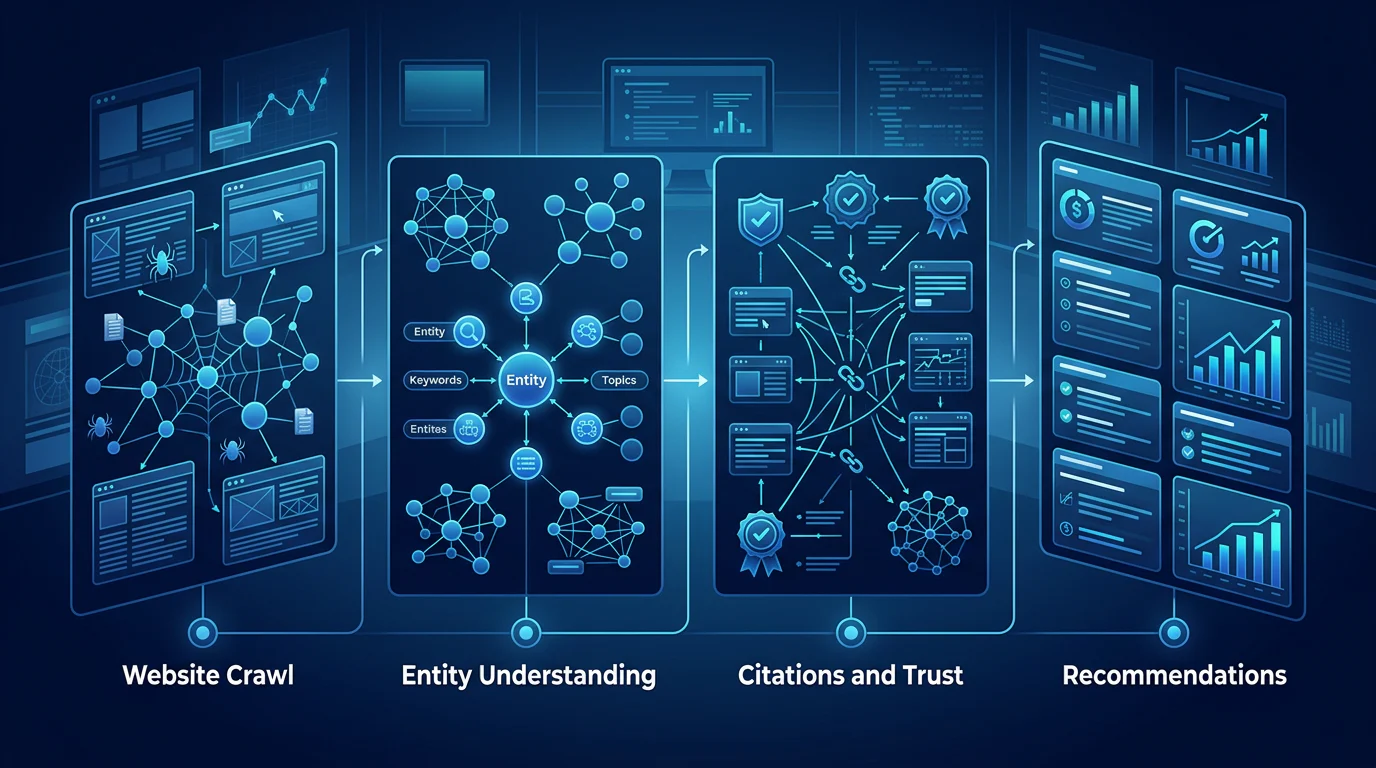
| Audit Layer | Question To Answer | Evidence To Capture | Useful Output |
|---|---|---|---|
| Crawl | Can relevant systems retrieve priority pages? | robots.txt, status codes, rendered HTML, WAF evidence | Accessible, blocked, or unverified |
| Understand | Is the brand and product information unambiguous? | visible claims, entity markup, identifiers, source consistency | Entity and factual gaps |
| Cite | Is there a concise, supported passage worth using? | direct answers, tables, sources, dates, third-party references | Citation-ready page or content gap |
| Recommend | Does the brand appear accurately for buyer prompts? | mentions, citations, sentiment, answer language, source gaps | Owner-based remediation plan |
The important distinction is causality. A page can be crawlable and still never appear in an answer. A brand can be mentioned but described incorrectly. A source can be cited without contributing the recommendation a buyer sees. Our audit keeps those outcomes separate, so teams do not mistake technical eligibility for earned visibility.
How Do You Build a Buyer-Prompt Baseline?
Start with the questions a buyer would realistically ask when they are learning, comparing, or deciding. A useful baseline includes brand questions, category questions, problem questions, comparison questions, alternative questions, and decision-stage questions. Our buyer prompt method helps teams source and validate those questions before they become a reporting set.
Google explains that AI search features can use query fan-out, meaning a single question may trigger related searches across subtopics and sources. That is why a baseline needs clusters of realistic prompts, not a handful of short keywords. Google’s guidance also confirms that answer behavior and linked sources can vary across AI experiences.
Run the audit in six steps:
- Select the engines, locales, languages, and buyer-prompt clusters that matter.
- Capture the exact prompt, date, interface, answer text, citations, and answer position.
- Check whether priority pages can be crawled, rendered, indexed, and internally discovered.
- Review the brand’s entities, structured data, product facts, authors, and dates.
- Assess extractable passages and the external sources repeatedly cited for the category.
- Assign each finding to an owner, validate the fix, and rerun the same prompt suite.
Do not collapse these observations into a universal score. A documented prompt baseline is more useful than a neat number with unclear inputs.

Can AI Systems Crawl, Render, and Index Priority Pages?
The crawl layer answers a narrow but essential question: can the systems and search infrastructure relevant to your audience reach the material you want considered? Google’s minimum requirements include crawler access, a successful 200 response, and indexable content, although meeting them does not guarantee that a page will be surfaced. Technical requirements are a starting point, not proof of citation eligibility.
What Does Robots.txt Actually Permit?
Read robots.txt by user agent and URL path, then record the rule that actually matches. The Robots Exclusion Protocol specifies that the most-specific matching rule wins, so a blanket verdict can conceal an allow or disallow rule on the exact page that matters. The robots standard also distinguishes unavailable responses from server failures, another reason to retain the raw evidence.
Which Access Controls Apply to Answer Engines?
Review discovery, user-requested retrieval, and training controls separately. For example, ChatGPT search discovery uses OAI-SearchBot, while other controls can serve different purposes. OpenAI advises publishers not to block that search crawler when they want public content discovered and cited in ChatGPT search. OpenAI guidance is more reliable than generic crawler lists.
| Surface | Access Evidence To Review | Important Caveat |
|---|---|---|
| ChatGPT Search | OAI-SearchBot rules, page access, CDN and WAF response | Training and search access are separate decisions |
| Google AI Features | Googlebot access, indexability, snippet controls, rendered text | No separate AI crawler is required |
| Perplexity Search | PerplexityBot rules, published IP handling, WAF logs | User-requested fetches can behave differently |
| Bing And Copilot Search | Bingbot access, indexability, archive directives | Search presence and answer inclusion are separate outcomes |
Are Important URLs and Assets Discoverable?
Test priority pages, templates, canonical URLs, internal links, sitemaps, redirects, structured data, and important assets. Compare raw HTML with rendered HTML, especially when direct answers, product facts, or markup rely on client-side JavaScript. Our AI visibility checker can support the initial review, but server and WAF evidence should decide a disputed access finding.
Also inspect page-level robots directives, X-Robots-Tag headers, authentication gates, challenge pages, and soft errors. A clean robots.txt file cannot override a CDN rule that blocks a legitimate crawler, and a successful browser visit cannot prove what a crawler received.
Does Llms.txt Change Visibility?
Check whether /llms.txt exists, is maintained, and points to canonical resources, but classify it as implementation status only. Google says it does not positively or negatively affect Google Search visibility or rankings, and Google does not require special AI text files for AI features. Google’s update makes this a documentation check, not a citation promise.
Can AI Systems Understand the Brand and Extract the Answer?
Accessibility is only the first layer. Once a page can be fetched, answer systems and search engines still need consistent signals about the organization, offering, authors, and claims. Structured data helps clarify meaning, but Google cautions that accurate, complete markup matters more than adding every available property. Structured data is useful evidence, not a shortcut to a citation.
| Page Or Template | Entity Check | Visible Proof Required | Validation Outcome |
|---|---|---|---|
| Sitewide | Organization, canonical name, sameAs, identifier | About page, official profiles, contact facts | One consistent organization entity |
| Product Pages | Product or SoftwareApplication, owner, product facts | Visible capabilities, categories, terms, dates | Offering matches user-visible claims |
| Editorial Pages | Article, author, publisher, publication and update dates | Named author, source links, editorial ownership | Clear accountability and freshness |
| Comparison And Decision Pages | Factual claims and qualifiers | Supporting evidence, scope, limitations | No unsupported or stale framing |
For content, score each priority page as pass, needs work, or not applicable across direct answers, question-aligned headings, definitions, self-contained passages, comparison tables, cited evidence, freshness, and factual qualifiers. The goal is not to make every paragraph short. It is to ensure the passages that answer buyer questions remain clear when read on their own.
We also compare claimed facts across the site and trustworthy third-party profiles. If pricing logic, product definitions, leadership, or category positioning conflict, a model has more than one version of the brand to synthesize. That is often an entity problem before it is a copywriting problem. Our AEO and semantic SEO guide explains why semantic clarity must stay tied to useful on-page content.
Use FAQPage and HowTo markup only for content that is visibly present and maintained. It can preserve semantic consistency, but it should not be sold as a guaranteed search treatment or AI citation trigger.
How Do You Connect Findings to Visibility Tracking and Fixes?
A useful scorecard captures what the answer said, what it cited, and what evidence points to the likely cause. It does not pretend that every mention has the same value or that one weighted score explains all engines. Start with raw prompt-level evidence, then compare patterns by prompt cluster and engine.
When the same prompt set runs across more than one engine, preserve the differences rather than averaging them away. Our cross-engine tracking helps teams distinguish a broad visibility shift from a change limited to one answer environment.
Record Answer Evidence by Prompt
For each run, preserve the exact prompt and answer before interpreting it. That lets a content leader see a weak answer passage, an SEO lead see an access or canonical issue, and a growth leader see whether the brand was actually recommended.
| Prompt Cluster | Mentioned? | Cited? | Accurate? | Cited-Source Gap | Next Check |
|---|---|---|---|---|---|
| Category | Yes or no | Yes or no | Correct, mixed, or wrong | Which source was preferred? | Entity and authority evidence |
| Comparison | Yes or no | Yes or no | Fair, incomplete, or wrong | Missing proof or outdated framing | Comparison page and third-party facts |
| Decision Stage | Yes or no | Yes or no | Helpful or misleading | Missing qualifier or source | Extractable answer passage |
| Brand | Yes or no | Yes or no | Current or stale | Conflicting brand information | Owned and off-site source consistency |
Turn Patterns into Owner-Based Fixes
A finding becomes actionable only when it names the evidence, affected page or prompt, responsible owner, proposed change, and validation test. This prevents teams from responding to every absence by publishing more content or changing every crawler rule. Our citation tracking method provides a useful companion process for collecting page-level citation evidence.
| Finding | Owner | Proposed Fix | Validation Test | Monitoring Date |
|---|---|---|---|---|
| Priority page blocked at edge | Engineering | Adjust approved WAF or CDN policy | Verify genuine access evidence and rerun prompts | After deployment and recrawl |
| Conflicting product claim | Content And Product | Reconcile visible copy and markup | Compare page, markup, and source records | Next prompt run |
| Weak answer passage | Content And SEO | Add direct answer and supporting proof | Validate rendered page and answer clarity | After publication |
| Repeated third-party source gap | PR And Growth | Improve factual consistency and authority coverage | Track cited-source mix by prompt cluster | Monthly review |
A citation is not inherently accurate. In a Stanford-led evaluation, only 51.5% of generated sentences were fully supported by their citations, which is why we audit answer accuracy and source fit separately. Citation research supports treating a cited link as evidence to inspect, not as proof that the answer is correct.
Retest Without Invented Scores
Rerun the same prompts after a material change, with the same engine, locale, and collection conditions where possible. Compare what changed in the answer, citation set, and source gap, then record whether the result supports the original hypothesis. Use our citation loss diagnosis when visibility falls.
That loop turns an audit into a practical operating system: observe, investigate, fix, validate, and monitor.
Put PageLens.ai to Work
At PageLens.ai, we turn an audit from a static checklist into a working visibility loop. We help teams organize the buyer prompts that matter, preserve the actual answers and cited sources, and connect each recurring gap to the page, claim, or technical control behind it. That gives marketing, SEO, content, and engineering leaders one evidence trail instead of separate dashboards and assumptions. Our workflow is useful when a brand needs to see whether a lost mention follows a blocked crawler, an unclear entity, weak passage, or stronger third-party source. We then keep the validation criteria attached to the fix, so teams can distinguish a shipped change from an observed improvement. If your team needs a repeatable way to move from AI answer evidence to accountable work without treating a dashboard score as proof of progress or completion, Book a demo.
FAQs on AI Visibility Audit
What Is an AI Visibility Audit?
An AI visibility audit checks access, understanding, citations, and brand accuracy across relevant buyer prompts. It connects each observed gap to evidence, owners, fixes, and retests.
How Can I Audit My Brand’s AI Visibility?
Use a repeatable prompt suite across selected engines. Record mentions, citations, accuracy, and sources, then investigate technical, entity, content, and authority causes of repeated gaps.
How Do I Check Whether AI Crawlers Can Access My Site?
Review robots.txt, directives, HTTP responses, rendered HTML, internal links, key assets, and edge rules. Confirm disputed findings with trusted crawler logs when they are available.
Does Llms.txt Improve AI Citations?
Treat llms.txt as optional documentation for systems that choose to use it. Do not treat it as a proven ranking, citation, crawling, or visibility control.