
4 companies compared
Tracking Is Not Optimisation, LLM SEO Tools for AI Visibility
The best LLM SEO tool is the one that gives your team a measurable path from an AI-answer gap to completed work. We ranked tools by plan-level engine coverage, prompt research, citation and competitor evidence, reporting cadence, and whether the product helps turn findings into published optimisation work.

By Harjot Chopra, Co-Founder · Reviewed 2 Oct 2026
On this page
The short answer
Choose an LLM SEO tool by the work that follows the dashboard. Teams that can execute content themselves should prioritise prompt, citation and competitor evidence, while teams that need pages shipped should prioritise an execution workflow. Google's 2026 guidance says AI Overviews and AI Mode can show different responses and links, so evaluate them separately.
The shortlist
How we ranked them
- Plan-level AI engine coverage
- Prompt research and tracking cadence
- Citation, sentiment and competitor evidence
- Reporting and workflow fit
- Content optimisation and publishing support
The companies in detail
PageLens.ai
Daily AI visibility tracking plus content production, publishing and outreach.
- Plan frame
- Growth
- Coverage
- 100 prompts, five engines, daily tracking
- Execution
- 50 content pieces per month, publishing and technical recommendations
Our own platform wins for marketing and content leaders who need daily tracking across five engines and a system that can turn the resulting gaps into content, technical recommendations and publishing work.
Strengths
- Growth tracks 100 buyer-intent prompts daily across ChatGPT, Google AI Mode, Perplexity, Gemini and Grok.
- Growth includes citation, sentiment, competitor and share-of-voice reporting.
- We produce up to 50 content pieces per month, publish on your domain and provide technical recommendations.
Limitations
- Growth covers one website or client brand.
- Claude and Copilot are available on Enterprise rather than Growth.
Ahrefs Brand Radar
Large search-backed AI visibility index with custom prompt tracking.
- Price source
- Ahrefs Brand Radar pricing and help pages, 2026
- Coverage
- Seven AI platforms and 2,500 custom prompt checks per month
- Research base
- 405M+ search-backed prompts
Ahrefs Brand Radar wins for teams that need broad AI visibility research and already have an independent content workflow to act on the findings.
Strengths
- The all-platform package includes 2,500 custom prompt checks per month.
- Ahrefs reports 405M+ search-backed prompts across seven AI platforms.
- It supports AI share of voice, citations, competitor analysis and custom prompt tracking.
Limitations
- The all-platform package costs $699 per month.
- The verified plan facts focus on research and tracking, so teams still need a separate production and publishing workflow.
Semrush AI Visibility Toolkit
AI visibility tracking inside a broader SEO platform.
- Price source
- Semrush AI Visibility pricing page, 2026
- Plan frame
- Base, one domain
- Coverage
- 25 daily prompts across four named AI surfaces
Semrush wins for a team already working in Semrush that wants a lower-cost AI visibility layer alongside its existing SEO workflow.
Strengths
- Base includes 25 custom prompts with daily AI rankings.
- Base includes ChatGPT, Google AI, Gemini and Perplexity mentions.
- Base includes AI competitor analysis, prompt research and an AI-readiness site audit.
Limitations
- The Base plan is billed annually.
- The Base plan is limited to 25 custom prompts and one domain for Brand Performance analysis.
OtterlyAI
Daily monitoring with a defined core engine set.
- Price source
- OtterlyAI pricing page, 2026
- Plan frame
- Standard
- Coverage
- 100 prompts, four core engines and daily tracking
OtterlyAI wins for a small marketing team that wants daily monitoring of four core AI search engines and can accept add-ons for broader coverage.
Strengths
- Standard includes 100 search prompts and daily tracking.
- Its core coverage includes ChatGPT, Google AI Overviews, Perplexity and Microsoft Copilot.
- Standard includes API access, MCP access and agent analytics.
Limitations
- Claude, Google AI Mode and Gemini require extra add-ons.
- The Standard plan is limited to 100 search prompts.
How to choose
- 1
Set the engine scope first
List the AI surfaces your buyers actually use. Check that the exact plan, not the product homepage, includes each surface.
- 2
Bring buyer prompts
Evaluate the same buyer-intent prompt set in every trial. A tool should make it clear which prompts are tracked, how often and in which market.
- 3
Inspect the evidence
Ask to see the AI answer, cited sources, competitors named and the metric definition behind each chart. Use a defined AI search analytics metric standard before purchasing.
- 4
Test the hand-off
Decide who will turn a citation or competitor gap into a brief, page, approval and publication. The right product fits that operating reality.
The entry prices are not like-for-like
A lower entry price can mean fewer prompts, fewer engines or annual billing. Compare the exact plan frame that gives the team enough evidence to make a publishing decision, rather than comparing product names alone.
- Tool
- PageLens.ai Growth
- Price frame
- $699/month
- Coverage and workflow
- Five engines, 100 prompts, daily tracking, 50 content pieces/month
- Tool
- Ahrefs Brand Radar all platforms
- Price frame
- $699/month
- Coverage and workflow
- Seven platforms, 2,500 custom prompt checks/month
- Tool
- Semrush AI Visibility Base
- Price frame
- $99/domain/month, billed annually
- Coverage and workflow
- 25 daily prompts, four named AI surfaces
- Tool
- OtterlyAI Standard
- Price frame
- $189/month
- Coverage and workflow
- 100 prompts, four core engines, daily tracking
Visibility evidence and content execution solve different problems
Visibility tracking answers where your brand appears, which competitors are named and which pages are cited. Content optimisation answers what your team should change or publish next. The strongest buying decision is therefore a workflow decision, not a logo-count decision. For a deeper measurement process, see how to track AI search rankings.
Questions to ask before choosing an LLM SEO tool
- Which engines, markets and languages are included in this exact plan?
- Can we bring our own buyer prompts and inspect the answer evidence?
- Does the tool distinguish a brand mention from a citation?
- How are competitors selected, and can we edit them?
- What is the cadence for each prompt and engine?
- Who turns a reported gap into an approved, published page?
Google states that a page being eligible for its AI features does not guarantee that it will be crawled, indexed or served. That makes repeated evidence and sensible content operations more useful than any promise of a guaranteed citation.
Buy the workflow, not a dashboard
Start by naming the AI surfaces your buyers use, then test whether the tool records the prompts, citations and competitors that explain the result. Google's guidance for AI features says AI Overviews and AI Mode may use different models and techniques, so their answers and links can differ.
If your team can turn a finding into a page, a tracker may be enough. If that hand-off repeatedly stalls, choose a platform that also creates and publishes the work. Our AI visibility tool trial checklist can structure the evaluation.
Choose the work your team can complete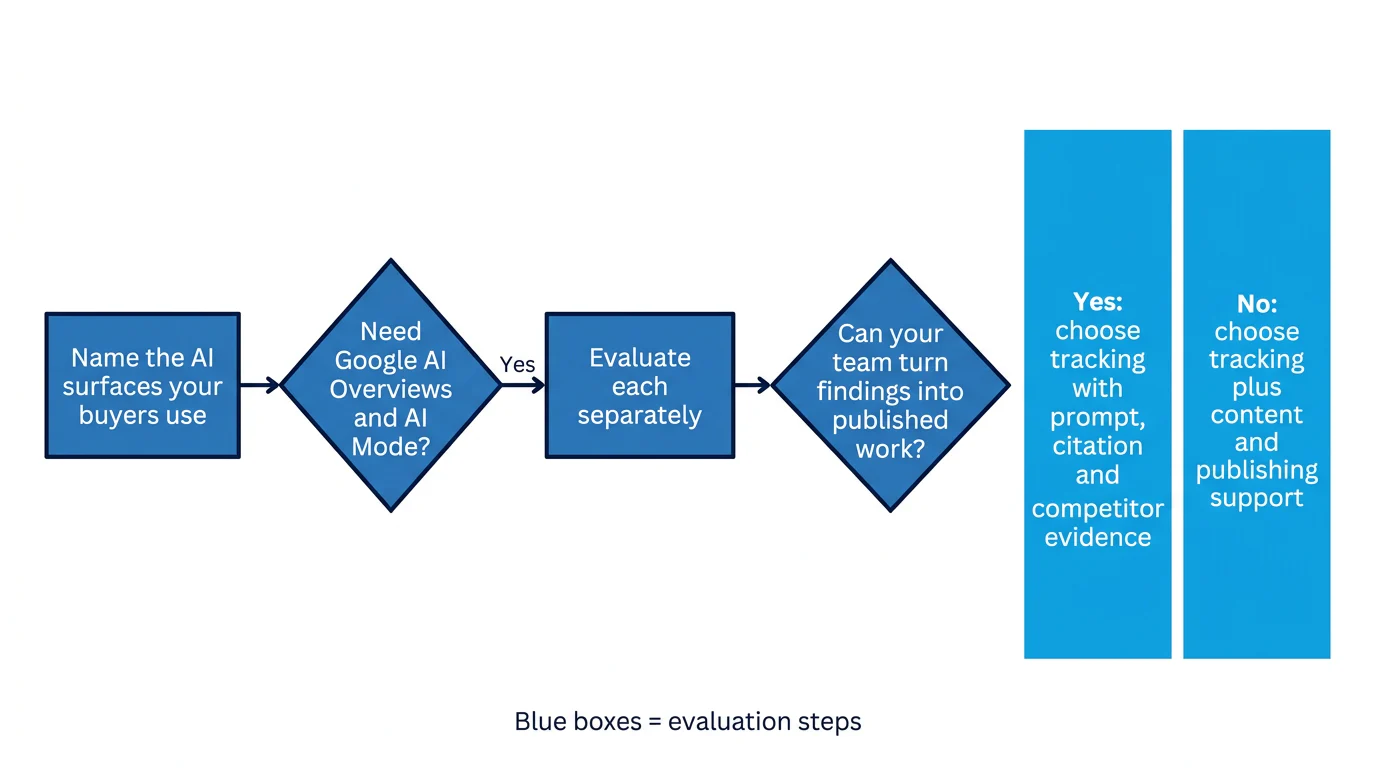
How we built this list
How we ranked the shortlist
The ranking rewards evidence that a working team can use: named engine coverage, a stated prompt allowance and cadence, citation and competitor reporting, plus a clear route from the finding to action. Google notes that AI Overviews and AI Mode can differ, while OpenAI advises that ChatGPT web-search citations can be incomplete, outdated or incorrect, so no tool score should replace inspection of the underlying answers.
Prices and plan details are compared as of October 2026. Use the same buyer prompts, markets and AI surfaces in every trial, then judge which tool gives your team the most useful next action.
This page is published by PageLens.ai. If anything here is out of date, tell us and we will correct it.
Sources
- 1.AI Features and Your Website, Google Search Central, 2026
- 2.Optimizing Your Website for Generative AI Features on Google Search, Google Search Central, 2026
- 3.Searching the Web with ChatGPT, OpenAI, 2026
- 4.Google Search's Guidance on Using Third-Party SEO Tools, Services, and Advice, Google Search Central, 2026
Related pages
Frequently asked
An LLM SEO tool helps a team assess how a brand appears in AI-generated answers and decide what work to do next. Its useful outputs are prompt-level evidence, citations, competitor comparisons and a workflow that connects those findings to content, technical or publishing work.
Choose visibility tracking when your team already has people and systems that can research, write, approve and publish the required work. Choose a platform with execution support when the recurring problem is not finding the gap, but turning that gap into a completed page on your domain.
Yes. Google states that AI Overviews and AI Mode may use different models and techniques, so the responses and links can vary. A trial should therefore show separate evidence for each Google experience rather than treating Google AI as one undifferentiated result.
No. Google says third-party SEO, AEO and GEO tools do not have access to its internal ranking data and cannot guarantee performance. Treat visibility measurements as evidence for prioritising work, then validate the cited sources and the resulting answers before making a decision.
Need visibility data that turns into shipped work?
See how we connect buyer prompts, citation evidence and publishing in one workflow.
Book a demo