
AI Visibility Platform Comparison: Is It Right for Your Team?
Our AI visibility platform comparison weighs PageLens.ai, measurement-first software, and spreadsheets for 100-prompt tracking.

AI answers are already a material discovery surface: in a 2025 browsing study, 58% of respondents saw at least one search result with an AI-generated summary. That makes a repeatable way to observe recommendations, citations, and competitors more useful than occasional spot checks.
For a lean team tracking a defined prompt set, this AI visibility platform comparison favors measurement-first software when recurring, comparable reporting is the goal. Choose PageLens.ai when monitoring must also drive prompt research, content production, or technical action. Choose a spreadsheet only when subscription spend must remain at zero and the team can consistently absorb collection, quality control, and reporting work.
Here, we compare those three operating models, show how to test a claimed category benchmark, and map the practical workload of tracking 100 prompts across multiple answer engines.
What an AI Visibility Platform Measures
An AI visibility platform should preserve the evidence behind every result, not merely label a brand as present or absent. At minimum, the team needs the exact prompt, answer engine, collection date, response text, brand mention, recommendation position where meaningful, cited source URLs, named alternatives, and an outcome classification.
This matters because answer engines can search, synthesize, and cite sources differently across runs. OpenAI explains that search responses can include inline citations and a sources view, making the answer and its citations a record worth retaining, not a vanity metric. See our framework for tracking source citations before choosing a dashboard.
Visibility Is More Than a Mention
A mention answers, “Were we named?” It does not answer whether the model recommended us, described us favorably, cited our site, or positioned a rival as the better fit. Record those separately. A brand can be mentioned frequently but framed as expensive, niche, or unsuitable.
Citations Need Their Own Field
A citation is a source URL shown with, or supporting, an answer. It is not proof that the cited page caused a recommendation. Keep the URL, domain, page type, and the surrounding claim together so the team can distinguish a source gap from a messaging gap.
Selected Competitors Are Not a Category Benchmark
A selected-competitor share of voice divides recommendations among the brands you chose. A true category benchmark requires a defined category universe, a documented inclusion rule, and the same prompt and engine sample for every member. Without those controls, “category average” may simply be a comparison against a handpicked set.
Trends Require a Stable Method
Trend lines are useful only when prompts, engines, taxonomy, and scoring rules are stable. If a prompt is rewritten or a competitor list changes, annotate the date rather than presenting the movement as comparable history. Start with a deliberately curated buyer prompt dataset, then lock the first reporting period.

Where Recurring Monitoring Excels
Measurement-first software is a sensible choice for teams whose main question is, “How often do we appear, who appears instead, and how is that changing?” It reduces repetitive retrieval and makes prompt-level comparisons easier to review across an agreed cadence.
For a 100-prompt program, daily tracking across three engines creates 300 observations each day. Even if the team reviews only exceptions, that volume is difficult to manage manually without a disciplined schema.
-
Recurring measurement: A stable prompt library can reveal changes in recommendation frequency, citations, and competitor presence over time.
-
Competitive review: Teams can inspect which named alternatives recur on commercially important prompts, then separate genuine category competitors from one-off answer artifacts.
-
Evidence-ready reporting: Exportable prompt-level records give marketing, content, and leadership a shared basis for discussion instead of a collection of screenshots.
The limitation is equally important. Monitoring identifies a pattern, but it does not automatically produce the approved page, improve site architecture, earn authority, or implement technical changes. Google’s guidance for AI search still emphasizes unique, useful content for people, not a special shortcut for being surfaced in AI experiences. Our content optimization stack begins where measurement ends.
Where Monitoring Stops
A dashboard can tell a team that it is missing from a valuable prompt. It cannot decide which buyer concern should be addressed first, verify the claims in a new article, obtain approvals, publish changes, or confirm that the site is technically ready to serve the revised page.
That distinction should drive the purchase. If the operating problem is diagnosis, recurring monitoring can be enough. If the problem is ownership of the path from signal to published improvement, the team needs an execution workflow around the data.
| Decision Need | Measurement-First Platform | PageLens.ai | Manual Spreadsheet |
|---|---|---|---|
| Recurring prompt observations | Core use case | Included in monitoring plans | Manual collection |
| Brand mentions and competitors | Core review field | Included in visibility reporting | Manual tagging |
| Citations and source URLs | Reviewable when supplied | Included in visibility reporting | Manual capture |
| Selected-competitor share | Often available | Included in visibility reporting | Formula and manual upkeep |
| True category average | Confirm methodology first | Reported as category average | Requires defined category universe |
| Prompt research | Usually separate workflow | Available in our platform | Manual research |
| Prioritized recommendations | Usually separate workflow | Available in our platform | Manual analysis |
| Content execution | External process | Available in managed workflow | Internal team process |
| Technical fixes | External process | Available in managed workflow | Internal team process |
| Cross-engine reporting | Depends on plan | Available by plan | Manual consolidation |
| Historical comparisons | Depends on retention rules | Available while tracking continues | Spreadsheet governance required |
| Exports | Confirm plan terms | Reporting workflow available | Native file ownership |
The relevant question is not whether monitoring is valuable. It is whether the team has a dependable owner for the action that follows the finding. That is why a useful AI visibility workflow assigns both a measurement owner and an execution owner.
How PageLens.ai Compares in This AI Visibility Platform Comparison
We built PageLens.ai for leaders who need to see what AI tells buyers and then do something useful with that evidence. Our public plans currently show a $49 monthly single-site monitoring plan for 50 daily prompts on one engine, a $199 monthly plan for 100 daily prompts across ChatGPT, Google AI, and Perplexity, and a managed tier with broader engine coverage, content production, and technical fixes. Capabilities and plan terms can change, so confirm them on our current pricing before purchase.
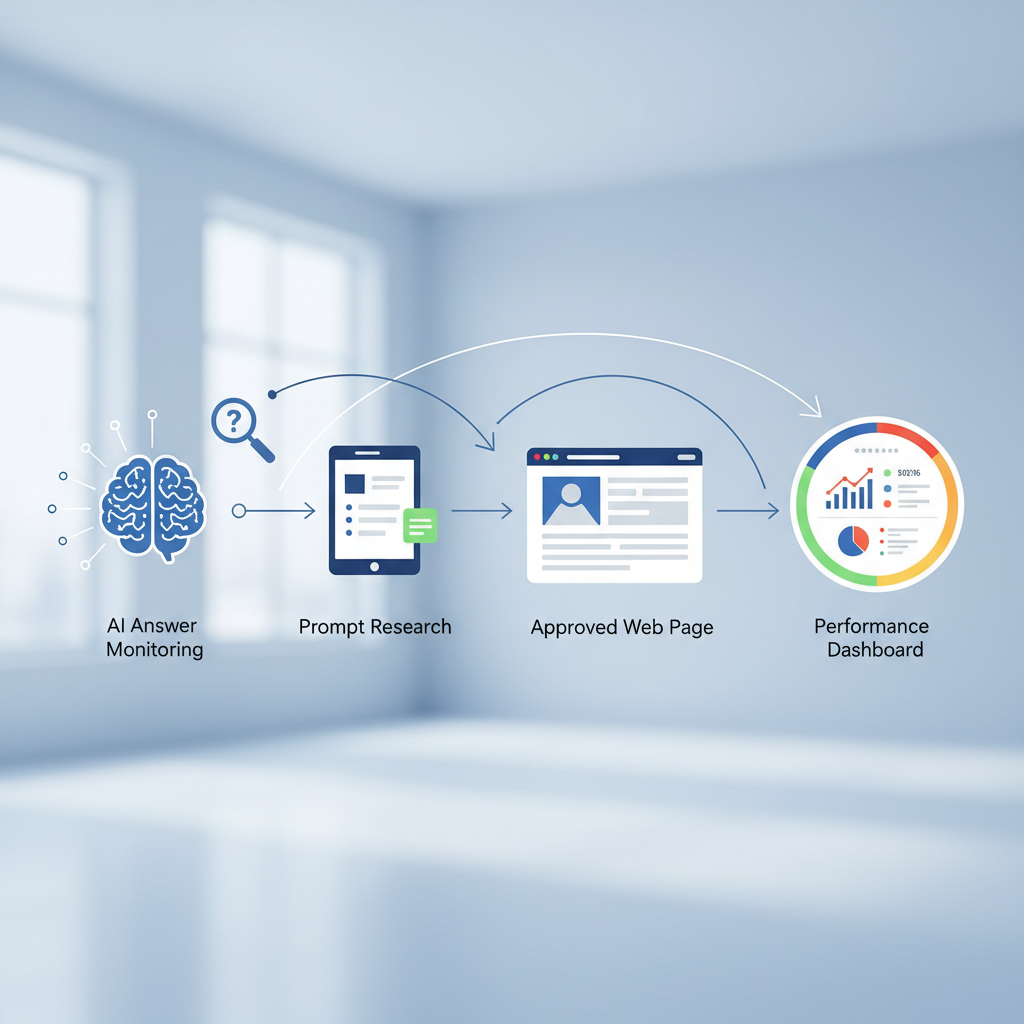
Monitoring and Category Context
Our platform records visibility, competitors, sentiment, and cited sources across the answer engines included in a plan. We also show a category average, but teams should still ask how the category is defined, when it is refreshed, and whether the comparison reflects a complete universe or a chosen peer set.
Prompt Research and Recommendations
We use prompt research to find the buyer questions worth monitoring, then connect gaps to specific moves. This matters when a weak result is caused by an untracked buyer concern rather than a poor answer on an already-known prompt.
Content and Technical Execution
For teams that need a single operating loop, our managed workflow adds content production and technical fixes to daily visibility tracking. That is materially different from handing a report to an already overloaded content or web team and hoping it is actioned.
Reporting for the Actual Decision
A defensible report includes the prompt set, engine mix, date range, selected competitors, result definitions, and raw answer access. We recommend reporting the category benchmark next to selected-competitor share, never as a substitute for it. For a deeper comparison of operating models, see 100-prompt tracking options.
| Normalized Monthly Cost Item | Measurement-First Platform | PageLens.ai Optimize | Manual Spreadsheet |
|---|---|---|---|
| Subscription | Vendor-specific | $199 per month | $0 |
| Prompt allowance | Confirm contracted allowance | 100 prompts | Defined by team capacity |
| Engine coverage | Confirm contracted engines | ChatGPT, Google AI, Perplexity | Chosen and retrieved manually |
| Refresh cadence | Confirm contracted cadence | Daily | Chosen by team |
| Monthly observation volume at 100 prompts and 3 engines | Depends on cadence | About 9,000 at daily collection | About 9,000 at daily collection |
| Operating effort | Review, analysis, and action | Review, analysis, and action | Collection, QA, analysis, and reporting |
| Fully loaded operating cost | Subscription plus team hours | $199 plus team hours | Team hours only |
The spreadsheet line is not free if analysts must collect, clean, classify, and explain the records. Calculate it honestly: monthly collection and reporting hours multiplied by the team’s loaded hourly cost. That is the number to compare against software, not the software price alone.
A practical reporting program also needs a fixed taxonomy for intent, recommendation status, citations, sentiment, and action ownership. Without that shared language, more data simply creates more disagreement. Our guide to multi-engine signals explains why mention rate alone is insufficient.
When a Spreadsheet Works
A spreadsheet works for a time-boxed baseline, a very small prompt set, or a team that needs to prove demand before buying software. It also gives the team direct control over fields and scoring. The tradeoff is that every observation and audit trail depends on human consistency.
Use this five-step workflow for 100 prompts across three engines:
-
Build a locked prompt list with intent, market, funnel stage, and priority.
-
Run each prompt in each engine on a documented schedule, preserving the answer text and citation URLs.
-
Tag mention, recommendation, sentiment, cited domain, competitor set, and material answer change.
-
Quality-check a sample every reporting cycle, especially ambiguous brand references and competitor names.
-
Aggregate results by prompt cluster and engine, then assign an owner and due date to each action.
The required fields are prompt ID, verbatim prompt, engine, run date and time, answer URL when available, response text, mention status, recommendation status, sentiment, cited URL, cited domain, competitors named, reviewer, quality-check status, and action. A single-site team can begin with our manual ChatGPT workflow, then migrate when collection becomes the constraint.
Move from a spreadsheet to a measurement platform when retrieval and QA crowd out analysis, when reporting must be repeated reliably, or when multiple stakeholders need the same evidence. Move to PageLens.ai when the bigger constraint is acting on findings, especially prompt discovery, content work, and technical remediation.
Choose PageLens.ai When You Need the Next Move
PageLens.ai is for marketing, growth, SEO, and content leaders who do not want AI visibility to end as another dashboard. We help teams track the buyer prompts that matter, understand the recommendation and citation patterns behind the result, and turn prioritized gaps into work that can be reviewed and published. Our single-site plans start with focused daily monitoring, while our broader workflow adds the cross-engine context, content support, and technical fixes a team may need. The practical starting point is simple: bring a defined prompt set, identify the category and competitor universe, and decide who owns measurement, approval, and implementation. We will help you test whether the evidence supports a monitoring-only purchase or an execution-focused workflow. If your team needs the latter, Book a demo.
FAQs on AI Visibility Platform Comparison
Is a Spreadsheet Good Enough for AI Visibility Tracking?
A spreadsheet works for short baseline tests or tiny prompt sets when one owner records collection, citations, classifications, quality checks, and reporting decisions consistently every time.
How Many Prompts Should a Team Track First?
Start with commercial and category questions buyers actually ask. One hundred prompts work when teams group them by intent and review results on a weekly cadence.
What Makes a Category Benchmark Credible?
A credible category benchmark defines its category universe, inclusion rules, engines, prompts, dates, and scoring method. It then applies those same rules to each included brand.
Does PageLens.ai Include Content Execution?
Our managed workflow combines monitoring with content production and technical fixes. Confirm current plan terms and scope before purchasing because coverage depends on the selected plan.