
Do Your Blog Posts Appear in AI Answers? Measure Blog Visibility in AI Answers at Page Level
Learn how to track blog mentions and page citations in ChatGPT and Perplexity, map results to posts, and act on AI visibility gaps.

AI answers are a measurable content-distribution surface. A cross-platform research project examined 602 controlled prompts and found that citation behavior differs by engine, which is why a single rank-like score cannot explain whether a specific post is helping your brand appear.
You can measure blog visibility in AI answers by running a fixed set of category prompts in ChatGPT Search and Perplexity, recording both brand mentions and linked URLs, then mapping every observed citation to a canonical post, cluster, and publishing cohort. Repeat each prompt under controlled settings so you can separate durable exposure from a one-off answer.
This guide explains what counts as an appearance, which prompts to track, how to collect evidence, how to handle variation, and how to turn post-level gaps into editorial decisions.
What Counts as Appearing in an AI Answer?
An AI answer is not a ranked results page. A response can name your company without linking to your site, cite one of your posts without naming the company, quote language that resembles your article, or offer no visible evidence at all. Treat those as distinct observations, not as interchangeable versions of “visibility.”
A brand mention is the engine naming your company or product in its answer text. A linked citation is a source URL exposed through inline references or a source panel. A quoted passage is useful context for human review, but it is not proof that the post was the source. An inferred source is only a plausible match, so it belongs in reviewer notes and never in citation-rate math.
| Brand Named? | Owned URL Cited? | What It Shows | What It Does Not Show |
|---|---|---|---|
| Yes | Yes | Awareness and attributable page-level exposure | Whether the post supplied most of the answer |
| Yes | No | The brand is present in the answer | Which owned post earned the presence |
| No | Yes | A specific post supported the answer | That users saw or remembered the brand |
| No | No | No observed exposure for that run | That the brand can never appear for the prompt |
This four-state view stops a common reporting error: calling every brand mention a citation. It also reveals posts that support answers quietly, which matters when a content team is deciding whether to refresh a page, improve attribution, or expand a topic cluster. Our citation source tracking framework uses this same distinction between answer text and attributable URLs.
Which Prompts Should You Track?
Track the prompts buyers use when they are discovering a category, comparing approaches, diagnosing a problem, evaluating a use case, or preparing to buy. The goal is not to collect a huge keyword list. It is to build a stable prompt library that reveals whether your portfolio earns exposure across the decisions your readers actually make.
- Category Discovery: Ask how a category works, who it is for, and what a buyer should understand first.
- Comparisons: Ask for differences between approaches, tools, or implementation paths without forcing a preferred answer.
- Use Cases: Ask how teams solve a concrete workflow or operating problem.
- Problem Diagnosis: Ask what causes a pain point and what a credible solution looks like.
- Purchase Decisions: Ask what a buyer should evaluate before committing, including implementation, evidence, and fit.
Give every prompt a prompt ID, intent category, topic cluster, priority, and expected post or posts. Category discovery prompts may map to foundational explainers. Use-case prompts may map to templates, workflows, or customer-facing guides. Purchase prompts may map to comparison, security, implementation, or pricing-adjacent pages.
| Prompt ID | Intent | Topic Cluster | Expected Post Type | Observed Result |
|---|---|---|---|---|
| DISC-01 | Category discovery | AI visibility measurement | Foundational explainer | Mention, citation, or absence |
| USE-04 | Use case | Content portfolio reporting | Workflow guide | Mention, citation, or absence |
| PROB-02 | Problem diagnosis | Manual answer monitoring | Process article | Mention, citation, or absence |
| BUY-03 | Purchase decision | Enterprise measurement | Evaluation guide | Mention, citation, or absence |
Keep the first library small enough to repeat faithfully, then expand it only when a new customer question or content cluster warrants coverage. For help turning buyer language into a defensible library, start with buyer prompt research.
How Should You Collect AI Answers Across Engines?
A useful collection process preserves the evidence behind every score. If a dashboard says a post was cited, an editor should be able to see the exact prompt, engine, date, answer, and URL that produced the observation. That requirement is what makes the workflow more rigorous than keyword monitoring.
Lock the Test Conditions
Use a fresh conversation for each run, and record the engine, mode or model, search setting, account state, language, country, location setting, and timestamp. ChatGPT can rewrite a user prompt into targeted searches, and its search behavior can use context such as location and memory, according to OpenAI’s guidance.
Keep prompts verbatim across repeat runs. Do not add follow-up questions, paste new context, or change the requested format halfway through a collection window. If settings change, record the change and compare results only within the same condition.
Capture the Tracking Ledger
A tracking ledger should hold the raw response and the structured fields needed for later analysis. Save a response URL or screenshot when the interface permits it, and normalize every owned citation to its canonical URL before reporting.
| Field | What To Record | Why It Matters |
|---|---|---|
| Run ID | Unique observation ID | Keeps raw evidence auditable |
| Date And Time | UTC collection timestamp | Supports trend comparisons |
| Engine And Mode | Product, search state, selected model | Separates engine behavior |
| Prompt ID | Stable prompt identifier and full text | Connects runs to intent |
| Brand Mention | Yes or no, plus exact wording | Measures awareness |
| Cited URL | Every visible source URL | Measures attributable exposure |
| Canonical Post | Normalized owned-page URL | Connects citations to content |
| Reviewer Notes | Quote, inferred source, or anomaly | Preserves qualitative context |

Preserve Raw Evidence
A citation card, a source-panel entry, and a visible inline link are evidence. A company name in prose is a mention. A sentence that resembles your article is a review signal, not a citation unless the engine exposes an owned URL. This discipline prevents an optimistic interpretation from entering the dataset.
Perplexity describes its answers as including numbered citations to original sources, while other interfaces may display sources differently. Preserve what the user can actually inspect, rather than guessing at hidden retrieval behavior. A single-site tracking process is often the right place to establish those rules before applying them across a larger portfolio.
Automate the Repetition, Not the Judgment
High-output teams should automate scheduling, response capture, URL normalization, and recurring calculations. They should still retain human review for ambiguous mentions, duplicate URLs, misleading source matches, and editorial decisions. Automation should make the evidence easier to inspect, not turn a black-box score into a substitute for it.
For multi-engine collection, separate source formats and result denominators by engine from the beginning. This protects later analysis from blending observations that the interfaces expose differently.
How Do You Handle Answer Variation?
One answer is a sample, not a verdict. Generative systems can produce different outputs under the same input conditions, and NIST guidance recommends repeated testing and monitoring because deployed AI behavior is non-deterministic.
Start with three runs per prompt and engine in a monthly collection window. That creates a directional baseline without pretending that one response represents every user experience. Record the denominator beside every rate, such as 3 cited runs out of 12 valid runs, so a reader can see how much evidence supports the conclusion.
Keep the test conditions stable, compare engines separately, and review rolling windows rather than daily swings. If a cited URL changes but the brand remains present, that is a source-selection change. If the brand disappears across repeated runs, that is a stronger signal than one missing mention. A cross-engine method helps preserve those distinctions when you compare results across platforms.
How Do You Measure Blog Visibility in AI Answers at the Post Level?
Brand-level visibility tells you whether the company is present. Post-level analysis tells you which pages are doing the work, which clusters are thin, and where publishing volume has not translated into attributable exposure. That is the unit of analysis content leaders need when dozens of posts are published each month.
Calculate the Core Metrics
Use rates that retain their denominators and do not confuse exposure with traffic.
- Mention Rate: Valid runs that name the brand divided by all valid runs.
- Citation Rate: Valid runs citing at least one owned URL divided by all valid runs.
- Cited-Page Coverage: Distinct owned posts cited divided by tracked posts mapped to the prompt library.
- Competitor Presence: Valid runs naming each comparison brand divided by all valid runs.
- Change Over Time: The current equivalent collection window minus the previous one.
A descriptive cross-platform study separates citation selection from deeper answer influence. Use that distinction in reporting: a source can be linked without providing the central substance of an answer, and a familiar brand can be named without an owned post receiving credit.
Build the URL-Level Scorecard
The scorecard converts scattered answers into an editorial view of the portfolio. It should show page-level evidence beside context about the post’s topic, age, and intended prompt coverage.
| Canonical Post | Cluster | Cited Runs | Mention-Only Runs | Absent Runs | Last Observed | Editorial Decision |
|---|---|---|---|---|---|---|
| Foundational explainer | Category education | 4 | 2 | 6 | Current window | Refresh evidence |
| Workflow guide | Content operations | 1 | 3 | 8 | Prior window | Improve attribution |
| Overlapping article set | Manual monitoring | 0 | 1 | 11 | Not observed | Consolidate |
| Missing decision page | Enterprise evaluation | 0 | 0 | 12 | Not observed | Create |
Include publication date and last updated date as additional fields, but do not assume freshness caused a citation change. The scorecard is a decision aid, not proof of causality.
Map Prompts to Clusters and Cohorts
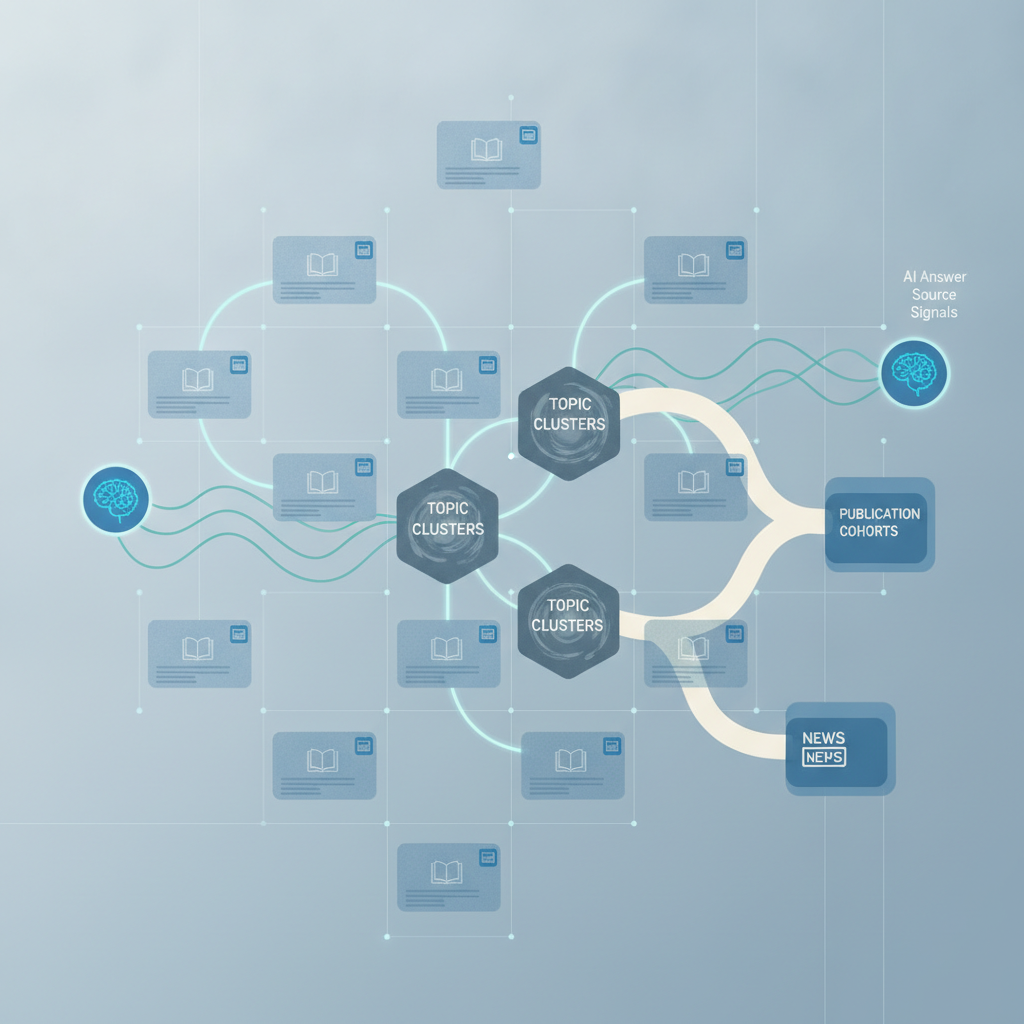
Review clusters and publishing cohorts together. A cluster with many recent posts but no citations may lack a clear answer page. A cluster with one repeatedly cited older post may need a refresh, supporting posts, or better internal consolidation. A cluster that earns citations without brand mentions may need stronger on-page attribution and distribution.
This is where traditional reporting and AI-answer reporting diverge. Organic traffic can be healthy while the posts mapped to high-value prompts remain absent from answers. Use visibility versus SEO reporting to place both views side by side without treating either as a replacement for the other.
What Should You Do with the Results?
The value of monitoring is the editorial choice it enables. Every repeated gap should end with a specific action, an owner, and a date for the next equivalent collection window. Otherwise, a visibility report becomes a recurring list of observations with no effect on the content portfolio.
Use this five-step monthly review workflow:
- Freeze the prompt library and collection settings for the period.
- Collect repeated runs and preserve raw answers and visible sources.
- Normalize URLs, calculate rates, and flag anomalous runs.
- Review the scorecard by post, topic cluster, and publishing cohort.
- Assign one action: refresh, consolidate, distribute, or create.
Refresh a previously cited page when its evidence is outdated or its coverage has declined. Consolidate when several overlapping posts split one topic’s authority. Distribute when a helpful post is cited but rarely tied back to the brand. Create when high-priority prompts remain absent after repeated, controlled checks. Our content optimization approach helps connect those choices to a larger publishing system.
Working with PageLens.ai
At PageLens.ai, we work with teams that have outgrown screenshots and occasional spot checks. We help marketing, growth, SEO, and content leaders turn a repeatable prompt set into an auditable visibility record across the AI engines that matter to their buyers. Our work stays anchored to the evidence in each response: the prompt, engine, date, mention wording, cited URL, and page level trend. That makes it easier to give editors a clear brief, show leaders where exposure changed, and verify whether a refresh or a new page changed the next collection window. If your team needs a durable operating rhythm instead of an untraceable dashboard number, we can help you design the prompt library, collection rules, URL mapping, and review cadence around your actual content portfolio through enterprise monitoring. We make evidence available for review, so reports remain useful when stakeholders ask which posts, prompts, and runs produced a conclusion. Book a demo
FAQs on Blog Visibility in AI Answers
These short answers use the same measurement rules as the workflow above. They separate visible evidence from what a reviewer can only infer.
Can a Post Be Cited Without Naming Our Brand?
Yes. An owned source link may support an answer even when the response never names your company. Record it as cited without mention, then review its cluster coverage.
Can Referral Analytics Show Every AI Answer Mention?
Referral analytics capture clicks, not every mention or source selection within an answer. Combine traffic data with recorded prompt runs, response evidence, and canonical citation fields.
How Many Repeats Do We Need?
Start with three runs per prompt and engine for a directional monthly baseline. Keep settings stable, report the denominator, and increase sampling when variation changes decisions.
What Is the Best Next Move When a Post Is Absent?
Confirm the prompt genuinely maps to the post’s topic before changing content. If absence persists across repeated runs, choose refresh, consolidation, distribution, or a new page.