


TL;DR
We built this comparison for SaaS teams that need repeatable evidence of whether ChatGPT mentions, recommends, or cites their product. It explains the signals worth tracking, compares PageLens.ai monitoring plans with manual checks, provides a 50-prompt SaaS starter panel, and shows how to choose a weekly or daily monitoring workflow.
ChatGPT Brand-Mention Tools for SaaS Teams Compared
OpenAI reported more than 800 million weekly users for ChatGPT in December 2025, making product recommendations inside AI answers a measurable buyer-discovery channel for SaaS teams.
ChatGPT brand-mention tools for SaaS automate a stable set of buyer prompts, retain the resulting answers, and show whether a product was named, recommended, cited, or described favorably. The useful tools make those outcomes reviewable over time, with prompt capacity, cadence, competitor evidence, response history, and transparent cost taking priority over dashboard volume.
We compare the monitoring choices that fit a SaaS workflow, show exactly which evidence to require, and provide a starter prompt panel that replaces recurring spreadsheet checks.
What ChatGPT Brand-Mention Tools Track
A reliable program separates visibility from attribution. A product can be named without being recommended, cited without being named, or discussed positively while another option is still listed first. Those are different signals that should not be collapsed into one percentage.
| Signal | What It Answers | Evidence To Preserve |
|---|---|---|
| Mention | Did the answer name our SaaS? | Full answer, prompt, engine, date |
| Recommendation | Did it present our SaaS as a viable choice? | Exact recommendation phrase and position |
| Citation | Did it link to our domain or another source? | Source URL and surrounding claim |
| Sentiment | How did the answer describe us? | Exact descriptive language |
| Referral | Did a user click through to our site? | Analytics session and conversion data |
A mention tells you that the product entered the answer. Citation tracking tells you which source the answer linked to, which may be your site, a reviewer, documentation, or a third party. Referral analytics measures visits after a click, so it cannot reveal the influence of an answer that a buyer reads without visiting your site. For the underlying audit process, use our AI recommendation audit.
The minimum useful record is therefore answer-level, not score-level. Each run should retain the prompt, market, engine, timestamp, exact response, named competitors, visible citations, and whether the product appeared first, later in a list, or not at all.
How Scheduled Monitoring Works
The workflow begins with a fixed panel of buyer-intent prompts. We run that panel on a defined cadence, preserve each answer, identify the named products and sources, then flag meaningful changes for a human reviewer. Stable prompts make trends interpretable. If the question changes every week, a reported gain may simply reflect a different test.
ChatGPT can automatically search the web when a question would benefit from current information, so a response can vary in its source behavior depending on the prompt and context. OpenAI’s search guidance also notes that citations can be incomplete, outdated, or incorrect. That is why full-answer access matters more than a binary mention count.
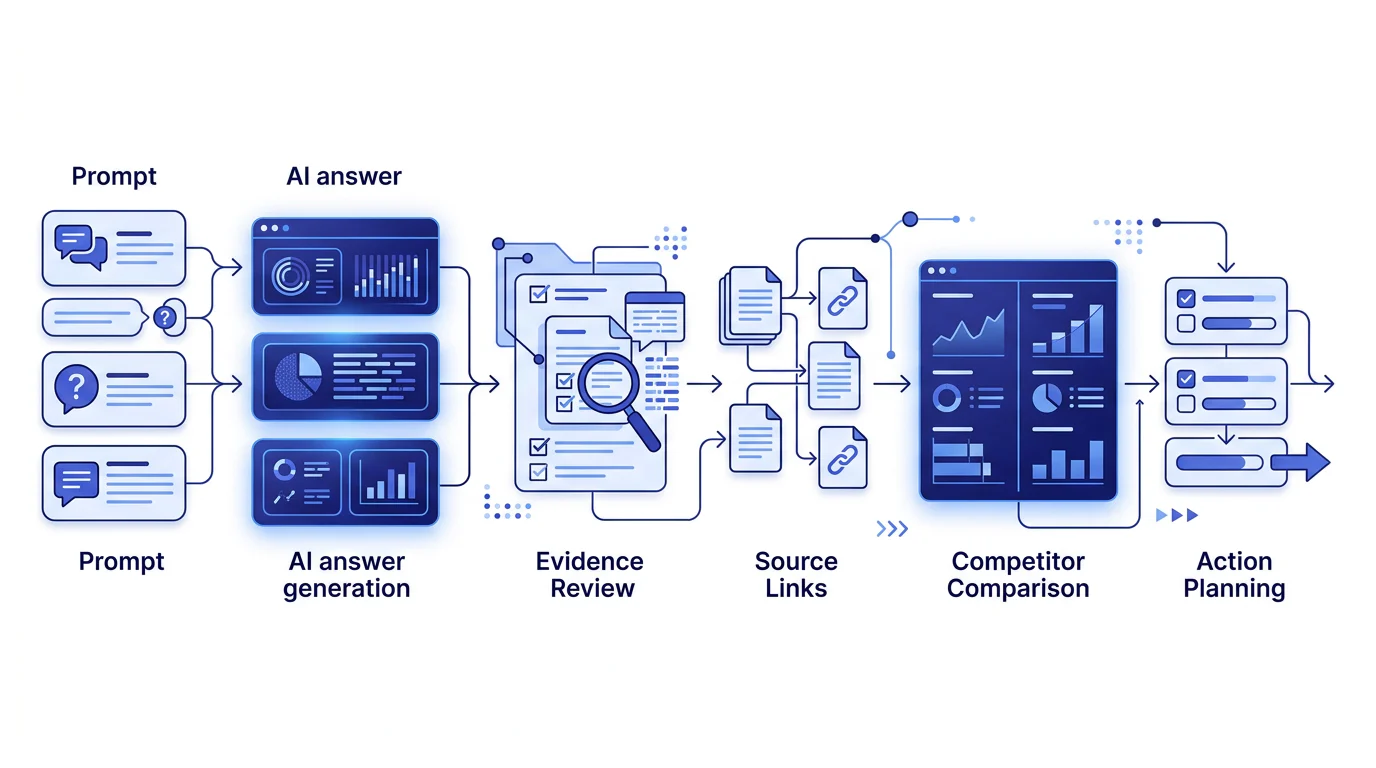
ChatGPT-only monitoring fits a team that wants to establish one repeatable baseline before expanding scope. Multi-engine monitoring is more useful when buyers compare products across several AI surfaces or when content leaders need to see whether an answer changes by engine. It also increases the volume of evidence that someone must review.
Technical availability belongs in the same operating model. OpenAI advises publishers not to block OAI-SearchBot when they want their content eligible for ChatGPT summaries and snippets, although eligibility does not guarantee inclusion. Our manual-check replacement workflow explains how to move from ad hoc checks to a documented recurring process.
Comparison of ChatGPT Brand-Mention Tools for SaaS
For a lean SaaS team, the best option is the smallest plan that can monitor the prompt panel you can genuinely review. Manual checking remains useful for prompt validation, but it does not create durable evidence or dependable alerts.
| Option | Public Price | Prompt Limit | Cadence | Engines | History And Full Answers | Competitors | Citations | Sentiment | Recommendation Position | Alerts | Exports | Trial |
|---|---|---|---|---|---|---|---|---|---|---|---|---|
| Manual controlled checks | $0 tool cost | Team-defined | Manual | ChatGPT selected by user | Team must retain answers | Manual | Manual | Manual | Manual | None | Spreadsheet | Not applicable |
| PageLens.ai Launch | $299/month | 100 | Weekly | ChatGPT, Google AI Mode, Perplexity | Verbatim evidence included, retention period not publicly stated | Included | Included | Included | Confirm in demo | Not publicly listed | Not publicly listed | Not publicly listed |
| PageLens.ai Growth | $699/month | 100 | Daily | Launch engines plus Gemini and Grok | Verbatim evidence included, retention period not publicly stated | Included | Included | Included | Confirm in demo | Not publicly listed | Not publicly listed | Not publicly listed |
| PageLens.ai Enterprise | $1,499/month | 200 | Daily | ChatGPT, Claude, Gemini, Perplexity, Grok, Copilot, Google AI Mode | Verbatim evidence included, retention period not publicly stated | Included | Included | Included | Confirm in demo | Not publicly listed | Not publicly listed | Not publicly listed |
Manual Checks for Prompt Validation
Manual checks are a sensible first step when you are still discovering which prompts resemble buyer language. Use them to test a small set, document the answer format, and decide whether recurring monitoring is worth funding. They become fragile once several people copy results into a spreadsheet or different sessions produce inconsistent evidence.
PageLens.ai Launch for a Weekly Baseline
We built Launch for one-site teams that need a structured weekly baseline. It includes 100 tracked buyer-intent prompts, 300 AI answers per week, coverage across three answer engines, and reporting for competitors, citations, sentiment, and share of voice. Use our ChatGPT tracking guide to shape the first stable panel.
PageLens.ai Growth for Daily Change Detection
Growth fits teams that publish frequently or need daily detection across a broader engine mix. It runs 100 tracked prompts daily and analyzes 500 AI answers per day. Daily monitoring does not eliminate the need for judgment, it gives the team a faster signal that deserves answer-level review.
PageLens.ai Enterprise for Broader Coverage
Enterprise supports 200 tracked prompts daily and 1,400 AI answers per day across seven listed engines. It is suited to organizations that need broader monitoring coverage alongside technical audits, fixes, and a dedicated account manager.
SaaS Prompt Setup for Recommendation Monitoring
A starter panel should reflect the questions a prospect asks before a sales conversation, not merely the keywords your company wants to rank for. Start with 50 prompts, hold most of them stable for a month, and keep new experiments separate from the baseline.
Category Prompts
Use 15 prompts that ask who belongs in the category. Examples include “What are the best project management tools for a 20-person startup?” and “Which platforms should a distributed product team evaluate?” These prompts reveal basic eligibility for the buying set.
Use-Case Prompts
Use 15 prompts focused on a specific operational problem, audience, and constraint. A strong template is: “What software helps [role] solve [problem] when [constraint] applies?” This distinguishes category recognition from relevance to a real job.
Alternatives and Comparison Prompts
Use 10 prompts that ask for alternatives or compare approaches. These answer whether your SaaS is considered when a buyer has already encountered another category option. Our buyer prompt research guide can help turn interviews, call notes, and support questions into defensible prompt language.
Integration and Objection Prompts
Use five integration prompts and five buyer-objection prompts. Ask about required ecosystems, implementation time, security expectations, pricing concerns, or change-management risk. These prompts often produce the most actionable language because they test whether the answer understands the trade-offs your buyers actually evaluate.
Selection Rubric for SaaS Teams
A tool should make a repeated monitoring workflow easier to run, easier to audit, and easier to act on. It should not just produce a more polished visibility score.
| Criterion | Weight | What Good Evidence Looks Like |
|---|---|---|
| Prompt Capacity And Cadence | 25% | Enough stable prompts and repeat runs for the buying cycle |
| Full-Answer Evidence | 20% | Original response, date, engine, and prompt remain accessible |
| Competitor And Position Data | 15% | Named alternatives and order of recommendation are visible |
| Citation Context | 15% | Cited sources can be inspected beside the answer |
| Alerts And Exports | 10% | Changes can reach owners and move into existing reporting |
| Engine Coverage | 10% | Coverage matches where target buyers research |
| Administration Effort | 5% | A named owner can maintain the panel each month |
Choose free checks when the task is learning what buyers ask. Choose lightweight monitoring when you have a stable 50 to 100 prompt panel and recurring stakeholder reporting. Choose broader daily coverage when multiple markets, engines, or teams require shared evidence and faster detection.
Citations deserve separate review because they can explain why an answer has changed, but they do not replace brand tracking. Our AI citation tracking method helps teams inspect sources without assuming every linked page caused a recommendation.
Next Steps for a 30-Day Baseline
In week one, define your SaaS category, product aliases, comparison set, markets, and 50-prompt panel. Assign one owner to review the baseline answers, because the important outcome is not a dashboard number. It is a trustworthy record of how the answer describes your product.
During weeks two through four, keep the core prompts unchanged. Review changes in product inclusion, recommendation position, cited sources, and unfavorable wording. Separate new prompts from the stable set so experimentation does not distort the trend.
At month end, decide whether a weekly baseline is sufficient or daily monitoring would improve the team’s response time. Then connect the evidence to an action, such as updating documentation, publishing a missing comparison page, correcting a product claim, or investigating a citation gap. For the operational details, follow our recommendation monitoring playbook.
Put PageLens.ai to Work
PageLens.ai gives SaaS teams a practical monitoring program instead of another score to explain. We run buyer-intent prompts on the cadence your plan supports, preserve answer-level evidence, and surface where your brand, competitors, cited sources, and narrative change. Start with a controlled prompt panel and a reporting owner, then decide whether weekly or daily coverage fits the speed of your category. Our Launch plan publishes 100 tracked prompts weekly for $299 a month. Growth publishes 100 daily prompts for $699 a month, while Enterprise publishes 200 daily prompts for $1,499 a month across a broader engine set. Before you choose, ask us about the evidence retention, alerting, exporting, markets, and governance requirements your team needs. Review our pricing details, then, for a walkthrough tailored to your operating model and budget, Book a demo
FAQs on ChatGPT Brand-mention Tools for SaaS
Use these questions to choose a monitoring workflow.
What Is the Difference Between a Mention and a Citation?
A mention means the answer names your company. A citation is a linked source, which may reference your site, a reviewer, or another publisher in context.
Can I Track Whether ChatGPT Recommends My SaaS?
Yes. Track fixed buyer prompts, preserve full answers, and record whether your SaaS appears, its list position, supporting language, named alternatives, and visible citations over time.
How Many SaaS Prompts Should a Team Monitor First?
Start with 50 prompts across category, use case, alternatives, integrations, and objections. That is enough to create a defensible baseline while keeping monthly answer review manageable.
Does Referral Traffic Measure All AI Search Influence?
No. Referral analytics records clicks to your website, while answer monitoring captures recommendation exposure, citations, and language that can influence buyers who never click through directly.