.png)
PageLens.ai vs AI Visibility Platforms: Methodology Compared
Compare PageLens.ai with AI visibility platforms by evidence, technical checks, citations, workflows, limits, and decision criteria.

PageLens.ai vs AI Visibility Platforms: Methodology Compared
Technical SEO still depends on measurable page experience. Google’s Core Web Vitals guidance sets a good Largest Contentful Paint target at 2.5 seconds, but a speed metric alone does not explain whether a page can be crawled, understood, trusted, or cited.
PageLens.ai Vs AI Visibility Platforms is a methodology decision: we inspect a site’s rendered evidence to diagnose technical issues and create a prioritised repair brief, while visibility monitors sample AI answers for mentions and citations. Choose us for evidence-led website diagnosis, choose monitoring for answer outcomes, and use both when operations need both records.
We compare the evidence each method collects, the conclusions it can support, and the operating model that follows. The practical question is not which dashboard has more charts. It is whether your next decision requires a site diagnosis, an answer-observation record, or both.
How Do PageLens.ai vs AI Visibility Platforms Differ?
Most comparison pages begin with feature lists. We begin with the question behind the feature: what evidence reaches the team making the next decision? Our inspections start with the live page and preserve the browser-level signals that explain a finding. You can see how our inspections work before deciding whether that output fits your workflow.
AI visibility platforms serve a different job. They run or collect defined AI-search prompts, then classify what an answer said about a brand, category, source, or competitor. That can be valuable evidence for marketing and content teams, but it is not a crawl, rendering, or Core Web Vitals diagnosis.
| Decision Need | PageLens.ai | AI Visibility Platforms |
|---|---|---|
| Primary job | Diagnose observable website issues | Observe answer outcomes across prompts |
| Core evidence | Rendered page, DOM, headers, links, screenshots, page signals | Prompt, engine, answer, mention, citation, timestamp |
| Supports | Technical findings and repair guidance | Visibility, citation, sentiment, and competitive observations |
| Does Not Support Alone | Proof of AI-answer mention frequency | Proof of a crawl, mobile, or performance cause |
| Implementation | Gives evidence-led guidance, then requires an owner to ship changes | Does not itself deploy website changes |
The distinction matters because a monitoring score can reveal that a brand is absent from an answer without revealing whether the cause is technical, editorial, competitive, temporal, or outside the site. Likewise, a clean technical report cannot prove that a brand will be recommended in a future AI answer.
What Does Each Method Measure?
We use a real browser to inspect public or scoped private pages. Our documented method captures screenshots, rendered DOM, headers, links, structured data, status codes, redirects, canonical and sitemap signals, accessibility output, and page metrics. We then apply deterministic checks where rules can be tested consistently and use assisted review where context matters, such as clarity, buyer path, mobile usability, and answerability.
That makes our evidence useful for questions such as: Is the mobile page missing important content? Does a redirect chain create a crawl risk? Are visible page elements difficult to use? Is structured data absent or inconsistent? It also lets us produce a prioritised repair plan rather than a generic recommendation.
Visibility monitoring has a different unit of analysis: an answer generated for a specified prompt. To be auditable, that record should retain the prompt, engine or model, locale, date, raw answer, cited sources, and the rule used to classify a mention or sentiment. Our guide to AI visibility monitoring explains why those inputs must remain available to the team making a decision.
A cited URL, named brand, recommendation phrase, or sentiment label can support an answer-level observation. It cannot, by itself, establish why the answer changed. Teams should retain the prompt, answer, cited source, and relevant surrounding wording with every observation.
Which Evidence Does the Methodology Matrix Verify?
A useful comparison labels what is actually documented instead of filling unknown cells with optimistic assumptions. In the matrix below, “Verified” means the method publicly documents the evidence, “Limited” means the scope is qualified, “Unavailable” means the method is not designed for that job, and “Not publicly documented” means buyers should request proof before relying on it.
| Methodology Question | PageLens.ai | AI Visibility Platform Requirement |
|---|---|---|
| What is inspected? | Verified: rendered website evidence | Verify engines, prompt set, locale, and answer mode |
| Are raw answers retained? | Unavailable for answer tracking | Require raw-answer retention |
| Are citations captured? | Unavailable for answer tracking | Require cited URL and context capture |
| Are crawl signals checked? | Verified: headers, links, status, canonical, sitemap signals | Unavailable unless site crawling is documented |
| Are mobile issues checked? | Verified: selected mobile viewport evidence | Unavailable unless page rendering is documented |
| Are Core Web Vitals checked? | Limited: lab and field-style signals where available | Unavailable unless performance data source is documented |
| Are mentions and sentiment measured? | Unavailable | Require definitions, examples, and repeat-run history |
| Can findings be verified after a change? | Verified: re-scan workflow | Require prompt reruns with retained comparison history |
What Inputs Create a Defensible Record?
Our record begins with the page itself and its observable state. Google’s crawl troubleshooting guidance similarly separates crawl availability, URL discovery, and indexing. A technical finding should identify the URL, the observed condition, why it matters, and a way to verify the repair.
An answer-monitoring record needs equivalent traceability. If it lacks the exact prompt, run date, engine, raw answer, and cited source, a reader cannot tell whether a change reflects the brand, the model, the prompt, or normal answer variability. Preserve that citation context whenever results inform a decision.
What Conclusions Can Each Method Support?
We can support a conclusion such as, “This page returned a specific status, exposed this header, rendered this mobile state, or contains this metadata gap.” We can also explain the likely impact and give a scoped repair recommendation.
An answer-monitoring workflow can support a conclusion such as, “This brand appeared in a sampled answer set for these prompts.” It cannot convert that observation into a verified technical cause without separate page evidence.
What Should Remain Undocumented Until Proven?
Do not assume setup time, dashboard separation, permissions, commercial terms, or remediation capability from a sales description. For every platform, request dated product evidence, contract terms where relevant, and a demonstration using your own domains, regions, prompts, and access model.
Teams should also keep multi-engine signals distinct from page findings, then validate sentiment classifications against the original answer wording. A category label should never substitute for evidence of what the model actually said.
Where Does Technical Remediation End and AI Visibility Begin?
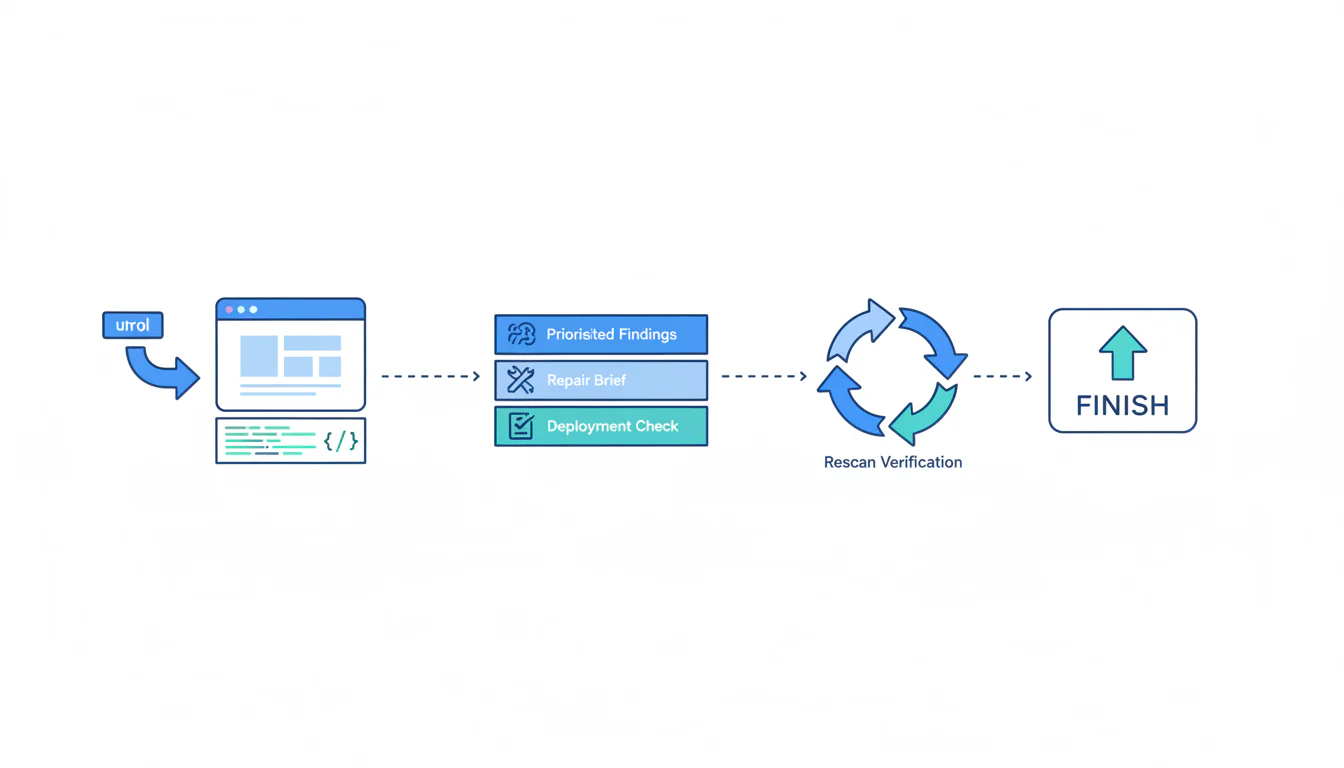
Technical remediation starts with an observed condition and ends only after an approved change is deployed and checked again. AI visibility monitoring begins with a defined prompt sample and ends with an answer-level observation. These workflows inform each other, but neither replaces the other.
| Stage | Technical Diagnosis Workflow | AI Visibility Workflow |
|---|---|---|
| Identify | Find a page-level condition | Record an answer-level outcome |
| Explain | Attach observable evidence and impact | Retain prompt, answer, citation, and classification |
| Recommend | Provide scoped repair guidance | Prioritise prompts or content hypotheses |
| Implement | Developer or coding agent changes the site | Owner updates content or operating plan |
| Verify | Re-scan the deployed page | Re-run the documented prompt set |
Identifying a Technical Issue
Our inspection can identify an observable crawlability, metadata, mobile, performance, accessibility, or browser-visible trust issue. For mobile-first indexing, Google expects important content and structured data to remain available on the mobile version, as its mobile indexing guidance explains.
Producing a Fix Recommendation
We turn evidence into prioritised guidance that a developer or coding agent can use. The recommendation should include the affected URL or route, observed evidence, acceptance condition, and a re-scan target. This is where content recommendations become operational rather than speculative.
Implementing and Verifying a Fix
We do not claim to autonomously implement production fixes. A developer, site owner, or authorised coding agent must make and deploy the change. We then help verify the live result through a re-scan, preserving the distinction between a recommendation and a completed remediation.
Which Workflow Fits Your Team?
For a developer-constrained technical SEO team, choose the method that produces a clear, evidence-backed work order. We fit when the immediate need is to uncover crawl, mobile, metadata, page-performance, or trust issues, prioritise the work, and hand a precise brief to the person or agent able to change the site.
If the immediate need is to know which prompts produce mentions, citations, recommendation language, or negative wording, an answer-monitoring workflow is the right first layer. When both needs exist, link the records by URL, market, prompt group, date, and owner. Do not merge them into one causal score.
For a multi-brand organisation with regional teams, create separate workspaces and permissions for the sites each team owns, then test from relevant locations where regional delivery or access rules matter. Use multi-client tracking for answer-level portfolio reporting, and pair it with our technical evidence where teams must also ship site improvements.
- Setup Evidence: Request a dated onboarding plan, domain limits, region coverage, and confirmation of whether staging or authenticated routes are in scope.
- Permission Evidence: Request workspace isolation, role definitions, revocation controls, and the audit trail available to regional stakeholders.
- Commercial Evidence: Request current pricing, contract duration, data retention, support scope, and what remediation language actually means in practice.
Before enterprise selection, turn those requests into a written operating checklist. The right choice is transparent about what it measures, what it cannot measure, and who remains accountable for the production change.
Why PageLens.ai Fits an Evidence-Led Repair Workflow
PageLens.ai gives marketing and SEO leaders a cleaner operating handoff when a live site needs attention. We render the page, preserve the observable evidence, rank the findings, and turn the important work into repair-ready guidance for the people or agents who can ship it. That means your team can discuss the URL, screenshot, header, mobile state, and acceptance condition instead of relaying a vague score.
We are the right fit when the immediate question is what is broken on the site, why it matters, and how to verify the fix after release. We do not claim to replace engineering ownership, security testing, legal review, or an AI-answer visibility program. For organisations that need citations and mentions too, keep the monitoring record beside our technical evidence, then decide changes using both. Start with the workflow your launch or growth team can actually execute with confidence, a clear owner, and documented proof after each deployed production change. Book a demo
FAQs on PageLens.ai vs AI Visibility Platforms
Does PageLens.ai Automatically Fix Crawl Errors?
No. We identify observed crawl and page issues, attach evidence and recommendations, then your developer or coding agent implements the change. We rescan the deployed page.
Does AI Visibility Monitoring Diagnose Core Web Vitals?
No. Answer monitoring records mentions, citations, and wording for a sampled response, but it cannot establish a page-performance cause or provide field diagnosis for a URL.
What Should Multi-Brand Teams Retain?
Keep each brand, market, prompt set, raw answer, cited URL, scan, finding, owner, deployment date, and rescan result separate, with permissions matched to each operating team.