
How to Track AI Citations over Time: An AI Citation Tracking Standard


TL;DR
We use AI citation tracking to measure whether answer engines cite our pages, mention our brand, recommend us, or send referred visits. This guide sets out an auditable prompt library, citation-event record, formulas, dashboard views, method comparisons, alerts, and a monthly content-improvement loop.
How to Track AI Citations over Time: An AI Citation Tracking Standard
AI answers shape discovery before a website visit occurs. A Pew study of 68,879 Google searches shows why measuring source visibility matters alongside traffic.
For reliable AI citation tracking, we keep a stable prompt library across the engines our audience uses, retain every cited domain, URL, answer passage, and timestamp, and calculate citation rate and citation share separately from mentions. We then compare results by engine, intent, market, target page, and peer while preserving raw responses for audit.
This guide explains the metrics, records, dashboard views, tracking methods, alerts, and content loop we use to turn changing AI visibility into defensible decisions.
What Should AI Citation Tracking Measure?
A useful measurement system separates what an answer says from what a visitor does afterward. A citation is source attribution, a mention is conversational visibility, a recommendation is selection language, and referral traffic is the smaller set of cases where someone clicked through.
| Metric | Definition | Formula | Interpretation | Failure Mode |
|---|---|---|---|---|
| Citation Rate | Valid answer runs citing at least one owned URL | Owned Citation Runs / Valid Runs × 100 | Breadth of source visibility | Counting a mention as a citation |
| Citation Share | Owned citation events within a fixed peer set | Owned Events / All Peer Events × 100 | Competitive source authority | Changing the peer set mid-period |
| Cited-Page Coverage | Priority owned URLs cited at least once | Cited Priority URLs / Tracked Priority URLs × 100 | Portfolio distribution | Treating one strong page as full coverage |
| Competitor Citation Gap | Difference between leading peer and owned citation rate | Leader Rate - Our Rate | Size of the catch-up opportunity | Mixing engines or markets |
| Source-Domain Frequency | Citation events earned by a source domain | Domain Events / Valid Runs | Which sources shape answers | Double-counting repeated URLs |
| URL Distribution | Share of owned events earned by each page | URL Events / Owned Events × 100 | Which pages concentrate visibility | Ignoring canonical URLs and redirects |
We retain the answer passage beside every source because a URL alone cannot explain why it appeared. Our citation-source records distinguish a page that supports a factual definition from one that appears beside a recommendation.
A brand can be mentioned without being cited, cited without being recommended, or recommended with no owned URL attached. We report each state separately, then inspect overlap rather than compressing four different signals into one attractive but opaque score.
How Should We Choose Engines and Prompts?
We choose engines based on buyer behavior, not platform popularity alone. If our audience asks category questions in one environment, compares options in another, and validates technical claims elsewhere, the prompt library should reflect those distinct jobs.
Start with a small, stable core of prompts tagged by intent: educate, compare, shortlist, validate, purchase, and troubleshoot. Add product category, market, language, funnel stage, and business priority to every prompt. Our buyer prompt research process keeps this library grounded in customer questions rather than generic keywords.
Longer, question-led searches deserve deliberate coverage. In the same Pew research, 53% of searches with 10 or more words produced an AI summary, compared with 8% of one or two word searches.
For every run, we also freeze the configuration we can control: exact wording, market, language, device, account state, mode, collection cadence, and retry rule. That matters because different engines, modes, and locations can produce different source sets. We compare results only within a consistent cohort, not as one blended global result.
What Belongs in an Auditable Citation Record?
A dashboard total is a conclusion, not evidence. We treat every collected answer as a record that can be reopened, checked, and compared with the next equivalent run.
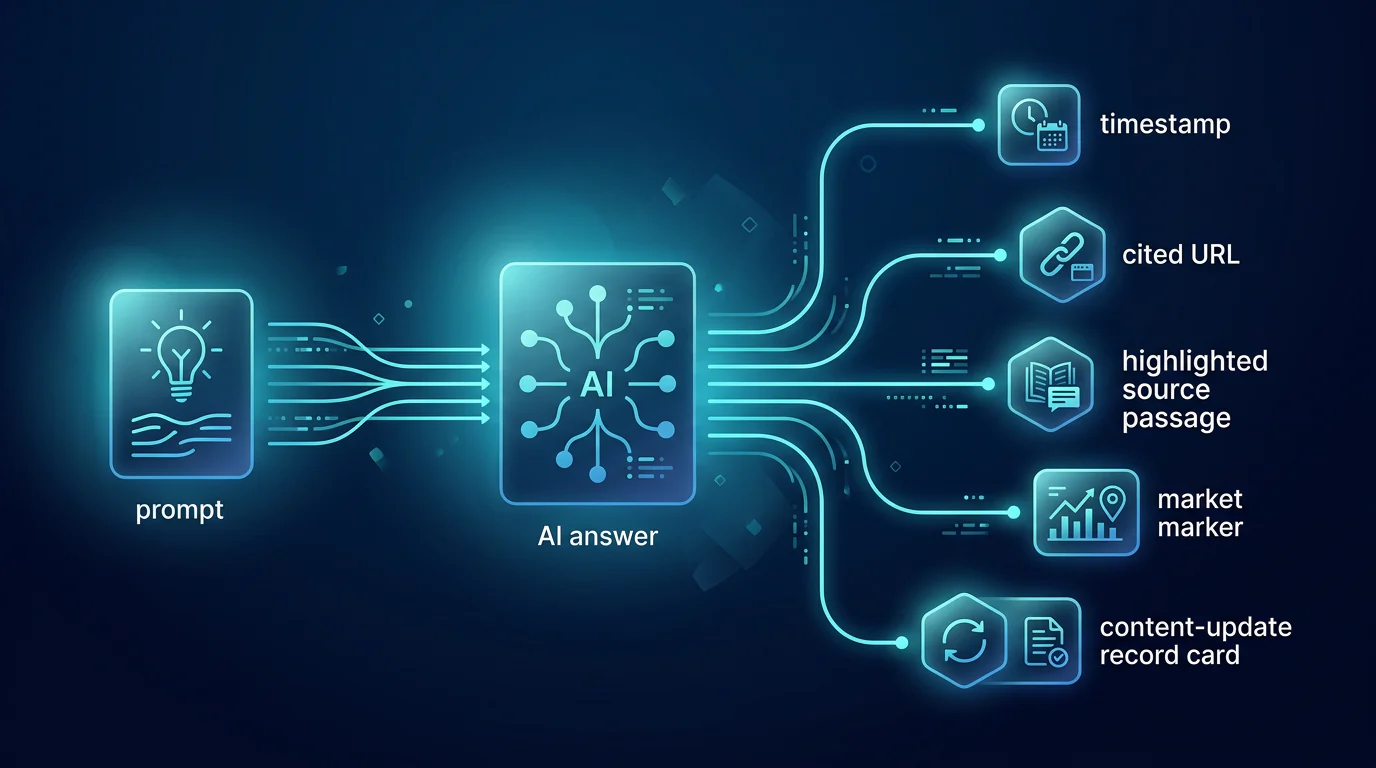
When we read results across systems, our multi-engine signals keep engine-specific movement visible instead of hiding it inside a blended average.
What Identifies the Run?
- Run Fields: Record a run ID, UTC timestamp, engine, mode, model version when exposed, exact prompt, prompt ID, cluster, intent, market, language, device, and account state.
- Collection Fields: Store the collection method, extraction version, retry status, and whether the answer was valid for comparison.
- Comparison Fields: Attach the prior equivalent run and a fixed cohort ID so a trend cannot be inflated by prompt changes.
What Captures Source Context?
- Answer Evidence: Preserve raw answer text, a response hash, and a screenshot or retained evidence path.
- Citation Evidence: Record source title, cited domain, canonical URL, citation position, redirect status, and the answer passage connected to that source.
- Visibility Labels: Mark brand mention, owned-page citation, recommendation presence, exact recommendation language, and human-review status.
Google’s citation documentation shows that source annotations can connect particular answer-text spans to URLs. That is why we save source context instead of treating a domain count as sufficient evidence.
How Do We Calculate Trends?
We calculate citation rate, citation share, cited-page coverage, and competitor citation gap within the same engine, prompt cluster, market, and date window. We show absolute valid runs and citation events beside percentages because a change from two runs is not comparable to a change from two hundred.
Our share-of-voice scoring also breaks trends down by engine, prompt cluster, source domain, target URL, market, and date. This reveals whether a gain came from more prompts, more engines, one highly cited page, or a genuine broadening of source coverage.
What Should the Dashboard Show?
An engine-by-prompt dashboard should make investigation easy, not merely make reporting easy. We use a heatmap for prompt-level changes, a source-domain view for replacements, a target-URL view for page concentration, and a content-change overlay for testable updates.
When a page appears often but does not match prompt intent, we flag it as a wrong-page citation. That keeps a strong total from masking a weak customer experience.
Which Tracking Method Fits Our Team?
Manual checks, automated platforms, and analytics integrations each answer a different question. The strongest program uses them together, while making the handoff between them explicit.
| Method | Best Use | Evidence To Retain | What It Cannot Prove Alone |
|---|---|---|---|
| Manual Checks | Baselines, claim reviews, quality assurance | Prompt, timestamp, raw answer, URLs, screenshot | Consistent large-sample trends |
| Automated Platform | Multi-engine monitoring and peer comparison | Raw output, source URLs, context, configuration, exports | Post-click commercial impact |
| Analytics Integration | Sessions, landing pages, conversions, revenue | Source, medium, landing page, conversion events | Citation or mention presence without a click |
We use manual checks to validate what automation classifies, especially when a recommendation or factual claim needs a human decision. We use automated collection for stable longitudinal cohorts, and we use analytics to understand what happened after an attributable visit. Our page-level citation checks make sure cited pages still match the customer question.
Google’s AI feature guidance supports combining Search Console and analytics for site-performance analysis. That makes analytics valuable, but it does not replace prompt-level source evidence. Our approach keeps those layers distinct.
How Do We Act on Citation Changes?
A meaningful change should trigger a review path, not a reflexive content rewrite. We configure alerts around conditions that reveal lost authority, source displacement, page mismatch, or a brand claim that could create risk.
Which Alerts Should We Set?
| Alert | Starting Trigger | Immediate Review |
|---|---|---|
| Citation Loss | Citation rate falls 5 percentage points across two comparable cycles with at least 10 valid runs | Raw answers, configuration, replacement sources |
| Source Replacement | A previous source is displaced in three high-intent prompt events | New source domain, cited passage, peer changes |
| Wrong-Page Citation | A high-intent prompt cites an obsolete or mismatched owned page | Redirects, canonical URL, page intent |
| Factual Misattribution | An answer assigns an incorrect claim to us or an owned page | Evidence capture, claim review, escalation owner |
These thresholds are starting points, not universal rules. We calibrate them to baseline volume, prompt importance, and the cost of a missed error. Our visibility versus SEO framework keeps referral outcomes separate from source visibility.
How Do We Connect Gaps to Content Updates?
First, we inspect the cited passages from our pages and the sources that replaced them. Then we identify the actual gap: missing definition, stale evidence, unclear comparison, weak page structure, unsupported claim, or incorrect intent mapping.
Next, we update one mapped page, record a content-change ID and hypothesis, then rerun the unchanged cohort after an appropriate collection window. We label the result as confirmed, inconclusive, or reversed. Our citation-drop audit helps prevent us from mistaking a temporary answer change for a proven content effect.
What Makes the Loop Credible?
The monthly loop works because it preserves controls. We leave some prompts untouched, keep the peer set stable, compare like with like, and retain the original answers even when the dashboard improves.
OpenAI’s source guidance notes that search results and citations can be incomplete, outdated, or incorrect. That is reason enough to review raw evidence before treating an AI answer as a reliable statement about our brand.
Work with PageLens.ai
At PageLens.ai, we believe citation monitoring should be defensible enough for a content decision, not just presentable enough for a weekly chart. That is why we encourage teams to start with the stable prompts, raw answer evidence, page mappings, and review rules described here. The discipline helps growth, SEO, and content leaders explain movement with evidence their teams can inspect before they decide which page deserves the next update.
Bring your existing prompt library, priority pages, markets, and peer set to a working session. We will use the framework in this guide to discuss the fields, comparisons, review cadence, and escalation rules your reporting needs. We can also map your current reporting workflow, clarify the evidence stakeholders need, and identify the smallest useful starting cohort. If the workflow fits, Book a demo to see how we approach it, then visit PageLens.ai
FAQs on AI Citation Tracking
How Often Should We Monitor AI Citations?
We use a regular core cadence and add faster checks after important releases or visible anomalies. Any factual error needs immediate capture, verification, assigned ownership, and correction.
Can Analytics Prove an AI Citation Occurred?
Analytics shows attributed sessions, landing pages, and conversions after a click. It cannot show whether an answer cited us, mentioned us, or changed a no-click decision.
Should We Count a Mention as a Citation?
No. We record mentions, citations, recommendations, and referred visits separately, then inspect their overlap. Combining them produces a score that cannot explain the underlying visibility change.