.png)
The New Age of Search: How Consumers Find Brands and Measure AI Search Share of Voice


TL;DR
At PageLens.ai, we see AI search share of voice as the proportion of tracked AI answers that mention, recommend, or cite a brand. We explain the May 2026 search-discovery shift, distinguish confirmed evidence from interpretation, and show how marketing leaders can preserve SEO fundamentals while measuring prompts, citations, message quality, and outcomes.
The New Age of Search: How Consumers Find Brands and Measure AI Search Share of Voice
In May 2026, Google reported that AI Mode had surpassed 1 billion monthly users globally, putting AI-led discovery squarely inside ordinary search behavior. Consumers can now ask a question, refine it, add an image, and receive a synthesized answer before they ever choose a website.
AI search share of voice is the share of a defined set of AI answers in which a brand is mentioned, recommended, or cited. For SEO leaders, the shift means keeping conventional search fundamentals while measuring visibility across real buyer prompts, engines, markets, and message quality, then tying the result to qualified business outcomes.
We explain what changed in May 2026, what the evidence actually supports, and how to build a defensible measurement system around the answers buyers see.
The May 22 Story Is a Signal, Not a Single Launch
The May 22, 2026 story captured a real change in consumer discovery, but it was not a discrete platform launch or a new universal ranking factor. It was a public articulation of a shift already visible in search products: people can ask longer questions, continue a conversation, search with images or voice, and encounter an answer before deciding whether to visit a site.
That distinction matters. A move from lists of links toward answer-led journeys does not mean conventional search has disappeared, nor does it prove that every website will lose traffic. It means the unit of competition is broader. A brand can win a conventional result, be absent from the answer above it, and lose the moment when a buyer forms a shortlist.
Google’s May guidance reinforces the practical point: its generative features remain grounded in core search systems, while user expectations are moving toward more complex and exploratory queries. We would treat the news as an operational signal to expand measurement, not as a reason to abandon SEO.
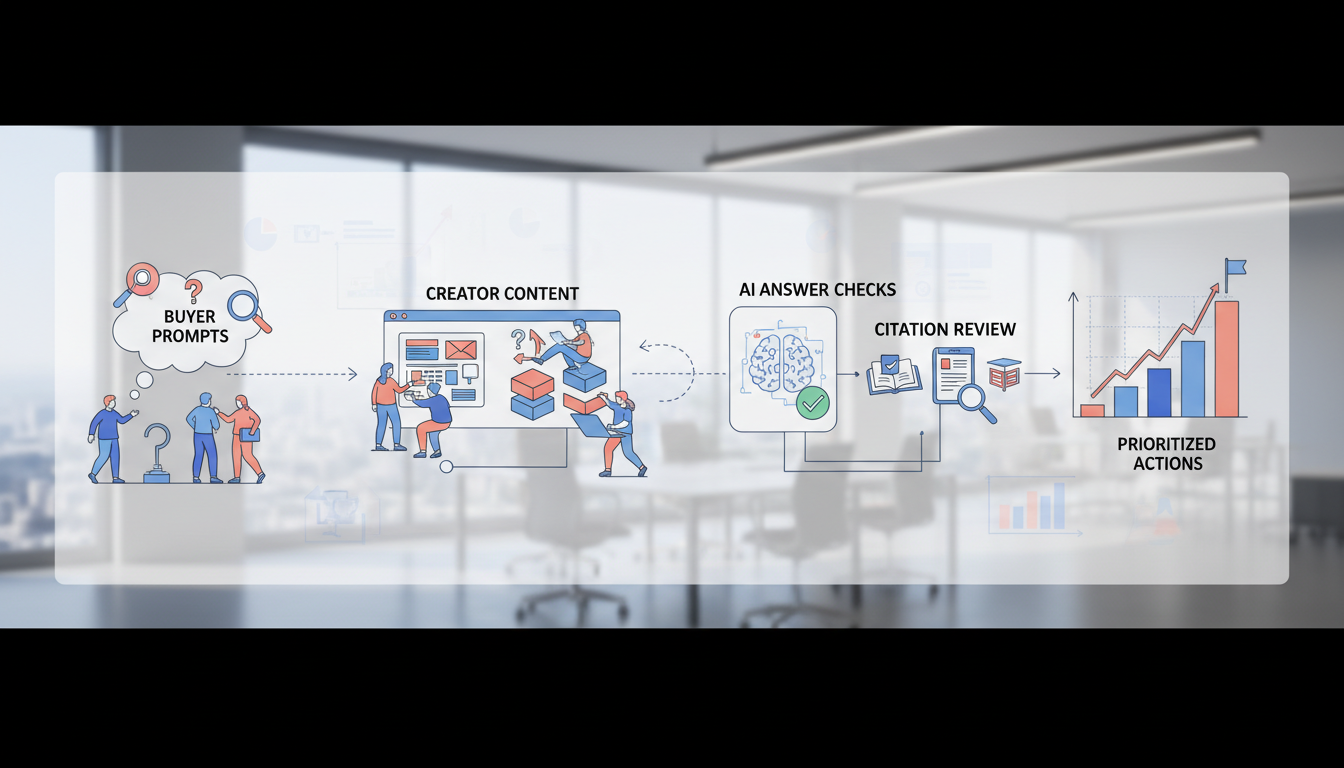
To begin, build a representative buyer prompt dataset around the questions that introduce, compare, and qualify your category. This turns an abstract concern about AI into a set of observable opportunities.
Why Consumer Discovery Is Changing, but Not Uniformly
The most useful evidence separates interface change from business impact. AI answers reduce the work of gathering basic information, while follow-up questions can expand research into a longer decision journey. Both can happen in the same session.
Independent behavior data shows why traffic forecasts need restraint. In a study of 900 U.S. adults and 68,879 unique Google searches, the Pew study found that users clicked a traditional result in 8% of visits with an AI summary, compared with 15% without one. It also found that only 1% of visits with an AI summary clicked a cited source.
| Signal | What It Shows | What It Does Not Show |
|---|---|---|
| AI answers reduce basic research steps | Some informational searches may end without an outbound visit | Every category will suffer the same traffic outcome |
| Longer conversational prompts grow | Buyers can express more context and intent | A single keyword ranking predicts answer inclusion |
| Citations appear inside answers | Source selection is part of brand visibility | A citation alone proves revenue impact |
| Follow-up search is easier | Research can extend across several turns | Every answer replaces conventional search |
The practical implication is to monitor both outcomes. We use AI search visibility measurement to distinguish answer inclusion from organic clicks, then evaluate each against the intent and economics of the underlying prompt.

How to Measure AI Search Share of Voice
A useful AI search share of voice program starts with a stable definition. We calculate it within a fixed prompt set, peer set, engine, market, device, and time period. Without those controls, a score can look precise while comparing different questions, different answer formats, or different competitive contexts.
A practical audit treats each answer as evidence, not as a vague impression. Save the prompt, response, citations, date, and surrounding language so that movement can be reviewed instead of guessed at. The resulting record should let another team member understand why a score changed without recreating the entire exercise.
That discipline makes trend reporting credible. The score should describe a repeatable slice of buyer discovery, not a shifting mix of prompts selected after a favorable result. Consistent sampling also makes it easier to separate actual competitive movement from temporary answer variation.
Separate Presence from Recommendation
A brand mention is not automatically a recommendation. A neutral reference, a favorable shortlist placement, and an explicit endorsement have different commercial meanings. Keep them separate in reporting so the team does not celebrate superficial visibility while missing recommendation gaps.
Use a Controlled Prompt Corpus
A cross-engine tracking method should preserve wording, market settings, device context, and the peer set between runs. Include informational, comparison, use-case, category, and purchase-intent prompts, then classify each according to its job in the buyer journey.
Document any prompt additions or removals alongside the results. This creates a clean baseline for executives and prevents a rising score from masking the fact that the underlying sample has changed. A controlled corpus also makes it easier to assign a visibility gap to a specific page, claim, or content brief.
Before comparing results, create a run log that records the date, locale, device, engine version when available, and material response-format changes. That log turns a visibility score into an auditable observation and protects the team from reading temporary interface changes as permanent shifts in demand or content quality.
Audit Citations and Message Quality
Record which sources support the answer, whether your own pages are cited, and the exact claims placed beside your brand. Our phrase-level sentiment guide helps teams inspect the language that shapes perception instead of reducing it to an unexplained score.
Connect Visibility to Business Outcomes
AI answer visibility is an upstream signal. Pair it with branded demand, qualified site visits, assisted conversions, and sales feedback, while avoiding claims of causation that the data cannot support.
| Metric | Numerator | Denominator | Decision It Supports |
|---|---|---|---|
| Mention Presence | Prompts where the brand appears | All tracked prompts | Where the brand is absent |
| Recommendation Share | Prompts with an explicit recommendation | All eligible recommendation prompts | Which high-intent topics need work |
| Citation Share | Citations linking to owned pages | All citations in the tracked answer set | Which pages earn source visibility |
| Message Quality | Favorable, accurate brand language | Brand-containing answers | Whether visibility builds or weakens trust |
What SEO Still Needs to Do
SEO remains the foundation for being eligible to appear, but it should now support a larger visibility system. Strong crawlability, indexable content, useful internal links, accurate information, and clear page structure still matter because answer experiences draw from the web rather than operating outside it. We use AI citation tracking to identify cited pages and correct outdated claims before they shape buyer perceptions.
Google’s site-owner guidance is unusually clear on this point: there are no extra technical requirements or special schema required to appear in its AI search features. We would not spend a quarter chasing a magic markup file. We would spend it improving the evidence, clarity, and accessibility of pages that matter to buyers.
- Keep Pages Eligible: Make important content crawlable, indexable, internally linked, and available as visible text.
- Add Original Value: Publish reporting, firsthand expertise, useful comparisons, or data that improves on generic summaries.
- Match Evidence to Intent: Give evaluators clear answers, source transparency, and relevant supporting detail.
- Protect Source Accuracy: Review priority pages regularly when market facts, product details, or category language change.
Search Console has also begun a limited rollout of a dedicated report view for generative-AI impressions in Google Search. Where available, use it for page-level and market-level signals, then combine it with answer auditing and a content optimization stack for the work that follows.
Put PageLens.ai to Work
At PageLens.ai, we help marketing, growth, SEO, and content teams turn vague concern about AI discovery into a repeatable evidence program. Our platform organizes the buyer prompts that matter, checks answers across selected AI engines, and preserves the precise language surrounding each mention. We use those records to show where your brand appears, where it is recommended, which pages are cited, and what needs attention before reporting week arrives. That makes the discussion more useful than a single blended visibility score. Teams can compare equivalent prompts, isolate movements by market or engine, assign content work to the evidence behind it, and keep conventional search performance in view. If you need a practical baseline and a defensible operating rhythm with a clear owner, review cadence, and documented decision path for every priority category, explore our methodology, and bring your team together, then Book a demo.
FAQs on AI Search Share of Voice
Is SEO Still Relevant in AI Search?
Yes. We retain technical eligibility, helpful original content, clear site structure, and accurate information as SEO foundations. AI visibility measurement supplies additional evidence, it never replaces SEO.
How Do We Calculate AI Search Share of Voice?
Divide the brand's tracked mentions or recommendations by equivalent appearances among the defined peer set. Report the exact prompt corpus, engine, market, device, and measurement period.
Can We Use Search Console for This Measurement?
Use it for available Google generative-search impressions and page performance. Pair it with controlled answer captures elsewhere, and keep Google metrics separate from cross-engine calculations.